PUBLISHER: Global Market Insights Inc. | PRODUCT CODE: 2071163

PUBLISHER: Global Market Insights Inc. | PRODUCT CODE: 2071163
North America Workplace Wellness Market Opportunity, Growth Drivers, Industry Trend Analysis, and Forecast 2026 - 2035
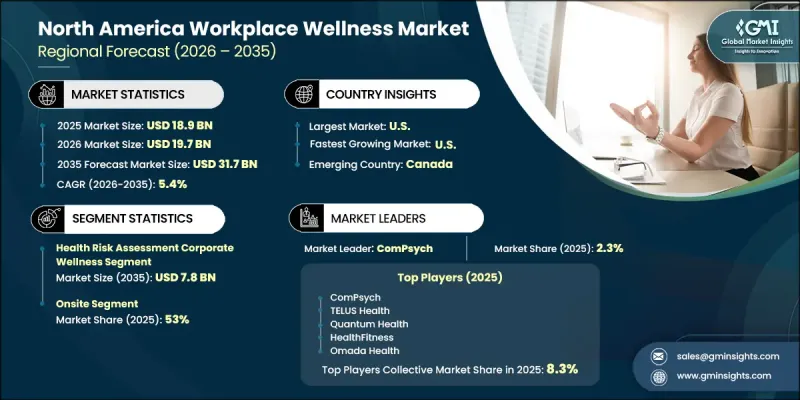
North America Workplace Wellness Market was valued at USD 18.9 billion in 2025 and is estimated to grow at a CAGR of 5.4% to reach USD 31.7 billion by 2035.
Growth in the North America workplace wellness industry is driven by the evolving role of employee well-being within modern workforce management strategies. Organizations are increasingly recognizing wellness initiatives as a strategic investment that can improve workforce productivity, reduce healthcare-related expenditures, and support long-term business performance. Rising healthcare costs continue to encourage employers to adopt preventive health programs designed to manage future medical expenses while creating greater stability in employee benefits spending. Data-driven workforce management practices are also contributing to market growth, as employers increasingly use health and engagement insights to develop comprehensive wellness programs tailored to employee needs. These initiatives often encompass a broad range of physical, mental, and lifestyle health services that support both workforce well-being and organizational goals. In addition, the growing prevalence of chronic health conditions associated with lifestyle factors among working-age populations is increasing demand for workplace wellness solutions, reinforcing the importance of preventive care and health management programs across North America.
| Market Scope | |
|---|---|
| Start Year | 2025 |
| Forecast Year | 2026-2035 |
| Start Value | $18.9 Billion |
| Forecast Value | $31.7 Billion |
| CAGR | 5.4% |
The health risk assessment segment generated USD 4.2 billion in 2025 and is anticipated to reach USD 7.8 billion by 2035. Health risk assessments continue to represent the largest revenue-generating category within the workplace wellness market because they serve as the foundation for effective employee health management strategies. These assessments provide employers with critical insights into workforce health trends, enabling organizations to identify potential risks and design targeted wellness initiatives. By collecting and analyzing relevant health-related information, companies can better understand workforce needs, allocate resources efficiently, and implement interventions that support improved employee outcomes. The ability to establish a comprehensive baseline for health planning remains a key factor supporting the segment's continued growth and market leadership.
The onsite delivery segment accounted for 53% share in 2025, making it the largest service delivery model. Despite the increasing adoption of remote and hybrid work arrangements, onsite wellness services continue to maintain a dominant position across the region. Their strong market presence is supported by the need for direct interaction, specialized assessments, and healthcare services that require physical administration and professional supervision. Onsite programs also tend to achieve stronger participation rates and higher levels of employee engagement compared to alternative delivery methods. The convenience of accessing wellness services within the workplace environment contributes significantly to employee involvement and program effectiveness, helping sustain demand for onsite solutions across organizations of various sizes.
United States Workplace Wellness Market held a 91.4% share in 2025. The country's dominant position is supported by its extensive corporate landscape, significant healthcare expenditures, and strong emphasis on workforce productivity and cost management. Employers continue to invest in comprehensive wellness programs as a means of addressing rising healthcare expenses, reducing absenteeism, and improving employee performance. Demand is further strengthened by the widespread availability of employer-sponsored health benefits and employee assistance programs, which support long-term participation in workplace wellness initiatives. Additionally, the advanced state of the country's digital health ecosystem and the rapid adoption of technology-enabled wellness solutions continue to drive innovation and market expansion throughout the United States.
Major companies operating in the North America workplace wellness market include TELUS Health, Omada Health, BetterUp, Castlight Health, Marathon Health, Noom Health, Carrot Fertility, Included Health, Quantum Health, Burnalong, BrightPlan, League, Maven Clinic, HealthFitness, Foodsmart, LifeSpeak, Calm Health, Dario Health, ComPsych, meQuilibrium, and Headversity. Companies active in the North America workplace wellness industry are implementing a variety of strategic initiatives to strengthen their market position and expand their customer base. Product and service innovation remains a key focus area, with organizations investing in personalized wellness solutions, digital health platforms, and integrated employee engagement tools. Market participants are increasingly leveraging data analytics, artificial intelligence, and predictive health technologies to deliver more targeted and measurable wellness outcomes. Strategic partnerships with employers, healthcare providers, and insurance organizations are helping companies expand service offerings and improve market penetration.
Table of Contents
Chapter 1 Methodology & Scope
- 1.1 Research approach
- 1.2 Quality Commitments
- 1.2.1 GMI AI policy & data integrity commitment
- 1.2.1.1 Source consistency protocol
- 1.2.1 GMI AI policy & data integrity commitment
- 1.3 Research Trail & Confidence Scoring
- 1.3.1 Research Trail Components
- 1.3.2 Scoring Components
- 1.4 Data Collection
- 1.4.1 Partial list of primary sources
- 1.5 Data mining sources
- 1.5.1 Paid sources
- 1.5.1.1 Sources, by region
- 1.5.1 Paid sources
- 1.6 Base estimates and calculations
- 1.6.1 Base year calculation for any one approach
- 1.7 Forecast model
- 1.7.1 Quantified market impact analysis
- 1.7.1.1 Mathematical impact of growth parameters on forecast
- 1.7.1 Quantified market impact analysis
- 1.8 Research transparency addendum
- 1.8.1 Source attribution framework
- 1.8.2 Quality assurance metrics
- 1.8.3 Our commitment to trust
Chapter 2 Executive Summary
- 2.1 Industry 360° synopsis, 2022 - 2035
- 2.2 Key market trends
- 2.2.1 Country
- 2.2.2 Service
- 2.2.3 Category
- 2.2.4 End Use
- 2.2.5 Delivery Mode
Chapter 3 Industry Insights
- 3.1 Industry ecosystem analysis
- 3.1.1 Supplier landscape
- 3.1.2 Profit margin
- 3.1.3 Value addition at each stage
- 3.1.4 Factor affecting the value chain
- 3.2 Industry impact forces
- 3.2.1 Growth drivers
- 3.2.1.1 Rising industrialization & demand for a healthier workforce
- 3.2.1.2 Increasing workplace stress levels
- 3.2.1.3 Growing awareness of preventive healthcare
- 3.2.2 Industry pitfalls & challenges
- 3.2.2.1 Lack of time & administrative overload
- 3.2.2.2 Low employee engagement & participation
- 3.2.3 Opportunities
- 3.2.3.1 Expansion of personalized & data-driven wellness solutions
- 3.2.3.2 Growth in mental health & emotional well-being services
- 3.2.1 Growth drivers
- 3.3 Growth potential analysis
- 3.4 Future market trends
- 3.5 Technology and innovation landscape
- 3.5.1 Current technological trends
- 3.5.2 Emerging technologies
- 3.6 Regulatory landscape
- 3.6.1 Standards & compliance requirements
- 3.6.2 Regional regulatory frameworks
- 3.6.3 Certification standards
- 3.7 Impact of AI & generative AI on the market
- 3.7.1 AI-driven disruption of existing business models
- 3.7.2 GenAI use cases & adoption roadmap by segment
- 3.7.3 Risks, limitations & regulatory considerations
- 3.8 Pricing Analysis (driven by primary research)
- 3.8.1 Historical price trend analysis (driven by primary research)
- 3.8.2 Pricing strategy by provider type (premium / value / cost-plus) (driven by primary research)
- 3.9 Porter's analysis
- 3.10 PESTEL analysis
- 3.11 Service delivery capacity & provider infrastructure (driven by primary research)
- 3.11.1 Provider network density & coverage by region (driven by primary research)
- 3.11.2 Capacity gaps & addressable demand mismatch (driven by primary research)
- 3.11.3 Scalability constraints for mid-market employers
Chapter 4 Competitive Landscape, 2025
- 4.1 Introduction
- 4.2 Company market share analysis
- 4.2.1 By country
- 4.2.1.1 U.S.
- 4.2.1.2 Canada
- 4.2.1 By country
- 4.3 Company matrix analysis
- 4.4 Competitive analysis of major market players
- 4.5 Competitive positioning matrix
- 4.6 Key developments
- 4.6.1 Mergers & acquisitions
- 4.6.2 Partnerships & collaborations
- 4.6.3 New product launches
- 4.6.4 Expansion plans
Chapter 5 Workplace Wellness Market Estimates & Forecast, By Service, 2022-2035 (USD Billion)
- 5.1 Key trends
- 5.2 Nutrition and weight management
- 5.3 Fitness services
- 5.4 Health risk assessment corporate wellness
- 5.5 Stress management
- 5.6 Smoking cessation
- 5.7 Health screening
- 5.8 Alcohol and drug abuse services
- 5.9 Health education services
- 5.10 Biometric screening
- 5.11 Others
Chapter 6 Workplace Wellness Market Estimates & Forecast, By Category, 2022-2035 (USD Billion)
- 6.1 Key trends
- 6.2 Fitness & nutrition consultants
- 6.3 Behavioral health professionals
- 6.4 Occupational health service providers
- 6.5 Technology platforms & digital health providers
- 6.6 Integrated wellness organizations
Chapter 7 Workplace Wellness Market Estimates & Forecast, By End Use 2022-2035 (USD Billion)
- 7.1 Key trends
- 7.2 Small-size private organizations
- 7.3 Mid-size private organizations
- 7.4 Large-size private organizations
- 7.5 Public sector
- 7.6 NGO
Chapter 8 Workplace Wellness Market Estimates & Forecast, By Delivery Mode 2022-2035 (USD Billion)
- 8.1 Key trends
- 8.2 Onsite
- 8.3 Offsite
Chapter 9 Market Estimates & Forecast, By Country, 2022-2035 (USD Billion)
- 9.1 Key trends
- 9.2 U.S.
- 9.3 Canada
Chapter 10 Company Profiles
- 10.1 Global Companies
- 10.1.1 BetterUp
- 10.1.1.1 Business Overview
- 10.1.1.2 Financial Data
- 10.1.1.3 Product Landscape
- 10.1.1.4 Strategic Outlook
- 10.1.1.5 SWOT Analysis
- 10.1.2 Calm Health
- 10.1.3 ComPsych
- 10.1.4 HealthFitness
- 10.1.5 Noom Health
- 10.1.6 Omada Health
- 10.1.7 Quantum Health
- 10.1.1 BetterUp
- 10.2 Regional Companies
- 10.2.1 Burnalong
- 10.2.2 Carrot Fertility
- 10.2.3 Castlight Health
- 10.2.4 League
- 10.2.5 LifeSpeak
- 10.2.6 Marathon Health
- 10.2.7 TELUS Health
- 10.3 Emerging Companies
- 10.3.1 BrightPlan
- 10.3.2 Dario Health
- 10.3.3 Foodsmart
- 10.3.4 Headversity
- 10.3.5 Included Health
- 10.3.6 Maven Clinic
- 10.3.7 meQuilibrium

