PUBLISHER: Global Market Insights Inc. | PRODUCT CODE: 2071178

PUBLISHER: Global Market Insights Inc. | PRODUCT CODE: 2071178
North America Adult Incontinence Products Market Opportunity, Growth Drivers, Industry Trend Analysis, and Forecast 2026 - 2035
North America Adult Incontinence Products Market was valued at USD 5.6 billion in 2025 and is estimated to grow at a CAGR of 5.4% to reach USD 9.4 billion by 2035.
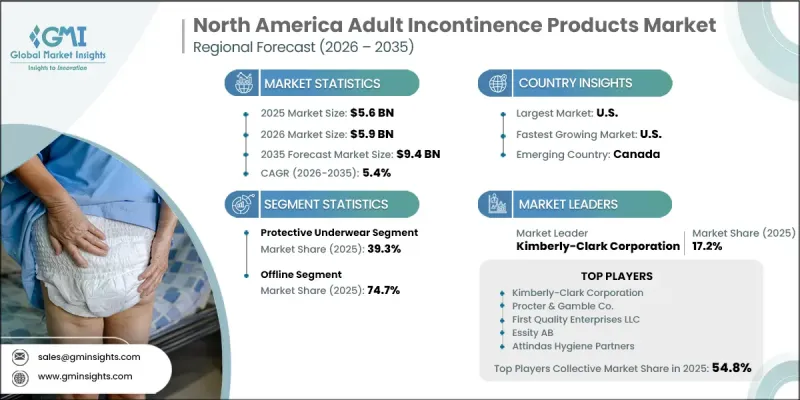
Growth across the North America adult incontinence products industry is supported by several long-term structural trends, including population aging, the continued evolution of digital purchasing channels, and expanding institutional procurement networks. Unlike many consumer healthcare categories, demand for adult incontinence products is primarily driven by demographic and medical needs rather than discretionary spending patterns, providing a stable and resilient revenue foundation. The rapid shift toward online purchasing platforms and direct-to-consumer distribution models is further accelerating market expansion by improving accessibility, convenience, and product availability. Subscription-based purchasing programs are becoming increasingly important, helping consumers maintain uninterrupted access to essential products while strengthening customer retention rates for manufacturers and retailers. These recurring purchase models also support higher average selling prices compared with traditional retail channels, contributing to stronger revenue generation. As the aging population across North America continues to grow, demand for reliable, comfortable, and discreet incontinence management solutions is expected to remain a key driver of long-term market growth.
| Market Scope | |
|---|---|
| Start Year | 2025 |
| Forecast Year | 2026-2035 |
| Start Value | $5.6 Billion |
| Forecast Value | $9.4 Billion |
| CAGR | 5.4% |
The protective underwear segment held a 39.3% share in 2025 and projected to grow at a CAGR of 6.5% through 2035. The segment's strong performance is supported by increasing consumer preference for products that offer improved comfort, discretion, fit, and mobility compared to conventional alternatives. Continuous advancements in absorbent technologies, lightweight materials, and product design have significantly enhanced user experience while improving protection levels for individuals managing varying degrees of incontinence. Demand is particularly strong among active consumers seeking products that allow them to maintain independence and confidence in everyday activities. As the aging population progresses through higher-risk age groups, adoption of protective underwear products is expected to continue increasing across the region.
The offline distribution channels segment held a 74.7% share in 2025. The dominance of offline sales reflects the extensive reach of pharmacies, retail outlets, warehouse-based retailers, and medical supply distribution networks throughout the region. Physical retail channels remain highly influential because they provide consumers with immediate product access, professional guidance, and personalized purchasing support. These advantages are particularly valuable for individuals purchasing incontinence products for the first time, helping them navigate a diverse marketplace with multiple product specifications and performance features. Although online sales continue to gain momentum, traditional retail infrastructure remains a critical component of market distribution across North America.
United States Adult Incontinence Products Industry held an 84.7% share in 2025 while expanding at a CAGR of 5.5% during 2026-2035. Market leadership is supported by a large and steadily growing elderly population, advanced retail and e-commerce ecosystems, and a well-established direct-to-consumer product landscape. Additionally, government-supported healthcare programs continue to facilitate access to medically necessary incontinence supplies for eligible individuals, helping maintain stable procurement volumes and reinforcing long-term market demand across the United States.
Key companies operating in the North America adult incontinence products market include Attindas Hygiene Partners, Kimberly-Clark Corporation, First Quality Enterprises LLC, Medline Inc., Essity AB, Ontex Group NV, Cardinal Health Inc., Procter & Gamble Co., Abena Group (Abena North America), Paul Hartmann AG, TZMO SA / Seni, Dynarex Corporation, Drylock Technologies, Because Market, NorthShore Care Supply, Secure Personal Care Products LLC (SPCP), Principle Business Enterprises (PBE), LiveDo USA Inc., Nexwear (Valrico LLC), Dri-Line Products Ltd., and Rearz Inc. Companies competing in the North America adult incontinence products market are implementing a variety of strategic initiatives to strengthen their market position and increase customer loyalty. Product innovation remains a key focus, with manufacturers investing in advanced absorbent technologies, improved comfort features, skin-friendly materials, and discreet product designs. Businesses are also expanding direct-to-consumer sales channels and subscription-based purchasing programs to improve recurring revenue and enhance customer retention. Strategic partnerships with healthcare providers, pharmacies, long-term care facilities, and distribution networks are helping companies broaden market reach and improve product accessibility.
Table of Contents
Chapter 1 Methodology & Scope
- 1.1 Research approach
- 1.2 Quality Commitments
- 1.2.1 GMI AI policy & data integrity commitment
- 1.2.1.1 Source consistency protocol
- 1.2.1 GMI AI policy & data integrity commitment
- 1.3 Research Trail & Confidence Scoring
- 1.3.1 Research Trail Components
- 1.3.2 Scoring Components
- 1.4 Data Collection
- 1.4.1 Partial list of primary sources
- 1.5 Data mining sources
- 1.5.1 Paid sources
- 1.5.1.1 Sources, by region
- 1.5.1 Paid sources
- 1.6 Base estimates and calculations
- 1.6.1 Base year calculation for any one approach
- 1.7 Forecast model
- 1.7.1 Quantified market impact analysis
- 1.7.1.1 Mathematical impact of growth parameters on forecast
- 1.7.1 Quantified market impact analysis
- 1.8 Research transparency addendum
- 1.8.1 Source attribution framework
- 1.8.2 Quality assurance metrics
- 1.8.2.1 Our commitment to trust
Chapter 2 Executive Summary
- 2.1 Industry 360° synopsis, 2022 - 2035
- 2.2 Key market trends
- 2.2.1 Country
- 2.2.2 Product type
- 2.2.3 Consumer group
- 2.2.4 Age group
- 2.2.5 Category
- 2.2.6 Size
- 2.2.7 Price
- 2.2.8 End Use
- 2.2.9 Distribution channel
Chapter 3 Industry Insights
- 3.1 Industry ecosystem analysis
- 3.1.1 Supplier landscape
- 3.1.2 Profit margin
- 3.1.3 Value addition at each stage
- 3.1.4 Factor affecting the value chain
- 3.2 Industry impact forces
- 3.2.1 Growth drivers
- 3.2.1.1 Rapidly Expanding Elderly Population
- 3.2.1.2 Rising E-Commerce Penetration and DTC Subscription Adoption
- 3.2.1.3 Accelerating Growth of U.S. Long-Term Care and Assisted Living Facilities
- 3.2.2 Industry pitfalls & challenges
- 3.2.2.1 Limited Insurance and Medicare Coverage for OTC Incontinence Products
- 3.2.2.2 Growing Acceptance of Reusable Products and Pelvic Health Therapy Alternatives
- 3.2.3 Opportunities
- 3.2.3.1 R&D in Bio-Based, Sustainable Materials and Eco-Friendly Products
- 3.2.3.2 Integration of Smart Diaper Technologies and Digital Health Solutions
- 3.2.1 Growth drivers
- 3.3 Growth potential analysis
- 3.4 Regulatory framework
- 3.4.1 Standards & Compliance Requirements
- 3.4.2 Regional Regulatory Frameworks
- 3.4.3 Certification Standards
- 3.5 Major market trends and disruptions
- 3.6 Technology/innovation landscape
- 3.6.1 Current trends
- 3.6.2 Emerging trends
- 3.7 Pricing Analysis (driven by primary research)
- 3.7.1 Historical price trend analysis (driven by primary research)
- 3.7.2 Pricing strategy by player type (premium / value / cost-plus) (driven by primary research)
- 3.8 Future market trends
- 3.9 Trade data analysis (driven by paid database) (HS Code-961900)
- 3.9.1 Import/export volume & value trends (driven by primary research)
- 3.9.2 Key trade corridors & tariff impact (driven by primary research)
- 3.10 Impact of AI & Generative AI on the Market
- 3.10.1 AI-driven disruption of existing business models
- 3.10.2 Gen-AI use cases & adoption roadmap by segment
- 3.10.3 Risks, limitations & regulatory considerations
- 3.11 Porter's analysis
- 3.12 PESTEL analysis
- 3.13 Distribution infrastructure & channel penetration landscape (driven by primary research)
- 3.13.1 Channel coverage by country & format (modern trade vs. Traditional pharmacy vs. Institutional) (driven by primary research)
- 3.13.2 Last-mile infrastructure gaps & emerging channel shifts (driven by primary research)
- 3.14 Consumer behaviour analysis
- 3.14.1 Purchasing patterns
- 3.14.2 Preference analysis
- 3.14.3 Regional variations in consumer behavior
- 3.14.4 Impact of e-commerce on buying decisions
Chapter 4 Competitive Landscape, 2025
- 4.1 Introduction
- 4.2 Company market share analysis
- 4.2.1 By Country
- 4.2.1.1 U.S.
- 4.2.1.2 Canada
- 4.2.1 By Country
- 4.3 Company matrix analysis
- 4.4 Competitive analysis of major market players
- 4.5 Competitive positioning matrix
- 4.6 Key developments
- 4.6.1 Mergers & acquisitions
- 4.6.2 Partnerships & collaborations
- 4.6.3 New product launches
- 4.6.4 Expansion plans
Chapter 5 Market Estimates and Forecast, By Product Type, 2022 - 2035 (USD Billion) (Thousand Units)
- 5.1 Key trends
- 5.2 Adult diapers/briefs (tab-fastened)
- 5.2.1 Standard absorbency
- 5.2.2 High/overnight absorbency
- 5.3 Protective underwear/pull-ups
- 5.3.1 Light-to-moderate absorbency
- 5.3.2 Moderate-to-heavy absorbency
- 5.4 Pads & liners
- 5.4.1 Guards & shields (male-oriented)
- 5.4.2 Pads & mini-pads (female-oriented)
- 5.4.3 Maxi/overnight pads
- 5.5 Underpads & bed protectors
- 5.5.1 Disposable underpads
- 5.5.2 Reusable/washable underpads
- 5.6 Skincare & cleansing accessories
- 5.6.1 Wet wipes & perineal cleansers
- 5.6.2 Barrier creams & skin protectants
- 5.7 Others
Chapter 6 Market Estimates and Forecast, By Consumer Group, 2022 - 2035 (USD Billion) (Thousand Units)
- 6.1 Key trends
- 6.2 Male
- 6.3 Female
- 6.4 Unisex
Chapter 7 Market Estimates and Forecast, By Age Group, 2022 - 2035 (USD Billion) (Thousand Units)
- 7.1 Key trends
- 7.2 Young adults (20-39)
- 7.3 Middle-aged adults (40-64)
- 7.4 Senior (65 & above)
Chapter 8 Market Estimates and Forecast, By Category, 2022 - 2035 (USD Billion) (Thousand Units)
- 8.1 Key trends
- 8.2 Reusable
- 8.3 Disposable
Chapter 9 Market Estimates and Forecast, By Size, 2022 - 2035 (USD Billion) (Thousand Units)
- 9.1 Key trends
- 9.2 Small
- 9.3 Medium
- 9.4 Large
- 9.5 Extra large
Chapter 10 Market Estimates and Forecast, By Price, 2022 - 2035 (USD Billion) (Thousand Units)
- 10.1 Key trends
- 10.2 Low
- 10.3 Medium
- 10.4 High
Chapter 11 Market Estimates and Forecast, By End Use, 2022 - 2035 (USD Billion) (Thousand Units)
- 11.1 Key trends
- 11.2 Home Care
- 11.3 Long-Term Care & Nursing Homes
- 11.4 Hospitals & Acute Care
Chapter 12 Market Estimates and Forecast, By Distribution Channel, 2022 - 2035 (USD Billion) (Thousand Units)
- 12.1 Key trends
- 12.2 Offline
- 12.2.1 Supermarkets & hypermarkets
- 12.2.2 Pharmacies
- 12.2.3 Others
- 12.3 Online
- 12.3.1 E-commerce
- 12.3.2 Brand websites
Chapter 13 Market Estimates & Forecast, By Country, 2022 - 2035, (USD Billion) (Thousand Units)
- 13.1 Key trends
- 13.2 U.S.
- 13.3 Canada
Chapter 14 Company Profiles
- 14.1 Global Companies
- 14.1.1 Attindas Hygiene Partners
- 14.1.1.1 Business Overview
- 14.1.1.2 Financial Data
- 14.1.1.3 Product Landscape
- 14.1.1.4 Strategic Outlook
- 14.1.1.5 SWOT Analysis
- 14.1.2 Essity AB
- 14.1.3 First Quality Enterprises LLC
- 14.1.4 Kimberly-Clark Corporation
- 14.1.5 Ontex Group NV
- 14.1.6 Paul Hartmann AG
- 14.1.7 Procter & Gamble Co.
- 14.1.1 Attindas Hygiene Partners
- 14.2 Regional Champions
- 14.2.1 Cardinal Health, Inc.
- 14.2.2 Drylock Technologies
- 14.2.3 Dynarex Corporation
- 14.2.4 LiveDo USA Inc.
- 14.2.5 Medline Inc.
- 14.2.6 Principle Business Enterprises (PBE)
- 14.2.7 TZMO SA / Seni
- 14.3 Emerging Companies
- 14.3.1 Abena Group (Abena North America)
- 14.3.2 Because Market
- 14.3.3 Dri-Line Products Ltd.
- 14.3.4 Nexwear (Valrico LLC)
- 14.3.5 NorthShore Care Supply
- 14.3.6 Rearz Inc.
- 14.3.7 Secure Personal Care Products LLC (SPCP)

