
PUBLISHER: Global Market Insights Inc. | PRODUCT CODE: 2071185

PUBLISHER: Global Market Insights Inc. | PRODUCT CODE: 2071185
Selective Culture Media for Pathogen Detection Market Opportunity, Growth Drivers, Industry Trend Analysis, and Forecast 2026 - 2035
The Global Selective Culture Media for Pathogen Detection Market was valued at USD 2.9 billion in 2025 and is estimated to grow at a CAGR of 7.5% to reach USD 6.1 billion by 2035.
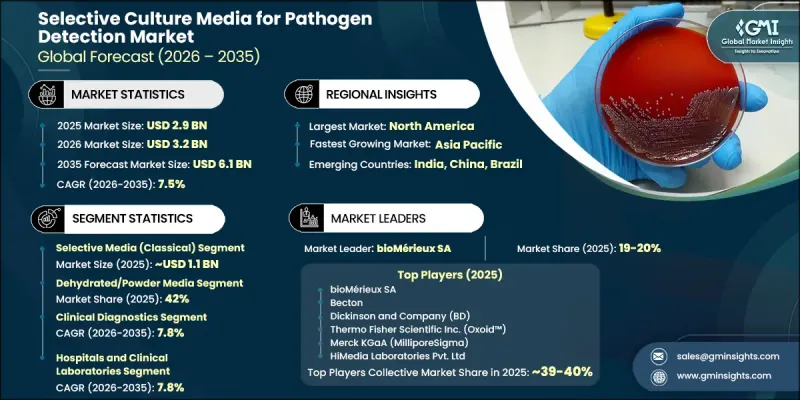
Market expansion reflects the critical role of selective culture media across clinical diagnostics, pharmaceutical manufacturing, food safety testing, and environmental monitoring, where reliable pathogen detection remains essential for regulatory compliance and public health protection. Demand is being strengthened by increasing emphasis on antimicrobial resistance surveillance, which has elevated culture-based pathogen identification from a routine laboratory procedure to a strategic component of disease monitoring and infection control programs. At the same time, the market is benefiting from a gradual shift toward premium media formulations that offer enhanced performance characteristics and command higher average selling prices compared with conventional alternatives. Growing regulatory oversight across healthcare, food production, and pharmaceutical industries continues to create sustained demand for advanced pathogen detection solutions. In addition, expanding laboratory infrastructure across emerging economies and increasing investment in diagnostic capabilities are broadening market opportunities worldwide. These long-term industry fundamentals are supporting stable growth prospects and reinforcing the importance of selective culture media as a cornerstone technology within modern microbiological testing environments.
| Market Scope | |
|---|---|
| Start Year | 2025 |
| Forecast Year | 2026-2035 |
| Start Value | $2.9 Billion |
| Forecast Value | $6.1 Billion |
| CAGR | 7.5% |
The chromogenic selective media segment accounted for 28% share in 2025 and is projected to grow at a CAGR of 9.8% through 2035, making it one of the fastest-growing product categories within the market. Growth is being driven by increasing adoption in antimicrobial resistance monitoring programs, expanding quality assurance requirements, and broader acceptance of advanced microbiological testing methods. Chromogenic selective media provide enhanced differentiation of target microorganisms through visual identification mechanisms, enabling laboratories to accelerate preliminary pathogen detection and streamline testing workflows. The ability to improve laboratory efficiency and reduce turnaround times has contributed significantly to growing adoption across multiple end-use sectors. As healthcare systems and testing facilities continue to prioritize rapid and accurate diagnostic outcomes, demand for chromogenic media is expected to remain strong throughout the forecast period.
The clinical diagnostics segment held a 43% share in 2025 and advancing at a CAGR of 7.8%. The segment's leadership is supported by the essential role of selective culture media in routine microbiological testing conducted by healthcare laboratories. Demand remains highly stable because diagnostic facilities require these products as part of established testing protocols, resulting in predictable procurement patterns regardless of broader healthcare spending fluctuations. The expansion of antimicrobial resistance monitoring initiatives and enhanced disease surveillance programs has further increased laboratory utilization rates, driving higher consumption of selective culture media. Growing emphasis on infection control, early disease detection, and diagnostic accuracy continues to support sustained demand across healthcare institutions worldwide.
North America Selective Culture Media for Pathogen Detection Market held 49% share in 2025, generating USD 1.4 billion. The region's dominance is supported by a highly developed laboratory infrastructure, extensive utilization of microbiological testing technologies, and stringent regulatory requirements governing pathogen detection across multiple industries. Strong investment in public health programs, food safety monitoring, and pharmaceutical quality assurance continues to drive substantial demand for selective culture media products. In addition, advanced diagnostic capabilities, widespread adoption of laboratory best practices, and ongoing efforts to strengthen disease surveillance frameworks contribute to the region's leading market position. These factors collectively support North America's continued prominence within the global industry.
Key companies operating in the Global Selective Culture Media for Pathogen Detection Market include bioMerieux SA, Becton, Dickinson and Company (BD), Thermo Fisher Scientific Inc., Merck KGaA (MilliporeSigma), Liofilchem S.r.l., HiMedia Laboratories Pvt. Ltd., Neogen Corporation, Bio-Rad Laboratories, Inc., Hardy Diagnostics, Conda-Pronadisa, CHROMagar Microbiology, Anaerobe Systems, Alpha Teknova, Inc., and TM Media (Titan Media). Companies participating in the Selective Culture Media for Pathogen Detection Market are pursuing a range of strategic initiatives to strengthen their competitive positions and expand market presence. Product innovation remains a primary focus, with manufacturers investing in advanced media formulations that improve detection accuracy, laboratory efficiency, and workflow optimization. Businesses are also expanding production capabilities and strengthening distribution networks to meet growing demand across healthcare, pharmaceutical, food safety, and environmental testing sectors. Strategic collaborations with research institutions, diagnostic laboratories, and healthcare organizations are helping companies accelerate product development and improve market penetration. In addition, investments in quality assurance, regulatory compliance, and technical support services are enhancing customer confidence and brand loyalty.
Table of Contents
Chapter 1 Methodology & Scope
- 1.1 Market scope and definition
- 1.2 Research design
- 1.2.1 Research approach
- 1.2.2 Data collection methods
- 1.3 Data mining sources
- 1.3.1 Global
- 1.3.2 Regional/Country
- 1.4 Base estimates and calculations
- 1.4.1 Base year calculation
- 1.4.2 Key trends for market estimation
- 1.5 Primary research and validation
- 1.5.1 Primary sources
- 1.6 Forecast model
- 1.7 Research assumptions and limitations
Chapter 2 Executive Summary
- 2.1 Industry 360° synopsis
- 2.2 Key market trends
- 2.2.1 Product type
- 2.2.2 Format
- 2.2.3 Pathogen Target
- 2.2.4 Application
- 2.2.5 End-User
- 2.2.6 Regional
- 2.3 TAM Analysis, 2026-2035
- 2.4 CXO perspectives: Strategic imperatives
Chapter 3 Industry Insights
- 3.1 Industry ecosystem analysis
- 3.1.1 Supplier landscape
- 3.1.2 Profit margin
- 3.1.3 Value addition at each stage
- 3.1.4 Factor affecting the value chain
- 3.1.5 Disruptions
- 3.2 Industry impact forces
- 3.2.1 Growth drivers
- 3.2.2 Industry pitfalls and challenges
- 3.2.3 Market opportunities
- 3.3 Growth potential analysis
- 3.4 Regulatory landscape
- 3.4.1 North America
- 3.4.2 Europe
- 3.4.3 Asia Pacific
- 3.4.4 Latin America
- 3.4.5 Middle East & Africa
- 3.5 Porter's analysis
- 3.6 PESTEL analysis
- 3.7 Price trends
- 3.7.1 By region
- 3.7.2 By product type
- 3.8 Future market trends
- 3.9 Technology and Innovation landscape
- 3.9.1 Current technological trends
- 3.9.2 Emerging technologies
- 3.10 Patent Landscape
- 3.11 Trade statistics (HS code)
- 3.11.1 Major importing countries
- 3.11.2 Major exporting countries
- 3.12 Sustainability and environmental aspects
- 3.12.1 Sustainable practices
- 3.12.2 Waste reduction strategies
- 3.12.3 Energy efficiency in production
- 3.12.4 Eco-friendly initiatives
- 3.13 Carbon footprint consideration
Chapter 4 Competitive Landscape, 2025
- 4.1 Introduction
- 4.2 Company market share analysis
- 4.2.1 By region
- 4.2.1.1 North America
- 4.2.1.2 Europe
- 4.2.1.3 Asia Pacific
- 4.2.1.4 LATAM
- 4.2.1.5 MEA
- 4.2.1 By region
- 4.3 Competitive analysis of major market players
- 4.4 Competitive positioning matrix
- 4.5 Key developments
- 4.5.1 Mergers & acquisitions
- 4.5.2 Partnerships & collaborations
- 4.5.3 New Product Launches
- 4.5.4 Expansion Plans
Chapter 5 Market Estimates and Forecast, By Product Type, 2022-2035 (USD Billion) (Kilo Tons)
- 5.1 Key trends
- 5.2 Selective media (classical)
- 5.3 Chromogenic selective media
- 5.4 Selective-differential media
- 5.5 Specialized selective media (AMR detection)
Chapter 6 Market Estimates and Forecast, By Format, 2022-2035 (USD Million) (Kilo Tons)
- 6.1 Key trends
- 6.2 Dehydrated/powder media
- 6.3 Ready-to-use media (prepared plates + bottles)
- 6.4 Liquid media (selective broth)
- 6.5 Semi-solid media
- 6.6 Solid media (agar-based)
Chapter 7 Market Estimates and Forecast, By Pathogen Target, 2022-2035 (USD Million) (Kilo Tons)
- 7.1 Key trends
- 7.2 Bacterial pathogens
- 7.3 Fungal pathogens
- 7.4 Mycobacteria
- 7.5 Viral pathogens
- 7.6 Others (emerging pathogens)
Chapter 8 Market Estimates and Forecast, By Application, 2022-2035 (USD Million) (Kilo Tons)
- 8.1 Key trends
- 8.2 Clinical diagnostics
- 8.3 Food & beverage safety testing
- 8.4 Pharmaceutical & biopharmaceutical production
- 8.5 Environmental monitoring
- 8.6 Academic & research institutions
- 8.7 Others (cosmetics, veterinary)
Chapter 9 Market Estimates and Forecast, By End user, 2022-2035 (USD Million) (Kilo Tons)
- 9.1 Key trends
- 9.2 Hospitals & clinical laboratories
- 9.3 Food safety testing laboratories
- 9.4 Pharmaceutical & biotechnology companies
- 9.5 Academic & research institutions
- 9.6 Environmental testing agencies
- 9.7 Others (CROs, veterinary, cosmetics)
Chapter 10 Market Estimates and Forecast, By Region, 2022-2035 (USD Million) (Kilo Tons)
- 10.1 Key trends
- 10.2 North America
- 10.2.1 U.S.
- 10.2.2 Canada
- 10.3 Europe
- 10.3.1 Germany
- 10.3.2 UK
- 10.3.3 France
- 10.3.4 Spain
- 10.3.5 Italy
- 10.3.6 Rest of Europe
- 10.4 Asia Pacific
- 10.4.1 China
- 10.4.2 India
- 10.4.3 Japan
- 10.4.4 Australia
- 10.4.5 South Korea
- 10.4.6 Rest of Asia Pacific
- 10.5 Latin America
- 10.5.1 Brazil
- 10.5.2 Mexico
- 10.5.3 Argentina
- 10.5.4 Rest of Latin America
- 10.6 Middle East and Africa
- 10.6.1 Saudi Arabia
- 10.6.2 South Africa
- 10.6.3 UAE
- 10.6.4 Rest of Middle East and Africa
Chapter 11 Company Profiles
- 11.1 bioMerieux
- 11.2 Becton, Dickinson and Company
- 11.3 Thermo Fisher Scientific Inc.
- 11.4 Merck KGaA
- 11.5 HiMedia Laboratories Pvt. Ltd.
- 11.6 Neogen Corporation
- 11.7 Bio-Rad Laboratories, Inc.
- 11.8 Hardy Diagnostics
- 11.9 Conda-Pronadisa
- 11.10 Oxoid
- 11.11 CHROMagar Microbiology
- 11.12 Anaerobe Systems
- 11.13 Alpha Teknova, Inc.
- 11.14 TM Media

