
PUBLISHER: Global Market Insights Inc. | PRODUCT CODE: 2071207

PUBLISHER: Global Market Insights Inc. | PRODUCT CODE: 2071207
Asia Pacific Beverage Packaging Machine Market Opportunity, Growth Drivers, Industry Trend Analysis, and Forecast 2026 - 2035
Asia Pacific Beverage Packaging Machine Market was valued at USD 6.7 billion in 2025 and is estimated to grow at a CAGR of 6.4% to reach USD 12.3 billion by 2035.
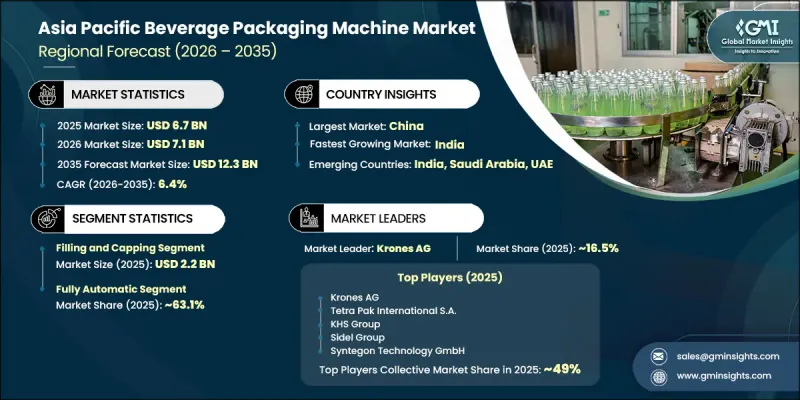
Market expansion is supported by sustained investments in beverage production line upgrades, rising consumption of packaged drinks, and rapid adoption of automated packaging systems across both mature and emerging manufacturing hubs. A key growth driver is the steady increase in per-capita consumption of packaged beverages across Asia Pacific's expanding middle-income population, which continues to fuel demand across multiple product categories. Manufacturers are increasingly transitioning from semi-automatic setups to fully automated packaging lines to improve efficiency, consistency, and output scalability. At the same time, evolving regulatory standards are influencing machinery design requirements, particularly in areas related to hygiene, safety, and production traceability. Growing production capacities among both multinational beverage companies and regional manufacturers are further strengthening demand for advanced packaging equipment. Expanding urbanization, changing consumer lifestyles, and increasing preference for convenience-oriented beverages are collectively reinforcing long-term investment in high-performance packaging machinery across the Asia Pacific beverage packaging machine industry.
| Market Scope | |
|---|---|
| Start Year | 2025 |
| Forecast Year | 2026-2035 |
| Start Value | $6.7 Billion |
| Forecast Value | $12.3 Billion |
| CAGR | 6.4% |
The filling and capping machines segment accounted for held 32.9% share, generating USD 2.2 billion in 2025. This segment maintains its leadership due to its essential role in beverage production lines, where precise filling and secure sealing are critical to maintaining product quality and safety. High-speed automation requirements and precision engineering standards continue to drive sustained investment in this category across large-scale manufacturing facilities.
The semi-automatic machines segment held a 32.2% share in 2025. Demand for these systems remains concentrated among small and mid-sized beverage producers that operate with limited capital expenditure capacity. These machines support partial automation of key packaging processes such as filling, sealing, labeling, and capping, while still requiring manual intervention. Their affordability and operational flexibility make them a preferred choice for emerging manufacturers and regional producers that are gradually scaling production capabilities without fully transitioning to automated systems.
China Beverage Packaging Machine Market captured significant share in 2025, supported by its large-scale beverage production ecosystem and ongoing industrial automation advancements. The country's beverage manufacturing base spans a wide mix of product categories, each requiring specialized packaging machinery solutions for filling, labeling, and secondary packaging operations. Continuous modernization of production facilities and strong domestic manufacturing capacity are further strengthening China's position as the dominant contributor to regional market revenue.
Key companies operating in the Asia Pacific beverage packaging machine market include KHS Group, Tetra Pak International S.A., Krones AG, Sidel Group, GEA Group AG, Syntegon Technology GmbH, Coesia S.p.A., IMA Group (Industria Macchine Automatiche), ProMach, Barry-Wehmiller Companies, Serac Group, SMI S.p.A. (SMIGROUP), Newamstar Packaging Machinery Co., Ltd., CFT Group S.p.A., Cama Group S.r.l., Guangzhou Tech-Long Packaging Machinery Co., Ltd., Zhangjiagang King Machine Co., Ltd., Nichrome Packaging Solutions Ltd., FUJI MACHINERY CO., LTD., TOYO JIDOKI Co., Ltd., and Haver & Boecker Packaging. Companies operating in the Asia Pacific beverage packaging machine market are adopting strategies focused on automation advancement, technological integration, and production efficiency enhancement to strengthen their market position. Leading players are investing in high-speed, fully automated packaging systems equipped with digital monitoring and smart control capabilities to improve operational precision. Many manufacturers are expanding product portfolios to include flexible machinery solutions that support multiple beverage formats and production scales. Strategic collaborations with beverage producers are enabling customized equipment development and long-term supply partnerships. Companies are also strengthening regional manufacturing bases to reduce lead times and improve service responsiveness.
Table of Contents
Chapter 1 Research Methodology
- 1.1 Research approach
- 1.2 Quality Commitments
- 1.2.1 GMI AI policy & data integrity commitment
- 1.2.1.1 Source consistency protocol
- 1.2.1 GMI AI policy & data integrity commitment
- 1.3 Research Trail & Confidence Scoring
- 1.3.1 Research Trail Components
- 1.3.2 Scoring Components
- 1.4 Data Collection
- 1.4.1 Partial list of primary sources
- 1.5 Data mining sources
- 1.5.1 Paid sources
- 1.5.1.1 Sources, by region
- 1.5.1 Paid sources
- 1.6 Base estimates and calculations
- 1.6.1 Base year calculation for any one approach
- 1.7 Forecast model
- 1.7.1 Quantified market impact analysis
- 1.7.1.1 Mathematical impact of growth parameters on forecast
- 1.7.1 Quantified market impact analysis
- 1.8 Research transparency addendum
- 1.8.1 Source attribution framework
- 1.8.2 Quality assurance metrics
- 1.8.3 Our commitment to trust
Chapter 2 Executive Summary
- 2.1 Industry 360° synopsis, 2022 - 2035
- 2.2 Key market trends
- 2.2.1 Regional
- 2.2.2 Product
- 2.2.3 Automation level
- 2.2.4 Application
- 2.2.5 Material
- 2.2.6 Distribution channel
Chapter 3 Industry Insights
- 3.1 Industry ecosystem analysis
- 3.1.1 Supplier landscape
- 3.1.2 Profit margin
- 3.1.3 Value addition at each stage
- 3.1.4 Factor affecting the value chain
- 3.2 Industry impact forces
- 3.2.1 Growth drivers
- 3.2.1.1 Rising consumption of packaged beverages globally
- 3.2.1.2 Growing automation across beverage manufacturing facilities
- 3.2.1.3 Increasing focus on sustainable packaging and efficient production processes
- 3.2.2 Pitfalls & Challenges
- 3.2.2.1 High capital investment associated with advanced packaging machinery
- 3.2.2.2 Fluctuating raw material and packaging material costs
- 3.2.3 Opportunities
- 3.2.3.1 Rising demand for smart packaging automation and robotics integration
- 3.2.3.2 Expansion of beverage manufacturing in emerging economies
- 3.2.1 Growth drivers
- 3.3 Growth potential analysis
- 3.4 Future market trends
- 3.5 Regulatory landscape
- 3.5.1 Standards and compliance requirements
- 3.5.2 Regional regulatory frameworks
- 3.5.3 Certification standards
- 3.6 Porter's analysis
- 3.7 PESTEL analysis
- 3.8 Pricing analysis (driven by primary research)
- 3.8.1 Historical price trend analysis by machine type (2019-2024) (driven by primary research)
- 3.8.2 Pricing strategy by player type (premium / value / cost-plus) (driven by primary research)
- 3.8.3 Price sensitivity by end-user segment (large manufacturers vs. craft producers) (driven by primary research)
- 3.9 Trade data analysis (driven by paid database)
- 3.9.1 Import/export volume & value trends by machine type (HS code 8422) (driven by paid database)
- 3.9.2 Key trade corridors & tariff impact (China-EU, US-LATAM, intra-Asia) (driven by paid database)
- 3.9.3 Trade policy shifts & anti-dumping measures affecting OEM exports (driven by paid database)
- 3.10 Impact of AI & generative AI on the market
- 3.10.1 AI-driven disruption of existing business models (predictive maintenance, line optimization)
- 3.10.2 GenAI use cases & adoption roadmap by machine segment
- 3.10.3 Digital twins & AI-powered changeover optimization
- 3.10.4 Risks, limitations & regulatory considerations for AI in food-grade machinery
- 3.11 Capacity & production landscape (driven by primary research)
- 3.11.1 Installed capacity by region & key producer (driven by primary research)
- 3.11.2 Capacity utilization rates & expansion pipelines (driven by primary research)
Chapter 4 Competitive Landscape, 2025
- 4.1 Introduction
- 4.2 Company market share analysis
- 4.3 Competitive positioning matrix
- 4.4 Strategic outlook matrix
- 4.5 Competitive analysis of major market players
- 4.6 Key developments
- 4.6.1 Mergers & acquisitions
- 4.6.2 Partnerships & collaborations
- 4.6.3 New product launches
- 4.6.4 Expansion plans
Chapter 5 Market Estimates & Forecast, By Product Type, 2022 - 2035, (USD Billion) (Thousand Units)
- 5.1 Key trends
- 5.2 Filling and capping machine
- 5.3 Labeling and coding machine
- 5.4 Palletizing and depalletizing machine
- 5.5 Conveying and handling machine
- 5.6 Cleaning and sterilizing machine
- 5.7 Wrapping and bundling machine
- 5.8 Others
Chapter 6 Market Estimates & Forecast, By Automation Level, 2022 - 2035, (USD Billion) (Thousand Units)
- 6.1 Key trends
- 6.2 Manual machines
- 6.3 Semi-automatic machines
- 6.4 Fully automatic machines
Chapter 7 Market Estimates & Forecast, By Beverage Type, 2022 - 2035, (USD Billion) (Thousand Units)
- 7.1 Key trends
- 7.2 Alcoholic beverages
- 7.3 Non-alcoholic beverages
- 7.4 Dairy beverages
Chapter 8 Market Estimates & Forecast, By Packaging Format, 2022 - 2035, (USD Billion) (Thousand Units)
- 8.1 Key trends
- 8.2 Bottles
- 8.3 Cans
- 8.4 Cartons
- 8.5 Pouches & flexible formats
- 8.6 Others
Chapter 9 Market Estimates & Forecast, By Packaging Material, 2022 - 2035, (USD Billion) (Thousand Units)
- 9.1 Key trends
- 9.2 Glass
- 9.3 Metal
- 9.4 Paperboard
- 9.5 Plastic
- 9.6 Others
Chapter 10 Market Estimates & Forecast, By Distribution Channel, 2022 - 2035, (USD Billion) (Thousand Units)
- 10.1 Key trends
- 10.2 Direct sales
- 10.3 Indirect sales
Chapter 11 Market Estimates & Forecast, By Region, 2022 - 2035, (USD Billion) (Million Units)
- 11.1 Key trends
- 11.2 China
- 11.3 India
- 11.4 Japan
- 11.5 Australia
- 11.6 South Korea
- 11.7 Philippines
- 11.8 Thailand
- 11.9 Vietnam
Chapter 12 Company Profiles
- 12.1 Global players
- 12.1.1 Krones AG
- 12.1.2 Tetra Pak International S.A.
- 12.1.3 Sidel Group
- 12.1.4 GEA Group AG
- 12.1.5 KHS Group
- 12.1.6 Coesia S.p.A.
- 12.1.7 Barry-Wehmiller Companies
- 12.2 Regional players
- 12.2.1 ProMach
- 12.2.2 IMA Group (Industria Macchine Automatiche)
- 12.2.3 Serac Group
- 12.2.4 Syntegon Technology GmbH
- 12.2.5 SMI S.p.A. (SMIGROUP)
- 12.2.6 Newamstar Packaging Machinery Co., Ltd.
- 12.2.7 CFT Group S.p.A.
- 12.3 Emerging players
- 12.3.1 Douglas Machine Inc.
- 12.3.2 EconoCorp Inc.
- 12.3.3 Cama Group S.r.l.
- 12.3.4 Accutek Packaging Equipment Companies
- 12.3.5 IC Filling Systems Ltd.
- 12.3.6 Combi Packaging Systems LLC
- 12.3.7 Massman Automation Designs LLC

