
PUBLISHER: Global Market Insights Inc. | PRODUCT CODE: 2071217

PUBLISHER: Global Market Insights Inc. | PRODUCT CODE: 2071217
Asia Pacific Industrial Blower Market Opportunity, Growth Drivers, Industry Trend Analysis, and Forecast 2026 - 2035
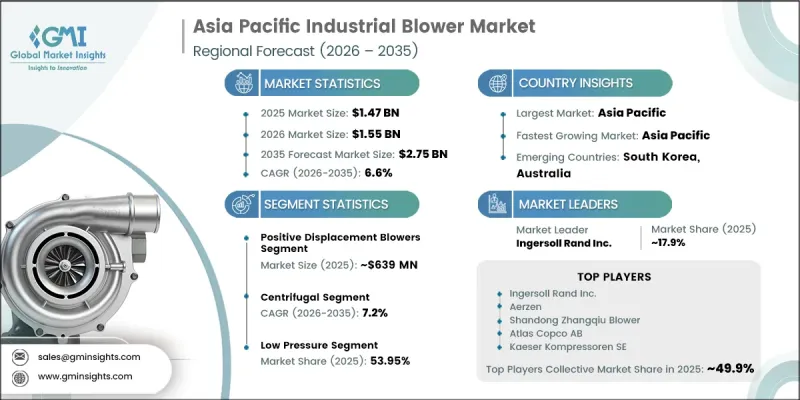
Asia Pacific Industrial Blower Market was valued at USD 1.47 billion in 2025 and is estimated to grow at a CAGR of 6.6% to reach USD 2.75 billion by 2035.
Strong industrial development across the Asia Pacific region continues to create favorable growth opportunities for the market. Rising production activities across manufacturing-intensive sectors are increasing the need for efficient airflow management systems that support operational performance and process reliability. Industrial blowers play a critical role in maintaining airflow, supporting production environments, facilitating material movement, and enhancing process efficiency within industrial facilities. Ongoing investments in industrial infrastructure and supportive government initiatives aimed at strengthening manufacturing capabilities are contributing to higher installation rates of industrial blower systems across the region. At the same time, end users are placing greater emphasis on energy efficiency, durability, and long-term operational reliability, encouraging manufacturers to introduce advanced blower technologies capable of meeting demanding industrial requirements. Expanding energy infrastructure projects throughout the region are further supporting market growth, as industrial blowers remain essential for airflow regulation, cooling functions, and gas management applications within power-related operations. The combination of industrial expansion, infrastructure development, and growing demand for energy-efficient equipment is expected to sustain long-term growth across the Asia Pacific industrial blower market. Companies operating in the market are strengthening their competitive positions through product innovation, capacity expansion, strategic collaborations, and investments in energy-efficient technologies. Manufacturers are focusing on developing advanced blower systems that offer enhanced performance, lower maintenance requirements, and improved operational efficiency to meet evolving customer expectations. Several market participants are expanding their production capabilities and regional distribution networks to improve market reach and customer accessibility. Long-term partnerships with industrial customers are also becoming increasingly important as companies seek to secure recurring business and strengthen customer relationships. In addition, investments in research and development are enabling the introduction of technologically advanced blower solutions tailored to diverse industrial applications. Mergers, acquisitions, and regional expansion initiatives continue to support business growth while helping companies enhance their market presence and strengthen their foothold across the Asia Pacific industrial blower industry.
| Market Scope | |
|---|---|
| Start Year | 2025 |
| Forecast Year | 2026-2035 |
| Start Value | $1.47 Billion |
| Forecast Value | $2.75 Billion |
| CAGR | 6.6% |
The positive displacement blower segment generated USD 639 million in 2025 and is anticipated to record a CAGR of 5.3% between 2026 and 2035. This segment maintains a strong position within the Asia Pacific industrial blower market owing to its dependable operation, adaptability, and ability to deliver consistent airflow under varying operating conditions. Positive displacement blowers are widely preferred in industrial environments where stable pressure and continuous airflow are essential for efficient process performance. Their ability to operate effectively under demanding conditions has contributed significantly to their widespread adoption across numerous industrial applications. Consistent operational reliability and proven performance continue to support the segment's market leadership throughout the region.
The centrifugal blower segment accounted for 53% share in 2025 and is forecast to grow at a CAGR of 7.2% through 2035. This technology segment remains the leading category due to its ability to deliver high operational efficiency and superior airflow performance in large-scale industrial settings. Centrifugal blowers utilize rotating impellers to generate airflow and convert kinetic energy into pressure, allowing for efficient air movement across various industrial processes. Growing preference for oil-free systems, reduced maintenance requirements, and compatibility with energy-saving control technologies continues to support demand for centrifugal blowers. Their ability to enhance operational efficiency while minimizing energy consumption positions the segment for sustained growth over the forecast period.
China Industrial Blower Industry reached USD 599.4 million in 2025. China's dominant position is supported by its extensive industrial manufacturing base and strong demand for industrial airflow solutions across multiple production sectors. Continuous industrial expansion and significant infrastructure investments are generating substantial demand for blower systems that support ventilation, airflow regulation, material movement, and industrial process optimization. Both positive displacement and centrifugal blower technologies continue to experience widespread adoption across the country based on specific operational requirements. The presence of numerous domestic manufacturers offering competitively priced and high-capacity solutions further strengthens China's leadership within the regional market.
Key companies operating in the Asia Pacific Industrial Blower Market include Atlas Copco AB, Ingersoll Rand Inc., Aerzen Maschinenfabrik GmbH, Kaeser Kompressoren SE, Howden Group Ltd., Xylem Inc., Busch Group, Ebara Corporation, IHI Corporation, Mitsubishi Heavy Industries Ltd., Shandong Zhangqiu Blower Co., Ltd., Kaifeng Blower Group Co., Ltd., Everest Blowers Pvt. Ltd., Taiko Kikai Industries Co., Ltd., DongKun Industrial Co., Ltd., Xinxiang Simo Blower Limited Company, Trane Technologies plc, Xiamen Leesii Industry and Trade Co., Ltd., Kay International, Hubei Shuangjian Blower Co., Ltd., and Changsha Blower Works Co., Ltd. Companies operating in the Asia Pacific industrial blower market are focusing on several strategic initiatives to strengthen their market presence and expand their customer base. Product innovation remains a key priority, with manufacturers investing in the development of energy-efficient, high-performance, and low-maintenance blower systems that align with evolving industrial requirements. Businesses are also increasing investments in research and development to enhance operational reliability, durability, and automation capabilities. Capacity expansion and the establishment of regional manufacturing facilities are helping companies improve supply chain efficiency and reduce delivery timelines.
Table of Contents
Chapter 1 Methodology & Scope
- 1.1 Market scope and definition
- 1.2 Research design
- 1.2.1 Research approach
- 1.2.2 Data collection methods
- 1.3 Data mining sources
- 1.3.1 Global
- 1.3.2 Regional/Country
- 1.4 Base estimates and calculations
- 1.4.1 Base year calculation
- 1.4.2 Key trends for market estimation
- 1.5 Primary research and validation
- 1.5.1 Primary sources
- 1.6 Forecast model
- 1.7 Research assumptions and limitations
Chapter 2 Executive Summary
- 2.1 Industry 360° synopsis
- 2.2 Key market trends
- 2.2.1 Country
- 2.2.2 Type
- 2.2.3 Technology
- 2.2.4 Pressure
- 2.2.5 End-use
- 2.2.6 Distribution channel
Chapter 3 Industry Insights
- 3.1 Industry ecosystem analysis
- 3.1.1 Supplier landscape
- 3.1.2 Profit margin
- 3.1.3 Value addition at each stage
- 3.1.4 Factor affecting the value chain
- 3.2 Industry impact forces
- 3.2.1 Growth drivers
- 3.2.1.1 Rapid expansion of wastewater treatment and water management infrastructure globally
- 3.2.1.2 Rising industrialization and manufacturing activity across emerging economies
- 3.2.1.3 Growing deployment of high-speed turbo blowers in energy-efficient aeration applications
- 3.2.2 Pitfalls & Challenges
- 3.2.2.1 High capital costs and long procurement cycles for industrial-grade blower systems
- 3.2.2.2 Increasing competition from low-cost regional manufacturers reducing pricing power
- 3.2.3 Opportunities
- 3.2.3.1 Growing adoption of smart, IoT-enabled blowers with predictive maintenance capabilities
- 3.2.3.2 Expansion of oil & gas and power generation infrastructure in developing markets
- 3.2.1 Growth drivers
- 3.3 Growth potential analysis
- 3.4 Future market trends
- 3.5 Technology and innovation landscape
- 3.5.1 Current technological trends
- 3.5.2 Emerging technologies
- 3.6 Regulatory landscape
- 3.6.1 Standards and compliance requirements
- 3.6.2 Regional regulatory frameworks
- 3.6.3 Certification standards
- 3.7 Porter's analysis
- 3.8 PESTEL analysis
- 3.9 Pricing analysis (driven by primary research)
- 3.9.1 Historical price trend analysis (2021-2024) (driven by primary research)
- 3.9.2 Pricing strategy by player type (premium/value/cost-plus) (driven by primary research)
- 3.9.3 Regional price variations
- 3.9.4 Price sensitivity analysis by end-user segment
- 3.10 Trade data analysis (driven by paid database)
- 3.10.1 Import/export volume and value trends by region (driven by paid database)
- 3.10.2 Key trade corridors and tariff impact analysis (driven by paid database)
- 3.10.3 HS code classification (8414.80, 8414.59)
- 3.11 Impact of AI and generative AI on the market
- 3.11.1 AI-driven disruption of existing business models
- 3.11.2 GenAI use cases and adoption roadmap by segment
- 3.11.3 Predictive maintenance and failure prediction
- 3.11.4 Energy optimization and performance tuning
- 3.11.5 Design optimization and CFD simulation
- 3.11.6 Supply chain and demand forecasting
- 3.11.7 Risks, limitations and regulatory considerations
- 3.12 Capacity and production landscape (driven by primary research)
- 3.12.1 Installed manufacturing capacity by region and key producer (driven by primary research)
- 3.12.2 Capacity utilization rates and expansion pipelines (driven by primary research)
Chapter 4 Competitive Landscape, 2025
- 4.1 Introduction
- 4.2 Company market share analysis
- 4.2.1 By Country
- 4.2.1.1 China
- 4.2.1.2 Japan
- 4.2.1.3 India
- 4.2.1.4 South Korea
- 4.2.1.5 Australia
- 4.2.1.6 Philippines
- 4.2.1.7 Thailand
- 4.2.1.8 Vietnam
- 4.2.1 By Country
- 4.3 Company matrix analysis
- 4.4 Competitive analysis of major market players
- 4.5 Competitive positioning matrix
- 4.6 Key developments
- 4.6.1 Mergers & acquisitions
- 4.6.2 Partnerships & collaborations
- 4.6.3 New product launches
- 4.6.4 Expansion plans
Chapter 5 Market Estimates & Forecast, By Type, 2022 - 2035, (USD Billion) (Thousand Units)
- 5.1 Key trends
- 5.2 Positive displacement (PD) blowers
- 5.3 Centrifugal blowers
- 5.4 High speed turbo blowers
- 5.5 Multistage centrifugal blowers
- 5.6 Others
Chapter 6 Market Estimates & Forecast, By Technology, 2022 - 2035, (USD Billion) (Thousand Units)
- 6.1 Key trends
- 6.2 Centrifugal
- 6.3 Axial
Chapter 7 Market Estimates & Forecast, By Pressure, 2022 - 2035, (USD Billion) (Thousand Units)
- 7.1 Key trends
- 7.2 Low pressure
- 7.3 Medium pressure
- 7.4 High pressure
Chapter 8 Market Estimates & Forecast, By End-Use, 2022 - 2035, (USD Billion) (Thousand Units)
- 8.1 Key trends
- 8.2 Food & beverage
- 8.3 Wastewater treatment
- 8.4 Cement plant
- 8.5 Steel plant
- 8.6 Mining
- 8.7 Power plant
- 8.8 Chemical
- 8.9 Oil and gas
- 8.10 Aerospace and defense
- 8.11 Pulp and paper
- 8.12 Water treatment plant
- 8.13 Others
Chapter 9 Market Estimates & Forecast, By Distribution Channel, 2022 - 2035, (USD Billion) (Thousand Units)
- 9.1 Key trends
- 9.2 Direct
- 9.3 Indirect
Chapter 10 Market Estimates & Forecast, By Country, 2022 - 2035, (USD Billion) (Thousand Units)
- 10.1 Key trends
- 10.2 China
- 10.3 Japan
- 10.4 India
- 10.5 South Korea
- 10.6 Australia
- 10.7 Philippines
- 10.8 Thailand
- 10.9 Vietnam
Chapter 11 Company Profiles
- 11.1 Top Global Players
- 11.1.1 Atlas Copco AB
- 11.1.2 Ingersoll Rand Inc.
- 11.1.3 Aerzen Maschinenfabrik GmbH
- 11.1.4 Kaeser Kompressoren SE
- 11.1.5 Howden Group Ltd.
- 11.1.6 Xylem Inc.
- 11.1.7 Busch Group
- 11.2 Regional Champions
- 11.2.1 Ebara Corporation
- 11.2.2 IHI Corporation
- 11.2.3 Mitsubishi Heavy Industries Ltd.
- 11.2.4 Shandong Zhangqiu Blower Co., Ltd.
- 11.2.5 Kaifeng Blower Group Co., Ltd.
- 11.2.6 Everest Blowers Pvt. Ltd.
- 11.2.7 Taiko Kikai Industries Co., Ltd.
- 11.3 Emerging & Specialized Players
- 11.3.1 DongKun Industrial Co., Ltd.
- 11.3.2 Xinxiang Simo Blower Limited Company
- 11.3.3 Trane Technologies plc
- 11.3.4 Xiamen Leesii Industry and Trade Co., Ltd.
- 11.3.5 Kay International
- 11.3.6 Hubei Shuangjian Blower Co., Ltd.
- 11.3.7 Changsha Blower

