PUBLISHER: Global Market Insights Inc. | PRODUCT CODE: 2071221

PUBLISHER: Global Market Insights Inc. | PRODUCT CODE: 2071221
Europe Textile Machinery Market Opportunity, Growth Drivers, Industry Trend Analysis, and Forecast 2026 - 2035
Europe Textile Machinery Market was valued at USD 4.8 billion in 2025 and is estimated to grow at a CAGR of 5.9% to reach USD 8.5 billion by 2035.
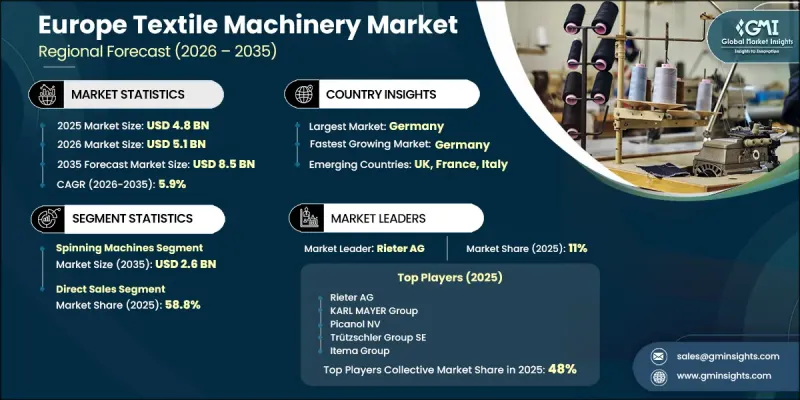
Growth across the Europe textile machinery industry is fueled by the increasing adoption of automation and intelligent manufacturing solutions that integrate digital technologies with environmentally responsible production practices. Manufacturers are investing in advanced equipment that supports lower energy consumption, minimizes production waste, and aligns with circular manufacturing objectives. The ongoing transition toward Industry 4.0 is encouraging textile producers to deploy machinery capable of enhancing operational visibility, improving process optimization, enabling predictive maintenance, and increasing overall production efficiency. Rising investments in facility modernization, digital transformation initiatives, and product portfolio expansion are further contributing to demand for high-performance and energy-efficient textile machinery. The Europe textile machinery market continues to benefit from the region's strong emphasis on engineering excellence, technological advancement, and sustainable industrial development. Growing regulatory focus on environmental performance and increased awareness regarding resource efficiency are accelerating the adoption of advanced textile production equipment throughout the region.
| Market Scope | |
|---|---|
| Start Year | 2025 |
| Forecast Year | 2026-2035 |
| Start Value | $4.8 Billion |
| Forecast Value | $8.5 Billion |
| CAGR | 5.9% |
The digital transformation of textile manufacturing operations, combined with continuous upgrades of existing production facilities, has significantly increased demand for next-generation textile machinery. Market participants are focusing on equipment that delivers higher productivity while maintaining operational efficiency across varying investment levels. Continuous advancements in automation and sustainability-focused technologies have strengthened innovation throughout the European textile machinery landscape. Modern machinery increasingly incorporates connected technologies, intelligent monitoring capabilities, advanced quality management systems, and automated production processes that improve manufacturing consistency and operational performance. Additionally, the growing importance of supply chain stability and manufacturing resilience has emerged as a major factor supporting investment in advanced textile machinery. Europe continues to maintain a leading position in precision engineering and sustainable manufacturing, supported by stringent regulatory standards and increasing industry commitment to environmentally responsible production.
The spinning machines segment generated USD 1.4 billion in 2025 and is anticipated to reach USD 2.6 billion by 2035, expanding at a CAGR of 6.3% during 2026-2035. Increasing emphasis on superior yarn production, improved manufacturing efficiency, and optimized energy utilization has driven consistent demand for technologically advanced spinning equipment. Manufacturers are increasingly seeking machinery equipped with automated monitoring, intelligent control systems, and enhanced operational capabilities to improve productivity and product consistency. The growing use of specialized textile materials across multiple end-use industries has further accelerated the adoption of precision-engineered spinning solutions capable of processing a wider range of fiber materials. Equipment designed to deliver lower energy requirements, reduced servicing needs, and integrated quality assurance functions continues to support long-term growth within the spinning machines segment.
The direct sales channel accounted for 58.8% share in 2025 and is forecast to grow at a CAGR of 6.1% from 2025 to 2035. Many textile manufacturers prefer purchasing machinery directly from equipment providers because it allows greater access to tailored solutions, technical expertise, and comprehensive post-installation support. Direct engagement with suppliers also helps buyers make informed capital investment decisions by providing detailed product information and customized recommendations. In addition, direct sales networks offer specialized engineering assistance, machinery demonstrations, and configuration support that improve the overall procurement experience and strengthen customer confidence throughout the purchasing process.
Europe Textile Machinery Industry is expected to grow from USD 4.8 billion in 2025 to USD 8.5 billion by 2035, reflecting a CAGR of 5.9%. Market expansion is supported by the region's longstanding reputation for engineering excellence, advanced manufacturing capabilities, and strong demand for reliable, high-quality industrial equipment. European buyers consistently prioritize performance, durability, technical precision, and operational efficiency when investing in textile production technologies. The region's leadership in mechanical engineering and industrial automation continues to drive demand for digitally integrated machinery capable of delivering enhanced productivity while reducing environmental impact. Strong commitment to sustainable manufacturing practices and advanced production standards remains a key factor supporting continued growth across the Europe textile machinery market.
Major companies operating in the Europe textile machinery market include Benninger AG, Bruckner Textile Technologies, CHTC Fong's International, Itema Group, KARL MAYER Group, Kornit Digital Ltd., LMW Limited, Mayer & Cie. Global, Mimaki Engineering, Murata Machinery, Picanol NV, Rieter AG, Saurer Intelligent Technology, Savio Macchine Tessili, Shima Seiki, SPGPrints B.V., Staubli International, Thies GmbH & Co. KG, Toyota Industries, Trutzschler Group SE, and Tsudakoma Corp. Companies operating in the Europe textile machinery market are implementing a range of strategic initiatives to strengthen their market position and expand their customer base. Leading manufacturers are increasing investments in research and development to introduce technologically advanced machinery that improves automation, energy efficiency, and production performance. Product innovation remains a central strategy, with companies focusing on digital integration, intelligent monitoring systems, and sustainable manufacturing solutions. Strategic collaborations, technology partnerships, and distribution network expansion are also helping businesses enhance market reach and improve customer engagement. Many industry participants are investing in after-sales services, technical support programs, and customized machinery solutions to strengthen long-term customer relationships.
Table of Contents
Chapter 1 Research Methodology
- 1.1 Research approach
- 1.2 Quality Commitments
- 1.2.1 GMI AI policy & data integrity commitment
- 1.2.1.1 Source consistency protocol
- 1.2.1 GMI AI policy & data integrity commitment
- 1.3 Research Trail & Confidence Scoring
- 1.3.1 Research Trail Components
- 1.3.2 Scoring Components
- 1.4 Data Collection
- 1.4.1 Partial list of primary sources
- 1.5 Data mining sources
- 1.5.1 Paid sources
- 1.5.1.1 Sources, by countries
- 1.5.1 Paid sources
- 1.6 Base estimates and calculations
- 1.6.1 Base year calculation for any one approach
- 1.7 Forecast model
- 1.7.1 Quantified market impact analysis
- 1.7.1.1 Mathematical impact of growth parameters on forecast
- 1.7.1 Quantified market impact analysis
- 1.8 Research transparency addendum
- 1.8.1 Source attribution framework
- 1.8.2 Quality assurance metrics
- 1.8.3 Our commitment to trust
Chapter 2 Executive Summary
- 2.1 Industry 360° snapshot
- 2.2 Company market share analysis
- 2.3 Type
- 2.4 Material
- 2.5 Operation
- 2.6 Application
- 2.7 Distribution Channel
Chapter 3 Industry Insights
- 3.1 Industry ecosystem analysis
- 3.1.1 Supplier landscape
- 3.1.2 Profit margin
- 3.1.3 Value addition at each stage
- 3.1.4 Factor affecting the value chain
- 3.2 Industry impact forces
- 3.2.1 Market growth driver
- 3.2.2 Market challenges
- 3.2.3 Opportunities
- 3.3 Growth potential analysis
- 3.4 Future market trends
- 3.5 Technology and innovation landscape
- 3.5.1 Current technological trends
- 3.5.2 Emerging technologies
- 3.6 Regulatory landscape
- 3.7 Impact on forces
- 3.7.1 Growth drivers
- 3.7.2 Industry pitfalls & challenges
- 3.7.3 Opportunities
- 3.8 Pricing analysis, 2025 (driven by primary research)
- 3.8.1 Historical price trend analysis (2022-2025)
- 3.8.2 Pricing strategy by player type (premium/value/cost-plus)
- 3.8.3 Regional price variation analysis
- 3.8.4 Impact of raw material costs on pricing
- 3.9 Growth potential analysis
- 3.10 Porter's analysis
- 3.11 PESTEL analysis
- 3.12 Trade data analysis (driven by paid database)
- 3.12.1 Import/export volume & value trends (Driven by Primary Research)
- 3.12.2 Key trade corridors & tariff impact (Driven by Primary Research)
- 3.13 Impact of AI & generative AI on the market
- 3.13.1 AI-driven disruption of existing business models
- 3.13.2 GenAI use cases & adoption roadmap by segment
- 3.13.3 Risks, limitations & regulatory considerations
- 3.14 Capacity & Production Landscape (Driven by Primary Research)
- 3.14.1 Installed Capacity by Region & Key Producer (Driven by Primary Research)
- 3.14.2 Capacity Utilization Rates & Expansion Pipelines (Driven by Primary Research)
Chapter 4 Competitive Landscape, 2025
- 4.1 Introduction
- 4.2 Company market share analysis
- 4.3 Company matrix analysis
- 4.4 Competitive analysis of major market players
- 4.5 Competitive positioning matrix
- 4.6 Key developments
- 4.6.1 Mergers & acquisitions
- 4.6.2 Partnerships & collaborations
- 4.6.3 New product launches
- 4.6.4 Expansion plans
Chapter 5 Market Estimates & Forecast, By Type, 2022-2035 (USD Billion) (Thousand Units)
- 5.1 Key Trends
- 5.2 Spinning Machines
- 5.3 Weaving Machines
- 5.4 Dyeing & finishing machines
- 5.5 Knitting Machines
- 5.6 Printing Machines
- 5.7 Others
Chapter 6 Market Estimates & Forecast, By Material, 2022-2035 (USD Billion) (Thousand Units)
- 6.1 Key Trends
- 6.2 Synthetic
- 6.3 Natural
Chapter 7 Market Estimates & Forecast, By Operation, 2022-2035 (USD Billion) (Thousand Units)
- 7.1 Key Trends
- 7.2 Automatic
- 7.3 Semi-automatic
Chapter 8 Market Estimates & Forecast, By Application, 2022 - 2035, (USD Billion) (Thousand Units)
- 8.1 Key Trends
- 8.2 Garments and apparel
- 8.3 Household and home textiles
- 8.4 Technical textiles
- 8.5 Others
Chapter 9 Market Estimates & Forecast, By Distribution Channel, 2022 - 2035, (USD Billion) (Thousand Units)
- 9.1 Key Trends
- 9.2 Direct Sales
- 9.3 Indirect Sales
Chapter 10 Market Estimates & Forecast, By Country, 2022 - 2035, (USD Billion) (Thousand Units)
- 10.1 Key trends
- 10.2 Germany
- 10.3 Italy
- 10.4 France
- 10.5 UK
- 10.6 Spain
- 10.7 Poland
- 10.8 Netherlands
- 10.9 Sweden
Chapter 11 Company Profiles
- 11.1 Top Global Players
- 11.1.1 Rieter AG
- 11.1.2 KARL MAYER Group
- 11.1.3 Picanol NV
- 11.1.4 Trutzschler Group SE
- 11.1.5 Itema Group
- 11.1.6 Staubli International
- 11.1.7 Shima Seiki
- 11.1.8 CHTC Fong's International
- 11.1.9 Toyota Industries
- 11.1.10 Murata Machinery
- 11.1.11 Savio Macchine Tessili
- 11.1.12 Saurer Intelligent Technology
- 11.1.13 Bruckner Textile Technologies
- 11.2 Regional Champions
- 11.2.1 LMW Limited
- 11.2.2 Tsudakoma Corp.
- 11.2.3 Benninger AG
- 11.2.4 Thies GmbH & Co. KG
- 11.2.5 Mimaki Engineering
- 11.3 Emerging & Specialized Players
- 11.3.1 Kornit Digital Ltd.
- 11.3.2 SPGPrints B.V.
- 11.3.3 Mayer & Cie. Global

