PUBLISHER: Global Market Insights Inc. | PRODUCT CODE: 2071230

PUBLISHER: Global Market Insights Inc. | PRODUCT CODE: 2071230
Automotive Spatial Audio and Immersive Infotainment Software Market Opportunity, Growth Drivers, Industry Trend Analysis, and Forecast 2026 - 2035
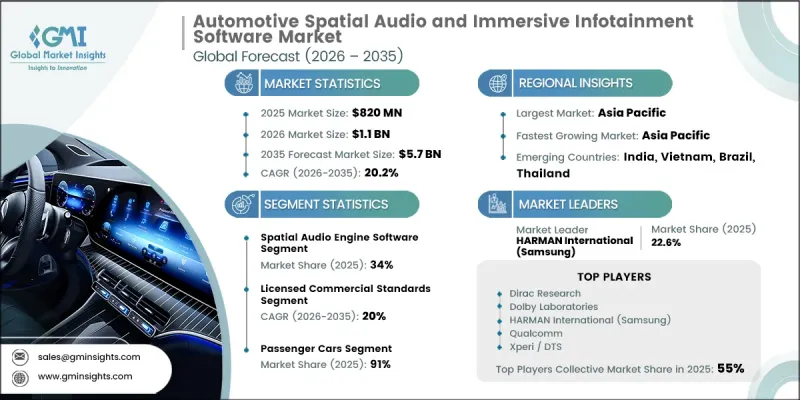
The Global Automotive Spatial Audio and Immersive Infotainment Software Market was valued at USD 820 million in 2025 and is estimated to grow at a CAGR of 20.2% to reach USD 5.7 billion by 2035.
The market is experiencing substantial growth as vehicle manufacturers increasingly focus on enhancing the in-cabin digital experience through advanced audio and infotainment technologies. The rapid evolution of the automotive industry, particularly the expansion of connected and electrified vehicles, is creating strong demand for next-generation entertainment solutions that deliver a more engaging and immersive environment for occupants. Consumers are placing greater value on premium digital experiences, encouraging automakers to integrate sophisticated multimedia platforms capable of providing enhanced audio performance and seamless content delivery. The growing emphasis on connected mobility is also accelerating the adoption of software-driven infotainment ecosystems that support personalized entertainment experiences. As automotive manufacturers compete to differentiate their vehicles through advanced cabin technologies, investments in immersive audio solutions and intelligent infotainment platforms continue to rise. The convergence of connectivity, software innovation, and digital media consumption trends is expected to play a significant role in shaping the future of the automotive spatial audio and immersive infotainment software market over the coming years.
| Market Scope | |
|---|---|
| Start Year | 2025 |
| Forecast Year | 2026-2035 |
| Start Value | $820 Million |
| Forecast Value | $5.7 Billion |
| CAGR | 20.2% |
The automotive spatial audio and immersive infotainment software market is benefiting from the increasing integration of connected technologies and advanced cockpit architectures across modern vehicles. Growing adoption of software-defined vehicle platforms is enabling seamless deployment of sophisticated entertainment systems that enhance the overall driving and passenger experience. Advances in artificial intelligence, machine learning, and high-performance computing technologies are improving the capability of infotainment systems to deliver adaptive audio environments and real-time sound optimization. Automotive manufacturers are increasingly incorporating multidimensional audio technologies into vehicle cabins to create a richer and more engaging entertainment experience. At the same time, AI-powered infotainment solutions are enabling customized user experiences through intelligent content management and personalized sound adjustments. These technological advancements continue to support the expansion of immersive in-vehicle entertainment systems across a wide range of vehicle categories.
The spatial audio engine software segment accounted for 34% share in 2025 and is anticipated to grow at a CAGR of 20.4% from 2026 to 2035. The segment is witnessing strong momentum as automakers increasingly integrate advanced audio processing capabilities into modern vehicles. Growing consumer expectations for premium cabin experiences are encouraging manufacturers to adopt software solutions that can deliver realistic, immersive sound environments. As demand for connected and technologically advanced vehicles continues to increase, spatial audio engine software is becoming a critical component within next-generation infotainment platforms.
The passenger cars segment held a 91% share in 2025. Demand within this segment remains particularly strong due to increasing consumer preference for high-quality entertainment experiences during travel. The widespread integration of advanced audio systems, intelligent infotainment platforms, and connected digital services across passenger vehicles is supporting market growth. Increasing availability of sophisticated entertainment technologies across both premium and mass-market vehicle categories is further strengthening the segment's dominant position within the automotive spatial audio and immersive infotainment software market.
China Automotive Spatial Audio and Immersive Infotainment Software Industry held a 62% share, generating USD 222 million in 2025. Market growth in the country is being driven by the rapid expansion of electric vehicle manufacturing, increasing deployment of connected vehicle technologies, and rising consumer demand for intelligent in-cabin experiences. Automotive manufacturers are actively incorporating advanced infotainment ecosystems, immersive audio capabilities, and artificial intelligence-enabled cockpit technologies into their vehicle portfolios. Continued innovation within the automotive sector and strong consumer interest in digitally enhanced mobility experiences are expected to support sustained market growth throughout the forecast period.
Key companies operating in the Global Automotive Spatial Audio and Immersive Infotainment Software Market include Qualcomm, Dolby Laboratories, HARMAN International (Samsung), Xperi / DTS, Sony, Pioneer, Cerence, BlackBerry QNX, Dirac Research, and Fraunhofer IIS. Companies operating in the automotive spatial audio and immersive infotainment software market are focusing on strategic innovation, technology partnerships, and product enhancement initiatives to strengthen their competitive position. Significant investments in research and development are enabling companies to improve audio processing capabilities, artificial intelligence integration, and personalized infotainment experiences. Collaboration with automotive manufacturers remains a critical strategy, allowing software providers to embed advanced entertainment technologies directly into next-generation vehicle platforms. Businesses are also expanding their software ecosystems to support seamless connectivity, enhanced user interfaces, and intelligent content management features. In addition, companies are investing in cloud-based services, over-the-air update capabilities, and advanced audio optimization technologies to improve customer satisfaction and long-term product value.
Table of Contents
Chapter 1 Research Methodology
- 1.1 Research approach
- 1.2 Quality Commitments
- 1.2.1 GMI AI policy & data integrity commitment
- 1.2.1.1 Source consistency protocol
- 1.2.1 GMI AI policy & data integrity commitment
- 1.3 Research Trail & Confidence Scoring
- 1.3.1 Research Trail Components
- 1.3.2 Scoring Components
- 1.4 Data Collection
- 1.4.1 Partial list of primary sources
- 1.5 Data mining sources
- 1.5.1 Paid sources
- 1.5.1.1 Sources, by region
- 1.5.1 Paid sources
- 1.6 Base estimates and calculations
- 1.6.1 Base year calculation for any one approach
- 1.7 Forecast model
- 1.7.1 Quantified market impact analysis
- 1.7.1.1 Mathematical impact of growth parameters on forecast
- 1.7.1 Quantified market impact analysis
- 1.8 Research transparency addendum
- 1.8.1 Source attribution framework
- 1.8.2 Quality assurance metrics
- 1.8.3 Our commitment to trust
Chapter 2 Executive Summary
- 2.1 Industry 360° synopsis, 2022 - 2035
- 2.2 Key market trends
- 2.2.1 Regional
- 2.2.2 Software
- 2.2.3 Audio Technology
- 2.2.4 Vehicle
- 2.2.5 Deployment Mode
- 2.3 TAM Analysis, 2026-2035
- 2.4 CXO perspectives: Strategic imperatives
Chapter 3 Industry Insights
- 3.1 Industry ecosystem analysis
- 3.1.1 Supplier landscape
- 3.1.2 Profit margin analysis
- 3.1.3 Cost structure
- 3.1.4 Value addition at each stage
- 3.1.5 Factor affecting the value chain
- 3.1.6 Disruptions
- 3.2 Industry impact forces
- 3.2.1 Growth drivers
- 3.2.1.1 Rising adoption of connected and software defined vehicles
- 3.2.1.2 Growing demand for premium in vehicle entertainment experiences
- 3.2.1.3 Expansion of electric and autonomous vehicle ecosystems
- 3.2.1.4 Advancements in artificial intelligence and edge computing
- 3.2.2 Industry pitfalls and challenges
- 3.2.2.1 High integration complexity across vehicle architectures
- 3.2.2.2 Cybersecurity and data privacy concerns
- 3.2.3 Market opportunities
- 3.2.3.1 Growth in software defined vehicle platforms
- 3.2.3.2 Rising integration of immersive audio in electric vehicles
- 3.2.3.3 Increasing adoption of subscription based digital services
- 3.2.1 Growth drivers
- 3.3 Growth potential analysis
- 3.4 Technology and innovation landscape
- 3.4.1 Current technological trends
- 3.4.2 Emerging technologies
- 3.5 Pricing Analysis (Driven by primary research)
- 3.5.1 Historical Price Trend Analysis
- 3.5.2 Pricing Strategy by Player Type
- 3.6 Regulatory landscape
- 3.6.1 North America
- 3.6.1.1 U.S. California Consumer Privacy Act and California Privacy Rights Act
- 3.6.1.2 U.S. California Privacy Protection Agency Regulations
- 3.6.1.3 Canada Personal Information Protection and Electronic Documents Act
- 3.6.2 Europe
- 3.6.2.1 European Union General Data Protection Regulation
- 3.6.2.2 UNECE UN Regulation No. 155 Cyber security and cyber security management system
- 3.6.2.3 UNECE UN Regulation No. 156 Software update and software update management system
- 3.6.2.4 European Union Data Act
- 3.6.2.5 European Union Artificial Intelligence Act
- 3.6.3 Asia Pacific
- 3.6.3.1 China Cybersecurity Law
- 3.6.3.2 China Data Security Law
- 3.6.3.3 China Personal Information Protection Law
- 3.6.3.4 India Digital Personal Data Protection Act 2023
- 3.6.3.5 Japan Act on the Protection of Personal Information
- 3.6.3.6 Singapore Personal Data Protection Act
- 3.6.4 Latin America
- 3.6.4.1 Brazil General Data Protection Law
- 3.6.4.2 Brazil National Data Protection Authority International Data Transfer Regulation
- 3.6.5 Middle East & Africa
- 3.6.5.1 UAE Federal Decree Law No. 45 of 2021 Concerning the Protection of Personal Data
- 3.6.5.2 Saudi Arabia Personal Data Protection Law
- 3.6.1 North America
- 3.7 Porter's analysis
- 3.8 PESTEL analysis
- 3.9 Patent analysis (Driven by primary research)
- 3.10 Cost breakdown analysis
- 3.11 Impact of AI and Generative AI on the Market
- 3.11.1 AI Driven Disruption of Existing Business Models
- 3.11.2 GenAI Use Cases and Adoption Roadmap by Segment
- 3.11.3 Risks Limitations and Regulatory Considerations
- 3.12 Sustainability and environmental aspects
- 3.12.1 Sustainable practices
- 3.12.2 Waste reduction strategies
- 3.12.3 Energy efficiency in production
- 3.12.4 Eco-friendly Initiatives
- 3.12.5 Carbon footprint considerations
- 3.13 Forecast assumptions & scenario analysis (Driven by Primary Research)
- 3.13.1 Base Case- Key Macro & Industry Variables Driving CAGR
- 3.13.2 Optimistic Scenarios- Favorable macro and industry tailwinds
- 3.13.3 Pessimistic Scenario - Macroeconomic slowdown or industry headwinds
Chapter 4 Competitive Landscape, 2025
- 4.1 Introduction
- 4.2 Company market share analysis
- 4.2.1 North America
- 4.2.2 Europe
- 4.2.3 Asia Pacific
- 4.2.4 LATAM
- 4.2.5 MEA
- 4.3 Competitive analysis of major market players
- 4.4 Competitive positioning matrix
- 4.5 Key developments
- 4.5.1 Mergers & acquisitions
- 4.5.2 Partnerships & collaborations
- 4.5.3 New Product Launches
- 4.5.4 Expansion Plans and funding
- 4.6 Company tier benchmarking
- 4.6.1 Tier classification criteria & qualifying thresholds
- 4.6.2 Tier positioning matrix by revenue, geography & innovation
Chapter 5 Market Estimates & Forecast, By Software, 2022 - 2035 (USD Mn)
- 5.1 Key trends
- 5.2 Spatial Audio Engine Software
- 5.3 Active Noise Cancellation (ANC) & Cabin Noise Management Software
- 5.4 Personal Audio Zone Software
- 5.5 Immersive Infotainment Platform Middleware
- 5.6 AI-Based Real-Time Equalization & Acoustic Profiling
Chapter 6 Market Estimates & Forecast, By Audio Technology, 2022 - 2035 (USD Mn)
- 6.1 Key trends
- 6.2 Licensed Commercial Standards
- 6.2.1 Dolby Atmos
- 6.2.2 DTS:X & DTS Headphone:X
- 6.3 Open/Academic Standards
- 6.3.1 Ambisonics (First-Order & Higher-Order)
- 6.3.2 Binaural / HRTF-Based Audio (Standalone Implementations)
- 6.3.3 Wave Field Synthesis (WFS)
- 6.4 Proprietary OEM Formats
Chapter 7 Market Estimates & Forecast, By Vehicle, 2022 - 2035 (USD Mn)
- 7.1 Key trends
- 7.2 Passenger Cars
- 7.2.1 Hatchback
- 7.2.2 Sedan
- 7.2.3 SUV
- 7.3 Commercial Vehicles
- 7.3.1 Light Commercial Vehicles (LCV)
- 7.3.2 Medium Commercial Vehicles (MCV)
- 7.3.3 Heavy Commercial Vehicles (HCV)
Chapter 8 Market Estimates & Forecast, By Deployment Mode, 2022 - 2035 (USD Mn)
- 8.1 Key trends
- 8.2 OEM Embedded
- 8.3 Aftermarket Integration
Chapter 9 Market Estimates & Forecast, By Region, 2022 - 2035 (USD Mn)
- 9.1 Key trends
- 9.2 North America
- 9.2.1 US
- 9.2.2 Canada
- 9.3 Europe
- 9.3.1 Germany
- 9.3.2 UK
- 9.3.3 France
- 9.3.4 Italy
- 9.3.5 Spain
- 9.3.6 Russia
- 9.3.7 Norway
- 9.3.8 Netherlands
- 9.3.9 Sweden
- 9.4 Asia Pacific
- 9.4.1 China
- 9.4.2 India
- 9.4.3 Japan
- 9.4.4 Australia
- 9.4.5 South Korea
- 9.4.6 Singapore
- 9.4.7 Thailand
- 9.4.8 Indonesia
- 9.4.9 Vietnam
- 9.5 Latin America
- 9.5.1 Brazil
- 9.5.2 Mexico
- 9.5.3 Argentina
- 9.6 MEA
- 9.6.1 South Africa
- 9.6.2 Saudi Arabia
- 9.6.3 UAE
- 9.6.4 Turkey
Chapter 10 Company Profiles
- 10.1 Global Players
- 10.1.1 BlackBerry QNX
- 10.1.2 Bose
- 10.1.3 Dolby Laboratories
- 10.1.4 HARMAN International (Samsung)
- 10.1.5 Pioneer
- 10.1.6 Qualcomm Technologies
- 10.1.7 Sony
- 10.1.8 Xperi / DTS
- 10.2 Regional Players
- 10.2.1 Aptiv
- 10.2.2 Cerence
- 10.2.3 Dirac Research
- 10.2.4 DSP Concepts
- 10.2.5 Fraunhofer IIS
- 10.2.6 Panasonic Automotive Systems
- 10.2.7 Renesas Electronics
- 10.3 Emerging Players
- 10.3.1 Audyssey Laboratories
- 10.3.2 Cinemo
- 10.3.3 Synaptics
- 10.3.4 VerVent Audio
- 10.3.5 Waves Audio

