PUBLISHER: Global Market Insights Inc. | PRODUCT CODE: 2071236

PUBLISHER: Global Market Insights Inc. | PRODUCT CODE: 2071236
North America Fruit Picking Robots Market Opportunity, Growth Drivers, Industry Trend Analysis, and Forecast 2026 - 2035
North America Fruit Picking Robots Market was valued at USD 334.02 million in 2025 and is estimated to grow at a CAGR of 14.4% to reach USD 1.31 billion by 2035.
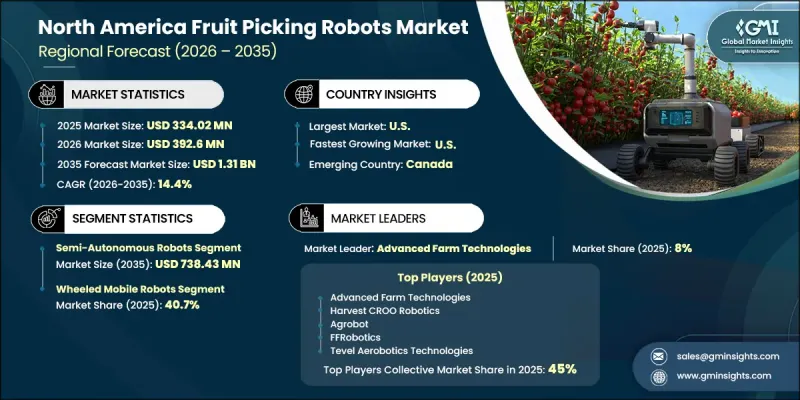
Market expansion is driven by persistent labor availability challenges across the agricultural sector, ongoing reductions in robotic system pricing, and the growing commercialization of advanced harvesting solutions. The entry of large-scale equipment manufacturers and distribution networks is further improving market accessibility and deployment capabilities. Government-backed agricultural support programs are also contributing to adoption by providing financial and technical assistance for precision farming and automation investments, including robotic harvesting technologies. Eligible agricultural operations can receive cost-sharing support ranging from 40% to 90% of qualified expenditures. In addition, annual average selling price (ASP) declines of approximately 8-10% are making robotic harvesting solutions increasingly accessible to a broader range of producers. As berry harvesting robot systems approach the USD 150K price point and apple harvesting systems move closer to USD 250K, the minimum economically viable farm size is declining from more than 200 acres to roughly 75 acres. This transition is significantly widening the potential customer base across the North America fruit picking robots industry.
| Market Scope | |
|---|---|
| Start Year | 2025 |
| Forecast Year | 2026-2035 |
| Start Value | $334.02 Million |
| Forecast Value | $1.31 Billion |
| CAGR | 14.4% |
The semi-autonomous systems segment accounted for 59.1% share and reached USD 197.55 million. Demand for semi-autonomous solutions remains strong because these platforms offer a practical balance between automation and human oversight. Their comparatively lower acquisition costs, simpler integration into existing harvesting operations, and greater adaptability across diverse agricultural environments continue to support widespread adoption. These advantages position semi-autonomous systems as a preferred technology choice during the industry's transition toward more advanced automated harvesting practices.
Based on mobility type, the wheeled mobile robots segment held a 40.7%, generating USD 135.99 million in 2025. Their leadership position is supported by proven operational efficiency, reliable field performance, and compatibility with commonly used agricultural layouts. The ability of wheeled robotic platforms to navigate large-scale cultivation environments efficiently while maintaining productivity has reinforced their strong market presence. Continued advancements in navigation systems, machine vision, and mobility technologies are expected to further strengthen demand for wheeled mobile robots throughout the forecast period.
United States Fruit Picking Robots Market held a 79.2% share, reaching USD 264.7 million in 2025. Market growth is supported by rising labor costs, increasing adoption of agricultural automation technologies, and the need to improve harvesting efficiency. Labor expenditures continue to represent a substantial portion of overall production costs across major fruit-growing operations, encouraging producers to invest in robotic harvesting solutions that can improve productivity and reduce workforce dependence. These factors are expected to maintain the United States' leadership position within the regional market over the coming decade.
Major companies operating in the North America fruit picking robots market include Advanced Farm Technologies, Agrobot, FFRobotics, Four Growers, Gripwiq, Harvest CROO Robotics, J. Schmalz GmbH, JHCTECH, K2 Tech / Qogori, MetoMotion, Nanovel, NeuPeak Robotics, Organifarms, Oxipital AI, Picker Agrobotics, Ripe Robotics, Robotics Plus, Tevel Aerobotics Technologies, Zimmer Group, Zivid, and Zordi. Companies participating in the North America fruit picking robots industry are focusing on a combination of technological innovation, strategic partnerships, and commercial expansion initiatives to strengthen their market position. Many manufacturers are investing heavily in artificial intelligence, machine vision, advanced sensing technologies, and precision harvesting capabilities to improve picking accuracy and operational efficiency. Strategic acquisitions and collaborations with agricultural equipment providers are helping companies expand distribution networks and accelerate market penetration. Businesses are also prioritizing product affordability through continuous engineering improvements that lower system costs and increase accessibility for mid-sized farming operations. In addition, firms are expanding pilot programs, enhancing after-sales support services, and developing scalable robotic platforms tailored to different fruit categories.
Table of Contents
Chapter 1 Research Methodology
- 1.1 Research approach
- 1.2 Quality Commitments
- 1.2.1 GMI AI policy & data integrity commitment
- 1.2.1.1 Source consistency protocol
- 1.2.1 GMI AI policy & data integrity commitment
- 1.3 Research Trail & Confidence Scoring
- 1.3.1 Research Trail Components
- 1.3.2 Scoring Components
- 1.4 Data Collection
- 1.4.1 Partial list of primary sources
- 1.5 Data mining sources
- 1.5.1 Paid sources
- 1.5.1.1 Sources, by region
- 1.5.1 Paid sources
- 1.6 Base estimates and calculations
- 1.6.1 Base year calculation for any one approach
- 1.7 Forecast model
- 1.7.1 Quantified market impact analysis
- 1.7.1.1 Mathematical impact of growth parameters on forecast
- 1.7.1 Quantified market impact analysis
- 1.8 Research transparency addendum
- 1.8.1 Source attribution framework
- 1.8.2 Quality assurance metrics
- 1.8.3 Our commitment to trust
Chapter 2 Executive Summary
- 2.1 Industry 360° synopsis, 2022 - 2035
- 2.2 Key market trends
- 2.2.1 Regional
- 2.2.2 Automation Level
- 2.2.3 Crop Type
- 2.2.4 Deployment Environment
- 2.2.5 Navigation System
- 2.2.6 Distribution Channel
Chapter 3 Industry Insights
- 3.1 Industry ecosystem analysis
- 3.1.1 Factor affecting the value chain
- 3.1.2 Profit margin analysis
- 3.1.3 Disruptions
- 3.1.4 Future outlook
- 3.1.5 Manufacturers
- 3.1.6 Distributors
- 3.2 Supplier landscape
- 3.3 Key news & initiatives
- 3.4 Technology & Innovation Landscape
- 3.5 Regulatory landscape
- 3.6 Impact on forces
- 3.6.1 Growth drivers
- 3.6.2 Industry pitfalls & challenges
- 3.6.3 Opportunities
- 3.7 Pricing analysis, 2025 (driven by primary research)
- 3.7.1 Historical price trend analysis (2022-2025)
- 3.7.2 Pricing strategy by player type (premium/value/cost-plus)
- 3.7.3 Regional price variation analysis
- 3.8 Growth potential analysis
- 3.9 Porter's analysis
- 3.10 PESTEL analysis
- 3.11 Trade data analysis (driven by paid database)
- 3.11.1 Import/export volume & value trends (Driven by Primary Research)
- 3.11.2 Key trade corridors & tariff impact (Driven by Primary Research)
- 3.12 Impact of AI & generative AI on the market
- 3.12.1 AI-driven disruption of existing business models
- 3.12.2 GenAI use cases & adoption roadmap by segment
- 3.12.3 Risks, limitations & regulatory considerations
- 3.13 Capacity & Production Landscape (Driven by Primary Research)
- 3.13.1 Installed Capacity by Region & Key Producer (Driven by Primary Research)
- 3.13.2 Capacity Utilization Rates & Expansion Pipelines (Driven by Primary Research)
Chapter 4 Competitive Landscape, 2025
- 4.1 Introduction
- 4.2 Company market share analysis
- 4.3 Competitive positioning matrix
- 4.4 Strategic outlook matrix
- 4.5 Competitive analysis of major market players
- 4.6 Key developments
- 4.6.1 Mergers & acquisitions
- 4.6.2 Partnerships & collaborations
- 4.6.3 New product launches
- 4.6.4 Expansion plans
Chapter 5 Market Estimates & Forecast, By Automation Level, 2022-2035 (USD Million) (Thousand Units)
- 5.1 Key trends
- 5.2 Fully Autonomous Robots
- 5.3 Semi-Autonomous Robots
Chapter 6 Market Estimates & Forecast, By Crop Type, 2022-2035 (USD Million) (Thousand Units)
- 6.1 Key trends
- 6.2 Berry Picking
- 6.3 Apple Picking
- 6.4 Grape & Vineyard Picking
- 6.5 Citrus Picking
- 6.6 Stone Fruit Picking
- 6.7 Others (Avocado, Kiwi, Mango & Emerging)
Chapter 7 Market Estimates & Forecast, By Deployment Environment, 2022-2035 (USD Million) (Thousand Units)
- 7.1 Key trends
- 7.2 Open-Field Orchards
- 7.3 Greenhouses & Controlled Environment Agriculture (CEA)
- 7.4 Vineyards
- 7.5 Research Institutes & Trial Farms
Chapter 8 Market Estimates & Forecast, By Navigation System, 2022-2035 (USD Million) (Thousand Units)
- 8.1 Key trends
- 8.2 Wheeled Mobile Robots
- 8.3 Rail-Based Systems
- 8.4 Multi-Robot Collaborative Systems
- 8.5 Aerial & Drone-Assisted Systems
- 8.6 Others (Emerging & Hybrid Navigation Platforms)
Chapter 9 Market Estimates & Forecast, By Distribution Channel, 2022-2035 (USD Million) (Thousand Units)
- 9.1 Key trends
- 9.2 Direct Sales
- 9.3 Distributors & Dealers
- 9.3.1 Agricultural Equipment Dealers
- 9.3.2 Regional Agri-Tech Distributors
- 9.4 Online Sales
- 9.4.1 Manufacturer E-Commerce Platforms
- 9.4.2 Third-Party Agricultural Equipment Marketplaces
- 9.5 Others (Leasing, RaaS Models & Agri-Tech Incubator Partnerships)
Chapter 10 & Forecast, By Country, 2022 - 2035, (USD Million) (Thousand Units)
- 10.1 Key trends
- 10.2 U.S.
- 10.3 Canada
Chapter 11 Company Profiles (Business Overview, Financial Data, Product Landscape, Strategic Outlook, SWOT Analysis)
- 11.1 Global players
- 11.1.1 Harvest CROO Robotics
- 11.1.2 Advanced Farm Technologies
- 11.1.3 Zimmer Group
- 11.1.4 J. Schmalz GmbH
- 11.1.5 Zivid
- 11.1.6 FFRobotics
- 11.1.7 Tevel Aerobotics Technologies
- 11.2 Regional players
- 11.2.1 NeuPeak Robotics
- 11.2.2 Four Growers
- 11.2.3 Agrobot
- 11.2.4 Ripe Robotics
- 11.2.5 Robotics Plus
- 11.2.6 MetoMotion
- 11.2.7 Organifarms
- 11.3 Emerging players
- 11.3.1 Oxipital AI
- 11.3.2 Nanovel
- 11.3.3 Picker Agrobotics
- 11.3.4 Gripwiq
- 11.3.5 K2 Tech / Qogori
- 11.3.6 JHCTECH
- 11.3.7 Zordi

