PUBLISHER: Global Market Insights Inc. | PRODUCT CODE: 2071242

PUBLISHER: Global Market Insights Inc. | PRODUCT CODE: 2071242
Heavy Equipment Telematics Market Opportunity, Growth Drivers, Industry Trend Analysis, and Forecast 2026 - 2035
The Global Heavy Equipment Telematics Market was valued at USD 2.8 billion in 2025 and is estimated to grow at a CAGR of 12.4% to reach USD 9 billion by 2035.
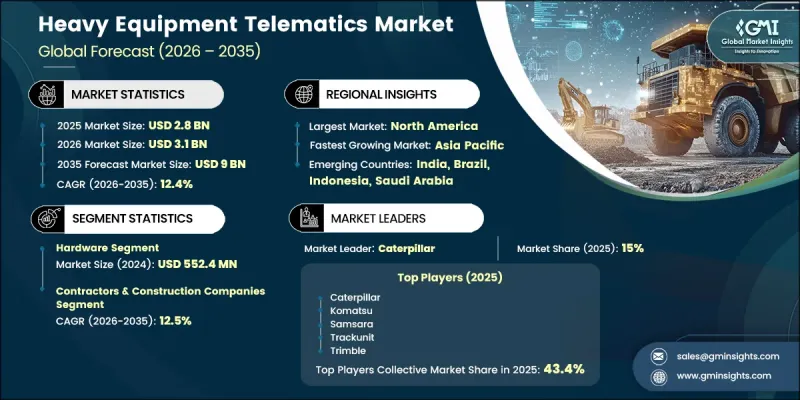
Market expansion is fueled by the growing adoption of connected equipment technologies, increasing regulatory oversight, and rising demand for real-time fleet intelligence across construction, mining, infrastructure, and industrial operations. Businesses are increasingly relying on telematics platforms to improve asset utilization, optimize equipment performance, reduce downtime, and support predictive maintenance strategies. As large-scale infrastructure investments continue across multiple regions, visibility into equipment operations has become an essential requirement rather than a competitive advantage. Regulatory requirements related to emissions monitoring, operational reporting, and workplace safety are also accelerating the deployment of telematics solutions. Connected systems provide automated data collection, location tracking, utilization monitoring, and operator performance insights, helping organizations streamline compliance processes and improve operational efficiency. In addition, growing emphasis on workplace safety, equipment accountability, and digital fleet management is strengthening demand for advanced telematics technologies. As organizations seek to improve productivity while reducing operating costs, telematics solutions are becoming an increasingly important component of heavy equipment fleet management strategies worldwide.
| Market Scope | |
|---|---|
| Start Year | 2025 |
| Forecast Year | 2026-2035 |
| Start Value | $2.8 Billion |
| Forecast Value | $9 Billion |
| CAGR | 12.4% |
The hardware segment is projected to grow at a CAGR of 9.8% through 2035. Hardware solutions include telematics control units, location tracking devices, onboard diagnostic systems, communication gateways, asset monitoring equipment, and connected sensor technologies designed to operate in demanding industrial environments. While the segment continues to play a critical role in enabling connectivity, its growth rate is comparatively moderate due to the increasing integration of telematics functionality directly into new equipment platforms. As connected capabilities become standard features in newly manufactured machinery, market revenue is gradually shifting toward software-based solutions and subscription-driven service offerings.
The contractor segment is expected to grow at a CAGR of 12.5% through 2035, closely aligned with overall market growth. Contractors constitute the broadest customer base for telematics solutions, encompassing organizations involved in infrastructure development, commercial construction, residential projects, and specialized industrial services. The increasing need for fleet visibility, project efficiency, equipment tracking, and resource optimization continues to support strong adoption of telematics technologies across this segment.
North America Heavy Equipment Telematics Market held a 37.8% share in 2025. Market leadership is supported by widespread digitalization across heavy equipment fleets, high adoption of cloud-based fleet management platforms, and well-established regulatory requirements related to operational performance, emissions management, and workplace safety. The region also benefits from a mature technology ecosystem and strong investment in connected equipment solutions, which continue to drive telematics deployment across construction, mining, logistics, and industrial sectors.
Major companies operating in the global heavy equipment telematics market include Caterpillar, Komatsu, Trackunit, Trimble, Samsara, John Deere, Volvo Construction Equipment, ORBCOMM, Topcon, CalAmp, CNH Industrial, Liebherr, Hitachi Construction Machinery, J C Bamford (JCB), Actia, DSA Daten- und Systemtechnik, MiX Telematics, Machinemax, and DPL Telematics. Companies operating in the heavy equipment telematics market are adopting a range of strategies to strengthen their market position and expand their customer base. Key initiatives include investing in advanced telematics platforms that incorporate artificial intelligence, predictive analytics, remote diagnostics, and real-time fleet monitoring capabilities. Market participants are increasingly focusing on software innovation and subscription-based business models to generate recurring revenue streams and improve customer retention. Strategic partnerships with equipment manufacturers, fleet operators, and technology providers are helping companies enhance solution interoperability and accelerate market penetration. Investments in cloud-based platforms, IoT connectivity, and data analytics are enabling businesses to deliver more comprehensive fleet management solutions.
Table of Contents
Chapter 1 Methodology
- 1.1 Research approach
- 1.2 Quality Commitments
- 1.2.1 GMI AI policy & data integrity commitment
- 1.3 Research Trail & Confidence Scoring
- 1.3.1 Research Trail Components
- 1.3.2 Scoring Components
- 1.4 Data Collection
- 1.5 Data mining sources
- 1.5.1 Paid sources
- 1.6 Base estimates and calculations
- 1.6.1 Base year calculation
- 1.7 Forecast model
- 1.7.1 Quantified market impact analysis
- 1.8 Research transparency addendum
- 1.8.1 Source attribution framework
- 1.8.2 Quality assurance metrics
- 1.8.3 Our commitment to trust
Chapter 2 Executive Summary
- 2.1 Industry 360° synopsis
- 2.2 Key market trends
- 2.2.1 Regional
- 2.2.2 Offering
- 2.2.3 Application
- 2.2.4 Connectivity
- 2.2.5 Equipment Category
- 2.2.6 Sales Channel
- 2.2.7 End Use
- 2.3 TAM analysis, 2026-2035
- 2.4 CXO perspectives: Strategic imperatives
Chapter 3 Industry Insights
- 3.1 Industry ecosystem analysis
- 3.1.1 Supplier landscape
- 3.1.2 Profit margin
- 3.1.3 Cost structure
- 3.1.4 Value addition at each stage
- 3.1.5 Factor affecting the value chain
- 3.1.6 Disruptions
- 3.2 Industry impact forces
- 3.2.1 Growth drivers
- 3.2.1.1 Regulatory Mandates for Emissions Monitoring & Safety Compliance
- 3.2.1.2 Rising Demand for Operational Efficiency & Asset Utilization Optimization
- 3.2.1.3 OEM Integration of Smart Systems & Factory-Installed Telematics
- 3.2.1.4 Growth in Equipment Rental & Leasing Models Requiring Fleet Tracking
- 3.2.2 Industry pitfalls and challenges
- 3.2.2.1 High Upfront Deployment Costs & ROI Uncertainty for Small Contractors
- 3.2.2.2 Integration Challenges with Legacy Equipment Lacking Diagnostic Capabilities
- 3.2.3 Market opportunities
- 3.2.3.1 AI-Based Predictive Maintenance Premium Services
- 3.2.3.2 Telematics-as-a-Service
- 3.2.3.3 Integration with Autonomous Equipment & Remote Operation in Hazardous Environments
- 3.2.1 Growth drivers
- 3.3 Technology and innovation landscape
- 3.3.1 Current technological trends
- 3.3.2 Emerging technologies
- 3.4 Growth potential analysis
- 3.5 Pricing Analysis (Driven by Primary Research)
- 3.5.1 Historical Price Trend Analysis
- 3.5.2 Pricing Strategy by Player Type (Premium / Value / Cost-plus)
- 3.6 Regulatory landscape
- 3.6.1 North America
- 3.6.1.1 US - OSHA Safety Standards
- 3.6.1.2 US - FCC Equipment Authorization
- 3.6.1.3 Canada - ISED Radio Standards Specifications (RSS)
- 3.6.2 Europe
- 3.6.2.1 EU - General Data Protection Regulation (GDPR)
- 3.6.2.2 EU - Machinery Regulation (EU) 2023/1230
- 3.6.3 Asia Pacific
- 3.6.3.1 China - MIIT Type Approval
- 3.6.3.2 Japan - Radio Law Certification (MIC)
- 3.6.4 LATAM
- 3.6.4.1 Brazil - ANATEL Certification
- 3.6.4.2 Mexico - IFT Homologation
- 3.6.5 MEA
- 3.6.5.1 UAE - TDRA Certification
- 3.6.5.2 Saudi Arabia - CST Type Approval
- 3.6.1 North America
- 3.7 Porter's analysis
- 3.8 PESTEL analysis
- 3.9 Cost breakdown analysis
- 3.10 Patent analysis (Driven by Primary Research)
- 3.11 Impact of AI & generative AI on the market
- 3.11.1 AI-driven disruption of existing business models
- 3.11.2 GenAI use cases & adoption roadmap by segment
- 3.11.3 Risks, limitations & regulatory considerations
- 3.12 Cybersecurity & Functional Safety Analysis
- 3.13 Infrastructure & Deployment Landscape
- 3.13.1 Scalability Constraints & Infrastructure Investment Trends
- 3.13.2 Connectivity Coverage Gaps (Cellular vs. Satellite)
- 3.13.3 OEM Factory-Install Rates vs. Aftermarket Retrofit Rates
- 3.14 Forecast assumptions & scenario analysis (Driven by Primary Research)
- 3.14.1 Base Case- Key Macro & Industry Variables Driving CAGR
- 3.14.2 Optimistic Scenarios- Favorable macro and industry tailwinds
- 3.14.3 Pessimistic Scenario - Macroeconomic slowdown or industry headwinds
Chapter 4 Competitive Landscape, 2025
- 4.1 Introduction
- 4.2 Company market share analysis
- 4.2.1 North America
- 4.2.2 Europe
- 4.2.3 Asia Pacific
- 4.2.4 LATAM
- 4.2.5 MEA
- 4.3 Competitive analysis of major market players
- 4.4 Competitive positioning matrix
- 4.5 Key developments
- 4.5.1 Mergers & acquisitions
- 4.5.2 Partnerships & collaborations
- 4.5.3 New product launches
- 4.5.4 Expansion plans and funding
- 4.6 Company tier benchmarking
- 4.6.1 Tier classification criteria & qualifying thresholds
- 4.6.2 Tier positioning matrix by revenue, geography & innovation
Chapter 5 Market Estimates and Forecast, By Offering, 2022 - 2035 ($ Mn)
- 5.1 Key trends
- 5.2 Hardware
- 5.2.1 Telematics Control Units (TCUs)
- 5.2.2 GPS Receivers
- 5.2.3 Sensors
- 5.2.4 Display Units
- 5.2.5 Connectivity Modules
- 5.3 Software
- 5.3.1 Fleet Management Platforms
- 5.3.2 Data Analytics & Reporting
- 5.3.3 Others
- 5.4 Services
- 5.4.1 Professional services
- 5.4.1.1 Installation & Integration
- 5.4.1.2 Maintenance & Support
- 5.4.1.3 Consulting & Training
- 5.4.2 Managed services
- 5.4.1 Professional services
Chapter 6 Market Estimates and Forecast, By Application, 2022 - 2035 ($ Mn)
- 6.1 Key trends
- 6.2 Fleet Management & Performance Reporting
- 6.3 Navigation & Asset Tracking
- 6.4 Fuel Management
- 6.5 Equipment Maintenance & Diagnostics
- 6.6 Fleet Safety & Compliance
- 6.7 Others
Chapter 7 Market Estimates and Forecast, By Connectivity, 2022 - 2035 ($ Mn)
- 7.1 Key trends
- 7.2 Cellular
- 7.2.1 3G/4G LTE
- 7.2.2 5G
- 7.3 Satellite
Chapter 8 Market Estimates and Forecast, By Equipment Category, 2022 - 2035 ($ Mn, Fleet Size)
- 8.1 Key trends
- 8.2 Earthmoving Equipment
- 8.3 Material Handling Equipment
- 8.4 Road Construction Equipment
- 8.5 Hauling Equipment
- 8.6 Forestry Equipment
- 8.7 Others
Chapter 9 Market Estimates and Forecast, By Sales Channel, 2022 - 2035 ($ Mn)
- 9.1 Key trends
- 9.2 OEM/factory-installed
- 9.3 Aftermarket
Chapter 10 Market Estimates and Forecast, By End Use, 2022 - 2035 ($ Mn)
- 10.1 Key trends
- 10.2 Rental & Leasing Companies
- 10.3 Contractors & Construction Companies
- 10.4 Mining Companies
- 10.5 Agriculture & Forestry Companies
- 10.6 Government & Municipal Agencies
- 10.7 Others
Chapter 11 Market Estimates & Forecast, By Region, 2022 - 2035 ($Mn, Fleet Size)
- 11.1 Key trends
- 11.2 North America
- 11.2.1 US
- 11.2.2 Canada
- 11.3 Europe
- 11.3.1 Germany
- 11.3.2 UK
- 11.3.3 France
- 11.3.4 Italy
- 11.3.5 Spain
- 11.3.6 Russia
- 11.3.7 Poland
- 11.3.8 Norway
- 11.4 Asia Pacific
- 11.4.1 China
- 11.4.2 India
- 11.4.3 Japan
- 11.4.4 Australia
- 11.4.5 Indonesia
- 11.4.6 South Korea
- 11.4.7 Thailand
- 11.4.8 Vietnam
- 11.5 Latin America
- 11.5.1 Brazil
- 11.5.2 Mexico
- 11.5.3 Argentina
- 11.6 MEA
- 11.6.1 South Africa
- 11.6.2 Saudi Arabia
- 11.6.3 UAE
Chapter 12 Company Profiles
- 12.1 Global players
- 12.1.1 Samsara
- 12.1.2 Trimble
- 12.1.3 Geotab
- 12.1.4 Caterpillar
- 12.1.5 Komatsu
- 12.1.6 Deere & Company
- 12.1.7 ORBCOMM
- 12.1.8 Topcon
- 12.1.9 CalAmp
- 12.1.10 Volvo Construction Equipment
- 12.1.11 CNH Industrial
- 12.1.12 Liebherr
- 12.1.13 Hitachi Construction Machinery
- 12.2 Regional players
- 12.2.1 Trackunit
- 12.2.2 J C Bamford
- 12.2.3 Actia
- 12.2.4 DSA Daten- und Systemtechnik
- 12.2.5 MiX Telematics
- 12.3 Emerging players
- 12.3.1 Machinemax
- 12.3.2 DPL Telematics

