PUBLISHER: Global Market Insights Inc. | PRODUCT CODE: 2071244

PUBLISHER: Global Market Insights Inc. | PRODUCT CODE: 2071244
EV Power Module Market Opportunity, Growth Drivers, Industry Trend Analysis, and Forecast 2026 - 2035
The Global EV Power Module Market was valued at USD 3 billion in 2025 and is estimated to grow at a CAGR of 23.6% to reach USD 25.9 billion by 2035.
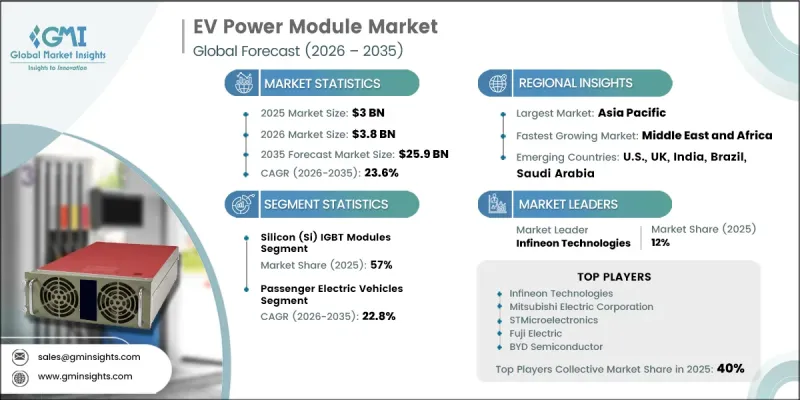
The rapid growth of the EV power module industry is driven by the simultaneous increase in battery electric vehicle production across major automotive manufacturing regions, which collectively account for the vast majority of global EV output. Beyond the rise in vehicle volumes, a key factor supporting market expansion is the ongoing transition from traditional silicon-based insulated gate bipolar transistor (IGBT) technologies toward advanced wide-bandgap semiconductor solutions. Technologies such as silicon carbide (SiC) MOSFETs and gallium nitride (GaN) devices are gaining momentum due to their ability to deliver higher power density, improved thermal management, and enhanced energy efficiency. In addition, regulatory initiatives promoting vehicle electrification and emission reduction targets are encouraging broader adoption of advanced powertrain technologies. Significant investments in semiconductor manufacturing capacity and supply chain development are further strengthening the EV power module market by accelerating the commercialization and deployment of next-generation automotive power electronics.
| Market Scope | |
|---|---|
| Start Year | 2025 |
| Forecast Year | 2026-2035 |
| Start Value | $3 Billion |
| Forecast Value | $25.9 Billion |
| CAGR | 23.6% |
Silicon IGBT modules accounted for 57% share in 2025, maintaining their position as the dominant technology for mainstream 400V electric vehicle platforms. Although the segment continues to generate strong revenue growth, its expansion rate remains below the overall market average due to the increasing adoption of silicon carbide and gallium nitride alternatives. The continued use of IGBT modules is largely supported by their cost advantages in 400V vehicle architectures.
The commercial electric vehicle segment is expected to grow at a CAGR of 26.7% through 2035. Market growth is being fueled by the accelerating electrification of commercial transportation platforms, which require substantially higher power levels than passenger vehicles. Power modules used in commercial EV applications typically operate within the 250 kW to 500 kW range or higher, resulting in significantly greater semiconductor content per vehicle. On a value basis, the power module requirement for a commercial electric vehicle is estimated to be four to seven times greater than that of a passenger EV. This higher content value creates substantial revenue opportunities for manufacturers, making commercial vehicle electrification a major growth driver despite comparatively lower production volumes.
North America EV Power Module Market held a 21.1% share in 2025 and is forecast to grow at a CAGR of 21.4% during 2026-2035. Market development in the region is being supported by government initiatives designed to strengthen domestic electric vehicle supply chains and encourage localized production of advanced automotive components. Growing investments in semiconductor manufacturing facilities and power electronics production capabilities are helping establish a more resilient regional ecosystem for EV powertrain technologies. Increased focus on domestic sourcing, supply chain security, and next-generation semiconductor development continues to create favorable conditions for EV power module manufacturers operating throughout North America.
Major companies operating in the global EV power module market include Infineon Technologies, STMicroelectronics, ROHM, Semiconductor Components Industries (onsemi), Mitsubishi Electric, Navitas Semiconductor, and Allegro MicroSystems. Companies active in the EV power module market are adopting a variety of strategic initiatives to strengthen their competitive position and expand market share. Leading manufacturers are investing heavily in research and development to advance silicon carbide and gallium nitride technologies that offer superior efficiency and performance. Capacity expansion remains a key priority as companies work to meet rising demand from electric vehicle manufacturers. Strategic partnerships across the automotive, semiconductor, and power electronics value chains are also helping companies accelerate product development and improve market penetration.
Table of Contents
Chapter 1 Methodology & Scope
- 1.1 Research approach
- 1.2 Quality commitments
- 1.2.1 GMI AI policy & data integrity commitment
- 1.2.1.1 Source consistency protocol
- 1.2.1 GMI AI policy & data integrity commitment
- 1.3 Research trail & confidence scoring
- 1.3.1 Research trail components
- 1.3.2 Scoring components
- 1.4 Data collection
- 1.4.1 Partial list of primary sources
- 1.5 Data mining sources
- 1.5.1 Paid sources
- 1.5.1.1 Sources, by region
- 1.5.1 Paid sources
- 1.6 Base estimates and calculations
- 1.6.1 Base year calculation for any one approach
- 1.7 Market estimates & forecasts parameters
- 1.8 Forecast model
- 1.8.1 Quantified market impact analysis
- 1.8.1.1 Mathematical impact of growth parameters on forecast
- 1.8.1 Quantified market impact analysis
- 1.9 Research transparency addendum
- 1.9.1 Source attribution framework
- 1.9.2 Quality assurance metrics
- 1.9.3 Our commitment to trust
- 1.10 Market definitions
Chapter 2 Executive Summary
- 2.1 Industry synopsis, 2022 - 2035
- 2.1.1 Business trends
- 2.1.2 Semiconductor material trends
- 2.1.3 Vehicle trends
- 2.1.4 Cooling method trends
- 2.1.5 Regional trends
Chapter 3 Industry Insights
- 3.1 Industry ecosystem analysis
- 3.1.1 Raw material availability & sourcing analysis
- 3.1.2 Supply chain resilience & risk factors
- 3.1.3 Disruptions
- 3.2 Regulatory landscape
- 3.3 Industry impact forces
- 3.3.1 Growth drivers
- 3.3.1.1 Accelerating global EV adoption
- 3.3.1.2 Tightening emission regulations & EV mandates across key markets
- 3.3.1.3 Structural transition from 400V to 800V powertrain architecture
- 3.3.2 Industry pitfalls & challenges
- 3.3.2.1 SiC substrate supply concentration & wafer yield constraints
- 3.3.1 Growth drivers
- 3.4 Growth potential analysis
- 3.5 Porter's analysis
- 3.5.1 Bargaining power of suppliers
- 3.5.2 Bargaining power of buyers
- 3.5.3 Threat of new entrants
- 3.5.4 Threat of substitutes
- 3.6 PESTEL analysis
- 3.6.1 Political factors
- 3.6.2 Economic factors
- 3.6.3 Social factors
- 3.6.4 Technological factors
- 3.6.5 Legal factors
- 3.6.6 Environmental factors
- 3.7 Impact of AI & Generative AI on the market
- 3.7.1 AI-Driven disruption of module design & simulation workflows
- 3.7.2 GenAI adoption roadmap
- 3.7.3 Risks, limitations & regulatory considerations
- 3.8 Emerging opportunities & trends
- 3.9 Investment & Funding Analysis
- 3.10 Sustainability initiatives & industry 4.0 integration
Chapter 4 Competitive Landscape, 2026
- 4.1 Introduction
- 4.2 Company market share analysis, by region, 2025
- 4.2.1 North America
- 4.2.2 Europe
- 4.2.3 Asia Pacific
- 4.2.4 Middle East & Africa
- 4.2.5 Latin America
- 4.3 Key developments
- 4.3.1 Key partnerships & collaborations
- 4.3.2 Major M&A activities
- 4.3.3 Product innovations & launches
- 4.3.4 Market expansion strategies
- 4.4 Competitive positioning matrix
Chapter 5 Market Size and Forecast, By Semiconductor material, 2022 - 2035 (USD Million)
- 5.1 Key trends
- 5.2 Silicon (Si) IGBT modules
- 5.3 Silicon carbide (SiC) MOSFET modules
- 5.4 Gallium nitride (GaN) modules
Chapter 6 Market Size and Forecast, By Vehicle, 2022 - 2035 (USD Million)
- 6.1 Key trends
- 6.2 Passenger electric vehicles
- 6.3 Commercial electric vehicles
- 6.4 Industrial electric vehicles
- 6.5 Others
Chapter 7 Market Size and Forecast, By Cooling method, 2022 - 2035 (USD Million)
- 7.1 Key trends
- 7.2 Air cooled
- 7.3 Liquid cooled
- 7.4 Hybrid cooled
Chapter 8 Market Size and Forecast, By Region, 2022 - 2035 (USD Million)
- 8.1 Key trends
- 8.2 North America
- 8.2.1 U.S.
- 8.2.2 Canada
- 8.2.3 Mexico
- 8.3 Europe
- 8.3.1 Germany
- 8.3.2 UK
- 8.3.3 France
- 8.3.4 Netherlands
- 8.3.5 Italy
- 8.4 Asia Pacific
- 8.4.1 China
- 8.4.2 India
- 8.4.3 Japan
- 8.4.4 South Korea
- 8.4.5 Australia
- 8.5 Middle East & Africa
- 8.5.1 Saudi Arabia
- 8.5.2 UAE
- 8.5.3 South Africa
- 8.6 Latin America
- 8.6.1 Brazil
- 8.6.2 Argentina
Chapter 9 Company Profiles
- 9.1 Allegro MicroSystems, Inc.
- 9.2 Alpha & Omega Semiconductor
- 9.3 BYD Semiconductor
- 9.4 Denso Corporation
- 9.5 Fuji Electric
- 9.6 Hitachi Energy
- 9.7 Infineon Technologies AG
- 9.8 Microchip Technology Inc.
- 9.9 Mitsubishi Electric Corporation
- 9.10 Navitas Semiconductor
- 9.11 NXP Semiconductors
- 9.12 Robert Bosch
- 9.13 ROHM
- 9.14 Semiconductor Components Industries, LLC
- 9.15 Semikron Danfoss
- 9.16 StarPower Semiconductor
- 9.17 STMicroelectronics
- 9.18 Toshiba Corporation
- 9.19 Vishay Intertechnology
- 9.20 Wolfspeed

