PUBLISHER: Global Market Insights Inc. | PRODUCT CODE: 2071248

PUBLISHER: Global Market Insights Inc. | PRODUCT CODE: 2071248
North America Manual Cutting Equipment Market Opportunity, Growth Drivers, Industry Trend Analysis, and Forecast 2026 - 2035
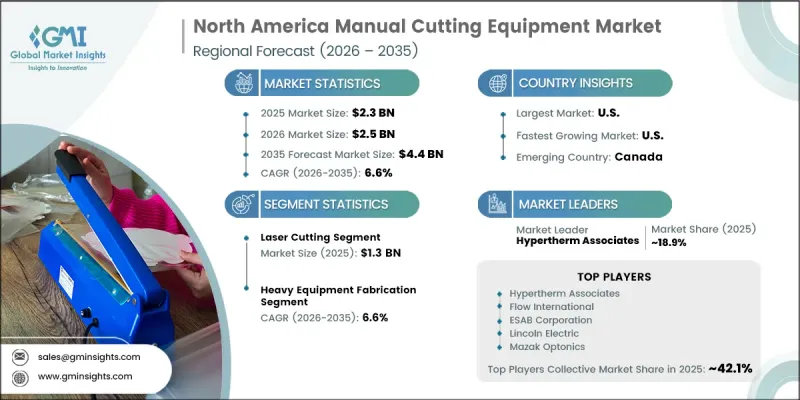
North America Manual Cutting Equipment Market was valued at USD 2.3 billion in 2025 and is estimated to grow at a CAGR of 6.6% to reach USD 4.4 billion by 2035.
Growth is fueled by increased capital allocation toward manufacturing expansion, fabrication processes, and large-scale infrastructure upgrades. The steady shift toward advanced production methodologies is creating sustained demand for cutting solutions that enhance operational precision and efficiency. Across the U.S. and Canada, industries are accelerating the adoption of modern fabrication technologies to improve throughput and optimize resource utilization. At the same time, the expansion of industrial output continues to reinforce the need for high-performance cutting equipment. The integration of automation and digital manufacturing practices is also contributing to market momentum, as businesses adopt connected systems and precision-driven tools. Ongoing efforts to strengthen domestic production capabilities and reduce reliance on external supply chains are further supporting investments in advanced cutting technologies, encouraging both equipment modernization and new system installations.
| Market Scope | |
|---|---|
| Start Year | 2025 |
| Forecast Year | 2026-2035 |
| Start Value | $2.3 Billion |
| Forecast Value | $4.4 Billion |
| CAGR | 6.6% |
The laser cutting segment accounted for USD 1.3 billion in 2025 and is expected to grow at a CAGR of 8.3% through 2035. This segment leads the regional market due to its ability to deliver high accuracy, faster processing speeds, and versatility in handling multiple material types. The increasing preference for laser-based systems is driven by their capability to enhance production quality, minimize material waste, and support large-scale manufacturing requirements. Their growing integration into industrial workflows continues to strengthen their market position across North America.
The heavy equipment fabrication segment held a 27.9% share in 2025 and is projected to grow at a CAGR of 6.6% from 2026 to 2035. This segment maintains a strong presence due to the rising demand for advanced fabrication processes that support large and complex equipment manufacturing. Cutting technologies that can efficiently process thick materials and maintain high precision are essential for improving productivity and ensuring consistent output quality. The continued expansion of fabrication operations is driving the adoption of advanced cutting solutions throughout the region.
United States Manual Cutting Equipment Market reached USD 2 billion in 2025, and is expected to grow at a CAGR of 6.7% through 2035. Market growth is supported by a well-established industrial base and increasing demand for precision-focused manufacturing solutions. Companies across various sectors are investing in advanced cutting systems to improve efficiency, reduce waste, and meet evolving production standards. The continued focus on high-performance manufacturing processes is expected to sustain growth across the U.S. market.
Key companies operating in the North America manual cutting equipment market include ESAB Corporation, Hypertherm Associates, Messer Cutting Systems, The Lincoln Electric Company, Koike Aronson, Inc., Kjellberg Finsterwalde, and Flow International. Additional notable participants include Cincinnati Incorporated, Panasonic Connect - Welding Division, MC Machinery Systems, Voortman Steel Machinery, Mazak Optonics, and DAIHEN Corporation. Emerging and specialized companies such as Jet Edge, Inc., WARDJet, Machitech Automation, GENSTAR Technologies, KMT Waterjet, Torchmate CNC, Techni Waterjet, and MultiCam Inc. are also contributing to the competitive landscape. Companies in the North America manual cutting equipment market are enhancing their competitive position through continuous technological advancement and strategic expansion initiatives. A key focus is on developing high-precision cutting systems integrated with automation, digital controls, and smart manufacturing capabilities to improve efficiency and reduce operational costs. Partnerships and collaborations with industrial manufacturers are helping companies strengthen long-term customer relationships and expand their market reach.
Table of Contents
Chapter 1 Methodology & Scope
- 1.1 Market scope and definition
- 1.2 Research design
- 1.2.1 Research approach
- 1.2.2 Data collection methods
- 1.3 Data mining sources
- 1.3.1 Global
- 1.3.2 Regional/Country
- 1.4 Base estimates and calculations
- 1.4.1 Base year calculation
- 1.4.2 Key trends for market estimation
- 1.5 Primary research and validation
- 1.5.1 Primary sources
- 1.6 Forecast model
- 1.7 Research assumptions and limitations
Chapter 2 Executive Summary
- 2.1 Industry 360° synopsis
- 2.2 Key market trends
- 2.2.1 Country
- 2.2.2 Product type
- 2.2.3 Application
- 2.2.4 Distribution channel
Chapter 3 Industry Insights
- 3.1 Industry ecosystem analysis
- 3.1.1 Supplier landscape
- 3.1.2 Profit margin
- 3.1.3 Value addition at each stage
- 3.1.4 Factor affecting the value chain
- 3.2 Industry impact forces
- 3.2.1 Growth drivers
- 3.2.1.1 Rising industrial manufacturing and metal fabrication activities across North America
- 3.2.1.2 Growing adoption of industrial automation and smart manufacturing systems
- 3.2.1.3 Expansion of infrastructure, transportation, and heavy equipment projects
- 3.2.2 Pitfalls & Challenges
- 3.2.2.1 High capital investment and maintenance costs for advanced cutting equipment
- 3.2.2.2 Skilled workforce shortages and operational complexity
- 3.2.3 Opportunities
- 3.2.3.1 Rising investments in reshoring and advanced manufacturing initiatives
- 3.2.3.2 Growing adoption of energy-efficient and high-precision cutting systems
- 3.2.1 Growth drivers
- 3.3 Growth potential analysis
- 3.4 Future market trends
- 3.5 Technology and innovation landscape
- 3.5.1 Current technological trends
- 3.5.2 Emerging technologies
- 3.6 Regulatory landscape
- 3.6.1 Standards and compliance requirements
- 3.6.2 Regional regulatory frameworks
- 3.6.3 Certification standards
- 3.7 Porter's analysis
- 3.8 PESTEL analysis
- 3.9 Pricing analysis (driven by primary research)
- 3.9.1 Historical price trend analysis (driven by primary research)
- 3.9.2 Pricing strategy by player type (premium / value / cost-plus) (driven by primary research)
- 3.9.3 Regional price variations and drivers
- 3.9.4 Price sensitivity by end-user segment
- 3.10 Trade data analysis (driven paid database)
- 3.10.1 Import/export volume and value trends (driven by paid database)
- 3.10.2 Key trade corridors and tariff impact (driven by paid database)
- 3.10.3 Trade policy changes and market access
- 3.11 Impact of AI and generative AI on the market
- 3.11.1 AI-driven disruption of existing business models
- 3.11.2 GenAI use cases and adoption roadmap by segment
- 3.11.3 Predictive maintenance for manual equipment
- 3.11.4 AI-assisted operator training and skill development
- 3.11.5 Design optimization and material usage efficiency
- 3.11.6 Risks, limitations, and regulatory considerations
- 3.12 Capacity and production landscape (driven by primary research)
- 3.12.1 Installed capacity by region and key producer (driven by primary research)
- 3.12.2 Capacity utilization rates and expansion pipelines (driven by primary research)
Chapter 4 Competitive Landscape, 2025
- 4.1 Introduction
- 4.2 Company market share analysis
- 4.2.1 By Country
- 4.2.1.1 U.S.
- 4.2.1.2 Canada
- 4.2.1 By Country
- 4.3 Company matrix analysis
- 4.4 Competitive analysis of major market players
- 4.5 Competitive positioning matrix
- 4.6 Key developments
- 4.6.1 Mergers & acquisitions
- 4.6.2 Partnerships & collaborations
- 4.6.3 New product launches
- 4.6.4 Expansion plans
Chapter 5 Market Estimates & Forecast, By Technology Type, 2022 - 2035, (USD Billion) (Thousand Units)
- 5.1 Key trends
- 5.2 Laser cutting
- 5.3 Plasma cutting
- 5.4 Waterjet cutting
- 5.5 Oxy-fuel cutting
- 5.6 Carbon arc cutting
Chapter 6 Market Estimates & Forecast, By Application, 2022 - 2035, (USD Billion) (Thousand Units)
- 6.1 Key trends
- 6.2 Heavy equipment fabrication
- 6.3 Automotive & transportation
- 6.4 Construction
- 6.5 Shipbuilding & offshore
- 6.6 Others
Chapter 7 Market Estimates & Forecast, By Distribution Channel, 2022 - 2035, (USD Billion) (Thousand Units)
- 7.1 Key trends
- 7.2 Direct
- 7.3 Indirect
Chapter 8 Market Estimates & Forecast, By Country, 2022 - 2035, (USD Billion) (Thousand Units)
- 8.1 Key trends
- 8.2 U.S.
- 8.3 Canada
Chapter 9 Company Profiles
- 9.1 Top Global Players
- 9.1.1 Hypertherm Associates
- 9.1.2 ESAB Corporation
- 9.1.3 The Lincoln Electric Company
- 9.1.4 Messer Cutting Systems
- 9.1.5 Koike Aronson, Inc.
- 9.1.6 Kjellberg Finsterwalde
- 9.1.7 Flow International
- 9.2 Regional Champions
- 9.2.1 DAIHEN Corporation
- 9.2.2 Ador Welding Ltd.
- 9.2.3 Voortman Steel Machinery
- 9.2.4 Cebora S.p.A.
- 9.2.5 Panasonic Connect - Welding Division
- 9.2.6 Hornet Cutting Systems
- 9.2.7 Esprit Automation
- 9.3 Emerging & Specialized Players
- 9.3.1 Jet Edge, Inc.
- 9.3.2 WARDJet
- 9.3.3 ZINSER GmbH
- 9.3.4 GENSTAR TECHNOLOGIES
- 9.3.5 KMT Waterjet
- 9.3.6 Torchmate CNC
- 9.3.7 Techni Waterjet

