PUBLISHER: Global Market Insights Inc. | PRODUCT CODE: 2071249

PUBLISHER: Global Market Insights Inc. | PRODUCT CODE: 2071249
Sustainable Marine Fuels Market Opportunity, Growth Drivers, Industry Trend Analysis, and Forecast 2026 - 2035
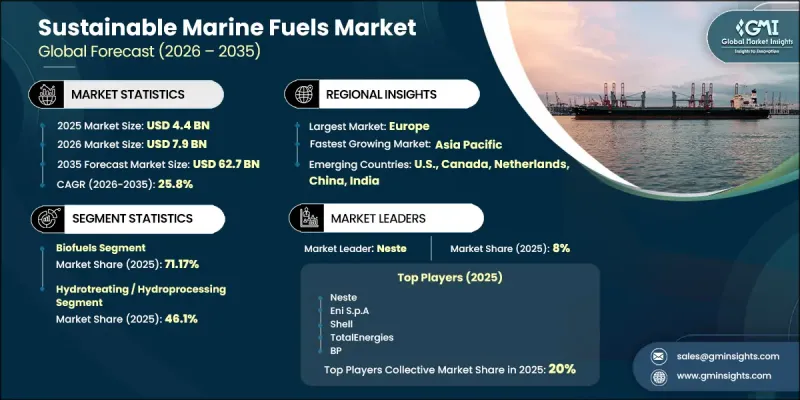
The Global Sustainable Marine Fuels Market was valued at USD 4.4 billion in 2025 and is estimated to grow at a CAGR of 25.8% to reach USD 62.7 billion by 2035.
Growth across the sustainable marine fuels industry is influenced by tightening global emissions regulations, mandatory greenhouse gas intensity reduction targets, and increasing carbon pricing mechanisms that are reshaping operational and procurement strategies across the shipping sector. Decarbonization commitments from cargo owners are further reinforcing demand, as supply chain emissions are increasingly incorporated into corporate net-zero frameworks. This shift is encouraging long-term fuel procurement agreements that help stabilize demand and support infrastructure investment. As a result, shipping operators are increasingly aligning with industrial partners to secure reliable access to low-emission fuel supplies while improving compliance with evolving environmental standards. The transition toward sustainable marine fuels is also being reinforced by growing collaboration across the maritime value chain, where fuel producers, logistics operators, and cargo stakeholders are jointly supporting the scale-up of low-carbon fuel ecosystems. These combined structural drivers are expected to significantly reshape marine fuel sourcing patterns over the forecast period.
| Market Scope | |
|---|---|
| Start Year | 2025 |
| Forecast Year | 2026-2035 |
| Start Value | $4.4 Billion |
| Forecast Value | $62.7 Billion |
| CAGR | 25.8% |
The bio-based marine fuels segment held a 71.17% share, generating USD 3.13 billion, while expanding at a CAGR of 16.3%. Their leadership position is largely attributed to their compatibility with existing marine engine systems and fuel distribution infrastructure, enabling adoption without requiring major vessel modifications. This operational flexibility has made bio-based fuels one of the most practical short-term pathways for maritime decarbonization across global shipping fleets.
The hydrotreatment and hydroprocessing technologies segment held a 46.1% share in 2025, generating USD 2.03 billion. These processes convert lipid-based raw materials into low-carbon marine fuels through hydrogen-based refining methods, supporting the production of renewable diesel-type fuels. Their ability to efficiently transform diverse feedstocks into standardized fuel products has strengthened their adoption within large-scale sustainable fuel production systems.
North America Sustainable Marine Fuels Market held 22.45% share in 2025, valued at USD 0.99 billion, and is projected to grow at a CAGR of 23.2% through 2035. The United States serves as the key growth engine in the region, supported by policy frameworks designed to accelerate the transition toward low-emission maritime operations. Increasing investments in clean fuel infrastructure and expanding adoption across commercial shipping and defense-related maritime activities are further reinforcing regional market growth.
Key companies operating in the global sustainable marine fuels market include Shell, BP, Exxon Mobil Corporation, Chevron Corporation, TotalEnergies, Repsol, Eni S.p.A, Neste Corporation, World Energy, Cargill, Bunker Holding, FincoEnergies, Gevo, GoodFuels, Argent Energy, Moeve, Evergent Technologies, Kvasir Technologies, Steeper Energy, and Sunpine AB. Companies operating in the sustainable marine fuels market are focusing on strengthening their competitive positioning through large-scale investments in production capacity, long-term supply agreements, and strategic partnerships across the maritime value chain. Many market participants are prioritizing the expansion of biofuel and synthetic fuel production facilities to meet rising demand from shipping operators transitioning toward low-carbon operations. Collaboration with cargo owners and logistics providers is becoming increasingly important to secure offtake agreements and stabilize revenue streams. Firms are also investing heavily in research and development to improve fuel efficiency, feedstock flexibility, and production scalability.
Table of Contents
Chapter 1 Methodology & Scope
- 1.1 Research approach
- 1.2 Quality commitments
- 1.2.1 GMI AI policy & data integrity commitment
- 1.2.1.1 Source consistency protocol
- 1.2.1 GMI AI policy & data integrity commitment
- 1.3 Research trail & confidence scoring
- 1.3.1 Research trail components
- 1.3.2 Scoring components
- 1.4 Data collection
- 1.4.1 Partial list of primary sources
- 1.5 Data mining sources
- 1.5.1 Paid sources
- 1.5.1.1 Sources, by region
- 1.5.1 Paid sources
- 1.6 Base estimates and calculations
- 1.6.1 Base year calculation for any one approach
- 1.7 Market estimates & forecasts parameters
- 1.8 Forecast model
- 1.8.1 Quantified market impact analysis
- 1.8.1.1 Mathematical impact of growth parameters on forecast
- 1.8.1 Quantified market impact analysis
- 1.9 Research transparency addendum
- 1.9.1 Source attribution framework
- 1.9.2 Quality assurance metrics
- 1.9.3 Our commitment to trust
- 1.10 Market definitions
Chapter 2 Executive Summary
- 2.1 Industry synopsis, 2022 - 2035
- 2.1.1 Business trends
- 2.1.2 Fuel type trends
- 2.1.3 Conversion process trends
- 2.1.4 Application trends
- 2.1.5 Regional trends
Chapter 3 Industry Insights
- 3.1 Industry ecosystem analysis
- 3.1.1 Feedstock availability & sourcing analysis
- 3.1.2 Supply chain resilience & risk factors
- 3.1.3 Distribution network analysis
- 3.1.4 Disruptions
- 3.2 Regulatory landscape
- 3.2.1 IMO GHG Strategy & fuel EU maritime regulation
- 3.2.2 Regional Regulatory mandates (EU ETS, US EPA, IACS)
- 3.2.3 Carbon Intensity Indicator (CII) & EEXI compliance
- 3.3 Industry impact forces
- 3.3.1 Growth drivers
- 3.3.2 Industry pitfalls & challenges
- 3.4 Growth potential analysis
- 3.5 Porter's Analysis
- 3.5.1 Bargaining power of suppliers
- 3.5.2 Bargaining power of buyers
- 3.5.3 Threat of new entrants
- 3.5.4 Threat of substitutes
- 3.6 PESTEL Analysis
- 3.6.1 Political factors
- 3.6.2 Economic factors
- 3.6.3 Social factors
- 3.6.4 Technological factors
- 3.6.5 Environmental factors
- 3.6.6 Legal factors
- 3.7 Emerging opportunities & trends
- 3.8 Digitalization & IoT integration
- 3.9 Investment analysis & future prospects
- 3.10 Technology & innovation landscape
- 3.10.1 AI-Driven Disruption of bunkering, logistics & fleet management
- 3.10.2 GenAI use cases & adoption roadmap by fuel segment
- 3.10.3 Risks, limitations & regulatory considerations
- 3.11 Impact of AI & Generative AI on the market (Solution Core)
- 3.11.1 AI-driven production optimization
- 3.11.2 Predictive maintenance & fault detection
Chapter 4 Competitive Landscape, 2026
- 4.1 Introduction
- 4.2 Company market share analysis, 2025
- 4.2.1 By region
- 4.2.1.1 North America
- 4.2.1.2 Europe
- 4.2.1.3 Asia Pacific
- 4.2.1.4 Middle East & Africa
- 4.2.1.5 Latin America
- 4.2.2 Market concentration analysis
- 4.2.1 By region
- 4.3 Competitive analysis of major market players
- 4.4 Competitive positioning matrix
- 4.5 key developments
- 4.5.1 Merger & acquisition
- 4.5.2 Partnership & collaboration
- 4.5.3 New product launched
- 4.5.4 Expansion plans & funding
- 4.6 Company tier benchmarking
- 4.6.1 Tier classification criteria & qualifying thresholds
- 4.6.2 Tier positioning matrix by revenue, geography & innovation
Chapter 5 Market Size and Forecast, By Fuel type, 2022 - 2035 (USD Million)
- 5.1 Key trends
- 5.2 Biofuel
- 5.2.1 Biodiesel
- 5.2.2 HVO /Renewable Diesel
- 5.2.3 Bio-Oil
- 5.2.4 Biocrude
- 5.3 Green Methanol
- 5.4 Green Ammonia
- 5.5 Green Hydrogen
- 5.6 Bio-LNG / RNG
- 5.7 Others
Chapter 6 Market Size and Forecast, By Conversion process, 2022 - 2035 (USD Million)
- 6.1 Key trends
- 6.2 Transesterification
- 6.3 Electrolysis-based synthesis
- 6.4 Fischer-tropsch synthesis (FTS)
- 6.5 Hydrotreating / hydroprocessing
- 6.6 Anaerobic digestion
- 6.7 Others
Chapter 7 Market Size and Forecast, By Application, 2022 - 2035 (USD Million)
- 7.1 Key trends
- 7.2 Commercial Vessels
- 7.2.1 Cargo vessels
- 7.2.2 Tankers
- 7.2.3 Passenger vessels
- 7.2.4 Working vessels
- 7.3 Defense vessels
- 7.3.1 Naval surface ships
- 7.3.2 Amphibious & support vessels
- 7.4 Others
Chapter 8 Market Size and Forecast, By Region, 2022 - 2035 (USD Million)
- 8.1 Key trends
- 8.2 North America
- 8.2.1 U.S.
- 8.2.2 Canada
- 8.3 Europe
- 8.3.1 Norway
- 8.3.2 Germany
- 8.3.3 France
- 8.3.4 Netherlands
- 8.3.5 UK
- 8.4 Asia Pacific
- 8.4.1 China
- 8.4.2 India
- 8.4.3 Japan
- 8.4.4 South Korea
- 8.4.5 Singapore
- 8.5 Middle East & Africa
- 8.5.1 Saudi Arabia
- 8.5.2 UAE
- 8.5.3 South Africa
- 8.6 Latin America
- 8.6.1 Brazil
- 8.6.2 Argentina
Chapter 9 Company Profiles
- 9.1 Argent Energy
- 9.2 BP
- 9.3 Bunker Holding
- 9.4 Cargill
- 9.5 Chevron Corporation
- 9.6 Eni S.p.A
- 9.7 Evergent Technologies
- 9.8 Exxon Mobil Corporation
- 9.9 FincoEnergies
- 9.10 Gevo
- 9.11 GoodFuels
- 9.12 Kvasir Technologies
- 9.13 Moeve
- 9.14 Neste Corporation
- 9.15 Shell plc
- 9.16 Steeper Energy
- 9.17 Sunpine AB
- 9.18 Repsol
- 9.19 TotalEnergies
- 9.20 World Energy

