PUBLISHER: Global Market Insights Inc. | PRODUCT CODE: 2071250

PUBLISHER: Global Market Insights Inc. | PRODUCT CODE: 2071250
Food Traceability Solutions Market Opportunity, Growth Drivers, Industry Trend Analysis, and Forecast 2026 - 2035
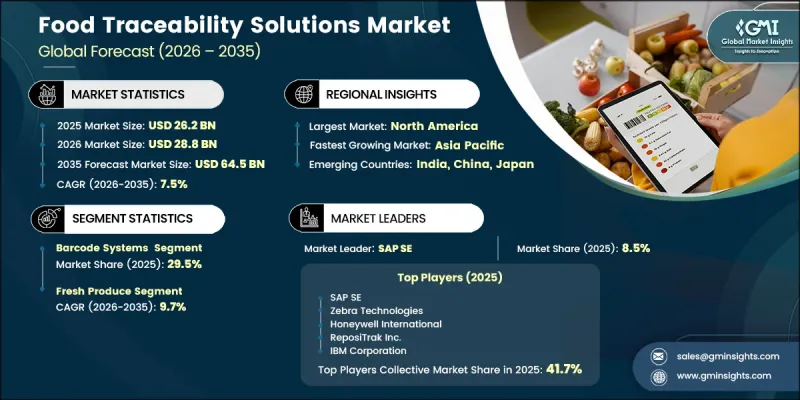
The Global Food Traceability Solutions Market was valued at USD 26.2 billion in 2025 and is estimated to grow at a CAGR of 7.5% to reach USD 64.5 billion by 2035.
This upward trajectory reflects increasing investment in digitized supply chain infrastructure and the growing demand for comprehensive product tracking across production, processing, and distribution stages. Organizations are prioritizing enhanced visibility at the lot level to meet compliance requirements and maintain supply chain accountability. The shift from early-stage implementation to large-scale commercial deployment of traceability technologies is further strengthening market growth. Additionally, mounting pressure from commercial stakeholders is pushing food companies to adopt transparent tracking systems as a prerequisite for market participation. Regulatory compliance continues to be a critical and non-optional investment area, reinforcing the long-term demand for advanced traceability systems across the global food industry.
| Market Scope | |
|---|---|
| Start Year | 2025 |
| Forecast Year | 2026-2035 |
| Start Value | $26.2 Billion |
| Forecast Value | $64.5 Billion |
| CAGR | 7.5% |
Regulatory frameworks are acting as a major catalyst for the adoption of food traceability solutions across key regions. In the United States, stringent compliance requirements are driving large-scale implementation of digital traceability systems across thousands of food businesses, creating a significant demand surge. Similarly, evolving regulatory mandates in Europe are expanding compliance obligations, compelling companies to implement more advanced and verifiable supply chain tracking mechanisms across domestic and international operations.
The barcode-based systems segment accounted for 29.5% share in 2025 and is projected to grow at a CAGR of 6.9% through 2035. Their continued dominance is supported by widespread adoption across food production, storage, and retail environments. These systems provide essential traceability at the lot level, meeting baseline compliance requirements in most markets. Their cost-effectiveness, accessibility, and established operational familiarity make them a preferred choice, particularly for small and mid-sized enterprises and participants in emerging economies.
The fresh produce segment held a 22.2% share in 2025 and is anticipated to grow at a CAGR of 9.7% through 2035. This segment's strong position is driven by heightened regulatory oversight and the economic impact associated with contamination risks in perishable goods. The need for rapid identification and response within supply chains has increased the adoption of traceability systems, enabling improved monitoring and operational efficiency across production and distribution channels.
North America Food Traceability Solutions Market accounted for 34.5% share in 2025 and is expected to grow at a CAGR of 8.1% through 2035. The region's growth is primarily supported by strict regulatory requirements that are accelerating the adoption of digital traceability platforms across many food enterprises. Implementation timelines extending into 2026 are prompting organizations to prioritize traceability investments as part of their immediate operational and capital planning strategies.
Key companies operating in the Global Food Traceability Solutions Market include SAP SE, Honeywell International Inc., Zebra Technologies Corporation, IBM Corporation, Cognex Corporation, SGS SA, OPTEL Group, FoodLogiQ, rfxcel Corporation, Mojix Inc., Kezzler AS, ReposiTrak Inc., osapiens AG, TradeEdge (EdgeVerve Systems), and Verdara. Companies in the food traceability solutions market are focusing on strengthening their competitive position through innovation, strategic partnerships, and global expansion initiatives. Market players are investing in advanced digital technologies to enhance real-time tracking, data analytics, and system integration capabilities. Collaborations with supply chain stakeholders are enabling seamless interoperability and faster deployment of traceability platforms. Firms are also expanding their service portfolios to address evolving compliance requirements and industry-specific needs.
Table of Contents
Chapter 1 Methodology & Scope
- 1.1 Market scope and definition
- 1.2 Research design
- 1.2.1 Research approach
- 1.2.2 Data collection methods
- 1.3 Data mining sources
- 1.3.1 Global
- 1.3.2 Regional/Country
- 1.4 Base estimates and calculations
- 1.4.1 Base year calculation
- 1.4.2 Key trends for market estimation
- 1.5 Primary research and validation
- 1.5.1 Primary sources
- 1.6 Forecast model
- 1.7 Research assumptions and limitations
Chapter 2 Executive Summary
- 2.1 Industry 360° synopsis
- 2.2 Key market trends
- 2.2.1 Technology type
- 2.2.2 Component
- 2.2.3 Application
- 2.2.4 End user
- 2.2.5 Regional
- 2.3 TAM Analysis, 2026-2035
- 2.4 CXO perspectives: Strategic imperatives
- 2.5 Future outlook and strategic recommendations
Chapter 3 Industry Insights
- 3.1 Industry ecosystem analysis
- 3.1.1 Supplier landscape
- 3.1.2 Profit margin
- 3.1.3 Value addition at each stage
- 3.1.4 Factor affecting the value chain
- 3.1.5 Disruptions
- 3.2 Industry impact forces
- 3.2.1 Growth drivers
- 3.2.1.1 Increasing demand for food safety transparency
- 3.2.1.2 Rising regulatory compliance requirements globally
- 3.2.1.3 Growing adoption of digital supply chains
- 3.2.2 Industry pitfalls and challenges
- 3.2.2.1 Integration with blockchain and IoT technologies
- 3.2.2.2 Expansion in emerging food export markets
- 3.2.3 Market opportunities
- 3.2.3.1 High implementation and maintenance costs
- 3.2.3.2 Data management and system integration challenges
- 3.2.3.3 Limited awareness among small-scale producers
- 3.2.1 Growth drivers
- 3.3 Growth potential analysis
- 3.4 Regulatory landscape
- 3.4.1 North America
- 3.4.2 Europe
- 3.4.3 Asia Pacific
- 3.4.4 Latin America
- 3.4.5 Middle East & Africa
- 3.5 Porter's analysis
- 3.6 PESTEL analysis
- 3.7 Technology and innovation landscape
- 3.7.1 Current technological trends
- 3.7.2 Emerging technologies
- 3.8 Price trends
- 3.8.1 By region
- 3.8.2 By technology type
- 3.9 Future market trends
- 3.10 Patent landscape
- 3.11 Trade statistics (HS code)
- 3.11.1 Major importing countries
- 3.11.2 Major exporting countries
- 3.12 Sustainability and environmental aspects
- 3.12.1 Sustainable practices
- 3.12.2 Waste reduction strategies
- 3.12.3 Energy efficiency in production
- 3.12.4 Eco-friendly initiatives
- 3.13 Carbon footprint consideration
Chapter 4 Competitive Landscape, 2025
- 4.1 Introduction
- 4.2 Company market share analysis
- 4.2.1 By region
- 4.2.1.1 North America
- 4.2.1.2 Europe
- 4.2.1.3 Asia Pacific
- 4.2.1.4 LATAM
- 4.2.1.5 MEA
- 4.2.1 By region
- 4.3 Company matrix analysis
- 4.4 Competitive analysis of major market players
- 4.5 Competitive positioning matrix
- 4.6 Key developments
- 4.6.1 Mergers & acquisitions
- 4.6.2 Partnerships & collaborations
- 4.6.3 New product launches
- 4.6.4 Expansion plans
Chapter 5 Market Estimates and Forecast, By Technology Type, 2022-2035 (USD Million) (Kilo Tons)
- 5.1 Key trends
- 5.2 Barcode systems
- 5.3 RFID/RTLS
- 5.4 IOT sensor-based systems
- 5.5 Blockchain-based platforms
- 5.6 EPCIS software platforms
- 5.7 Others
Chapter 6 Market Estimates and Forecast, By Component, 2022-2035 (USD Million) (Kilo Tons)
- 6.1 Key trends
- 6.2 Hardware
- 6.3 Software
- 6.4 Services
- 6.5 Others
Chapter 7 Market Estimates and Forecast, By Application, 2022-2035 (USD Million) (Kilo Tons)
- 7.1 Key trends
- 7.2 Fresh produce
- 7.3 Seafood
- 7.4 Dairy & eggs
- 7.5 Meat & poultry
- 7.6 Processed foods
- 7.7 Beverages
- 7.8 Others
Chapter 8 Market Estimates and Forecast, By End user, 2022-2035 (USD Million) (Kilo Tons)
- 8.1 Key trends
- 8.2 Farms & growers
- 8.3 Manufacturers & processors
- 8.4 Distributors & importers
- 8.5 Retailers & foodservice
- 8.6 Others
Chapter 9 Market Estimates and Forecast, By Region, 2022-2035 (USD Million) (Kilo Tons)
- 9.1 Key trends
- 9.2 North America
- 9.2.1 U.S.
- 9.2.2 Canada
- 9.3 Europe
- 9.3.1 Germany
- 9.3.2 UK
- 9.3.3 France
- 9.3.4 Spain
- 9.3.5 Italy
- 9.3.6 Rest of Europe
- 9.4 Asia Pacific
- 9.4.1 China
- 9.4.2 India
- 9.4.3 Japan
- 9.4.4 Australia
- 9.4.5 South Korea
- 9.4.6 Rest of Asia Pacific
- 9.5 Latin America
- 9.5.1 Brazil
- 9.5.2 Mexico
- 9.5.3 Argentina
- 9.5.4 Rest of Latin America
- 9.6 Middle East and Africa
- 9.6.1 Saudi Arabia
- 9.6.2 South Africa
- 9.6.3 UAE
- 9.6.4 Rest of Middle East and Africa
Chapter 10 Company Profiles
- 10.1 Honeywell International Inc.
- 10.2 Zebra Technologies Corporation
- 10.3 IBM Corporation
- 10.4 SAP SE
- 10.5 Cognex Corporation
- 10.6 SGS SA
- 10.7 OPTEL Group
- 10.8 FoodLogiQ
- 10.9 rfxcel Corporation
- 10.10 Mojix Inc.
- 10.11 Kezzler AS
- 10.12 ReposiTrak Inc.
- 10.13 osapiens AG
- 10.14 TradeEdge (EdgeVerve Systems)
- 10.15 Verdara

