PUBLISHER: Global Market Insights Inc. | PRODUCT CODE: 2071253

PUBLISHER: Global Market Insights Inc. | PRODUCT CODE: 2071253
Fruit Pickers Market Opportunity, Growth Drivers, Industry Trend Analysis, and Forecast 2026 - 2035
The Global Fruit Pickers Market was valued at USD 585 million in 2025 and is estimated to grow at a CAGR of 9.2% to reach USD 1.41 billion by 2035.
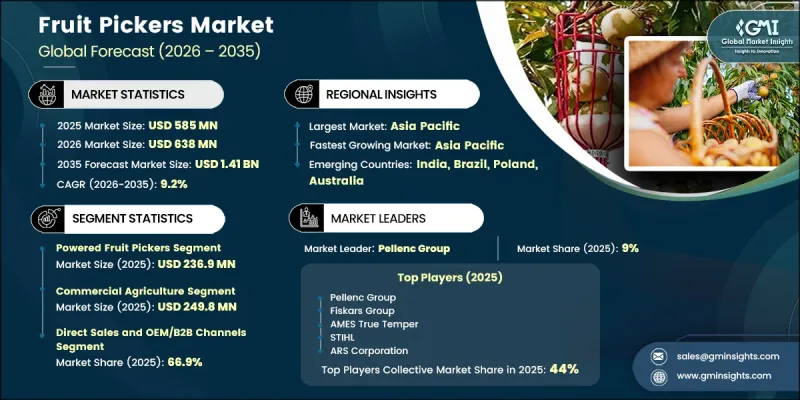
Market growth is shaped by a clear transition away from traditional manual harvesting tools toward battery-powered ergonomic equipment, alongside early-stage adoption of semi-automated and robotic harvesting solutions in commercial farming operations. Rising labor costs in developed agricultural economies are accelerating the shift toward mechanized picking systems that improve productivity while reducing dependence on seasonal labor availability. At the same time, expanding fruit cultivation activities across Asia Pacific are reinforcing global demand growth across both commercial and small-scale farming applications. Labor shortages and demographic aging trends in major agricultural economies, particularly across Europe, are further strengthening the case for mechanized harvesting tools that enhance operational efficiency without requiring full-scale automation investment. As a result, both established agricultural equipment manufacturers and emerging robotics developers are actively competing within the same evolving value chain, reshaping product development strategies and expanding the overall addressable market for fruit picking technologies.
| Market Scope | |
|---|---|
| Start Year | 2025 |
| Forecast Year | 2026-2035 |
| Start Value | $585 Million |
| Forecast Value | $1.41 Billion |
| CAGR | 9.2% |
The powered fruit pickers segment generated USD 236.9 million in 2025, accounting for 40.5% share. This segment's strong performance is driven by increasing adoption of battery-operated tools that offer higher efficiency, reduced physical strain, and improved productivity in commercial orchard operations. The growing preference for energy-efficient and ergonomically designed equipment continues to reinforce demand for powered solutions over traditional manual alternatives.
The commercial agriculture segment accounted for USD 249.8 million in 2025, representing 42.7% share. Demand is primarily driven by large-scale orchard operations across key fruit-producing regions worldwide, where mechanized harvesting tools are increasingly used to address labor shortages and improve operational efficiency. The continued expansion of fruit cultivation activities across both developed and emerging agricultural economies is further reinforcing the commercial adoption of advanced picking solutions.
North America Fruit Pickers Market held a 27% share in 2025. The United States remains the leading national market in the region, while Canada continues to show steady growth supported by commercial fruit farming operations. Rising labor costs across agricultural sectors are encouraging wider adoption of mechanized harvesting tools. The increasing focus on productivity improvement and labor efficiency in commercial orchards continues to support steady market expansion across the region.
Key companies operating in the global fruit pickers industry include AMES True Temper, Fiskars Group, STIHL, Kubota Corporation, Husqvarna Group, Pellenc Group, Corona Tools, Spear & Jackson, Wilkinson Sword, ARS Corporation, Agrobot S.E., FFRobotics, Harvest CROO Robotics, Dogtooth Technologies, Zenport Industries, Worth Garden, Flexrake, Darlac, and Edward Tools. Companies operating in the fruit pickers market are focusing on technology advancement, product innovation, and automation integration to strengthen their competitive position. Manufacturers are increasingly investing in battery-powered and ergonomic tool designs that improve efficiency and reduce physical strain for users. The development of semi-automated and robotic harvesting solutions is expanding capabilities in large-scale commercial orchards. Strategic partnerships with agricultural cooperatives and orchard operators are helping companies improve product adoption and real-world application feedback. Firms are also focusing on lightweight materials and energy-efficient systems to enhance product performance and usability.
Table of Contents
Chapter 1 Research Methodology
- 1.1 Research approach
- 1.2 Quality Commitments
- 1.2.1 GMI AI policy & data integrity commitment
- 1.2.1.1 Source consistency protocol
- 1.2.1 GMI AI policy & data integrity commitment
- 1.3 Research Trail & Confidence Scoring
- 1.3.1 Research Trail Components
- 1.3.2 Scoring Components
- 1.4 Data Collection
- 1.4.1 Partial list of primary sources
- 1.5 Data mining sources
- 1.5.1 Paid sources
- 1.5.1.1 Sources, by region
- 1.5.1 Paid sources
- 1.6 Base estimates and calculations
- 1.6.1 Base year calculation for any one approach
- 1.7 Forecast model
- 1.7.1 Quantified market impact analysis
- 1.7.1.1 Mathematical impact of growth parameters on forecast
- 1.7.1 Quantified market impact analysis
- 1.8 Research transparency addendum
- 1.8.1 Source attribution framework
- 1.8.2 Quality assurance metrics
- 1.8.3 Our commitment to trust
Chapter 2 Executive Summary
- 2.1 Industry 360° synopsis, 2022 - 2035
- 2.2 Key market trends
- 2.2.1 Regional
- 2.2.2 Product Type
- 2.2.3 Fruit type
- 2.2.4 Material
- 2.2.5 End user
- 2.2.6 Distribution channel
Chapter 3 Industry Insights
- 3.1 Industry ecosystem analysis
- 3.1.1 Factor affecting the value chain
- 3.1.2 Profit margin analysis
- 3.1.3 Disruptions
- 3.1.4 Future outlook
- 3.1.5 Manufacturers
- 3.1.6 Distributors
- 3.2 Supplier landscape
- 3.3 Key news & initiatives
- 3.4 Technology & Innovation Landscape
- 3.5 Regulatory landscape
- 3.6 Impact on forces
- 3.6.1 Growth drivers
- 3.6.2 Industry pitfalls & challenges
- 3.6.3 Opportunities
- 3.7 Pricing analysis, 2025 (driven by primary research)
- 3.7.1 Historical price trend analysis (2022-2025)
- 3.7.2 Pricing strategy by player type (premium/value/cost-plus)
- 3.7.3 Regional price variation analysis
- 3.8 Growth potential analysis
- 3.9 Porter's analysis
- 3.10 PESTEL analysis
- 3.11 Trade data analysis (driven by paid database)
- 3.11.1 Import/export volume & value trends (Driven by Primary Research)
- 3.11.2 Key trade corridors & tariff impact (Driven by Primary Research)
- 3.12 Impact of AI & generative AI on the market
- 3.12.1 AI-driven disruption of existing business models
- 3.12.2 GenAI use cases & adoption roadmap by segment
- 3.12.3 Risks, limitations & regulatory considerations
- 3.13 Capacity & Production Landscape (Driven by Primary Research)
- 3.13.1 Installed Capacity by Region & Key Producer (Driven by Primary Research)
- 3.13.2 Capacity Utilization Rates & Expansion Pipelines (Driven by Primary Research)
Chapter 4 Competitive Landscape, 2025
- 4.1 Introduction
- 4.2 Company market share analysis
- 4.3 Competitive positioning matrix
- 4.4 Strategic outlook matrix
- 4.5 Competitive analysis of major market players
- 4.6 Key developments
- 4.6.1 Mergers & acquisitions
- 4.6.2 Partnerships & collaborations
- 4.6.3 New product launches
- 4.6.4 Expansion plans
Chapter 5 Market Estimates & Forecast, By Product Type, 2022-2035 (USD Million) (Million Units)
- 5.1 Key trends
- 5.2 Manual Fruit Pickers
- 5.3 Powered Fruit Pickers
- 5.4 Others (Automatic, Semi-automatic)
Chapter 6 Market Estimates & Forecast, By Fruit Type, 2022-2035 (USD Million) (Million Units)
- 6.1 Key trends
- 6.2 Apples
- 6.3 Oranges & Citrus
- 6.4 Berries
- 6.5 Grapes
- 6.6 Peaches & Stone Fruits
- 6.7 Others (Mangoes, Avocados, Pears, etc.)
Chapter 7 Market Estimates & Forecast, By Material, 2022-2035 (USD Million) (Million Units)
- 7.1 Key trends
- 7.2 Plastic
- 7.3 Metal
- 7.4 Composite Materials
Chapter 8 Market Estimates & Forecast, By End User, 2022-2035 (USD Million) (Million Units)
- 8.1 Key trends
- 8.2 Commercial Agriculture
- 8.3 Horticulture & Orchard Mgmt
- 8.4 Home Gardening / Residential
- 8.5 Agriculture Rental Services
Chapter 9 Market Estimates & Forecast, By Distribution Channel, 2022-2035 (USD Million) (Million Units)
- 9.1 Key trends
- 9.2 Online Retail
- 9.3 Specialty Agricultural Equipment Stores
- 9.4 Hypermarkets & Supermarkets
- 9.5 Direct Sales & OEM/B2B Channels
- 9.6 Others (Agri-Cooperatives, Rental Platforms)
Chapter 10 & Forecast, By Region, 2022 - 2035, (USD Million) (Million Units)
- 10.1 Key trends
- 10.2 North America
- 10.2.1 U.S.
- 10.2.2 Canada
- 10.3 Europe
- 10.3.1 Germany
- 10.3.2 U.K.
- 10.3.3 France
- 10.3.4 Italy
- 10.3.5 Spain
- 10.4 Asia Pacific
- 10.4.1 China
- 10.4.2 India
- 10.4.3 Japan
- 10.4.4 South Korea
- 10.4.5 Australia
- 10.5 Latin America
- 10.5.1 Brazil
- 10.5.2 Mexico
- 10.5.3 Argentina
- 10.6 MEA
- 10.6.1 UAE
- 10.6.2 Saudi Arabia
- 10.6.3 South Africa
Chapter 11 Company Profiles (Business Overview, Financial Data, Product Landscape, Strategic Outlook, SWOT Analysis)
- 11.1 Global players
- 11.1.1 Pellenc Group
- 11.1.2 Fiskars Group
- 11.1.3 AMES True Temper
- 11.1.4 STIHL
- 11.1.5 ARS Corporation
- 11.1.6 Husqvarna Group
- 11.1.7 Kubota Corporation
- 11.2 Regional players
- 11.2.1 Corona Tools
- 11.2.2 Spear & Jackson
- 11.2.3 Worth Garden
- 11.2.4 Zenport Industries
- 11.2.5 Darlac
- 11.2.6 Wilkinson Sword
- 11.2.7 Flexrake
- 11.2.8 Edward Tools
- 11.3 Emerging players
- 11.3.1 Dogtooth Technologies
- 11.3.2 Harvest CROO Robotics
- 11.3.3 Agrobot S.E.
- 11.3.4 FFRobotics

