PUBLISHER: Global Market Insights Inc. | PRODUCT CODE: 2071254

PUBLISHER: Global Market Insights Inc. | PRODUCT CODE: 2071254
Aircraft Oxygen Systems Market Opportunity, Growth Drivers, Industry Trend Analysis, and Forecast 2026 - 2035
The Global Aircraft Oxygen Systems Market was valued at USD 3.9 billion in 2025 and is estimated to grow at a CAGR of 6.5% to reach USD 7.3 billion by 2035.
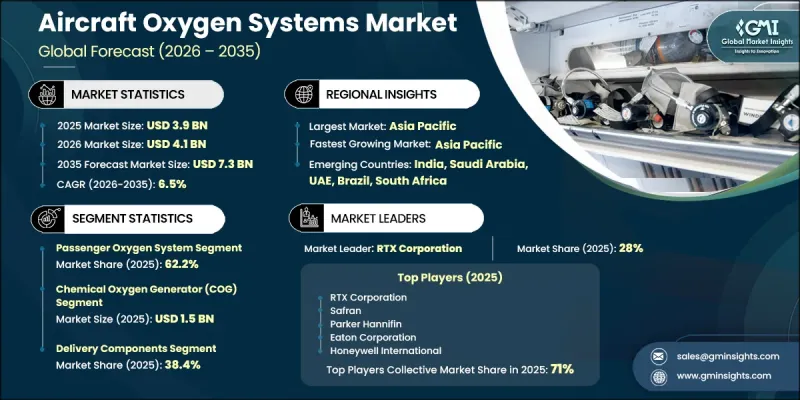
Growth in the aircraft oxygen systems market is driven by the continuous expansion of global aircraft fleets resulting from increasing air travel demand and the ongoing need to enhance onboard safety standards. As commercial and military aviation activities continue to grow, airlines and aircraft operators are investing in advanced safety equipment designed to ensure passenger and crew protection during flight operations. Regulatory compliance remains a major factor supporting market growth, as aviation authorities require aircraft to be equipped with dependable oxygen supply systems that meet stringent operational and safety requirements. The market is also benefiting from the increasing prevalence of long-duration and high-altitude flight operations, which require reliable oxygen delivery solutions to support safe aircraft performance. Furthermore, recurring replacement cycles for oxygen systems, along with continuous technological advancements in oxygen generation and delivery technologies, are creating new opportunities for manufacturers. These factors, combined with growing investments in next-generation aircraft platforms and aviation infrastructure, are expected to sustain long-term growth across the global aircraft oxygen systems market.
| Market Scope | |
|---|---|
| Start Year | 2025 |
| Forecast Year | 2026-2035 |
| Start Value | $3.9 Billion |
| Forecast Value | $7.3 Billion |
| CAGR | 6.5% |
The aircraft oxygen systems market continues to gain momentum due to the steady rise in global passenger traffic, which is contributing to increased aircraft production and fleet expansion worldwide. As aviation operators seek to accommodate growing travel demand, the importance of advanced onboard safety technologies has become increasingly significant. Oxygen systems remain a critical component of aircraft safety infrastructure, ensuring compliance with aviation regulations and supporting operational readiness. In addition, strict industry standards governing aircraft safety continue to reinforce demand for modern oxygen systems across various aircraft categories. Regulatory frameworks require aircraft operating under specific flight conditions to maintain reliable supplementary oxygen capabilities, further strengthening long-term market demand.
The crew oxygen system segment is expected to register a CAGR of 5.4% throughout 2035. Segment growth is driven by increasing emphasis on flight crew safety and the growing utilization of advanced oxygen delivery technologies in modern aviation operations. These systems are designed to provide superior reliability, enhanced performance, and seamless integration with advanced cockpit technologies. As aircraft manufacturers continue developing more sophisticated aviation platforms, demand for high-performance crew oxygen systems is expected to increase steadily, supporting continued segment expansion over the coming years.
The chemical oxygen generator segment generated USD 1.5 billion in 2025. Strong segment performance is attributed to its broad adoption across aircraft cabins and its ability to deliver dependable emergency oxygen capabilities without relying on complex storage infrastructure. These systems are widely recognized for their compact configuration, simplified maintenance requirements, and efficient integration into aircraft designs. Their operational advantages continue to support widespread deployment across high-volume aircraft production programs, contributing significantly to overall market revenue.
North America Aircraft Oxygen Systems Market accounted for 33.9% share in 2025. The region's market growth is supported by a substantial installed base of commercial and military aircraft, along with extensive maintenance, repair, and overhaul activities. Continuous fleet modernization efforts and ongoing investments in aviation safety technologies are creating favorable conditions for market expansion. The presence of leading aircraft manufacturers and system suppliers further strengthens regional demand for advanced oxygen solutions, enabling North America to maintain a prominent position within the global aircraft oxygen systems industry.
Major companies operating in the Global Aircraft Oxygen Systems Market include RTX Corporation, Safran, Eaton Corporation, Honeywell International, Parker Hannifin, Worthington Enterprises, Gentex Corporation, Air Liquide, Telephonics Corporation, Precise Flight, Ventura Aerospace, Aerox Aviation Oxygen Systems, Mountain High Equipment & Supply, Luxfer Holdings, Drager, Autoflug GmbH, Survitec Group, Thales, CIRCOR International, Diehl Aviation, Bucher Group, and Northrop Grumman. Companies participating in the aircraft oxygen systems market are adopting a variety of strategic initiatives to strengthen their market position and expand their competitive advantage. Product innovation remains a key priority, with manufacturers investing in advanced oxygen generation technologies, lightweight system designs, and enhanced safety features that improve overall aircraft performance. Strategic partnerships with aircraft manufacturers, defense organizations, and aviation service providers are helping companies secure long-term contracts and strengthen customer relationships. Businesses are also increasing research and development investments to improve system reliability, operational efficiency, and regulatory compliance.
Table of Contents
Chapter 1 Methodology and Scope
- 1.1 Market scope and definition
- 1.2 Research design
- 1.2.1 Research approach
- 1.2.2 Data collection methods
- 1.3 Data mining sources
- 1.3.1 Global
- 1.3.2 Regional/Country
- 1.4 Base estimates and calculations
- 1.4.1 Base year calculation
- 1.4.2 Key trends for market estimation
- 1.5 Primary research and validation
- 1.5.1 Primary sources
- 1.6 Forecast model
- 1.7 Research assumptions and limitations
Chapter 2 Executive Summary
- 2.1 Industry 360° synopsis, 2022 - 2035
- 2.2 Key market trends
- 2.2.1 System type trends
- 2.2.2 Technology trends
- 2.2.3 Component trends
- 2.2.4 Aircraft type trends
- 2.2.5 End-User trends
- 2.2.6 Regional trends
- 2.3 TAM Analysis, 2026-2035
- 2.4 CXO perspectives: Strategic imperatives
Chapter 3 Industry Insights
- 3.1 Industry ecosystem analysis
- 3.1.1 Supplier Landscape
- 3.1.2 Profit Margin
- 3.1.3 Cost structure
- 3.1.4 Value addition at each stage
- 3.1.5 Factor affecting the value chain
- 3.1.6 Disruptions
- 3.2 Industry impact forces
- 3.2.1 Growth drivers
- 3.2.1.1 Growth in global commercial air passenger traffic
- 3.2.1.2 Stringent aviation and safety regulations and certification standards
- 3.2.1.3 Expansion of high-altitude and ultra-long-range aircraft operations
- 3.2.1.4 Increasing replacement and lifecycle management of oxygen systems
- 3.2.1.5 Technological advancements in lightweight and chemical oxygen systems
- 3.2.2 Industry pitfalls and challenges
- 3.2.2.1 High certification and compliance complexities
- 3.2.2.2 Weight and space constraints in aircraft integration
- 3.2.3 Market opportunities
- 3.2.3.1 Adoption of next-generation aircraft programs and fleet modernization
- 3.2.3.2 Increasing investments in aircraft cabin safety and passenger experience enhancement
- 3.2.1 Growth drivers
- 3.3 Growth potential analysis
- 3.4 Regulatory landscape
- 3.4.1 North America
- 3.4.2 Europe
- 3.4.3 Asia Pacific
- 3.4.4 Latin America
- 3.4.5 Middle East & Africa
- 3.5 Porter's analysis
- 3.6 PESTEL analysis
- 3.7 Technology and Innovation landscape
- 3.7.1 Current technological trends
- 3.7.2 Emerging technologies
- 3.8 Price trends
- 3.8.1 By region
- 3.8.2 By product
- 3.9 Pricing Strategies
- 3.10 Emerging Business Models
- 3.11 Compliance Requirements
- 3.12 Patent and IP analysis
Chapter 4 Competitive Landscape, 2025
- 4.1 Introduction
- 4.2 Company market share analysis
- 4.2.1 By region
- 4.2.1.1 North America
- 4.2.1.2 Europe
- 4.2.1.3 Asia Pacific
- 4.2.1.4 Latin America
- 4.2.1.5 Middle East & Africa
- 4.2.2 Market concentration analysis
- 4.2.1 By region
- 4.3 Competitive benchmarking of key players
- 4.3.1 Financial performance comparison
- 4.3.1.1 Revenue
- 4.3.1.2 Profit margin
- 4.3.1.3 R&D
- 4.3.2 Product portfolio comparison
- 4.3.2.1 Product range breadth
- 4.3.2.2 Technology
- 4.3.2.3 Innovation
- 4.3.3 Geographic presence comparison
- 4.3.3.1 Global footprint analysis
- 4.3.3.2 Service network coverage
- 4.3.3.3 Market penetration by region
- 4.3.4 Competitive positioning matrix
- 4.3.4.1 Leaders
- 4.3.4.2 Challengers
- 4.3.4.3 Followers
- 4.3.4.4 Niche players
- 4.3.5 Strategic outlook matrix
- 4.3.1 Financial performance comparison
- 4.4 Key developments
- 4.4.1 Mergers and acquisitions
- 4.4.2 Partnerships and collaborations
- 4.4.3 Technological advancements
- 4.4.4 Expansion and investment strategies
- 4.4.5 Digital transformation initiatives
- 4.5 Emerging/ startup competitors landscape
Chapter 5 Market Estimates and Forecast, By System Type, 2022 - 2035 (USD Million)
- 5.1 Key trends
- 5.2 Passenger oxygen system
- 5.3 Crew oxygen system
Chapter 6 Market Estimates and Forecast, By Technology, 2022 - 2035 (USD Million)
- 6.1 Key trends
- 6.2 Chemical oxygen generator (COG)
- 6.3 Gaseous oxygen system (GOX)
- 6.4 Liquid oxygen system (LOX)
- 6.5 Onboard oxygen generation systems (OBOGS)
Chapter 7 Market Estimates and Forecast, By Component, 2022 - 2035 (USD Million)
- 7.1 Key trends
- 7.2 Storage components
- 7.3 Delivery components
- 7.4 Control & monitoring components
- 7.5 Deployment assemblies
Chapter 8 Market Estimates and Forecast, By Aircraft Type, 2022 - 2035 (USD Million)
- 8.1 Key trends
- 8.2 Commercial aircraft
- 8.3 Military aircraft
- 8.4 Business & general aviation aircraft
- 8.5 Rotary-wing aircraft
Chapter 9 Market Estimates and Forecast, By End-User, 2022 - 2035 (USD Million)
- 9.1 Key trends
- 9.2 Commercial operators
- 9.3 Military operators
- 9.4 Business aviation operators
- 9.5 Private/Recreational operators
- 9.6 Government & special mission operators
Chapter 10 Market Estimates and Forecast, By Region, 2022 - 2035 (USD Million)
- 10.1 Key trends
- 10.2 North America
- 10.2.1 U.S.
- 10.2.2 Canada
- 10.3 Europe
- 10.3.1 Germany
- 10.3.2 UK
- 10.3.3 France
- 10.3.4 Spain
- 10.3.5 Italy
- 10.3.6 Russia
- 10.4 Asia Pacific
- 10.4.1 China
- 10.4.2 India
- 10.4.3 Japan
- 10.4.4 Australia
- 10.4.5 South Korea
- 10.5 Latin America
- 10.5.1 Brazil
- 10.5.2 Mexico
- 10.5.3 Argentina
- 10.6 Middle East and Africa
- 10.6.1 South Africa
- 10.6.2 Saudi Arabia
- 10.6.3 UAE
Chapter 11 Company Profiles
- 11.1 Global Key Players
- 11.1.1 RTX Corporation
- 11.1.2 Safran
- 11.1.3 Parker Hannifin
- 11.1.4 Eaton Corporation
- 11.1.5 Honeywell International
- 11.2 Regional key players
- 11.2.1 North America
- 11.2.1.1 Worthington Enterprises
- 11.2.1.2 Gentex Corporation
- 11.2.1.3 Telephonics Corporation
- 11.2.1.4 Precise Flight
- 11.2.1.5 Ventura Aerospace
- 11.2.2 Asia Pacific
- 11.2.2.1 CIRCOR International
- 11.2.3 Europe
- 11.2.3.1 Air Liquide
- 11.2.3.2 Drager
- 11.2.3.3 Autoflug GmbH
- 11.2.3.4 Survitec Group
- 11.2.3.5 Thales
- 11.2.3.6 Diehl Aviation
- 11.2.3.7 Bucher Group
- 11.2.1 North America
- 11.3 Niche Players/Disruptors
- 11.3.1 Aerox Aviation Oxygen Systems

