PUBLISHER: Global Market Insights Inc. | PRODUCT CODE: 2071263

PUBLISHER: Global Market Insights Inc. | PRODUCT CODE: 2071263
Asia Pacific Wood Based Panel Market Opportunity, Growth Drivers, Industry Trend Analysis, and Forecast 2026 - 2035
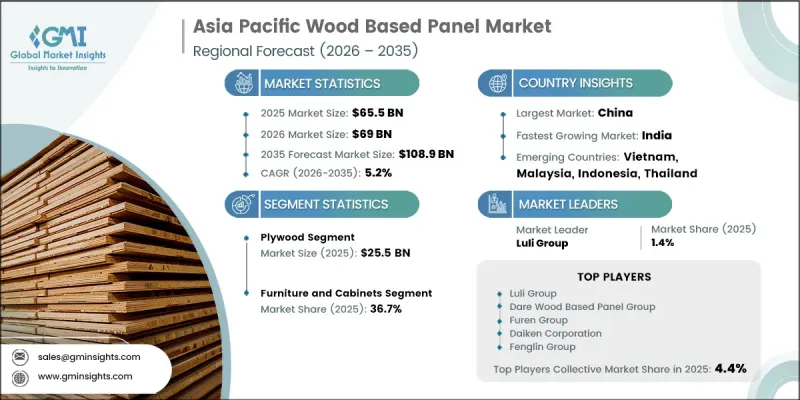
Asia Pacific Wood Based Panel Market was valued at USD 65.5 billion in 2025 and is estimated to grow at a CAGR of 5.2% to reach USD 108.9 billion by 2035.
Growth across the Asia Pacific Wood Based Panel Market continues to be supported by expanding construction activity, rising residential development, increasing urbanization, and the growing presence of large-scale furniture manufacturing operations throughout the region. Demand for plywood, medium-density fiberboard (MDF), and particleboard remains strong as governments and private sector stakeholders invest in housing, commercial buildings, and industrial infrastructure. The market is also benefiting from the increasing adoption of advanced resin technologies that improve product performance while helping manufacturers comply with tightening environmental standards. Growing emphasis on low-emission and sustainable wood panel solutions is encouraging producers to invest in next-generation binder systems that reduce formaldehyde content and enhance export competitiveness. These products provide manufacturers with greater flexibility in meeting international regulatory requirements while also supporting premium pricing opportunities. As production capabilities continue to expand and end-use industries increase consumption of engineered wood products, the Asia Pacific Wood Based Panel Market is expected to maintain steady growth momentum throughout the forecast period, supported by both domestic demand and export-oriented manufacturing activities across key regional economies.
| Market Scope | |
|---|---|
| Start Year | 2025 |
| Forecast Year | 2026-2035 |
| Start Value | $65.5 Billion |
| Forecast Value | $108.9 Billion |
| CAGR | 5.2% |
The plywood segment held a 38.9% share in 2025, generating USD 25.5 billion. The segment maintains its dominant position due to widespread usage across construction, infrastructure development, interior applications, and furniture manufacturing. Asia Pacific continues to represent the leading plywood-producing region globally, supported by extensive manufacturing capacity and a broad network of producers serving both domestic and international markets. Consistent demand from residential development projects, commercial construction activities, and industrial expansion continues to support plywood consumption across the region. In addition, increasing utilization of engineered wood products in value-added applications is reinforcing the segment's long-term growth prospects and market leadership.
The furniture and cabinets segment held a 36.7% share in 2025. The segment benefits from the region's strong position in global furniture production and exports, which continues to create substantial demand for wood-based panel products. Consumption of plywood, MDF, and particleboard remains closely linked to furniture manufacturing, cabinetry production, and interior furnishing applications. The long-established relationship between the furniture sector and engineered wood products has created a durable demand foundation that continues to support market expansion. Growing consumer spending on home furnishings, rising urban housing development, and increasing production capacity among furniture manufacturers are expected to sustain segment growth over the forecast period.
China Wood Based Panel Market held 59% share in 2025 and is projected to grow at 56.4% share by 2035. This gradual shift reflects the evolving geographic distribution of industry growth across the Asia Pacific region and marks a significant rebalancing of market revenues over the coming decade. Manufacturing activity remains highly concentrated within major production hubs where numerous plywood, MDF, and particleboard producers operate in a competitive environment. Intense competition among manufacturers continues to place pressure on average selling prices despite improvements in overall market demand and consumption trends. Nevertheless, the country remains the largest producer and consumer within the regional market, supported by extensive manufacturing infrastructure and strong end-user demand across the construction and furniture sectors.
Major companies operating in the Asia Pacific Wood Based Panel Market include Luli Group China, Dare Wood-Based Panel Group China, Furen Group China, Daiken Corporation Japan (TSE: 7905), Fenglin Group, Century Plyboards (India) Limited, Greenply Industries Limited, and Greenpanel Industries Limited. Companies participating in the Asia Pacific Wood Based Panel Market are focusing on capacity expansion, product innovation, and sustainability initiatives to strengthen their competitive position. Manufacturers are increasingly investing in advanced production technologies, automation systems, and environmentally compliant resin formulations to improve operational efficiency and meet evolving regulatory requirements. Many industry participants are expanding their portfolios with higher-value engineered wood products that offer enhanced durability, performance, and low-emission characteristics. Strategic investments in distribution networks, export capabilities, and regional manufacturing facilities are helping companies broaden market reach and improve customer access.
Table of Contents
Chapter 1 Methodology & Scope
- 1.1 Research approach
- 1.2 Quality Commitments
- 1.2.1 GMI AI policy & data integrity commitment
- 1.2.1.1 Source consistency protocol
- 1.2.1 GMI AI policy & data integrity commitment
- 1.3 Research Trail & Confidence Scoring
- 1.3.1 Research Trail Components
- 1.3.2 Scoring Components
- 1.4 Data Collection
- 1.4.1 Partial list of primary sources
- 1.5 Data mining sources
- 1.5.1 Paid sources
- 1.5.1.1 Sources, by region
- 1.5.1 Paid sources
- 1.6 Base estimates and calculations
- 1.6.1 Base year calculation for any one approach
- 1.7 Forecast model
- 1.7.1 Quantified market impact analysis
- 1.7.1.1 Mathematical impact of growth parameters on forecast
- 1.7.1 Quantified market impact analysis
- 1.8 Research transparency addendum
- 1.8.1 Source attribution framework
- 1.8.2 Quality assurance metrics
- 1.8.2.1 Our commitment to trust
Chapter 2 Executive Summary
- 2.1 Industry 360° synopsis, 2022 - 2035
- 2.2 Key market trends
- 2.2.1 Country
- 2.2.2 Product Type
- 2.2.3 Resin Type
- 2.2.4 Surface Treatment
- 2.2.5 Application
Chapter 3 Industry Insights
- 3.1 Industry ecosystem analysis
- 3.1.1 Supplier landscape
- 3.1.2 Profit margin
- 3.1.3 Value addition at each stage
- 3.1.4 Factor affecting the value chain
- 3.2 Industry impact forces
- 3.2.1 Growth drivers
- 3.2.1.1 China construction stimulus and infrastructure investment
- 3.2.1.2 India PM Awas Yojana and housing sector acceleration
- 3.2.1.3 SE Asia furniture manufacturing capacity expansion
- 3.2.2 Industry pitfalls & challenges
- 3.2.2.1 China property sector stress and construction demand volatility
- 3.2.2.2 Market fragmentation and pricing pressure from SME producers
- 3.2.3 Opportunities
- 3.2.3.1 Untapped rural & tier 2/3 city markets
- 3.2.3.2 Demand for sustainable and engineered wood panels
- 3.2.1 Growth drivers
- 3.3 Growth potential analysis
- 3.4 Regulatory framework
- 3.4.1 Standards & Compliance Requirements
- 3.4.1.1 Country-Level Regulatory Overview
- 3.4.1.2 Formaldehyde and VOC emission standard.
- 3.4.1.3 Key emission regulation
- 3.4.1 Standards & Compliance Requirements
- 3.5 Major market trends and disruptions
- 3.6 Technology/innovation landscape
- 3.6.1 Current trends
- 3.6.2 Emerging trends
- 3.7 Pricing Analysis (driven by primary research)
- 3.7.1 Historical price trend analysis (driven by primary research)
- 3.7.2 Pricing strategy by player type (premium / value / cost-plus) (driven by primary research)
- 3.8 Future market trends
- 3.9 Trade data analysis (driven by paid database) (HS Code-4412)
- 3.9.1 Import/export volume & value trends (driven by primary research)
- 3.9.2 Key trade corridors & tariff impact (driven by primary research)
- 3.10 Impact of AI & Generative AI on the Market
- 3.10.1 AI-driven disruption of existing business models
- 3.10.2 Gen-AI use cases & adoption roadmap by segment
- 3.10.3 Risks, limitations & regulatory considerations
- 3.11 Porter's analysis
- 3.12 PESTEL analysis
- 3.13 Capacity and production landscape (driven by primary research)
- 3.13.1 Installed production capacity by country and key producer
- 3.13.2 Capacity utilization rates and expansion pipelines
Chapter 4 Competitive Landscape, 2025
- 4.1 Introduction
- 4.2 Company market share analysis
- 4.2.1 By Country
- 4.2.1.1 China
- 4.2.1.2 India
- 4.2.1.3 Japan
- 4.2.1.4 South Korea
- 4.2.1.5 Australia
- 4.2.1.6 Rest of Asia Pacific
- 4.2.1 By Country
- 4.3 Company matrix analysis
- 4.4 Competitive analysis of major market players
- 4.5 Competitive positioning matrix
- 4.6 Key developments
- 4.6.1 Mergers & acquisitions
- 4.6.2 Partnerships & collaborations
- 4.6.3 New product launches
- 4.6.4 Expansion plans
Chapter 5 Market Estimates and Forecast, By Product Type, 2022 - 2035 (USD Billion) (Thousand Cubic Meters)
- 5.1 Key trends
- 5.2 Medium density fiberboard (MDF)
- 5.3 Particleboard
- 5.4 Oriented Strand Board (OSB)
- 5.5 Softboard
- 5.6 Plywood
- 5.7 Hardboard
- 5.8 Others (High density fiberboard, Laminated Veneer Lumber)
Chapter 6 Market Estimates & Forecast, By Resin Type, 2022-2035 (USD Billion) (Thousand Cubic Meters)
- 6.1 Key trends
- 6.2 Urea Formaldehyde (UF)
- 6.3 Melamine Formaldehyde (MF)
- 6.4 Phenol Formaldehyde (PF)
- 6.5 Methylene Diphenyl Diisocyanate (MDI)
- 6.6 Others
Chapter 7 Market Estimates & Forecast, By Surface Treatment 2022-2035 (USD Billion) (Thousand Cubic Meters)
- 7.1 Key trends
- 7.2 Raw / Untreated
- 7.3 Laminated (LPL / HPL)
- 7.4 Veneered
- 7.5 Coated / Painted / Digitally Printed
- 7.6 Others
Chapter 8 Market Estimates & Forecast, By Application, 2022-2035 (USD Billion) (Thousand Cubic Meters)
- 8.1 Key trends
- 8.2 Furniture
- 8.3 Flooring
- 8.4 Construction
- 8.5 Packaging
- 8.5.1 Others (automotive, industrial equipment, etc.)
Chapter 9 Market Estimates & Forecast, By Country, 2022 - 2035, (USD Billion) (Thousand Units)
- 9.1 Key trends
- 9.2 China
- 9.3 India
- 9.4 Japan
- 9.5 South Korea
- 9.6 Australia
- 9.7 Rest of Asia Pacific
Chapter 10 Company Profiles
- 10.1 Global Companies
- 10.1.1 Arauco (CMPC)
- 10.1.1.1 Business Overview
- 10.1.1.2 Financial Data
- 10.1.1.3 Product Landscape
- 10.1.1.4 Strategic Outlook
- 10.1.1.5 SWOT Analysis
- 10.1.2 Daiken Corporation
- 10.1.3 Dare Wood-Based Panel Group
- 10.1.4 Egger Group
- 10.1.5 Kastamonu Entegre
- 10.1.6 Kronospan
- 10.1.7 Sumitomo Forestry
- 10.1.1 Arauco (CMPC)
- 10.2 Regional Champions
- 10.2.1 Action Tesa
- 10.2.2 Carter Holt Harvey
- 10.2.3 Century Plyboards
- 10.2.4 Dongwha Enterprise
- 10.2.5 Fenglin Group
- 10.2.6 Furen Group
- 10.2.7 Greenpanel Industries
- 10.2.8 Greenply Industries
- 10.2.9 Jilin Forest Industry
- 10.2.10 Laminex Group
- 10.2.11 Luli Group
- 10.2.12 Ningfeng Wood Industry
- 10.3 Emerging Companies
- 10.3.1 Archidply Industries
- 10.3.2 Dongwha Vietnam

