PUBLISHER: Global Market Insights Inc. | PRODUCT CODE: 2071268

PUBLISHER: Global Market Insights Inc. | PRODUCT CODE: 2071268
North America Smart Backpack Market Opportunity, Growth Drivers, Industry Trend Analysis, and Forecast 2026 - 2035
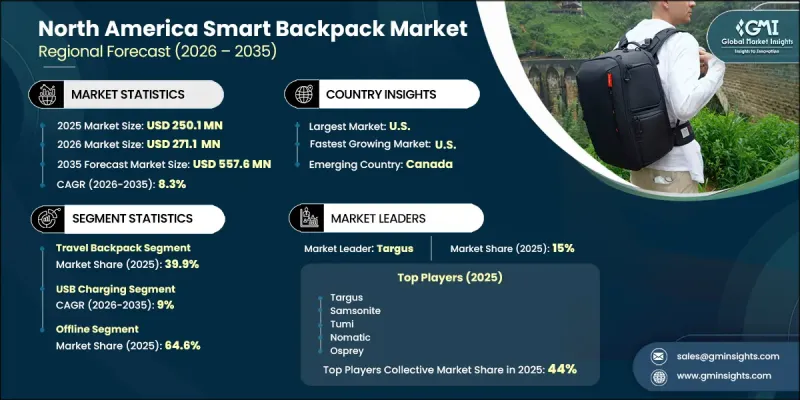
North America Smart Backpack Market was valued at USD 250.1 million in 2025 and is estimated to grow at a CAGR of 8.3% to reach USD 557.6 million by 2035.
Market growth is driven by strong structural demand factors, including widespread dependence on mobile devices, the normalization of hybrid work models, and continued expansion in the premium travel segment across the United States and Canada. The market structure is notably diversified, with no single product category accounting for more than 40% of total demand, which reduces volatility and supports steady long-term growth. A major transformation is underway as traditional backpacks evolve into connected, technology-enabled carry solutions featuring integrated charging systems, biometric security functions, IoT connectivity, and emerging energy-harvesting capabilities. The increasing penetration of smartphones, tablets, and wearable devices is reinforcing demand for portable power-enabled storage solutions. At the same time, evolving work patterns have redefined commuter and professional mobility needs, requiring backpacks that can safely carry multiple electronic devices while supporting seamless transitions across offices, co-working environments, travel hubs, and remote work settings. This combination of digital dependency, mobility requirements, and lifestyle transformation continues to strengthen the long-term outlook for the North America smart backpack industry.
| Market Scope | |
|---|---|
| Start Year | 2025 |
| Forecast Year | 2026-2035 |
| Start Value | $250.1 Million |
| Forecast Value | $557.6 Million |
| CAGR | 8.3% |
The travel backpacks segment accounted for 39.9% share and is projected to grow at a CAGR of 9.1% through 2035. This segment's leadership is supported by strong alignment with modern travel behavior, where consumers increasingly prioritize multifunctional, tech-integrated carry solutions. Demand is driven by the need for enhanced security, organized storage, device protection, and reliable charging capabilities in transit-oriented environments. The segment continues to benefit from the growing preference for versatile backpacks designed to support both professional and leisure travel needs.
The USB charging integration segment held a 42.3% share in 2025 and expanding at a CAGR of 9% through 2035. Growth in this segment is driven by near-universal adoption of mobile devices and increasing reliance on continuous device connectivity. Consumers increasingly expect built-in charging functionality that supports uninterrupted usage of smartphones, tablets, and other portable electronics. Rising adoption of standardized fast-charging technologies is further strengthening demand for integrated power solutions in smart backpacks across the region.
North America Smart Backpack Market is expected to grow at a CAGR of 8.4% through 2035. The regional growth pattern is supported by strong e-commerce penetration, a large professional workforce, and well-established retail distribution networks. High urban population density and strong commuter culture further reinforce demand for technology-enabled backpacks. While both countries share similar structural drivers, including hybrid work adoption and increased travel activity, differences in distribution ecosystems and market maturity levels contribute to slight variations in growth performance across the region.
Key companies operating in the North America smart backpack market include Nomatic, Peak Design, Targus, Samsonite, Timbuk2, Osprey, Pacsafe, Tumi, Herschel Supply Co., Incase, Aer, Bagsmart, Korin Design, Mancro, Mark Ryden Canada, Matein, Nordace, PKG Carry Goods, Tom Bihn, Tortuga Backpacks, and Voltaic Systems. Companies operating in the North America smart backpack market are focusing on innovation-driven product development, digital integration, and lifestyle-oriented design strategies to strengthen their market presence. Leading players are incorporating advanced features such as USB charging systems, anti-theft technologies, GPS tracking, and modular storage designs to enhance product functionality. Many brands are investing in lightweight, durable materials that improve comfort and long-term usability. Strategic expansion through e-commerce platforms and direct-to-consumer channels is enabling stronger brand visibility and customer engagement. Firms are also leveraging influencer marketing and digital campaigns to target tech-savvy and travel-focused consumers.
Table of Contents
Chapter 1 Research Methodology
- 1.1 Research approach
- 1.2 Quality Commitments
- 1.2.1 GMI AI policy & data integrity commitment
- 1.2.1.1 Source consistency protocol
- 1.2.1 GMI AI policy & data integrity commitment
- 1.3 Research Trail & Confidence Scoring
- 1.3.1 Research Trail Components
- 1.3.2 Scoring Components
- 1.4 Data Collection
- 1.4.1 Partial list of primary sources
- 1.5 Data mining sources
- 1.5.1 Paid sources
- 1.5.1.1 Sources, by region
- 1.5.1 Paid sources
- 1.6 Base estimates and calculations
- 1.6.1 Base year calculation for any one approach
- 1.7 Forecast model
- 1.7.1 Quantified market impact analysis
- 1.7.1.1 Mathematical impact of growth parameters on forecast
- 1.7.1 Quantified market impact analysis
- 1.8 Research transparency addendum
- 1.8.1 Source attribution framework
- 1.8.2 Quality assurance metrics
- 1.8.3 Our commitment to trust
Chapter 2 Executive Summary
- 2.1 Industry 360° synopsis, 2022 - 2035
- 2.2 Key market trends
- 2.2.1 Type
- 2.2.2 Technology
- 2.2.3 Capacity
- 2.2.4 Shell Type
- 2.2.5 Material
- 2.2.6 Price
- 2.2.7 Product
- 2.2.8 Distribution Channel
Chapter 3 Industry Insights
- 3.1 Industry ecosystem analysis
- 3.1.1 Factor affecting the value chain
- 3.1.2 Profit margin analysis
- 3.1.3 Disruptions
- 3.1.4 Future outlook
- 3.1.5 Manufacturers
- 3.1.6 Distributors
- 3.2 Supplier landscape
- 3.3 Key news & initiatives
- 3.4 Technology & Innovation Landscape
- 3.5 Regulatory landscape
- 3.6 Impact on forces
- 3.6.1 Growth drivers
- 3.6.2 Industry pitfalls & challenges
- 3.6.3 Opportunities
- 3.7 Pricing analysis, 2025 (driven by primary research)
- 3.7.1 Historical price trend analysis (2022-2025)
- 3.7.2 Pricing strategy by player type (premium/value/cost-plus)
- 3.7.3 Regional price variation analysis
- 3.8 Growth potential analysis
- 3.9 Porter's analysis
- 3.10 PESTEL analysis
- 3.11 Trade data analysis (driven by paid database)
- 3.11.1 Import/export volume & value trends (Driven by Primary Research)
- 3.11.2 Key trade corridors & tariff impact (Driven by Primary Research)
- 3.12 Impact of AI & generative AI on the market
- 3.12.1 AI-driven disruption of existing business models
- 3.12.2 GenAI use cases & adoption roadmap by segment
- 3.12.3 Risks, limitations & regulatory considerations
- 3.13 Capacity & Production Landscape (Driven by Primary Research)
- 3.13.1 Installed Capacity by Region & Key Producer (Driven by Primary Research)
- 3.13.2 Capacity Utilization Rates & Expansion Pipelines (Driven by Primary Research)
Chapter 4 Competitive Landscape, 2025
- 4.1 Introduction
- 4.2 Company market share analysis
- 4.3 Competitive positioning matrix
- 4.4 Strategic outlook matrix
- 4.5 Competitive analysis of major market players
- 4.6 Key developments
- 4.6.1 Mergers & acquisitions
- 4.6.2 Partnerships & collaborations
- 4.6.3 New product launches
- 4.6.4 Expansion plans
Chapter 5 Market Estimates & Forecast, By Type, 2022-2035 (USD Million) (Million Units)
- 5.1 Key trends
- 5.2 Travel backpack
- 5.3 Casual backpack
- 5.4 Laptop backpack
- 5.5 Others
Chapter 6 Market Estimates & Forecast, By Technology, 2022-2035 (USD Million) (Million Units)
- 6.1 Key trends
- 6.2 USB charging
- 6.3 Solar-powered
- 6.4 IoT-enabled
- 6.5 Smart locking systems
- 6.6 Sensors
- 6.7 Others
Chapter 7 Market Estimates & Forecast, By Capacity, 2022-2035 (USD Million) (Million Units)
- 7.1 Key trends
- 7.2 Below 30 Liters
- 7.3 30-40 Liters
- 7.4 Above 40 Liters
Chapter 8 Market Estimates & Forecast, By Material, 2022-2035 (USD Million) (Million Units)
- 8.1 Key trends
- 8.2 Polyester
- 8.3 Nylon
- 8.4 Leather
- 8.5 Others
Chapter 9 Market Estimates & Forecast, By Shell Type, 2022-2035 (USD Million) (Million Units)
- 9.1 Key trends
- 9.2 Hard shell
- 9.3 Soft shell
Chapter 10 Market Estimates & Forecast, By Price, 2022-2035 (USD Million) (Million Units)
- 10.1 Key trends
- 10.2 Low
- 10.3 Medium
- 10.4 High
Chapter 11 Market Estimates & Forecast, By Distribution Channel, 2022-2035 (USD Billion) (Million Units)
- 11.1 Key trends
- 11.2 Online
- 11.2.1 E-commerce site
- 11.2.2 Company website
- 11.3 Offline
- 11.3.1 Specialty stores
- 11.3.2 Supermarkets/Hypermarkets
- 11.3.3 Others
Chapter 12 & Forecast, By Country, 2022 - 2035, (USD Million) (Million Units)
- 12.1 Key trends
- 12.2 U.S.
- 12.3 Canada
Chapter 13 Company Profiles (Business Overview, Financial Data, Product Landscape, Strategic Outlook, SWOT Analysis)
- 13.1 Global players
- 13.1.1 Targus
- 13.1.2 Tumi
- 13.1.3 Samsonite
- 13.1.4 Tom Bihn
- 13.1.5 Nomatic
- 13.1.6 Osprey
- 13.1.7 Herschel Supply Co.
- 13.2 Regional players
- 13.2.1 Timbuk2
- 13.2.2 Peak Design
- 13.2.3 Aer
- 13.2.4 Tortuga Backpacks
- 13.2.5 Incase
- 13.2.6 Pacsafe
- 13.2.7 Voltaic Systems
- 13.3 Emerging players
- 13.3.1 Nordace
- 13.3.2 Matein
- 13.3.3 Korin Design
- 13.3.4 Mancro
- 13.3.5 PKG Carry Goods
- 13.3.6 Mark Ryden Canada
- 13.3.7 Bagsmart

