PUBLISHER: Global Market Insights Inc. | PRODUCT CODE: 2071283

PUBLISHER: Global Market Insights Inc. | PRODUCT CODE: 2071283
Watch Market Opportunity, Growth Drivers, Industry Trend Analysis, and Forecast 2026 - 2035
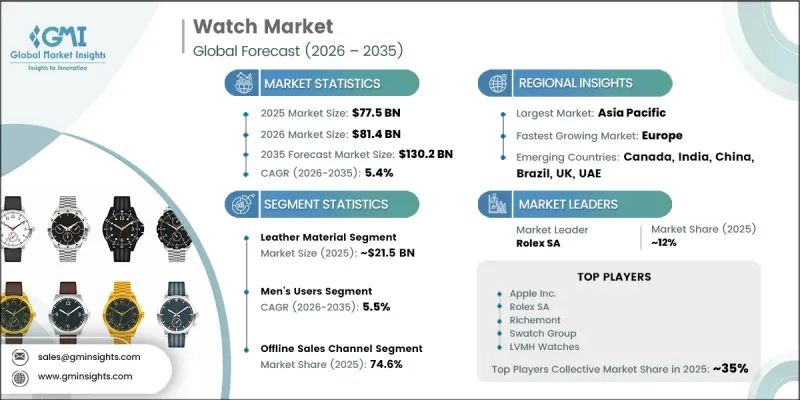
The Global Watch Market was valued at USD 77.5 billion in 2025 and is estimated to grow at a CAGR of 5.4% to reach USD 130.2 billion by 2035.
Growth is strongly influenced by increasing consumer demand for multifunctional wearable devices that combine communication, fitness tracking, and lifestyle management in a single product. Watches are increasingly positioned as connected digital tools rather than simple timekeeping accessories. Raising health consciousness is also playing a major role, with consumers prioritizing devices that support wellness monitoring, including heart rate tracking, sleep insights, stress measurement, and activity tracking. Continuous innovation in sensor technologies, battery optimization, artificial intelligence integration, and material engineering is further enhancing product capabilities and user experience. The market is also witnessing the rise of hybrid designs that combine traditional analog aesthetics with smart functionalities, broadening appeal across both fashion-conscious and tech-oriented consumers. Improvements in durability, display technologies, water resistance, and lightweight construction are further strengthening adoption across diverse consumer groups and use cases.
| Market Scope | |
|---|---|
| Start Year | 2025 |
| Forecast Year | 2026-2035 |
| Start Value | $77.5 Billion |
| Forecast Value | $130.2 Billion |
| CAGR | 5.4% |
The leather material segment generated USD 21.5 billion in 2025 and is projected to grow at a CAGR of 5.4% through 2035. Leather straps continue to be widely preferred due to their association with elegance, durability, and premium craftsmanship. Demand is particularly strong in luxury and mid-tier watch categories, where consumers view watches as both functional accessories and fashion statements. Rising urbanization and increasing disposable income are further reinforcing demand for aesthetically refined and customizable strap options.
The offline distribution channel accounted for 74.6% share in 2025 and is expected to grow at a CAGR of 5.2% during 2026-2035. Consumers continue to favor physical retail channels such as brand stores, specialty outlets, and department stores due to the high-value nature of watch purchases. In-store experiences allow customers to assess design quality, material finish, fit, and authenticity before purchase, while also benefiting from expert consultation and after-sales support. Strong brand visibility through physical retail locations further strengthens consumer trust and purchase confidence.
United States Watch Market captured USD 5.9 billion in 2025 and is projected to grow at a CAGR of 4.1% through 2035. Market growth is supported by a large base of digitally engaged consumers who are increasingly adopting smartwatches for health tracking, fitness monitoring, and seamless connectivity with mobile devices. The presence of established global brands along with a mature retail ecosystem spanning premium boutiques and online platforms continues to enhance product accessibility and market penetration.
Key companies operating in the global watch market include Apple Inc., Rolex SA, Richemont, The Swatch Group, LVMH Watches, Seiko Holdings Corporation, Citizen Watch Co., Ltd., Casio Computer Co., Ltd., Orient Watch Co., Ltd., Timex Group, Titan Company Limited, Fossil Group, Inc., Movado Group, Inc., Daniel Wellington, Garmin Ltd., MVMT Watches, Amazfit (Zepp Health), Noise, boAt, Withings, and Skagen. Market participants are strengthening their competitive positioning through continuous innovation in smartwatch functionality and hybrid watch designs that merge traditional aesthetics with digital features. Companies are investing in advanced health monitoring technologies, improved battery performance, and enhanced sensor integration to expand product utility. Strategic branding initiatives and celebrity endorsements are being widely used to enhance consumer appeal and brand differentiation. Firms are also expanding direct-to-consumer channels and strengthening omnichannel retail strategies to improve accessibility and customer engagement.
Table of Contents
Chapter 1 Methodology & Scope
- 1.1 Market scope and definition
- 1.2 Research design
- 1.2.1 Research approach
- 1.2.2 Data collection methods
- 1.3 Data mining sources
- 1.3.1 Global
- 1.3.2 Regional/Country
- 1.4 Base estimates and calculations
- 1.4.1 Base year calculation
- 1.4.2 Key trends for market estimation
- 1.5 Primary research and validation
- 1.5.1 Primary sources
- 1.6 Forecast model
- 1.7 Research assumptions and limitations
Chapter 2 Executive Summary
- 2.1 Industry 360° synopsis
- 2.2 Key market trends
- 2.2.1 Regional
- 2.2.2 Type
- 2.2.3 Strap material
- 2.2.4 Price range
- 2.2.5 End user
- 2.2.6 Distribution channel
Chapter 3 Industry Insights
- 3.1 Industry ecosystem analysis
- 3.1.1 Supplier landscape
- 3.1.2 Profit margin
- 3.1.3 Value addition at each stage
- 3.1.4 Factor affecting the value chain
- 3.2 Industry impact forces
- 3.2.1 Growth drivers
- 3.2.1.1 Rising demand for smartwatches & wearable technology
- 3.2.1.2 Growth in health & fitness awareness
- 3.2.1.3 Technological advancements
- 3.2.2 Industry pitfalls & challenges
- 3.2.2.1 Intense competition from smartphones
- 3.2.2.2 Counterfeit and grey market products
- 3.2.3 Opportunities
- 3.2.3.1 Health & wellness integration
- 3.2.3.2 Increasing demand for specialized watches
- 3.2.1 Growth drivers
- 3.3 Growth potential analysis
- 3.4 Future market trends
- 3.5 Technology and innovation landscape
- 3.5.1 Current technological trends
- 3.5.2 Emerging technologies
- 3.6 Regulatory landscape
- 3.6.1 Standards and compliance requirements
- 3.6.2 Regional regulatory frameworks
- 3.6.3 Certification standards
- 3.7 Trade data analysis (HS Code 9102)
- 3.7.1 Import/export volume & value trends
- 3.7.2 Key trade corridors & tariff impact
- 3.8 Pricing analysis
- 3.8.1 Historical price trend analysis (driven by primary research)
- 3.8.2 Pricing strategy by player type (premium / value / mass market)
- 3.9 Impact of AI & generative AI on the market
- 3.9.1 AI-driven disruption of existing business models
- 3.9.2 GenAI use cases & adoption roadmap by segment
- 3.9.3 Risks, limitations & regulatory considerations
- 3.10 Porter's analysis
- 3.11 PESTEL analysis
- 3.12 Consumer buying behavior analysis
- 3.12.1 Demographic trends
- 3.12.2 Factors affecting buying decisions
- 3.12.3 Consumer product adoption
- 3.12.4 Preferred distribution channel
Chapter 4 Competitive Landscape, 2025
- 4.1 Introduction
- 4.2 Company market share analysis
- 4.2.1 By Region
- 4.2.1.1 North America
- 4.2.1.2 Europe
- 4.2.1.3 Asia Pacific
- 4.2.1.4 Latin America
- 4.2.1.5 Middle East & Africa
- 4.2.1 By Region
- 4.3 Company matrix analysis
- 4.4 Competitive analysis of major market players
- 4.5 Competitive positioning matrix
- 4.6 Key developments
- 4.6.1 Mergers & acquisitions
- 4.6.2 Partnerships & collaborations
- 4.6.3 New product launches
- 4.6.4 Expansion plans
Chapter 5 Market Estimates & Forecast, By Type, 2022 - 2035, (USD Billion) (Million Units)
- 5.1 Key trends
- 5.2 Quartz wrist watches
- 5.3 Mechanical
- 5.4 Digital
- 5.4.1 Smart
- 5.4.2 Hybrid
- 5.4.3 Others
Chapter 6 Market Estimates & Forecast, By Strap Material, 2022 - 2035, (USD Billion) (Million Units)
- 6.1 Key trends
- 6.2 Plastic
- 6.3 Silicone
- 6.4 Leather
- 6.5 Stainless Steel
- 6.6 Others
Chapter 7 Market Estimates & Forecast, By Price range, 2022 - 2035, (USD Billion) (Million Units)
- 7.1 Key trends
- 7.2 Low range
- 7.3 Mid-range
- 7.4 Luxury
Chapter 8 Market Estimates & Forecast, By End User, 2022 - 2035, (USD Billion) (Million Units)
- 8.1 Key trends
- 8.2 Men
- 8.3 Women
- 8.4 Kids
Chapter 9 Market Estimates & Forecast, By Distribution Channel, 2022 - 2035, (USD Billion) (Million Units)
- 9.1 Key trends
- 9.2 Online
- 9.2.1 E-commerce Websites
- 9.2.2 Company-owned Websites
- 9.3 Offline
- 9.3.1 Mega Retail Stores
- 9.3.2 Specialty Stores
- 9.3.3 Others (Independent Stores, etc.)
Chapter 10 Market Estimates & Forecast, By Region, 2022 - 2035, (USD Billion) (Million Units)
- 10.1 Key trends
- 10.2 North America
- 10.2.1 U.S.
- 10.2.2 Canada
- 10.3 Europe
- 10.3.1 Germany
- 10.3.2 UK
- 10.3.3 France
- 10.3.4 Italy
- 10.3.5 Spain
- 10.4 Asia Pacific
- 10.4.1 China
- 10.4.2 India
- 10.4.3 Japan
- 10.4.4 South Korea
- 10.4.5 Australia
- 10.4.6 Indonesia
- 10.4.7 Malaysia
- 10.5 Latin America
- 10.5.1 Brazil
- 10.5.2 Mexico
- 10.5.3 Argentina
- 10.6 MEA
- 10.6.1 Saudi Arabia
- 10.6.2 UAE
- 10.6.3 South Africa
Chapter 11 Company Profiles
- 11.1 Top Global Players
- 11.1.1 Apple Inc.
- 11.1.2 Rolex SA
- 11.1.3 Richemont
- 11.1.4 The Swatch Group
- 11.1.5 LVMH Watches
- 11.1.6 Seiko Holdings Corporation
- 11.1.7 Citizen Watch Co., Ltd.
- 11.2 Regional Champions
- 11.2.1 Titan Company Limited
- 11.2.2 Timex Group
- 11.2.3 Movado Group, Inc.
- 11.2.4 Casio Computer Co., Ltd.
- 11.2.5 Orient Watch Co., Ltd.
- 11.2.6 Daniel Wellington
- 11.2.7 Fossil Group, Inc.
- 11.3 Emerging Players
- 11.3.1 Amazfit (Zepp Health)
- 11.3.2 Noise
- 11.3.3 boAt
- 11.3.4 Withings
- 11.3.5 MVMT Watches
- 11.3.6 Skagen
- 11.3.7 Garmin Ltd.

