PUBLISHER: Global Market Insights Inc. | PRODUCT CODE: 2071284

PUBLISHER: Global Market Insights Inc. | PRODUCT CODE: 2071284
Agriculture Fertilizer Spreader Market Opportunity, Growth Drivers, Industry Trend Analysis, and Forecast 2026 - 2035
The Global Agriculture Fertilizer Spreader Market was valued at USD 850.3 million in 2025 and is estimated to grow at a CAGR of 4.8% to reach USD 1,364.8 million by 2035.
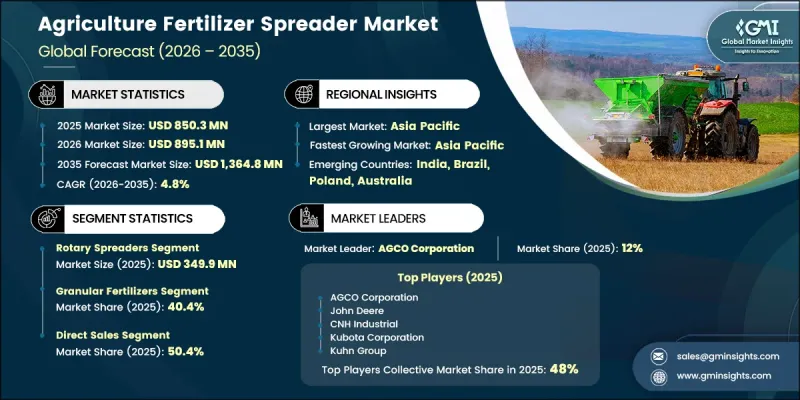
Market expansion is driven by the growing need to increase agricultural productivity as global food demand continues to rise. Population growth is placing significant pressure on agricultural systems to generate higher crop yields while utilizing increasingly limited farming resources. At the same time, the availability of arable land is declining due to urban development and environmental challenges, creating a greater need for efficient farming practices. Fertilizer spreaders play a critical role in optimizing nutrient application, minimizing input losses, and improving overall crop performance. These systems enable farmers to maximize productivity while supporting more sustainable agricultural operations. The increasing emphasis on efficient resource utilization and environmental stewardship is encouraging the adoption of advanced fertilizer application equipment. As the agricultural sector continues to focus on improving output from available farmland, demand for modern fertilizer spreaders is expected to increase steadily. The growing importance of precision farming, enhanced nutrient management, and sustainable food production practices will continue to support long-term growth across the global agriculture fertilizer spreader market.
| Market Scope | |
|---|---|
| Start Year | 2025 |
| Forecast Year | 2026-2035 |
| Start Value | $850.3 Million |
| Forecast Value | $1,364.8 Million |
| CAGR | 4.8% |
The agriculture fertilizer spreader market is benefiting from ongoing challenges associated with shrinking agricultural land availability and declining soil quality. Expanding urban infrastructure, industrial development, and environmental degradation are reducing the amount of productive farmland available for cultivation, increasing the need to maximize output from existing agricultural areas. Soil nutrient depletion and changing climatic conditions have further intensified the need for efficient crop management practices. Fertilizer spreaders are becoming increasingly important as they help improve nutrient distribution accuracy, reduce application inefficiencies, and support higher crop productivity. The growing focus on global food security is encouraging farmers to adopt advanced equipment equipped with precision application capabilities and data-driven operational features. These technological advancements are helping improve farming efficiency while supporting sustainable agricultural practices and long-term productivity goals.
Rotary spreaders generated USD 349.9 million in 2025, making them the largest product segment within the agriculture fertilizer spreader market. This category includes equipment designed to distribute fertilizers across agricultural land through broad and efficient application patterns. Rotary spreaders are widely recognized for their ability to deliver consistent coverage while accommodating different fertilizer materials and varying field conditions. Their operational flexibility and suitability for diverse farming environments have made them a preferred choice among agricultural producers. The ability to support efficient fertilizer application across a broad range of farm sizes continues to strengthen demand for rotary spreaders and reinforces their leadership position within the market.
The granular fertilizers segment accounted for 40.4% share in 2025, representing the leading application category. Granular fertilizer application remains one of the most widely utilized methods for nutrient management due to its effectiveness, operational efficiency, and compatibility with mechanized spreading equipment. Agricultural producers continue to invest in spreaders designed for granular fertilizer distribution because they enable rapid coverage and consistent nutrient placement across extensive cultivation areas. The need to improve application efficiency and optimize nutrient delivery remains a major factor driving adoption. Large-scale farming operations increasingly rely on mechanized fertilizer spreading solutions to support productivity objectives and manage significant fertilizer volumes efficiently, creating strong growth opportunities for this segment.
United States Agriculture Fertilizer Spreader Market held a 78.6% share, generating USD 182.3 million in 2025. Market growth in the country is supported by extensive agricultural activity, large-scale farming operations, and increasing adoption of precision agriculture technologies. Agricultural producers are continuing to invest in advanced fertilizer application equipment to improve operational efficiency and enhance crop performance. Strong demand for mechanized farming solutions, combined with ongoing modernization of agricultural practices, is supporting broader adoption of fertilizer spreaders. In addition, the presence of well-developed equipment distribution networks and service infrastructure is making advanced agricultural technologies more accessible to end users, further contributing to market expansion.
Key companies operating in the Global Agriculture Fertilizer Spreader Market include John Deere, AGCO Corporation, Kubota Corporation, CNH Industrial, Mahindra & Mahindra, Kuhn Group, Kverneland Group, Maschio Gaspardo, Rauch Landmaschinenfabrik, Sulky Burel, Bogballe A/S, Bredal Industries, Salford Group, Kasco Manufacturing, Dalton Ag Products, Abbey Machinery, Teagle Machinery, AMAZONE H. Dreyer GmbH & Co. KG, Vicon, and IRIS Spreaders Co. Companies operating in the agriculture fertilizer spreader market are focusing on innovation, product development, and precision agriculture integration to strengthen their competitive position. Manufacturers are investing in advanced technologies that improve application accuracy, operational efficiency, and resource optimization. The incorporation of digital farming tools, automated controls, and data-driven management systems is helping companies address evolving agricultural requirements. Strategic partnerships with agricultural technology providers and equipment distributors are further expanding market reach and enhancing customer engagement. Businesses are also emphasizing product durability, equipment versatility, and sustainability-focused solutions to meet growing demand for environmentally responsible farming practices.
Table of Contents
Chapter 1 Research Methodology
- 1.1 Research approach
- 1.2 Quality Commitments
- 1.2.1 GMI AI policy & data integrity commitment
- 1.2.1.1 Source consistency protocol
- 1.2.1 GMI AI policy & data integrity commitment
- 1.3 Research Trail & Confidence Scoring
- 1.3.1 Research Trail Components
- 1.3.2 Scoring Components
- 1.4 Data Collection
- 1.4.1 Partial list of primary sources
- 1.5 Data mining sources
- 1.5.1 Paid sources
- 1.5.1.1 Sources, by region
- 1.5.1 Paid sources
- 1.6 Base estimates and calculations
- 1.6.1 Base year calculation for any one approach
- 1.7 Forecast model
- 1.7.1 Quantified market impact analysis
- 1.7.1.1 Mathematical impact of growth parameters on forecast
- 1.7.1 Quantified market impact analysis
- 1.8 Research transparency addendum
- 1.8.1 Source attribution framework
- 1.8.2 Quality assurance metrics
- 1.8.3 Our commitment to trust
Chapter 2 Executive Summary
- 2.1 Industry 360° synopsis, 2022 - 2035
- 2.2 Key market trends
- 2.2.1 Regional
- 2.2.2 Spreader
- 2.2.3 Fertilizer
- 2.2.4 Technology
- 2.2.5 Power Source
- 2.2.6 Application
- 2.2.7 Distribution Channel
Chapter 3 Industry Insights
- 3.1 Industry ecosystem analysis
- 3.1.1 Factor affecting the value chain
- 3.1.2 Profit margin analysis
- 3.1.3 Disruptions
- 3.1.4 Future outlook
- 3.1.5 Manufacturers
- 3.1.6 Distributors
- 3.2 Supplier landscape
- 3.3 Key news & initiatives
- 3.4 Technology & Innovation Landscape
- 3.5 Regulatory landscape
- 3.6 Impact on forces
- 3.6.1 Growth drivers
- 3.6.2 Industry pitfalls & challenges
- 3.6.3 Opportunities
- 3.7 Pricing analysis, 2025 (driven by primary research)
- 3.7.1 Historical price trend analysis (2022-2025)
- 3.7.2 Pricing strategy by player type (premium/value/cost-plus)
- 3.7.3 Regional price variation analysis
- 3.7.4 Impact of raw material costs on pricing
- 3.8 Growth potential analysis
- 3.9 Porter's analysis
- 3.10 PESTEL analysis
- 3.11 Trade data analysis (driven by paid database)
- 3.11.1 Import/export volume & value trends (Driven by Primary Research)
- 3.11.2 Key trade corridors & tariff impact (Driven by Primary Research)
- 3.11.3 Export destination analysis
- 3.11.4 Import source analysis for raw materials
- 3.12 Impact of AI & generative AI on the market
- 3.12.1 AI-driven disruption of existing business models
- 3.12.2 GenAI use cases & adoption roadmap by segment
- 3.12.3 Risks, limitations & regulatory considerations
- 3.13 Capacity & Production Landscape (Driven by Primary Research)
- 3.13.1 Installed Capacity by Region & Key Producer (Driven by Primary Research)
- 3.13.2 Capacity Utilization Rates & Expansion Pipelines (Driven by Primary Research)
Chapter 4 Competitive Landscape, 2025
- 4.1 Introduction
- 4.2 Company market share analysis
- 4.3 Competitive positioning matrix
- 4.4 Strategic outlook matrix
- 4.5 Competitive analysis of major market players
- 4.6 Key developments
- 4.6.1 Mergers & acquisitions
- 4.6.2 Partnerships & collaborations
- 4.6.3 New product launches
- 4.6.4 Expansion plans
Chapter 5 Market Estimates & Forecast, By Spreader, 2022-2035 (USD Million) (Thousand Units)
- 5.1 Key Trends
- 5.2 Rotary spreaders
- 5.3 Dry spreaders
- 5.4 Drop spreaders
- 5.5 Pendulum spreaders
- 5.6 Liquid spreaders
Chapter 6 Market Estimates & Forecast, By Fertilizer, 2022-2035 (USD Million) (Thousand Units)
- 6.1 Key Trends
- 6.2 Granular fertilizers
- 6.3 Liquid fertilizers
- 6.4 Organic fertilizers
- 6.5 Chemical fertilizers
Chapter 7 Market Estimates & Forecast, By Technology, 2022-2035 (USD Million) (Million Units)
- 7.1 Key Trends
- 7.2 Manual
- 7.3 Hydraulic
- 7.4 GPS-enabled
- 7.5 Variable Rate Technology (VRT)
Chapter 8 Market Estimates & Forecast, By Power Source, 2022 - 2035, (USD Million) (Thousand Units)
- 8.1 Key Trends
- 8.2 Tractor-mounted
- 8.3 Self-propelled
- 8.4 Hand-pushed
- 8.5 ATV/UTV mounted
Chapter 9 Market Estimates & Forecast, By Application, 2022 - 2035, (USD Million) (Million Units)
- 9.1 Key Trends
- 9.2 Row crops
- 9.3 Orchards
- 9.4 Commercial lawns & gardens
Chapter 10 Market Estimates & Forecast, By Distribution Channel, 2022 - 2035, (USD Million) (Thousand Units)
- 10.1 Key Trends
- 10.2 Direct sales
- 10.3 Retail
- 10.4 Online platforms
Chapter 11 & Forecast, By Region, 2022 - 2035, (USD Million) (Thousand Units)
- 11.1 Key trends
- 11.2 North America
- 11.2.1 U.S.
- 11.2.2 Canada
- 11.3 Europe
- 11.3.1 Germany
- 11.3.2 U.K.
- 11.3.3 France
- 11.3.4 Italy
- 11.3.5 Spain
- 11.4 Asia Pacific
- 11.4.1 China
- 11.4.2 India
- 11.4.3 Japan
- 11.4.4 South Korea
- 11.4.5 Australia
- 11.5 Latin America
- 11.5.1 Brazil
- 11.5.2 Mexico
- 11.5.3 Argentina
- 11.6 MEA
- 11.6.1 UAE
- 11.6.2 Saudi Arabia
- 11.6.3 South Africa
Chapter 12 Company Profiles (Business Overview, Financial Data, Product Landscape, Strategic Outlook, SWOT Analysis)
- 12.1 Global players
- 12.1.1 AGCO Corporation
- 12.1.2 John Deere
- 12.1.3 CNH Industrial
- 12.1.4 Kubota Corporation
- 12.1.5 Kuhn Group
- 12.2 Regional players
- 12.2.1 AMAZONE H. Dreyer GmbH & Co. KG
- 12.2.2 Kverneland Group
- 12.2.3 Rauch Landmaschinenfabrik
- 12.2.4 Bogballe A/S
- 12.2.5 Bredal Industries
- 12.2.6 Sulky Burel
- 12.2.7 Maschio Gaspardo
- 12.2.8 Salford Group
- 12.2.9 Mahindra & Mahindra
- 12.2.10 Vicon
- 12.3 Emerging players
- 12.3.1 IRIS Spreaders Co.
- 12.3.2 Kasco Manufacturing
- 12.3.3 Dalton Ag Products
- 12.3.4 Teagle Machinery
- 12.3.5 Abbey Machinery

