PUBLISHER: Global Market Insights Inc. | PRODUCT CODE: 2071304

PUBLISHER: Global Market Insights Inc. | PRODUCT CODE: 2071304
External Blinds Market Opportunity, Growth Drivers, Industry Trend Analysis, and Forecast 2026 - 2035
The Global External Blinds Market was valued at USD 8.9 billion in 2025 and is estimated to grow at a CAGR of 4.3% to reach USD 13.4 billion by 2035.
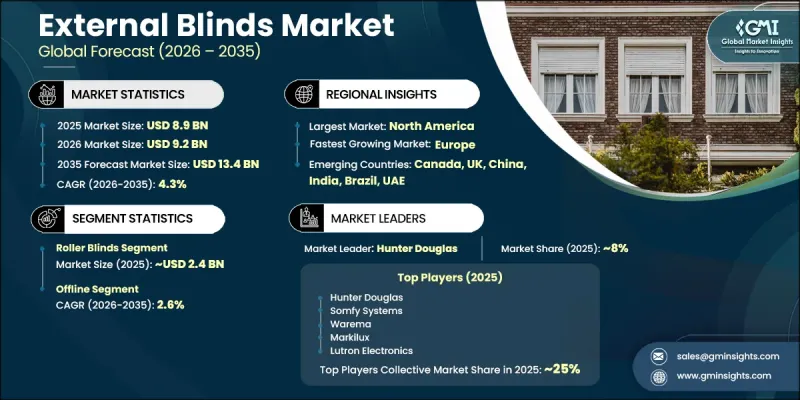
Market expansion is supported by the rising adoption of smart home and building automation technologies across residential and commercial environments. As connected living ecosystems continue to gain traction, consumers are increasingly favoring shading solutions that enhance comfort, improve energy efficiency, and integrate seamlessly with digital control systems. External blinds are becoming an essential component of modern automated building designs due to their ability to optimize daylight control and support thermal efficiency. Users are increasingly managing these systems through digital interfaces and centralized automation platforms, enabling improved convenience and operational flexibility. The integration of intelligent sensors that respond to environmental conditions such as sunlight intensity, temperature variations, and wind movement is further enhancing product functionality. These advancements allow automatic adjustment of blinds, contributing to better indoor climate control and reduced energy consumption. Growing demand for energy-efficient building solutions in both residential and commercial sectors is reinforcing market adoption. Additionally, increasing focus on sustainable building operations and smart infrastructure development is expected to support long-term growth across the external blinds market.
| Market Scope | |
|---|---|
| Start Year | 2025 |
| Forecast Year | 2026-2035 |
| Start Value | $8.9 Billion |
| Forecast Value | $13.4 Billion |
| CAGR | 4.3% |
The roller blinds segment generated USD 2.4 billion in 2025 and is anticipated to grow at a CAGR of 5.1% from 2026 to 2035. This segment continues to gain strong traction due to its practical design, effective light control capabilities, and contribution to improved indoor comfort. Roller blinds are widely preferred for their streamlined structure, ease of operation, and compatibility with automated systems. Their increasing integration into smart home environments is further driving adoption, particularly among consumers seeking modern, efficient, and technology-enabled shading solutions.
The offline distribution channel accounted for 51.4% share in 2025 and is expected to grow at a CAGR of 2.6% through 2035. This channel remains dominant due to strong consumer preference for physical product evaluation before purchase. Buyers often rely on in-person inspection to assess material quality, design accuracy, and operational features. External blinds also require precise customization and installation, which encourages consumers to seek professional consultation and end-to-end service support. The availability of expert assistance, including product selection, measurement guidance, installation services, and after-sales support, continues to strengthen the relevance of offline distribution channels.
United States External Blinds Market reached USD 1.9 billion in 2025 and is projected to grow at a CAGR of 4.8% from 2026 to 2035. Market growth in the country is supported by strong residential and commercial construction activity, alongside continuous urban development and renovation projects. Rising awareness regarding energy efficiency, UV protection, and indoor climate control is encouraging greater adoption of advanced external shading solutions. The rapid expansion of smart home ecosystems is further accelerating demand, as consumers increasingly prefer automated and sensor-based blinds integrated with connected building systems to enhance convenience and reduce energy costs.
Key companies operating in the Global External Blinds Market include Hunter Douglas, Warema, Griesser, Lutron, Markilux, Dooya, Alulux, Soltec, Sunscreen, Rehau, Draper, Brewster Home Fashions, Blinds.com, Somfy, and Renson. Companies in the external blinds market are implementing a range of strategies to strengthen their competitive position and expand market share. Product innovation remains a primary focus, with manufacturers developing motorized, sensor-enabled, and energy-efficient blind systems that align with smart building technologies. Businesses are increasingly investing in automation capabilities and IoT integration to enhance product functionality and user convenience. Strategic partnerships with construction firms, architects, and smart home solution providers are helping companies improve market penetration and project-based sales. Expansion of digital sales channels and online customization tools is further strengthening customer engagement and accessibility. Additionally, companies are emphasizing sustainable materials, durable product designs, and enhanced after-sales services to build long-term customer trust and reinforce their position in the global external blinds market.
Table of Contents
Chapter 1 Methodology & Scope
- 1.1 Market scope and definition
- 1.2 Research design
- 1.2.1 Research approach
- 1.2.2 Data collection methods
- 1.3 Data mining sources
- 1.3.1 Global
- 1.3.2 Regional/Country
- 1.4 Base estimates and calculations
- 1.4.1 Base year calculation
- 1.4.2 Key trends for market estimation
- 1.5 Primary research and validation
- 1.5.1 Primary sources
- 1.6 Forecast model
- 1.7 Research assumptions and limitations
Chapter 2 Executive Summary
- 2.1 Industry 360° synopsis
- 2.2 Key market trends
- 2.2.1 Regional
- 2.2.2 Product type
- 2.2.3 Material
- 2.2.4 Operation mode
- 2.2.5 Installation
- 2.2.6 Price
- 2.2.7 End use
- 2.2.8 Distribution channel
Chapter 3 Industry Insights
- 3.1 Industry ecosystem analysis
- 3.1.1 Supplier landscape
- 3.1.2 Profit margin
- 3.1.3 Value addition at each stage
- 3.1.4 Factor affecting the value chain
- 3.2 Industry impact forces
- 3.2.1 Growth drivers
- 3.2.1.1 Adoption of smart home & automation technologies
- 3.2.1.2 Growth in residential construction & renovation
- 3.2.1.3 Rising focus on aesthetic appeal & architectural design
- 3.2.2 Industry pitfalls & challenges
- 3.2.2.1 High product installation & lifecycle maintenance costs
- 3.2.2.2 Raw material price volatility
- 3.2.3 Opportunities
- 3.2.3.1 Rising demand for smart and automated blinds
- 3.2.3.2 Green building and sustainability initiatives
- 3.2.1 Growth drivers
- 3.3 Growth potential analysis
- 3.4 Future market trends
- 3.5 Technology and innovation landscape
- 3.5.1 Current technological trends
- 3.5.2 Emerging technologies
- 3.6 Regulatory landscape
- 3.6.1 Standards and compliance requirements
- 3.6.2 Regional regulatory frameworks
- 3.6.3 Certification standards
- 3.7 Trade data analysis (HS Code 6306.12.00)
- 3.7.1 Import/export volume & value trends
- 3.7.2 Key trade corridors & tariff impact
- 3.8 Pricing analysis
- 3.8.1 Historical price trend analysis (driven by primary research)
- 3.8.2 Pricing strategy by player type (premium / value / mass market)
- 3.9 Impact of AI & generative AI on the market
- 3.9.1 AI-driven disruption of existing business models
- 3.9.2 GenAI use cases & adoption roadmap by segment
- 3.9.3 Risks, limitations & regulatory considerations
- 3.10 Porter's analysis
- 3.11 PESTEL analysis
- 3.12 Consumer buying behavior analysis
- 3.12.1 Demographic trends
- 3.12.2 Factors affecting buying decisions
- 3.12.3 Consumer product adoption
- 3.12.4 Preferred distribution channel
Chapter 4 Competitive Landscape, 2025
- 4.1 Introduction
- 4.2 Company market share analysis
- 4.2.1 By Region
- 4.2.1.1 North America
- 4.2.1.2 Europe
- 4.2.1.3 Asia Pacific
- 4.2.1.4 Latin America
- 4.2.1.5 Middle East & Africa
- 4.2.1 By Region
- 4.3 Company matrix analysis
- 4.4 Competitive analysis of major market players
- 4.5 Competitive positioning matrix
- 4.6 Key developments
- 4.6.1 Mergers & acquisitions
- 4.6.2 Partnerships & collaborations
- 4.6.3 New product launches
- 4.6.4 Expansion plans
Chapter 5 Market Estimates & Forecast, By Product Type, 2022 - 2035, (USD Billion) (Million Units)
- 5.1 Key trends
- 5.2 Roller blinds
- 5.3 Venetian blinds
- 5.4 Vertical blinds
- 5.5 Panel blinds
- 5.6 Corded blinds
- 5.7 Others (monsoon blinds, etc.)
Chapter 6 Market Estimates & Forecast, By Material, 2022 - 2035, (USD Billion) (Million Units)
- 6.1 Key trends
- 6.2 Aluminum
- 6.3 Fabric
- 6.4 Vinyl
- 6.5 Wood
- 6.6 plastics
- 6.7 Others
Chapter 7 Market Estimates & Forecast, By Operation Mode, 2022 - 2035, (USD Billion) (Million Units)
- 7.1 Key trends
- 7.2 Manual
- 7.3 Automatic
Chapter 8 Market Estimates & Forecast, By Installation, 2022 - 2035, (USD Billion) (Million Units)
- 8.1 Key trends
- 8.2 New construction
- 8.3 Retro-fit
Chapter 9 Market Estimates & Forecast, By Price, 2022 - 2035, (USD Billion) (Million Units)
- 9.1 Key trends
- 9.2 Low
- 9.3 Medium
- 9.4 High
Chapter 10 Market Estimates & Forecast, By Application, 2022 - 2035, (USD Billion) (Million Units)
- 10.1 Key trends
- 10.2 Residential
- 10.3 Commercial
- 10.3.1 Hotels
- 10.3.2 Institutional
- 10.3.3 Corporate
- 10.3.4 Others
Chapter 11 Market Estimates & Forecast, By Distribution Channel, 2022 - 2035, (USD Billion) (Million Units)
- 11.1 Key trends
- 11.2 Online
- 11.2.1 E-commerce
- 11.2.2 Company website
- 11.3 Offline
- 11.3.1 Supermarket/hypermarket
- 11.3.2 Specialty stores
- 11.3.3 Others (departmental stores, etc.)
Chapter 12 Market Estimates & Forecast, By Region, 2022 - 2035, (USD Billion) (Million Units)
- 12.1 Key trends
- 12.2 North America
- 12.2.1 U.S.
- 12.2.2 Canada
- 12.3 Europe
- 12.3.1 Germany
- 12.3.2 UK
- 12.3.3 France
- 12.3.4 Italy
- 12.3.5 Spain
- 12.4 Asia Pacific
- 12.4.1 China
- 12.4.2 India
- 12.4.3 Japan
- 12.4.4 South Korea
- 12.4.5 Australia
- 12.4.6 Indonesia
- 12.4.7 Malaysia
- 12.5 Latin America
- 12.5.1 Brazil
- 12.5.2 Mexico
- 12.5.3 Argentina
- 12.6 MEA
- 12.6.1 Saudi Arabia
- 12.6.2 UAE
- 12.6.3 South Africa
Chapter 13 Company Profiles
- 13.1 Top Global Players
- 13.1.1 Hunter Douglas
- 13.1.2 Somfy
- 13.1.3 Warema
- 13.1.4 Griesser
- 13.1.5 Lutron
- 13.1.6 Rehau
- 13.1.7 Renson
- 13.2 Regional Champions
- 13.2.1 Markilux
- 13.2.2 Alulux
- 13.2.3 Draper
- 13.2.4 Soltec
- 13.2.5 Sunscreen
- 13.2.6 Blinds.com
- 13.2.7 Brewster Home Fashions
- 13.3 Emerging Players
- 13.3.1 Dooya
- 13.3.2 Nice Group
- 13.3.3 Bandalux
- 13.3.4 Luxaflex
- 13.3.5 Reflexa
- 13.3.6 Heroal
- 13.3.7 Roma KG

