PUBLISHER: Global Market Insights Inc. | PRODUCT CODE: 2071310

PUBLISHER: Global Market Insights Inc. | PRODUCT CODE: 2071310
Aerial Work Platform Rental Market Opportunity, Growth Drivers, Industry Trend Analysis, and Forecast 2026 - 2035
The Global Aerial Work Platform Rental Market was valued at USD 25.3 billion in 2025 and is estimated to grow at a CAGR of 5.1% to reach USD 40.9 billion by 2035.
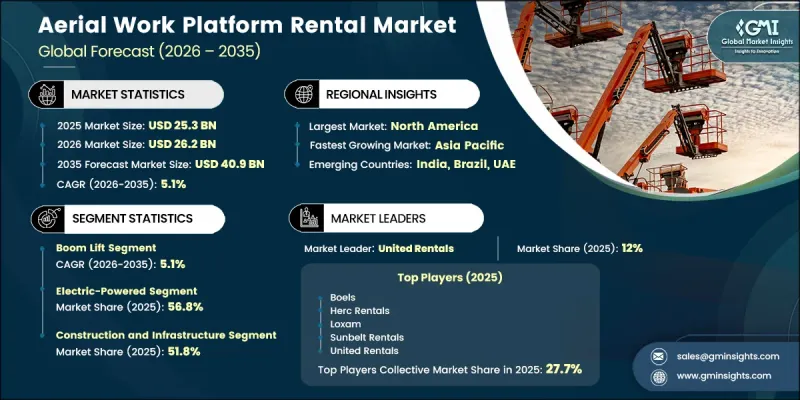
Market growth is supported by sustained infrastructure development initiatives, increasing reliance on equipment rental services, and the growing preference among contractors for flexible access to modern lifting equipment. Demand remains particularly strong across construction, industrial maintenance, utilities, telecommunications, and infrastructure development projects where access equipment is required for work at elevated heights. The industry continues to benefit from the expanding rental model, which enables end users to avoid substantial capital expenditures while gaining access to technologically advanced and safety-compliant machinery. Regulatory requirements related to workplace safety, equipment certification, and operational compliance are further encouraging businesses to rent equipment from professional fleet operators rather than maintain aging owned assets. Additionally, rental providers are investing heavily in fleet modernization through the adoption of advanced technologies, including electrified platforms, hybrid-powered units, telematics-enabled fleet management systems, and enhanced safety mechanisms. Rising rental penetration across emerging economies, coupled with growing investments in transportation, energy, urban infrastructure, and public development projects, is expected to provide a strong foundation for long-term market expansion throughout the forecast period.
| Market Scope | |
|---|---|
| Start Year | 2025 |
| Forecast Year | 2026-2035 |
| Start Value | $25.3 Billion |
| Forecast Value | $40.9 Billion |
| CAGR | 5.1% |
The boom lift segment generated USD 11.3 billion in 2025, accounting for 44.7% share. Its strong market position is supported by exceptional versatility across a wide range of working heights and access requirements. The ability to provide both vertical elevation and extended reach makes boom lifts a preferred solution across construction, industrial, infrastructure, and maintenance applications. Continued demand for equipment capable of operating in challenging environments is expected to support sustained growth throughout the forecast period.
The engine-powered segment represented 34.8% share in 2025, generating USD 8.8 billion. Despite the growing popularity of electric alternatives, engine-powered aerial work platforms continue to play a vital role in applications that require extended operating hours, high performance, and operation in locations where charging infrastructure may not be readily available. Their ability to perform effectively in demanding outdoor environments remains a key factor supporting continued adoption across multiple industries.
North America Aerial Work Platform Rental Market accounted for USD 16.3 billion in 2025, representing 64.6% share. Strong construction activity, extensive infrastructure investment programs, and a highly developed equipment rental ecosystem continue to drive regional demand. The widespread acceptance of rental solutions among contractors and project developers has established North America as the most mature market, supporting consistent fleet utilization and long-term growth opportunities.
Key companies operating in the global aerial work platform rental market include Boels Rental, Horizon Platforms, United Rentals, Sunstate Equipment, Kanamoto, Nishio Rent All, Speedy Hire, CDHORIZON, Loxam, Manlift, Herc Rentals, VP Plc, Mateco, Sanghvi Movers, Kiloutou, Aktio, APL Aerial Platforms, Al Faris, Mark One Hire, and Sunbelt Rentals. Companies operating in the aerial work platform rental market are focusing on fleet expansion, technological advancement, and geographic diversification to strengthen their competitive position. Major rental providers are investing in modern equipment fleets featuring electric and hybrid-powered platforms, telematics integration, and advanced safety systems to meet evolving customer requirements and regulatory standards. Strategic acquisitions, partnerships, and branch network expansions are being utilized to increase market coverage and improve service accessibility. Businesses are also emphasizing digital fleet management solutions, predictive maintenance capabilities, and real-time equipment monitoring to enhance operational efficiency and customer satisfaction. In addition, companies are expanding training programs, maintenance services, and value-added support offerings to build long-term customer relationships.
Table of Contents
Chapter 1 Methodology
- 1.1 Research approach
- 1.2 Quality Commitments
- 1.2.1 GMI AI policy & data integrity commitment
- 1.3 Research Trail & Confidence Scoring
- 1.3.1 Research Trail Components
- 1.3.2 Scoring Components
- 1.4 Data Collection
- 1.5 Data mining sources
- 1.5.1 Paid sources
- 1.6 Base estimates and calculations
- 1.6.1 Base year calculation
- 1.7 Forecast model
- 1.7.1 Quantified market impact analysis
- 1.8 Research transparency addendum
- 1.8.1 Source attribution framework
- 1.8.2 Quality assurance metrics
- 1.8.3 Our commitment to trust
Chapter 2 Executive Summary
- 2.1 Industry 360° synopsis
- 2.2 Key market trends
- 2.2.1 Regional
- 2.2.2 Product
- 2.2.3 Propulsion
- 2.2.4 Lift Height
- 2.2.5 End-Use
- 2.3 TAM analysis, 2026-2035
- 2.4 CXO perspectives: Strategic imperatives
Chapter 3 Industry Insights
- 3.1 Industry ecosystem analysis
- 3.1.1 Supplier landscape
- 3.1.2 Profit margin
- 3.1.3 Cost structure
- 3.1.4 Value addition at each stage
- 3.1.5 Factor affecting the value chain
- 3.1.6 Disruptions
- 3.2 Industry impact forces
- 3.2.1 Growth drivers
- 3.2.1.1 Rapid Infrastructure Development and Smart City Projects
- 3.2.1.2 Growth in Commercial and Residential Construction Activities
- 3.2.1.3 Government Investments in Transportation and Urban Infrastructure
- 3.2.1.4 Increasing Airport, Metro, and Telecom Infrastructure Projects
- 3.2.2 Industry pitfalls and challenges
- 3.2.2.1 Poor Road and Service Infrastructure in Remote Areas
- 3.2.2.2 Competition from Traditional Access Equipment like Scaffolding
- 3.2.3 Market opportunities
- 3.2.3.1 Expansion of Organized Rental Companies Across India
- 3.2.3.2 Growing Demand from Renewable Energy Projects
- 3.2.3.3 Rising Demand for Electric and Hybrid Aerial Work Platforms
- 3.2.1 Growth drivers
- 3.3 Technology and innovation landscape
- 3.3.1 Current technological trends
- 3.3.2 Emerging technologies
- 3.4 Growth potential analysis
- 3.5 Pricing Analysis (Driven by Primary Research)
- 3.5.1 Historical Price Trend Analysis
- 3.5.2 Pricing Strategy by Player Type (Premium / Value / Cost-plus)
- 3.6 Regulatory landscape
- 3.6.1 North America
- 3.6.1.1 US - US Occupational Safety and Health Administration (OSHA)
- 3.6.1.2 US - American National Standards Institute (ANSI)
- 3.6.1.3 Canada - Canadian Standards Association Group
- 3.6.2 Europe
- 3.6.2.1 UK - International Powered Access Federation (IPAF)
- 3.6.2.2 France - INRS France
- 3.6.3 Asia Pacific
- 3.6.3.1 China - State Administration for Market Regulation (SAMR)
- 3.6.3.2 Japan - Ministry of Land, Infrastructure, Transport and Tourism
- 3.6.4 LATAM
- 3.6.4.1 Brazil - Ministry of Labor and Employment
- 3.6.4.2 Brazil - Brazilian Association of Technical Standards
- 3.6.5 MEA
- 3.6.5.1 Saudi Arabia - SASO
- 3.6.5.2 UAE - OSHAD SF
- 3.6.1 North America
- 3.7 Porter's analysis
- 3.8 PESTEL analysis
- 3.9 Trade Data Analysis (Driven by Paid Database)
- 3.9.1 Import/Export Volume & Value Trends
- 3.9.2 Key Trade Corridors & Tariff Impact
- 3.10 Capacity & Production Landscape (Driven by Primary Research)
- 3.10.1 Installed Capacity by Region & Key Producer
- 3.10.2 Capacity Utilization Rates & Expansion Pipelines
- 3.11 Cost breakdown analysis
- 3.11.1 Equipment Rental Charges
- 3.11.2 Transportation and Logistics Costs
- 3.11.3 Operator and Labor Costs
- 3.11.4 Fuel, Power, and Battery Charging Expenses
- 3.11.5 Maintenance and Repair Costs
- 3.12 Patent analysis (Driven by Primary Research)
- 3.13 Sustainability and environmental aspects
- 3.13.1 Sustainable Practices
- 3.13.2 Waste Reduction Strategies
- 3.13.3 Energy Efficiency in Production
- 3.13.4 Eco-friendly Initiatives
- 3.13.5 Carbon Footprint Considerations
- 3.14 Impact of AI & generative AI on the market
- 3.14.1 AI-driven disruption of existing business models
- 3.14.2 GenAI use cases & adoption roadmap by segment
- 3.14.3 Risks, limitations & regulatory considerations
- 3.15 Urbanization & Smart City Development Trends
- 3.15.1 Smart City Project Pipeline & AWP Demand Correlation
- 3.15.2 Urban Infrastructure Modernization Impact on Rental Demand
- 3.16 Forecast assumptions & scenario analysis (Driven by Primary Research)
- 3.16.1 Base Case- Key Macro & Industry Variables Driving CAGR
- 3.16.2 Optimistic Scenarios- Favorable macro and industry tailwinds
- 3.16.3 Pessimistic Scenario - Macroeconomic slowdown or industry headwinds
Chapter 4 Competitive Landscape, 2025
- 4.1 Introduction
- 4.2 Company market share analysis
- 4.2.1 North America
- 4.2.2 Europe
- 4.2.3 Asia Pacific
- 4.2.4 LATAM
- 4.2.5 MEA
- 4.3 Competitive analysis of major market players
- 4.4 Competitive positioning matrix
- 4.5 Key developments
- 4.5.1 Mergers & acquisitions
- 4.5.2 Partnerships & collaborations
- 4.5.3 New product launches
- 4.5.4 Expansion plans and funding
- 4.6 Company tier benchmarking
- 4.6.1 Tier classification criteria & qualifying thresholds
- 4.6.2 Tier positioning matrix by revenue, geography & innovation
Chapter 5 Market Estimates and Forecast, By Product, 2022 - 2035 ($ Mn, Fleet Size)
- 5.1 Key trends
- 5.2 Boom Lifts
- 5.2.1 Articulating boom lifts
- 5.2.2 Telescopic boom lifts
- 5.3 Scissor Lifts
- 5.4 Vertical Mast Lifts
- 5.5 Push Around Lifts
- 5.6 Others
Chapter 6 Market Estimates and Forecast, By Propulsion, 2022 - 2035 ($ Mn, Fleet Size)
- 6.1 Key trends
- 6.2 Electric-Powered
- 6.3 Engine-Powered
- 6.4 Hybrid
Chapter 7 Market Estimates and Forecast, By Lift Height, 2022 - 2035 ($ Mn, Fleet Size)
- 7.1 Key trends
- 7.2 Less than 20 Feet
- 7.3 20-50 Feet
- 7.4 50-100 Feet
- 7.5 Above 100 Feet
Chapter 8 Market Estimates and Forecast, By End-Use, 2022 - 2035 ($ Mn)
- 8.1 Key trends
- 8.2 Construction & Infrastructure
- 8.3 Manufacturing
- 8.4 Telecommunication
- 8.5 Logistics
- 8.6 Others
Chapter 9 Market Estimates & Forecast, By Region, 2022 - 2035 ($Mn, Fleet Size)
- 9.1 Key trends
- 9.2 North America
- 9.2.1 US
- 9.2.2 Canada
- 9.3 Europe
- 9.3.1 Germany
- 9.3.2 UK
- 9.3.3 France
- 9.3.4 Italy
- 9.3.5 Spain
- 9.3.6 Netherlands
- 9.3.7 Norway
- 9.3.8 Sweden
- 9.4 Asia Pacific
- 9.4.1 China
- 9.4.2 India
- 9.4.3 Japan
- 9.4.4 South Korea
- 9.4.5 Vietnam
- 9.4.6 Thailand
- 9.4.7 Malaysia
- 9.5 Latin America
- 9.5.1 Brazil
- 9.5.2 Mexico
- 9.5.3 Argentina
- 9.5.4 Colombia
- 9.6 MEA
- 9.6.1 South Africa
- 9.6.2 Saudi Arabia
- 9.6.3 UAE
Chapter 10 Company Profiles
- 10.1 Global players
- 10.1.1 United Rentals
- 10.1.2 Sunbelt Rentals
- 10.1.3 Loxam
- 10.1.4 Herc Rentals
- 10.1.5 Aktio
- 10.1.6 Nishio Rent All
- 10.1.7 Boels Rental
- 10.1.8 Manlift
- 10.1.9 Kanamoto
- 10.1.10 CDHORIZON
- 10.2 Regional players
- 10.2.1 APL Aerial Platforms
- 10.2.2 Mark One Hire
- 10.2.3 Mateco
- 10.2.4 Kiloutou
- 10.2.5 VP Plc
- 10.2.6 Sanghvi Movers
- 10.2.7 Al Faris
- 10.3 Emerging players
- 10.3.1 Sunstate Equipment
- 10.3.2 Horizon Platforms
- 10.3.3 Speedy Hire

