PUBLISHER: Global Market Insights Inc. | PRODUCT CODE: 2071315

PUBLISHER: Global Market Insights Inc. | PRODUCT CODE: 2071315
Penetration Testing as-a-Service Market Opportunity, Growth Drivers, Industry Trend Analysis, and Forecast 2026 - 2035
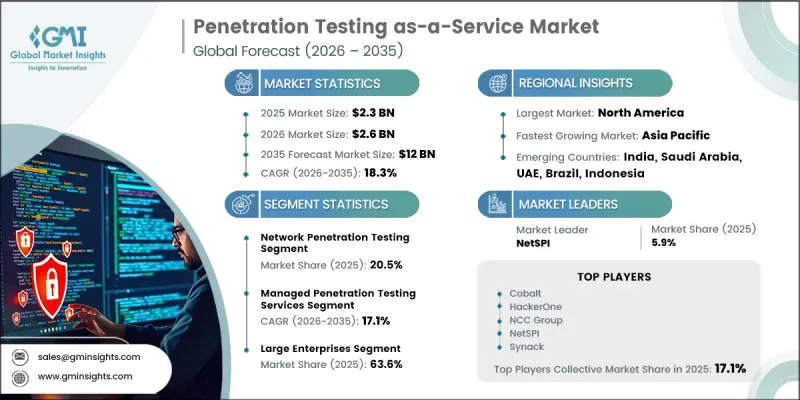
The Global Penetration Testing As-A-Service Market was valued at USD 2.3 billion in 2025 and is estimated to grow at a CAGR of 18.3% to reach USD 12 billion by 2035.
Market growth is driven by the escalating frequency and sophistication of cyber threats, including ransomware campaigns, phishing attacks, and advanced persistent threats that are forcing organizations to continuously strengthen their security postures. The rapid expansion of cloud computing environments, multi-cloud deployments, application programming interfaces, containerized applications, and hybrid IT ecosystems is significantly increasing the overall attack surface. As enterprises migrate critical workloads to cloud-based infrastructure, the number of exposed assets, identities, configurations, and potential vulnerabilities continues to rise, creating persistent security challenges. This evolving environment is making it increasingly difficult for security teams to maintain full visibility and protection across dynamic infrastructures. PTaaS solutions are being widely adopted to enable continuous security validation, real-time vulnerability identification, and ongoing assessment of cloud and hybrid environments. The shift away from traditional periodic testing toward continuous penetration testing is accelerating, supported by DevSecOps integration and the need to respond to rapidly evolving threat landscapes. This transition is reshaping cybersecurity strategies across enterprises globally and reinforcing the role of PTaaS as a core security function.
| Market Scope | |
|---|---|
| Start Year | 2025 |
| Forecast Year | 2026-2035 |
| Start Value | $2.3 Billion |
| Forecast Value | $12 Billion |
| CAGR | 18.3% |
Managed penetration testing services held a 56.6% share and is expected to grow at a CAGR of 17.1% through 2035. This service model provides comprehensive, end-to-end security testing delivered by cybersecurity specialists, covering planning, execution, analysis, reporting, and remediation guidance. Organizations prefer this approach as it reduces internal workload and allows them to focus on core business operations while ensuring continuous and expert-led vulnerability assessment.
The network penetration testing segment accounted for 20.5% share in 2025 and is projected to grow at a CAGR of 14.9% through 2035. This segment remains significant due to the continued importance of network security assessments in identifying infrastructure vulnerabilities. As enterprises shift from traditional on-premise systems to cloud-based environments, network security validation has become more complex, requiring advanced testing approaches to ensure comprehensive coverage across distributed systems and hybrid architectures.
United States Penetration Testing As-A-Service Market reached USD 729.2 million in 2025 and is expected to grow at a CAGR of 16.5% through 2035. Market expansion in the country is supported by strong cybersecurity investment levels, widespread adoption of cloud infrastructure, and robust regulatory compliance requirements across industries. Organizations across sectors such as finance, healthcare, technology, and government are increasingly prioritizing continuous security testing to strengthen their cyber resilience. The mature cybersecurity ecosystem in the country is enabling rapid adoption of advanced PTaaS platforms that combine automation with expert-driven testing methodologies, supporting a shift toward continuous and on-demand security validation.
Major companies operating in the Global Penetration Testing As-A-Service Market include NetSPI, HackerOne, NCC Group, Cobalt, Synack, CrowdStrike, and Bugcrowd, collectively accounting for 20.2% of the market in 2025. Companies operating in the penetration testing as-a-service market are focusing on strengthening their competitive position through continuous innovation and service expansion. A key strategy involves integrating artificial intelligence, automation, and machine learning into penetration testing platforms to improve speed, accuracy, and scalability of vulnerability detection. Market players are also enhancing cloud-native testing capabilities to support complex multi-cloud and hybrid environments. Subscription-based and on-demand service models are being adopted to provide greater flexibility and continuous testing coverage for enterprises. Strategic partnerships with cloud service providers, cybersecurity vendors, and DevSecOps platforms are enabling broader ecosystem integration. Companies are also investing in expanding their global delivery networks and security expertise pools to meet rising enterprise demand.
Table of Contents
Chapter 1 Methodology
- 1.1 Research approach
- 1.2 Quality Commitments
- 1.2.1 GMI AI policy & data integrity commitment
- 1.2.1.1 Source consistency protocol
- 1.2.1 GMI AI policy & data integrity commitment
- 1.3 Research Trail & Confidence Scoring
- 1.3.1 Research Trail Components
- 1.3.2 Scoring Components
- 1.4 Data Collection
- 1.4.1 Partial list of primary sources
- 1.5 Data mining sources
- 1.5.1 Paid sources
- 1.5.1.1 Sources, by region
- 1.5.1 Paid sources
- 1.6 Base estimates and calculations
- 1.6.1 Base year calculation
- 1.7 Forecast model
- 1.7.1 Quantified market impact analysis
- 1.7.1.1 Mathematical impact of growth parameters on forecast
- 1.7.1 Quantified market impact analysis
- 1.8 Research transparency addendum
- 1.8.1 Source attribution framework
- 1.8.2 Quality assurance metrics
- 1.8.3 Our commitment to trust
Chapter 2 Executive Summary
- 2.1 Industry 360° synopsis
- 2.2 Key market trends
- 2.2.1 Regional
- 2.2.2 Testing
- 2.2.3 Offering
- 2.2.4 Organization size
- 2.2.5 End use
- 2.3 TAM analysis, 2026-2035
- 2.4 CXO perspectives: Strategic imperatives
Chapter 3 Industry Insights
- 3.1 Industry ecosystem analysis
- 3.1.1 Supplier landscape
- 3.1.1.1 Technology & platform providers
- 3.1.1.2 Security researchers & ethical hackers
- 3.1.1.3 Managed service providers & resellers
- 3.1.1.4 End-user organizations
- 3.1.2 Profit margin
- 3.1.3 Cost structure
- 3.1.4 Value addition at each stage
- 3.1.5 Factor affecting the value chain
- 3.1.6 Disruptions
- 3.1.1 Supplier landscape
- 3.2 Industry impact forces
- 3.2.1 Growth drivers
- 3.2.1.1 Rising sophisticated cyberattack frequency
- 3.2.1.2 Tightening regulatory compliance mandates
- 3.2.1.3 Expanding cloud attack surfaces
- 3.2.1.4 Shortage of security professionals
- 3.2.2 Industry pitfalls and challenges
- 3.2.2.1 High-cost engagements limiting SMEs
- 3.2.2.2 Data privacy and confidentiality concerns
- 3.2.3 Market opportunities
- 3.2.3.1 AI LLM vulnerability testing growth
- 3.2.3.2 Rising OT IoT security demand
- 3.2.3.3 Emerging market expansion opportunities
- 3.2.3.4 Bug bounty integration growth
- 3.2.1 Growth drivers
- 3.3 Growth potential analysis
- 3.4 Technology and innovation landscape
- 3.4.1 Current technological trends
- 3.4.2 Emerging technologies
- 3.5 Cost breakdown analysis
- 3.6 Regulatory landscape
- 3.6.1 North America
- 3.6.1.1 Cybersecurity and Infrastructure Security Agency (U.S.)
- 3.6.1.2 Canadian Centre for Cyber Security (Canada)
- 3.6.2 Europe
- 3.6.2.1 Federal Office for Information Security (Germany)
- 3.6.2.2 National Cybersecurity Agency (Italy)
- 3.6.3 Asia Pacific
- 3.6.3.1 Cybersecurity Law of China (China)
- 3.6.3.2 Indian Computer Emergency Response Team (India)
- 3.6.4 Latin America
- 3.6.4.1 National Cybersecurity Strategy (Brazil)
- 3.6.4.2 Federal Law on Protection of Personal Data Held by Private Parties (Mexico)
- 3.6.5 Middle East & Africa
- 3.6.5.1 Dubai Electronic Security Center (Dubai)
- 3.6.5.2 National Cybersecurity Authority (Saudi Arabia)
- 3.6.1 North America
- 3.7 Porter's analysis
- 3.8 PESTEL analysis
- 3.9 Patent analysis (Driven by primary research)
- 3.10 Impact of AI & Generative AI on the Market
- 3.10.1 AI-driven disruption of existing business models
- 3.10.2 Gen AI use cases & adoption roadmap by segment
- 3.10.3 Risks, limitations & regulatory considerations
- 3.11 Sustainability and environmental aspects
- 3.11.1 Sustainable practices
- 3.11.2 Waste reduction strategies
- 3.11.3 Energy efficiency in production
- 3.11.4 Eco-friendly initiatives
- 3.11.5 Carbon footprint considerations
- 3.12 Forecast assumptions & scenario analysis (Driven by primary research)
- 3.12.1 Base Case - key macro & industry variables driving CAGR
- 3.12.2 Optimistic Scenarios - Favorable macro and industry tailwinds
- 3.12.3 Pessimistic Scenario - Macroeconomic slowdown or industry headwinds
Chapter 4 Competitive Landscape, 2025
- 4.1 Introduction
- 4.2 Company market share analysis
- 4.2.1 North America
- 4.2.2 Europe
- 4.2.3 Asia Pacific
- 4.2.4 LATAM
- 4.2.5 MEA
- 4.3 Competitive analysis of major market players
- 4.4 Competitive positioning matrix
- 4.5 Key developments
- 4.5.1 Mergers & acquisitions
- 4.5.2 Partnerships & collaborations
- 4.5.3 New product launches
- 4.5.4 Expansion plans and funding
- 4.6 4.6 Company tier benchmarking
- 4.6.1 Tier classification criteria & qualifying thresholds
- 4.6.2 Tier positioning matrix by revenue, geography & innovation
Chapter 5 Market Estimates & Forecast, By Testing, 2022 - 2035 ($Mn)
- 5.1 Key trends
- 5.2 Network penetration testing
- 5.3 Web application testing
- 5.4 Mobile application testing
- 5.5 API security testing
- 5.6 Cloud security testing
- 5.7 OT/ICS & IoT testing
- 5.8 Social engineering testing
- 5.9 Red team & adversary simulation
Chapter 6 Market Estimates & Forecast, By Offering, 2022 - 2035 ($Mn)
- 6.1 Key trends
- 6.2 Platform-based PTaaS
- 6.2.1 Self-serve continuous testing platforms
- 6.2.2 Crowdsourced security testing platforms
- 6.2.3 AI-augmented automated platforms
- 6.3 Managed penetration testing services
- 6.3.1 Expert-led recurring engagements
- 6.3.2 Hybrid (platform + managed) delivery
Chapter 7 Market Estimates & Forecast, By Organization Size, 2022 - 2035 ($Mn)
- 7.1 Key trends
- 7.2 Large enterprises
- 7.3 SMEs
Chapter 8 Market Estimates & Forecast, By End Use, 2022 - 2035 ($Mn)
- 8.1 Key trends
- 8.2 BFSI
- 8.2.1 Banking & retail financial services
- 8.2.2 Insurance
- 8.2.3 Capital markets & fintech
- 8.3 IT & telecom
- 8.4 Healthcare & lifesciences
- 8.5 Government & defense
- 8.6 Retail & E-commerce
- 8.7 Energy & utilities
- 8.8 Manufacturing
- 8.9 Others
Chapter 9 Market Estimates & Forecast, By Region, 2022 - 2035 ($Mn)
- 9.1 Key trends
- 9.2 North America
- 9.2.1 U.S.
- 9.2.2 Canada
- 9.3 Europe
- 9.3.1 Germany
- 9.3.2 UK
- 9.3.3 France
- 9.3.4 Italy
- 9.3.5 Spain
- 9.3.6 Netherland
- 9.3.7 Sweden
- 9.3.8 Poland
- 9.4 Asia Pacific
- 9.4.1 China
- 9.4.2 India
- 9.4.3 Japan
- 9.4.4 South Korea
- 9.4.5 Australia
- 9.4.6 Indonesia
- 9.4.7 Thailand
- 9.5 LATAM
- 9.5.1 Brazil
- 9.5.2 Mexico
- 9.5.3 Argentina
- 9.6 MEA
- 9.6.1 South Africa
- 9.6.2 Saudi Arabia
- 9.6.3 UAE
Chapter 10 Company Profiles
- 10.1 Global players
- 10.1.1 Bugcrowd
- 10.1.2 Cobalt
- 10.1.3 HackerOne
- 10.1.4 NCC
- 10.1.5 NetSPI
- 10.1.6 Rapid7
- 10.1.7 Secureworks
- 10.1.8 Synack
- 10.2 Regional players
- 10.2.1 Astra Security
- 10.2.2 CyberCX
- 10.2.3 ImmuniWeb
- 10.2.4 Intigriti
- 10.2.5 Outpost24
- 10.2.6 Pentest People
- 10.2.7 Vumetric
- 10.2.8 YesWeHack
- 10.3 Emerging players
- 10.3.1 BreachLock
- 10.3.2 Horizon3.ai
- 10.3.3 Pentera
- 10.3.4 Sprocket Security

