PUBLISHER: Global Market Insights Inc. | PRODUCT CODE: 2071320

PUBLISHER: Global Market Insights Inc. | PRODUCT CODE: 2071320
Crawler Crane Market Opportunity, Growth Drivers, Industry Trend Analysis, and Forecast 2026 - 2035
The Global Crawler Crane Market was valued at USD 3.2 billion in 2025 and is estimated to grow at a CAGR of 4.2% to reach USD 4.9 billion by 2035.
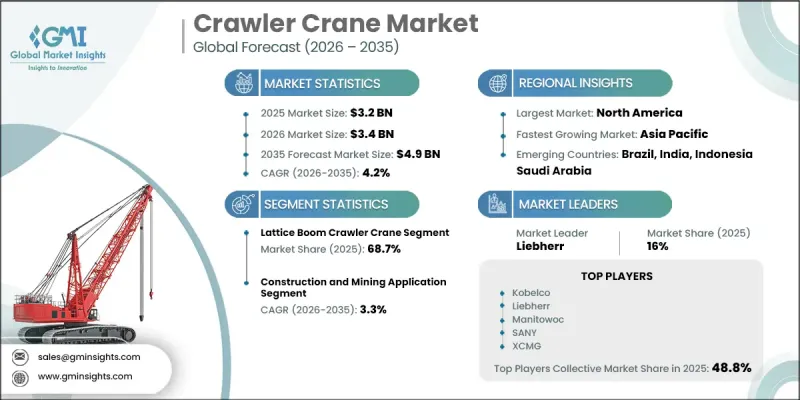
Market expansion is supported by rising investments in large-scale infrastructure development, industrial construction projects, energy installations, and transportation networks across major economies. Demand for crawler cranes continues to strengthen as governments and private sector developers increase spending on projects that require heavy lifting capabilities, high load stability, and reliable performance in challenging operating environments. The growing deployment of renewable energy infrastructure, particularly utility-scale power projects, is creating sustained demand for high-capacity lifting equipment capable of handling oversized components and complex installations. Industrial expansion across manufacturing, processing, and energy sectors is further supporting procurement activity. At the same time, increasing project complexity is elevating the importance of equipment efficiency, operational reliability, and lifecycle cost management. Despite favorable demand conditions, market participants continue to face challenges associated with transportation requirements, maintenance expenses, and workforce availability. The need for highly trained operators and specialized technical expertise remains a key consideration for project owners and contractors. Nevertheless, ongoing investments in infrastructure modernization and industrial development are expected to sustain long-term growth opportunities across the global crawler crane market.
| Market Scope | |
|---|---|
| Start Year | 2025 |
| Forecast Year | 2026-2035 |
| Start Value | $3.2 Billion |
| Forecast Value | $4.9 Billion |
| CAGR | 4.2% |
The lattice boom crawler crane segment is anticipated to reach USD 3.54 billion by 2035, growing at a CAGR of 4.7%, which exceeds the overall market growth rate. The strong position of lattice boom crawler cranes is attributed to their ability to support heavy-load operations while maintaining structural efficiency. Their design enables superior lifting performance, extended reach capabilities, and enhanced load management, making them highly suitable for demanding construction and industrial projects. As project requirements continue to increase in scale and complexity, demand for lattice boom configurations is expected to remain strong throughout the forecast period.
The construction and mining segment is forecast to reach USD 1.8 billion by 2035, growing at a CAGR of 3.3%. Demand is being driven by ongoing investments in infrastructure development, large-scale engineering projects, industrial facilities, and resource extraction operations. Long-duration projects requiring substantial lifting capacity continue to support equipment utilization rates and replacement demand. Additionally, mining operations and industrial construction activities are creating consistent opportunities for crawler crane deployment across multiple regions.
North America Crawler Crane Market is projected to reach USD 1.62 billion by 2035, expanding at a CAGR of 3.4%. Strong demand is supported by extensive infrastructure investments, industrial modernization programs, energy sector development, and a well-established equipment rental ecosystem. The region also benefits from a significant installed base of heavy construction equipment and a steady pipeline of commercial, industrial, and utility projects that require advanced lifting solutions. Continued investments in transportation networks, energy infrastructure, and industrial facilities are expected to sustain market growth over the coming years.
Major companies operating in the global crawler crane market include Zoomlion, Tadano, Kobelco, Manitowoc, Sennebogen, Liebherr, XCMG, Terex, SANY, and Sumitomo. Companies operating in the crawler crane market are implementing a range of strategic initiatives to strengthen their competitive position and expand market share. Manufacturers are investing heavily in product innovation, focusing on higher lifting capacities, improved fuel efficiency, advanced safety technologies, and digital monitoring capabilities. Many companies are integrating telematics, predictive maintenance solutions, and remote diagnostics to improve equipment performance and reduce downtime. Strategic partnerships with rental providers, construction firms, and industrial contractors are helping manufacturers expand customer reach and secure long-term contracts. Businesses are also strengthening after-sales service networks, operator training programs, and spare parts availability to enhance customer retention.
Table of Contents
Chapter 1 Methodology & Scope
- 1.1 Research approach
- 1.2 Quality Commitments
- 1.2.1 GMI AI policy & data integrity commitment
- 1.2.1.1 Source consistency protocol
- 1.2.1 GMI AI policy & data integrity commitment
- 1.3 Research Trail & Confidence Scoring
- 1.3.1 Research Trail Components
- 1.3.2 Scoring Components
- 1.4 Data Collection
- 1.4.1 Partial list of primary sources
- 1.5 Data mining sources
- 1.5.1 Paid sources
- 1.5.1.1 Sources, by region
- 1.5.1 Paid sources
- 1.6 Base estimates and calculations
- 1.6.1 Base year calculation
- 1.7 Forecast model
- 1.7.1 Quantified market impact analysis
- 1.7.1.1 Mathematical impact of growth parameters on forecast
- 1.7.1 Quantified market impact analysis
- 1.8 Research transparency addendum
- 1.8.1 Source attribution framework
- 1.8.2 Quality assurance metrics
- 1.8.3 Our commitment to trust
Chapter 2 Executive Summary
- 2.1 Industry 360° synopsis
- 2.2 Key market trends
- 2.2.1 Boom Type
- 2.2.2 Lifting Capacity
- 2.2.3 Propulsion
- 2.2.4 Application
- 2.2.5 End-User
- 2.3 TAM Analysis, 2026-2035
- 2.4 CXO perspectives: Strategic imperatives
Chapter 3 Industry Insights
- 3.1 Industry ecosystem analysis
- 3.1.1 Supplier landscape
- 3.1.1.1 Raw material suppliers
- 3.1.1.2 Component suppliers
- 3.1.1.3 Manufacturers
- 3.1.1.4 Service providers
- 3.1.1.5 Distribution channel
- 3.1.1.6 End Use
- 3.1.2 Cost structure
- 3.1.3 Profit margin
- 3.1.4 Value addition at each stage
- 3.1.5 Vertical integration trends
- 3.1.6 Disruptors
- 3.1.1 Supplier landscape
- 3.2 Industry impact forces
- 3.2.1 Growth drivers
- 3.2.1.1 Expansion of Infrastructure Development Projects
- 3.2.1.2 Growth in Renewable Energy Installations
- 3.2.1.3 Rising Industrial and Petrochemical Investments
- 3.2.1.4 Increasing Preference for Superior Stability and Lifting Capacity
- 3.2.2 Industry pitfalls & challenges
- 3.2.2.1 High Acquisition and Maintenance Costs
- 3.2.2.2 Skilled Operator Shortage
- 3.2.2.3 Project Delays and Construction Cyclicality
- 3.2.3 Market opportunities
- 3.2.3.1 Offshore wind infrastructure expansion
- 3.2.3.2 Emerging market infrastructure pipeline
- 3.2.3.3 Fleet electrification and telematics monetization
- 3.2.1 Growth drivers
- 3.3 Growth potential analysis
- 3.4 Technology and Innovation landscape
- 3.4.1 Current technologies
- 3.4.2 Emerging technologies
- 3.5 Pricing Analysis (Driven by Primary Research)
- 3.5.1 Historical Price Trend Analysis
- 3.5.2 Pricing Strategy by Player Type (Premium / Value / Cost-plus)
- 3.6 Regulatory landscape
- 3.6.1 North America
- 3.6.1.1 OSHA Crane & Derrick Standards
- 3.6.1.2 ASME B30.5 - Mobile & Locomotive Cranes
- 3.6.1.3 NCCCO Crane Operator Certification
- 3.6.1.4 CSA Z150 - Safety Code on Mobile Cranes
- 3.6.2 Europe
- 3.6.2.1 EU Machinery Regulation
- 3.6.2.2 EU Stage V Emission Standards
- 3.6.2.3 EN 13000 - Crane Safety Standard
- 3.6.2.4 LOLER - Lifting Equipment Regulations
- 3.6.3 Asia-Pacific
- 3.6.3.1 GB/T 14560 - Mobile Crane Safety Standard (China)
- 3.6.3.2 CCMA Crane Type Certification (China)
- 3.6.3.3 JCMA Safety Standards (Japan)
- 3.6.3.4 DGFASLI Crane Safety Regulations (India)
- 3.6.3.5 AS 2550.5 - Cranes Safety in Use (Australia)
- 3.6.4 Latin America
- 3.6.4.1 NR-11 & NR-12 Machinery Safety Regulations (Brazil)
- 3.6.4.2 NOM-009-STPS Lifting Equipment Regulations (Mexico)
- 3.6.5 Middle East & Africa
- 3.6.5.1 OSHAD Lifting Operations Code (UAE)
- 3.6.5.2 Saudi Aramco Lifting Equipment Standards
- 3.6.5.3 South Africa Lifting Machinery Regulations (SANS)
- 3.6.1 North America
- 3.7 Porter's analysis
- 3.8 PESTEL analysis
- 3.9 Patent analysis (Driven by Primary Research)
- 3.10 Trade Data Analysis (Driven by paid database)
- 3.10.1 Import/export volume & value trends
- 3.10.2 Key trade corridors & tariff impact
- 3.11 Capacity & Production Landscape (Driven by Primary Research)
- 3.11.1 Installed Capacity by Region & Key Producer
- 3.11.2 Capacity Utilization Rates & Expansion Pipelines
- 3.12 Cost breakdown analysis
- 3.13 Impact of AI & generative AI on the market
- 3.13.1 AI-Driven Disruption of Existing Business Models
- 3.13.2 Automated design optimization
- 3.13.3 Supply chain AI for demand forecasting
- 3.13.4 GenAI use cases & adoption roadmap by segment
- 3.13.5 Risks, Limitations & Regulatory Considerations
- 3.14 Forecast assumptions & scenario analysis (Driven by Primary Research)
- 3.14.1 Base Case - key macro & industry variables driving CAGR
- 3.14.2 Optimistic Scenarios - Favorable Macro and Industry Tailwinds
- 3.14.3 Pessimistic Scenario - Macroeconomic slowdown or industry headwinds
Chapter 4 Competitive Landscape, 2025
- 4.1 Introduction
- 4.2 Company market share analysis
- 4.2.1 North America
- 4.2.2 Europe
- 4.2.3 Asia-Pacific
- 4.2.4 Latin America
- 4.2.5 Middle East & Africa
- 4.3 Competitive positioning matrix
- 4.4 Key developments
- 4.4.1 Mergers & acquisitions
- 4.4.2 Partnerships & collaborations
- 4.4.3 New product launches
- 4.4.4 Expansion plans and funding
- 4.5 Company tier benchmarking
- 4.5.1 Tier classification criteria & qualifying thresholds
- 4.5.2 Tier positioning matrix by revenue, geography & innovation
Chapter 5 Market Estimates & Forecast, By Boom Type, 2022 - 2035 ($Mn, Units)
- 5.1 Key trends
- 5.2 Lattice Boom Crawler Cranes
- 5.3 Telescopic Boom Crawler Cranes
Chapter 6 Market Estimates & Forecast, By Lifting Capacity, 2022 - 2035 ($Mn, Units)
- 6.1 Key trends
- 6.2 Below 50 Metric Tons
- 6.3 50 to 250 Metric Tons
- 6.4 250 to 450 Metric Tons
- 6.5 Above 450 Metric Tons
Chapter 7 Market Estimates & Forecast, By Propulsion, 2022 - 2035 ($Mn, Units)
- 7.1 Key trends
- 7.2 ICE (Internal Combustion Engine)
- 7.3 Hybrid / Electric
Chapter 8 Market Estimates & Forecast, By Application, 2022 - 2035 ($Mn, Units)
- 8.1 Key trends
- 8.2 Construction & Mining
- 8.3 Utility
- 8.4 Manufacturing
- 8.5 Transport/Shipping
- 8.6 Oil & Gas/Energy
- 8.7 Others
Chapter 9 Market Estimates & Forecast, By End-User, 2022 - 2035 ($Mn, Units)
- 9.1 Key trends
- 9.2 Infrastructure Contractors
- 9.3 Industrial & Manufacturing Facilities
- 9.4 Energy & Utilities Companies
- 9.5 Crane Rental & Service Companies
- 9.6 Others
Chapter 10 Market Estimates & Forecast, By Region, 2022 - 2035 ($Mn, Units)
- 10.1 North America
- 10.1.1 US
- 10.1.2 Canada
- 10.2 Europe
- 10.2.1 UK
- 10.2.2 Germany
- 10.2.3 France
- 10.2.4 Italy
- 10.2.5 Spain
- 10.2.6 Belgium
- 10.2.7 Netherlands
- 10.2.8 Sweden
- 10.2.9 Russia
- 10.3 Asia Pacific
- 10.3.1 China
- 10.3.2 India
- 10.3.3 Japan
- 10.3.4 Australia
- 10.3.5 Singapore
- 10.3.6 South Korea
- 10.3.7 Vietnam
- 10.3.8 Indonesia
- 10.3.9 Thailand
- 10.4 Latin America
- 10.4.1 Brazil
- 10.4.2 Mexico
- 10.4.3 Argentina
- 10.5 MEA
- 10.5.1 South Africa
- 10.5.2 Saudi Arabia
- 10.5.3 UAE
- 10.5.4 Turkey
Chapter 11 Company Profiles
- 11.1 Global Players
- 11.1.1 Kobelco
- 11.1.2 Liebherr
- 11.1.3 Manitowoc
- 11.1.4 SANY
- 11.1.5 Sennebogen
- 11.1.6 Sumitomo
- 11.1.7 Tadano
- 11.1.8 Terex
- 11.1.9 XCMG
- 11.1.10 Zoomlion
- 11.2 Regional Players
- 11.2.1 Doosan Bobcat
- 11.2.2 Hyundai Construction Equipment
- 11.2.3 Link-Belt Cranes
- 11.2.4 LiuGong Machinery
- 11.2.5 Palfinger
- 11.3 Emerging Players / Disruptors
- 11.3.1 DAHAN Crane
- 11.3.2 Escorts
- 11.3.3 Jekko
- 11.3.4 Tianjin Anson International
- 11.3.5 YONGMAO

