PUBLISHER: Global Market Insights Inc. | PRODUCT CODE: 2071325

PUBLISHER: Global Market Insights Inc. | PRODUCT CODE: 2071325
Trailer Assist System Market Opportunity, Growth Drivers, Industry Trend Analysis, and Forecast 2026 - 2035
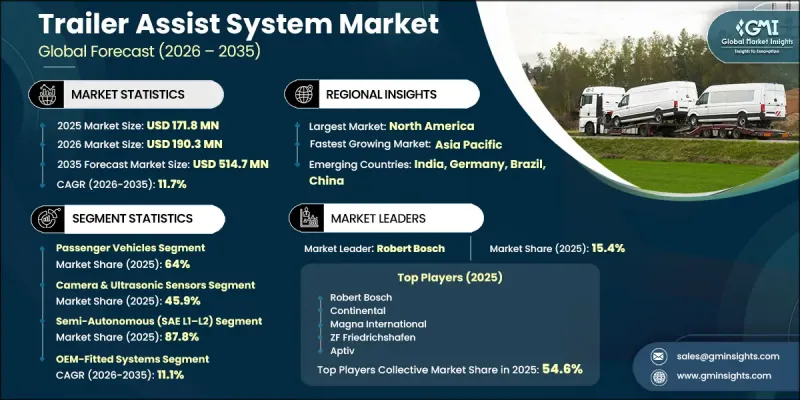
The Global Trailer Assist System Market was valued at USD 171.8 million in 2025 and is estimated to grow at a CAGR of 11.7% to reach USD 514.7 million by 2035.
The market is gaining significant momentum as vehicle manufacturers continue to enhance safety, convenience, and automation capabilities across modern transportation platforms. The growing integration of Advanced Driver Assistance Systems (ADAS) and intelligent parking technologies is creating strong demand for trailer assist solutions worldwide. Maneuvering a vehicle while towing a trailer remains one of the most complex driving tasks, particularly in confined spaces and during reverse operations. Trailer assist systems simplify this process by automatically managing steering inputs while allowing drivers to control acceleration and braking functions, significantly improving vehicle handling and reducing operational risks. Rising consumer expectations for safer towing experiences, combined with increasing vehicle automation, are encouraging automakers to incorporate these systems into a broader range of vehicle models. Demand for towing applications continues to expand across personal transportation, commercial operations, agriculture, logistics, and industrial sectors, further supporting market growth. In addition, advancements in sensor technologies, imaging systems, and intelligent vehicle control platforms are enhancing the accuracy and effectiveness of trailer maneuvering systems. The increasing deployment of connected vehicle technologies and automated driving features is expected to create substantial opportunities for the trailer assist system market throughout the forecast period.
| Market Scope | |
|---|---|
| Start Year | 2025 |
| Forecast Year | 2026-2035 |
| Start Value | $171.8 Million |
| Forecast Value | $514.7 Million |
| CAGR | 11.7% |
The passenger vehicles segment held a 64% share and is projected to grow at a CAGR of 10.1% between 2026 and 2035. The segment's leadership is primarily driven by rising adoption of towing assistance technologies across sport utility vehicles, pickup trucks, crossover vehicles, and premium passenger automobiles. Growing consumer interest in recreational towing and utility transportation is encouraging demand for advanced systems that simplify reversing, parking, and trailer handling. Vehicle manufacturers are increasingly integrating trailer assist functionality with parking assistance technologies, electronic steering systems, advanced imaging solutions, and intelligent vehicle control systems to enhance the overall driving experience.
The camera and ultrasonic sensors segment held a 45.9% share in 2025. These technologies serve as the foundation of modern trailer assist systems by delivering the real-time information required for vehicle positioning, trailer path prediction, and obstacle recognition. Camera-based monitoring systems and sensor technologies improve visibility around the vehicle and trailer combination, helping drivers navigate challenging environments with greater confidence. The growing adoption of sensor-based ADAS platforms and automated parking systems is further driving demand for camera and ultrasonic sensor solutions across both passenger and commercial vehicle categories.
China Trailer Assist System Market held a 56% share, generating USD 16.5 million in 2025. The country's strong position is supported by its large automotive manufacturing base and growing demand for technologically advanced vehicles equipped with intelligent safety features. Rising consumer interest in premium mobility solutions, coupled with increasing adoption of advanced driver assistance technologies, is accelerating the integration of trailer assist systems across a wider range of vehicle platforms. Ongoing advancements in vehicle automation and intelligent mobility solutions are expected to further strengthen market growth throughout the region.
Major companies operating in the global trailer assist system market include Aptiv, Magna International, Continental, Robert Bosch, Valeo, Siemens, Hitachi Astemo, HELLA (FORVIA HELLA), ZF Friedrichshafen, and Volkswagen. Companies competing in the trailer assist system market are pursuing a variety of strategies to strengthen their market presence and enhance competitive positioning. Key initiatives include investing in advanced driver assistance technologies, expanding sensor fusion capabilities, and integrating artificial intelligence-driven vehicle control systems to improve trailer maneuvering accuracy. Manufacturers are focusing on research and development to create more sophisticated and user-friendly solutions that enhance safety and convenience. Strategic partnerships with automotive OEMs, software developers, and sensor technology providers are helping companies accelerate product innovation and market penetration. In addition, businesses are expanding their product portfolios, strengthening global distribution networks, and increasing investments in connected vehicle technologies.
Table of Contents
Chapter 1 Research Methodology
- 1.1 Research approach
- 1.2 Quality Commitments
- 1.2.1 GMI AI policy & data integrity commitment
- 1.2.1.1 Source consistency protocol
- 1.2.1 GMI AI policy & data integrity commitment
- 1.3 Research Trail & Confidence Scoring
- 1.3.1 Research Trail Components
- 1.3.2 Scoring Components
- 1.4 Data Collection
- 1.4.1 Partial list of primary sources
- 1.5 Data mining sources
- 1.5.1 Paid sources
- 1.5.1.1 Sources, by region
- 1.5.1 Paid sources
- 1.6 Base estimates and calculations
- 1.6.1 Base year calculation for any one approach
- 1.7 Forecast model
- 1.7.1 Quantified market impact analysis
- 1.7.1.1 Mathematical impact of growth parameters on forecast
- 1.7.1 Quantified market impact analysis
- 1.8 Research transparency addendum
- 1.8.1 Source attribution framework
- 1.8.2 Quality assurance metrics
- 1.8.3 Our commitment to trust
Chapter 2 Executive Summary
- 2.1 Industry 360° synopsis, 2022 - 2035
- 2.2 Key market trends
- 2.2.1 Regional
- 2.2.2 Vehicle
- 2.2.3 Component
- 2.2.4 Technology
- 2.2.5 Sales Channel
- 2.3 TAM Analysis, 2026-2035
- 2.4 CXO perspectives: Strategic imperatives
Chapter 3 Industry Insights
- 3.1 Industry ecosystem analysis
- 3.1.1 Supplier landscape
- 3.1.2 Profit margin analysis
- 3.1.3 Cost structure
- 3.1.4 Value addition at each stage
- 3.1.5 Factor affecting the value chain
- 3.1.6 Disruptions
- 3.2 Industry impact forces
- 3.2.1 Growth drivers
- 3.2.1.1 Rising Demand for Vehicle Safety & Driver Assistance Features Driven by NCAP & GSR Mandates
- 3.2.1.2 Surge in Recreational Towing Activity Across Passenger Vehicle Segment (SUVs & Pickup Trucks)
- 3.2.1.3 Accelerating OEM Integration of ADAS Technologies as Standard or Optional Equipment
- 3.2.1.4 Growth in Commercial Fleet Modernization & Logistics Automation
- 3.2.2 Industry pitfalls and challenges
- 3.2.2.1 High System Integration & Component Costs Limiting Adoption in Price-Sensitive Markets
- 3.2.2.2 Sensor Performance Degradation in Adverse Weather Conditions (Rain, Fog, Snow)
- 3.2.3 Market opportunities
- 3.2.3.1 Rapid Growth of Semi-Autonomous & Autonomous Vehicle Platforms Creating System Upgrade Pathways
- 3.2.3.2 Expanding Aftermarket Retrofit Segment for Legacy Fleet Modernization
- 3.2.3.3 AI-Powered Trailer Assist Systems Enabling Predictive Maneuvering & Obstacle Intelligence
- 3.2.3.4 Electrification of Commercial Tow Vehicles - New Integration Opportunities for Trailer ADAS
- 3.2.1 Growth drivers
- 3.3 Growth potential analysis
- 3.4 Technology and innovation landscape
- 3.4.1 Current technological trends
- 3.4.2 Emerging technologies
- 3.5 Pricing Analysis (Driven by primary research)
- 3.5.1 Historical Price Trend Analysis
- 3.5.2 Pricing Strategy by Player Type
- 3.6 Regulatory landscape
- 3.6.1 North America
- 3.6.1.1 U.S.: National Highway Traffic Safety Administration (NHTSA) - Federal Motor Vehicle Safety Standards (FMVSS) Governing Trailer Assist and Towing Safety Systems
- 3.6.1.2 Canada: Transport Canada - Canada Motor Vehicle Safety Standards (CMVSS) for Trailer Assist and Towing Technologies
- 3.6.2 Europe
- 3.6.2.1 Germany: Federal Motor Transport Authority (KBA) - UNECE R79 and General Safety Regulation (EU) 2019/2144 for Trailer Assist Technologies
- 3.6.2.2 UK: Driver and Vehicle Standards Agency (DVSA) - UNECE Vehicle Safety Regulations for Trailer Assist Systems
- 3.6.2.3 France: Ministry for Ecological Transition & Road Safety Authority - EU General Safety Regulation (EU) 2019/2144 for Trailer Assistance Systems
- 3.6.3 Asia Pacific
- 3.6.3.1 China: Ministry of Industry and Information Technology (MIIT) - GB Vehicle Safety Standards and Intelligent Connected Vehicle (ICV) Regulations for Trailer Assist Systems
- 3.6.3.2 India: Ministry of Road Transport and Highways (MoRTH) - Automotive Industry Standards (AIS) and Central Motor Vehicle Rules (CMVR) for Trailer Assist Technologies
- 3.6.3.3 Japan: Ministry of Land, Infrastructure, Transport and Tourism (MLIT) - Advanced Safety Vehicle (ASV) Guidelines and Safety Regulations for Trailer Assist Systems
- 3.6.4 Latin America
- 3.6.4.1 Brazil: National Traffic Council (CONTRAN) - Brazilian Vehicle Safety Regulations for Trailer Towing and Assistance Systems
- 3.6.5 Middle East & Africa
- 3.6.5.1 Saudi Arabia: Saudi Standards, Metrology and Quality Organization (SASO) - GCC Vehicle Safety Regulations and Technical Standards for Trailer Assist Systems
- 3.6.1 North America
- 3.7 Porter's analysis
- 3.8 PESTEL analysis
- 3.9 Patent analysis (Driven by primary research)
- 3.10 Trade Data Analysis (Driven by paid database)
- 3.10.1 Import/export volume & value trends
- 3.10.2 Key trade corridors & tariff impact
- 3.11 Cost breakdown analysis
- 3.12 Impact of AI and Generative AI on the Market
- 3.12.1 AI Driven Disruption of Existing Business Models
- 3.12.2 GenAI Use Cases and Adoption Roadmap by Segment
- 3.12.3 Risks Limitations and Regulatory Considerations
- 3.13 Capacity & Production Landscape (Driven by Primary Research)
- 3.13.1 Installed Capacity by Region & Key Producer
- 3.13.2 Capacity Utilization Rates & Expansion Pipelines
- 3.14 Sustainability and environmental aspects
- 3.14.1 Sustainable practices
- 3.14.2 Waste reduction strategies
- 3.14.3 Energy efficiency in production
- 3.14.4 Eco-friendly Initiatives
- 3.14.5 Carbon footprint considerations
- 3.15 Forecast assumptions & scenario analysis (Driven by Primary Research)
- 3.15.1 Base Case- Key Macro & Industry Variables Driving CAGR
- 3.15.2 Optimistic Scenarios- Favorable macro and industry tailwinds
- 3.15.3 Pessimistic Scenario - Macroeconomic slowdown or industry headwinds
Chapter 4 Competitive Landscape, 2025
- 4.1 Introduction
- 4.2 Company market share analysis
- 4.2.1 North America
- 4.2.2 Europe
- 4.2.3 Asia Pacific
- 4.2.4 LATAM
- 4.2.5 MEA
- 4.3 Competitive analysis of major market players
- 4.4 Competitive positioning matrix
- 4.5 Key developments
- 4.5.1 Mergers & acquisitions
- 4.5.2 Partnerships & collaborations
- 4.5.3 New Product Launches
- 4.5.4 Expansion Plans and funding
- 4.6 Company tier benchmarking
- 4.6.1 Tier classification criteria & qualifying thresholds
- 4.6.2 Tier positioning matrix by revenue, geography & innovation
Chapter 5 Market Estimates & Forecast, By Vehicle, 2022 - 2035 (USD Mn)
- 5.1 Key trends
- 5.2 Passenger Vehicles
- 5.2.1 Hatchback
- 5.2.2 Sedan
- 5.2.3 SUV
- 5.3 Commercial Vehicles
- 5.3.1 LCV (Light Commercial Vehicles)
- 5.3.2 MCV (Medium Commercial Vehicles)
- 5.3.3 HCV (Heavy Commercial Vehicles)
Chapter 6 Market Estimates & Forecast, By Component, 2022 - 2035 (USD Mn)
- 6.1 Key trends
- 6.2 Camera & Ultrasonic Sensors
- 6.3 Software Modules & Algorithms
- 6.4 Electronic Control Unit (ECU)
Chapter 7 Market Estimates & Forecast, By Technology, 2022 - 2035 (USD Mn)
- 7.1 Key trends
- 7.2 Semi-Autonomous (SAE L1-L2)
- 7.3 Highly & Fully Autonomous (SAE L3-L5)
Chapter 8 Market Estimates & Forecast, By Sales Channel, 2022 - 2035 (USD Mn)
- 8.1 Key trends
- 8.2 OEM-Fitted Systems
- 8.3 Aftermarket Retrofits
Chapter 9 Market Estimates & Forecast, By Region, 2022 - 2035 (USD Mn)
- 9.1 Key trends
- 9.2 North America
- 9.2.1 US
- 9.2.2 Canada
- 9.3 Europe
- 9.3.1 Germany
- 9.3.2 UK
- 9.3.3 France
- 9.3.4 Italy
- 9.3.5 Spain
- 9.3.6 Russia
- 9.3.7 Norway
- 9.3.8 Netherlands
- 9.3.9 Sweden
- 9.4 Asia Pacific
- 9.4.1 China
- 9.4.2 India
- 9.4.3 Japan
- 9.4.4 Australia
- 9.4.5 South Korea
- 9.4.6 Singapore
- 9.4.7 Thailand
- 9.4.8 Indonesia
- 9.4.9 Vietnam
- 9.5 Latin America
- 9.5.1 Brazil
- 9.5.2 Mexico
- 9.5.3 Argentina
- 9.6 MEA
- 9.6.1 South Africa
- 9.6.2 Saudi Arabia
- 9.6.3 UAE
- 9.6.4 Turkey
Chapter 10 Company Profiles
- 10.1 Global Players
- 10.1.1 Bosch
- 10.1.2 Continental
- 10.1.3 ZF (including WABCO)
- 10.1.4 Magna
- 10.1.5 Valeo
- 10.1.6 Aptiv
- 10.1.7 FORVIA HELLA
- 10.1.8 Denso
- 10.1.9 Hitachi Astemo
- 10.1.10 Siemens
- 10.1.11 Ford Motor Company
- 10.1.12 General Motors
- 10.1.13 BMW
- 10.1.14 Mercedes-Benz
- 10.1.15 Volkswagen
- 10.2 Regional Players
- 10.2.1 Westfalia-Automotive
- 10.2.2 Knorr-Bremse
- 10.2.3 Cogent Embedded
- 10.2.4 DornerWorks
- 10.2.5 EchoMaster

