PUBLISHER: Global Market Insights Inc. | PRODUCT CODE: 2071327

PUBLISHER: Global Market Insights Inc. | PRODUCT CODE: 2071327
Household Vacuum Cleaner Market Opportunity, Growth Drivers, Industry Trend Analysis, and Forecast 2026 - 2035
The Global Household Vacuum Cleaner Market was valued at USD 20.3 billion in 2025 and is estimated to grow at a CAGR of 6.1% to reach USD 36.7 billion by 2035.
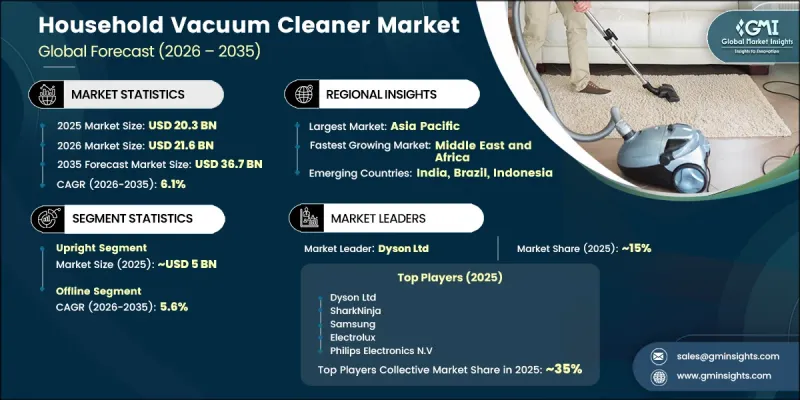
Market growth is driven by rising household incomes, rapid urbanization, and continuous improvements in product design and cleaning efficiency. Increasing awareness of indoor air quality and hygiene is also contributing significantly to product adoption across global households. Over time, consumer demand has shifted from traditional corded upright and canister models toward cordless and robotic vacuum cleaners, which are gaining strong traction in both premium and mid-range categories. Replacement demand in mature markets continues to support steady sales, while first-time adoption in developing economies is expanding the consumer base. In developed regions, shorter replacement cycles are being driven by rapid technological upgrades and improved performance features in newer models. In contrast, emerging markets are benefiting from expanding retail networks and rising brand penetration. Asia Pacific remains a key growth region due to rapid urban household expansion, while North America and Western Europe continue to contribute strong revenue supported by premium product adoption. Robotic vacuum cleaners represent the fastest-growing segment, reflecting strong consumer interest in automation and smart home integration.
| Market Scope | |
|---|---|
| Start Year | 2025 |
| Forecast Year | 2026-2035 |
| Start Value | $20.3 Billion |
| Forecast Value | $36.7 Billion |
| CAGR | 6.1% |
The upright vacuum cleaner segment generated USD 5 billion in 2025 and is expected to grow at a CAGR of 4.8% through 2035. This segment continues to maintain relevance due to its strong suction performance and suitability for deep cleaning applications. Consumers preferring high-capacity dust collection and consistent cleaning power continue to favor upright models despite the rising popularity of compact and automated alternatives.
The offline distribution channel accounted for 65.1% share in 2025 and is projected to grow at a CAGR of 5.6% through 2035. This channel remains dominant as consumers prefer physical evaluation of product features such as suction strength, ergonomics, and noise levels before purchase. In-store demonstrations and hands-on product experiences continue to influence buying decisions, especially for high-end models. Established retail networks remain critical for brand visibility and sales conversion across global markets.
United States Household Vacuum Cleaner Market reached USD 3.2 billion in 2025 and is expected to grow at a CAGR of 5.2% through 2035. Market growth is supported by high appliance ownership rates, strong demand for smart and connected cleaning solutions, and a mature retail and e-commerce ecosystem. Consumer preferences are increasingly shaped by advanced features such as cordless operation, intelligent navigation, and high-efficiency filtration systems. Energy efficiency standards and certification programs also influence purchasing decisions, particularly in the premium segment, while large retail chains continue to provide strong distribution support for leading brands.
Key companies operating in the Global Household Vacuum Cleaner Market include Dyson Ltd, SharkNinja, Philips Electronics N.V, Samsung, Electrolux, LG Electronics Inc, Panasonic Corporation, BSH Home Appliances Group, Ecovacs, Roborock, Dreame Technology, Midea, Hoover, Miele, iRobot, Bissell, Rowenta, Vorwerk & Co. Interhold AG, Eureka, Black+Decker, and Shojiki. Companies in the household vacuum cleaner market are strengthening their competitive position through continuous product innovation, smart technology integration, and expansion of distribution channels. A major focus is placed on developing cordless, robotic, and AI-enabled vacuum cleaners that enhance convenience, efficiency, and automation in household cleaning. Manufacturers are investing heavily in research and development to improve suction performance, battery life, filtration systems, and noise reduction capabilities. Strategic partnerships with e-commerce platforms and retail chains are helping companies improve product visibility and accessibility. Firms are also expanding into smart home ecosystems by integrating vacuum cleaners with connected devices and mobile applications. Geographic expansion into emerging markets is another key strategy supported by localized production and marketing efforts. In addition, companies are enhancing after-sales services, warranty programs, and customer engagement initiatives to strengthen brand loyalty.
Table of Contents
Chapter 1 Research Methodology
- 1.1 Research approach
- 1.2 Quality Commitments
- 1.2.1 GMI AI policy & data integrity commitment
- 1.2.1.1 Source consistency protocol
- 1.2.1 GMI AI policy & data integrity commitment
- 1.3 Research trail & confidence scoring
- 1.3.1 Research trail components
- 1.3.2 Scoring components
- 1.4 Data Collection
- 1.4.1 Partial list of primary sources
- 1.5 Data mining sources
- 1.5.1 Paid sources
- 1.5.1.1 Sources, by region
- 1.5.1 Paid sources
- 1.6 Base estimates and calculations
- 1.6.1 Base year calculation
- 1.7 Forecast model
- 1.7.1 Quantified market impact analysis
- 1.7.1.1 Mathematical impact of growth parameters on forecast
- 1.7.1 Quantified market impact analysis
- 1.8 Research transparency addendum
- 1.8.1 Source attribution framework
- 1.8.2 Quality assurance metrics
- 1.8.3 Our commitment to trust
Chapter 2 Executive Summary
- 2.1 Industry 360° synopsis
- 2.2 Business trends
- 2.3 Regional
- 2.4 Product type
- 2.5 Technology
- 2.6 Power type
- 2.7 Bucket type
- 2.8 Distribution channel
Chapter 3 Industry Insights
- 3.1 Industry ecosystem analysis
- 3.1.1 Supplier landscape
- 3.1.2 Manufacturers
- 3.1.3 Distributors
- 3.1.4 Retailers
- 3.1.5 Profit margin analysis
- 3.1.6 Value addition at each stage
- 3.1.7 Factor affecting the value chain
- 3.2 Industry impact forces
- 3.2.1 Growth drivers
- 3.2.1.1 Urbanization and rising household disposable income
- 3.2.1.2 Technological innovation in motor efficiency, battery performance, and robotic navigation
- 3.2.1.3 Heightened awareness of indoor air quality and allergen management
- 3.2.2 Industry pitfalls & challenges
- 3.2.2.1 Electronic waste generation and sustainability compliance pressure
- 3.2.2.2 Intense price competition
- 3.2.3 Opportunities
- 3.2.1 Growth drivers
- 3.3 Growth potential analysis
- 3.4 Technology and innovation landscape
- 3.4.1 Current technological trends
- 3.4.2 Emerging technologies
- 3.5 Price trends
- 3.5.1 By region
- 3.5.2 By product type
- 3.6 Trade data analysis
- 3.7 Regulatory landscape
- 3.7.1 Standards and compliance requirements
- 3.7.2 Regional regulatory frameworks
- 3.7.3 Certification standards
- 3.8 Porter's analysis
- 3.9 PESTEL analysis
- 3.10 Impact of AI & generative AI on the market
- 3.10.1 AI-driven disruption of existing business models
- 3.10.2 GenAI use cases & adoption roadmap by segment
- 3.10.3 Risks, limitations & regulatory considerations
- 3.11 Consumer behavior analysis
- 3.11.1 Demographic trends
- 3.11.2 Factors affecting buying decision
- 3.11.3 Consumer product adoption
- 3.11.4 Preferred distribution channel
- 3.11.5 Preferred price range
Chapter 4 Competitive Landscape, 2025
- 4.1 Introduction
- 4.2 Company market share analysis
- 4.2.1 By Region
- 4.2.1.1 North America
- 4.2.1.2 Europe
- 4.2.1.3 Asia Pacific
- 4.2.1.4 Latin America
- 4.2.1.5 Middle East & Africa
- 4.2.1 By Region
- 4.3 Company matrix analysis
- 4.4 Competitive analysis of major market players
- 4.5 Competitive positioning matrix
- 4.6 Key developments
- 4.6.1 Mergers & acquisitions
- 4.6.2 Partnerships & collaborations
- 4.6.3 New product launches
- 4.6.4 Expansion plans
Chapter 5 Market Estimates & Forecast, By Product Type, 2022 - 2035, (USD Billion) (Units)
- 5.1 Key trends
- 5.2 Robotic Vacuum Cleaners
- 5.3 Stick/Handheld
- 5.4 Upright
- 5.5 Canister
- 5.6 Wet & Dry
- 5.7 Others
Chapter 6 Market Estimates & Forecast, By Technology, 2022 - 2035, (USD Billion) (Units)
- 6.1 Key trends
- 6.2 Conventional
- 6.3 Smart/Connected
Chapter 7 Market Estimates & Forecast, By Power Type, 2022 - 2035, (USD Billion) (Units)
- 7.1 Key trends
- 7.2 Corded
- 7.3 Cordless
Chapter 8 Market Estimates & Forecast, By Bucket Type, 2022 - 2035, (USD Billion) (Units)
- 8.1 Key trends
- 8.2 Bagged
- 8.3 Bagless
Chapter 9 Market Estimates & Forecast, By Distribution Channel, 2022 - 2035, (USD Billion) (Units)
- 9.1 Key trends
- 9.2 Online
- 9.2.1 Company Websites
- 9.2.2 E-commerce Websites
- 9.3 Offline
- 9.3.1 Supermarkets and Hypermarkets
- 9.3.2 Specialty Stores
- 9.3.3 Others
Chapter 10 Market Estimates & Forecast, By Region, 2022 - 2035, (USD Billion) (Units)
- 10.1 Key trends
- 10.2 North America
- 10.2.1 U.S
- 10.2.2 Canada
- 10.3 Europe
- 10.3.1 Germany
- 10.3.2 UK
- 10.3.3 France
- 10.3.4 Italy
- 10.3.5 Spain
- 10.3.6 Sweden
- 10.3.7 Netherlands
- 10.4 Asia Pacific
- 10.4.1 China
- 10.4.2 India
- 10.4.3 Japan
- 10.4.4 South Korea
- 10.4.5 Australia
- 10.4.6 Indonesia
- 10.5 Latin America
- 10.5.1 Brazil
- 10.5.2 Mexico
- 10.5.3 Argentina
- 10.6 Middle East and Africa
- 10.6.1 Saudi Arabia
- 10.6.2 UAE
- 10.6.3 South Africa
Chapter 11 Company Profiles
- 11.1 Global Players
- 11.1.1 Philips Electronics N.V
- 11.1.2 Dyson Ltd
- 11.1.3 SharkNinja
- 11.1.4 Samsung
- 11.1.5 Electrolux
- 11.1.6 LG Electronics Inc
- 11.1.7 Panasonic Corporation
- 11.1.8 BSH Home Appliances Group
- 11.2 Regional Players
- 11.2.1 Ecovacs
- 11.2.2 Roborock
- 11.2.3 Dreame Technology
- 11.2.4 Midea
- 11.2.5 Hoover
- 11.2.6 Miele
- 11.2.7 iRobot
- 11.3 Emerging Players & Innovators
- 11.3.1 Bissell
- 11.3.2 Rowenta
- 11.3.3 Vorwerk & Co. Interhold AG
- 11.3.4 Eureka
- 11.3.5 Black+Decker
- 11.3.6 Shojiki

