PUBLISHER: Global Market Insights Inc. | PRODUCT CODE: 2071329

PUBLISHER: Global Market Insights Inc. | PRODUCT CODE: 2071329
Membrane Switch Market Opportunity, Growth Drivers, Industry Trend Analysis, and Forecast 2026 - 2035
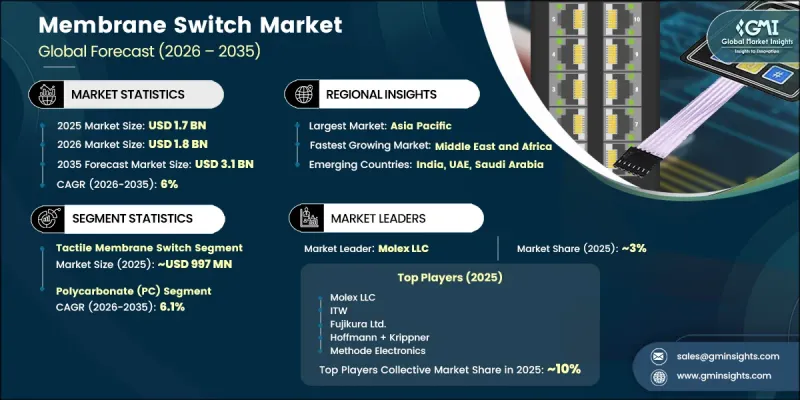
The Global Membrane Switch Market was valued at USD 1.7 billion in 2025 and is estimated to grow at a CAGR of 6% to reach USD 3.1 billion by 2035.
The expansion is underpinned by the convergence of multiple long-term demand drivers, including rising investment in automated manufacturing systems, ongoing modernization of medical devices under regulatory compliance requirements, and increasing output of electric vehicles, all of which reinforce stable procurement of sealed interface technologies. The market is further supported by the transition from conventional membrane assemblies to advanced formats featuring backlighting, haptic response layers, and connected IoT-enabled interfaces, which is steadily improving both product value and average selling prices. In industrial automation environments, membrane switches are widely deployed as primary human-machine interfaces across control systems such as PLC units, CNC machinery, VFD systems, and integrated process control panels. Their adoption is strongly linked to the requirement for sealed, durable interfaces with IP65 and IP67 protection standards that can withstand exposure to moisture, chemicals, vibration, and temperature fluctuations, where alternative touchscreen technologies often face performance limitations under demanding operating conditions.
| Market Scope | |
|---|---|
| Start Year | 2025 |
| Forecast Year | 2026-2035 |
| Start Value | $1.7 Billion |
| Forecast Value | $3.1 Billion |
| CAGR | 6% |
The tactile membrane switch category accounted for 57.8% share in 2025, reaching USD 997 million, and is expected to grow at a CAGR of 6.3% through 2035. This segment maintains strong adoption due to the integration of metal snap domes or polyester-based dome structures placed beneath graphic overlays, delivering precise tactile feedback during operation. Such feedback mechanisms are especially critical in environments where input confirmation is essential, including regulated medical systems, defense applications, and high-reliability industrial control platforms where operational accuracy is a core requirement.
The polycarbonate (PC) segment held a 47.2% share in 2025, generating USD 814 million, and is projected to grow at a CAGR of 6.1% through 2035, the highest among major substrate categories. Its dominance is attributed to strong optical clarity, excellent impact resistance, and superior thermal stability compared to alternative materials, making it highly suitable for medical interfaces, automotive control panels, and industrial equipment requiring durable, high-visibility overlays under continuous use conditions.
North America Membrane Switch Market accounted for USD 473 million in 2025, representing 27.4% share, and is projected to reach USD 822 million by 2035 at a CAGR of 5.6%, supported by strong demand from defense procurement programs, medical device manufacturing, and industrial automation investments concentrated across established OEM manufacturing hubs in key industrial corridors.
Companies operating in the global membrane switch industry include Molex LLC, ITW (Switches Division), Fujikura Ltd., Methode Electronics, Hoffmann + Krippner, Nelson-Miller (Sensata Technologies), XYMOX Technologies, Epec Engineered Technologies, and Polydome Electronics. Manufacturers in the membrane switch market are focusing on product miniaturization, integration of smart and connected interface technologies, and enhancement of durability standards to meet stringent industrial and medical requirements. Many players are investing in advanced materials such as high-performance polycarbonate and hybrid substrate solutions to improve lifecycle performance under harsh environments. Strategic collaborations with OEMs and industrial equipment manufacturers are enabling customized interface designs tailored to application-specific needs. Companies are also strengthening their presence through regional manufacturing expansion to reduce lead times and logistics costs. In addition, digital transformation initiatives, including simulation-based prototyping and automated production lines, are improving scalability and cost efficiency.
Table of Contents
Chapter 1 Research Methodology
- 1.1 Research approach
- 1.2 Quality Commitments
- 1.2.1 GMI AI policy & data integrity commitment
- 1.2.1.1 Source consistency protocol
- 1.2.1 GMI AI policy & data integrity commitment
- 1.3 Research trail & confidence scoring
- 1.3.1 Research trail components
- 1.3.2 Scoring components
- 1.4 Data Collection
- 1.4.1 Partial list of primary sources
- 1.5 Data mining sources
- 1.5.1 Paid sources
- 1.5.1.1 Sources, by region
- 1.5.1 Paid sources
- 1.6 Base estimates and calculations
- 1.6.1 Base year calculation
- 1.7 Forecast model
- 1.7.1 Quantified market impact analysis
- 1.7.1.1 Mathematical impact of growth parameters on forecast
- 1.7.1 Quantified market impact analysis
- 1.8 Research transparency addendum
- 1.8.1 Source attribution framework
- 1.8.2 Quality assurance metrics
- 1.8.3 Our commitment to trust
Chapter 2 Executive Summary
- 2.1 Industry 360° synopsis
- 2.2 Business trends
- 2.3 Regional
- 2.4 Type
- 2.5 Technology
- 2.6 Substrate material
- 2.7 Application
Chapter 3 Industry Insights
- 3.1 Industry ecosystem analysis
- 3.1.1 Supplier landscape
- 3.1.2 Manufacturers
- 3.1.3 Distributors
- 3.1.4 End users
- 3.1.5 Profit margin analysis
- 3.1.6 Value addition at each stage
- 3.1.7 Factor affecting the value chain
- 3.2 Industry impact forces
- 3.2.1 Growth drivers
- 3.2.1.1 Industry 4.0 and IIoT integration
- 3.2.1.2 Electric vehicle production expansion
- 3.2.1.3 EU MDR compliance and medical device re-certification
- 3.2.1.4 Aging population and medical device demand
- 3.2.2 Industry pitfalls & challenges
- 3.2.2.1 Touchscreen substitution in low-complexity applications
- 3.2.2.2 Raw material cost volatility
- 3.2.2.3 Supply chain concentration and geopolitical exposure
- 3.2.3 Opportunities
- 3.2.1 Growth drivers
- 3.3 Growth potential analysis
- 3.4 Technology and innovation landscape
- 3.4.1 Current technological trends
- 3.4.2 Emerging technologies
- 3.5 Pricing analysis (driven by primary research)
- 3.5.1 Historical price trend analysis by product category
- 3.5.2 Pricing strategy by player type (premium / value / cost-plus)
- 3.6 Trade data analysis (based on paid data sources)
- 3.6.1 Import/export volume & value trends
- 3.6.2 Key trade corridors & tariff impact
- 3.7 Regulatory landscape
- 3.7.1 Standards and compliance requirements
- 3.7.2 Regional regulatory frameworks
- 3.7.3 Certification standards
- 3.8 Porter's analysis
- 3.9 PESTEL analysis
- 3.10 Impact of AI & generative AI on the market
- 3.10.1 AI-driven disruption of existing business models
- 3.10.2 GenAI use cases & adoption roadmap by segment
- 3.10.3 Risks, limitations & regulatory considerations
Chapter 4 Competitive Landscape, 2025
- 4.1 Introduction
- 4.2 Company market share analysis
- 4.2.1 By Region
- 4.2.1.1 North America
- 4.2.1.2 Europe
- 4.2.1.3 Asia Pacific
- 4.2.1.4 Latin America
- 4.2.1.5 Middle East & Africa
- 4.2.1 By Region
- 4.3 Company matrix analysis
- 4.4 Competitive analysis of major market players
- 4.5 Competitive positioning matrix
- 4.6 Key developments
- 4.6.1 Mergers & acquisitions
- 4.6.2 Partnerships & collaborations
- 4.6.3 New product launches
- 4.6.4 Expansion plans
Chapter 5 Market Estimates & Forecast, By Type, 2022 - 2035, (USD Billion) (Units)
- 5.1 Key trends
- 5.2 Tactile
- 5.3 Non-Tactile
Chapter 6 Market Estimates & Forecast, By Technology, 2022 - 2035, (USD Billion) (Units)
- 6.1 Key trends
- 6.2 Resistive
- 6.3 Capacitive
- 6.4 Force-Sensitive Resistor
Chapter 7 Market Estimates & Forecast, By Substrate Material, 2022 - 2035, (USD Billion) (Units)
- 7.1 Key trends
- 7.2 Polyester
- 7.3 Polycarbonate
- 7.4 Others
Chapter 8 Market Estimates & Forecast, By Application, 2022 - 2035, (USD Billion) (Units)
- 8.1 Key trends
- 8.2 Industrial Control Equipment
- 8.2.1 PLCs & Process Automation Panels
- 8.2.2 Factory Machinery & Heavy Equipment Controls
- 8.2.3 Energy & Utility Metering Interfaces
- 8.3 Medical Equipment
- 8.4 Consumer Electronics
- 8.4.1 Household Appliances
- 8.4.2 Remote Controls & Home Automation Interfaces
- 8.4.3 Audio/Visual & Entertainment Equipment
- 8.5 Automotive
- 8.6 Aerospace & Defense
- 8.7 Others
Chapter 9 Market Estimates & Forecast, By Region, 2022 - 2035, (USD Billion) (Units)
- 9.1 Key trends
- 9.2 North America
- 9.2.1 U.S
- 9.2.2 Canada
- 9.3 Europe
- 9.3.1 Germany
- 9.3.2 UK
- 9.3.3 France
- 9.3.4 Italy
- 9.3.5 Spain
- 9.3.6 Sweden
- 9.3.7 Netherlands
- 9.4 Asia Pacific
- 9.4.1 China
- 9.4.2 India
- 9.4.3 Japan
- 9.4.4 South Korea
- 9.4.5 Australia
- 9.4.6 Indonesia
- 9.5 Latin America
- 9.5.1 Brazil
- 9.5.2 Mexico
- 9.5.3 Argentina
- 9.6 Middle East and Africa
- 9.6.1 Saudi Arabia
- 9.6.2 UAE
- 9.6.3 South Africa
Chapter 10 Company Profiles
- 10.1 Global Players
- 10.1.1 Molex LLC
- 10.1.2 Fujikura Ltd.
- 10.1.3 RAFI GmbH & Co KG
- 10.1.4 TE Connectivity Ltd.
- 10.1.5 Methode Electronics Inc.
- 10.2 Regional Players
- 10.2.1 Xymox Technologies Inc
- 10.2.2 Butler Technologies Inc.
- 10.2.3 Epec Engineered Technologies
- 10.2.4 TT Electronics plc
- 10.2.5 EAO Corporation
- 10.2.6 Schurter AG
- 10.2.7 Alps Alpine Co Ltd.
- 10.3 Emerging Players & Innovators
- 10.3.1 Shenzhen Lunfeng Technology Co Ltd.
- 10.3.2 GOT Interface
- 10.3.3 Dyna-Graphics Corporation
- 10.3.4 Nelson Miller Group
- 10.3.5 Design Mark Industries Inc.
- 10.3.6 JN White
- 10.3.7 DuraTech Industries
- 10.3.8 Techprint Inc.
- 10.3.9 Shenzhen Yu An Electronics Co Ltd.

