PUBLISHER: Global Market Insights Inc. | PRODUCT CODE: 2071331

PUBLISHER: Global Market Insights Inc. | PRODUCT CODE: 2071331
Polymeric Surfactants Market Opportunity, Growth Drivers, Industry Trend Analysis, and Forecast 2026 - 2035
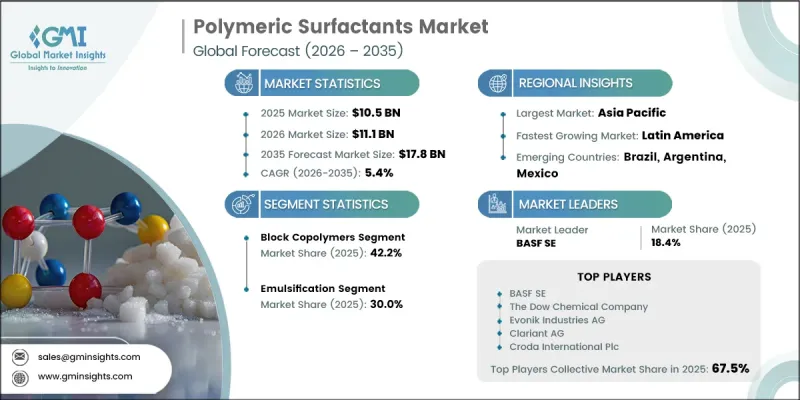
The Global Polymeric Surfactants Market was valued at USD 10.5 billion in 2025 and is estimated to grow at a CAGR of 5.4% to reach USD 17.8 billion by 2035.
Market growth is supported by the ongoing transition toward environmentally responsible formulation technologies across a wide range of industries. Water-based and low-volatile organic compound (VOC) systems are increasingly replacing traditional solvent-based formulations in coatings, paints, personal care products, and industrial applications, creating strong demand for advanced polymeric surfactants. These materials play a critical role in improving formulation stability, performance, and compatibility within modern product systems. Demand patterns are becoming increasingly diversified, with high-performance polymeric surfactants gaining traction in industrial and technical applications, while bio-based and sustainability-focused formulations continue to expand across consumer-oriented markets. The personal care and cosmetics industry remains one of the most attractive growth areas, driven by increasing consumer preference for premium products offering improved texture, stability, and sensory performance. In addition, polymeric surfactants are gaining importance in specialized industrial processes that require enhanced interfacial control, efficiency improvements, and optimized formulation characteristics. As regulatory requirements continue to evolve and sustainability objectives become more prominent, manufacturers are increasingly incorporating polymeric surfactants into next-generation product development strategies.
| Market Scope | |
|---|---|
| Start Year | 2025 |
| Forecast Year | 2026-2035 |
| Start Value | $10.5 Billion |
| Forecast Value | $17.8 Billion |
| CAGR | 5.4% |
Block copolymers accounted for 42.2% share in 2025, making them the leading product category. Their strong market position is attributed to their ability to provide precise control over molecular structure and amphiphilic properties, enabling formulators to tailor performance for specific applications. These materials are widely utilized across coatings, pharmaceuticals, agriculture, industrial processing, and personal care formulations due to their versatility, stability, and compatibility with a broad range of systems. Continued demand for high-performance formulations is expected to support sustained growth within this segment throughout the forecast period.
The emulsification segment held a 30% share in 2025. The segment's leadership is driven by the critical role polymeric surfactants play in stabilizing complex formulations and maintaining long-term product performance. Effective emulsion stability is essential across numerous industries, including coatings, agricultural products, personal care formulations, and specialty chemicals. The ability of polymeric surfactants to create durable interfacial structures and enhance formulation consistency continues to make them indispensable in advanced emulsification applications.
North America Polymeric Surfactants Market accounted for 27.7% share in 2025. Strong demand is supported by increasing adoption of environmentally compliant formulations, evolving product performance requirements, and stringent regulations governing emissions and chemical usage. Manufacturers throughout the region continue to invest in low-VOC and water-based product development, creating sustained demand for advanced surfactant technologies. Ongoing innovation in coatings, personal care products, and industrial formulations is expected to further strengthen regional market growth over the forecast period.
Major companies operating in the global polymeric surfactants market include BASF SE, Clariant AG, Croda International Plc, Evonik Industries AG, Solvay S.A., The Dow Chemical Company, Lubrizol Corporation, Stepan Company, ADEKA Corporation, Akzo Nobel N.V., Colonial Chemical, Inc., Huntsman International LLC, Kao Corporation, Nouryon, Sasol Limited, and Wacker Chemie AG. Companies operating in the polymeric surfactants market are pursuing multiple strategies to strengthen their competitive position and expand their market presence. Product innovation remains a primary focus, with manufacturers investing heavily in research and development to create high-performance, sustainable, and application-specific surfactant solutions. Many companies are expanding their portfolios of bio-based and environmentally friendly products to align with evolving regulatory requirements and customer sustainability goals. Strategic partnerships, acquisitions, and collaborations are also being utilized to enhance technological capabilities and broaden geographic reach. In addition, market participants are increasing investments in advanced manufacturing technologies to improve production efficiency and product consistency.
Table of Contents
Chapter 1 Methodology & Scope
- 1.1 Market scope and definition
- 1.2 Research design
- 1.2.1 Research approach
- 1.2.2 Data collection methods
- 1.3 Data mining sources
- 1.3.1 Global
- 1.3.2 Regional/Country
- 1.4 Base estimates and calculations
- 1.4.1 Base year calculation
- 1.4.2 Key trends for market estimation
- 1.5 Primary research and validation
- 1.5.1 Primary sources
- 1.6 Forecast model
- 1.7 Research assumptions and limitations
Chapter 2 Executive Summary
- 2.1 Industry 360° synopsis
- 2.2 Key market trends
- 2.2.1 Regional
- 2.2.2 Polymer Architecture
- 2.2.3 Application
- 2.2.4 End user industry
- 2.3 TAM Analysis, 2026-2035
- 2.4 CXO perspectives: Strategic imperatives
- 2.4.1 Executive decision points
Chapter 3 Industry Insights
- 3.1 Industry ecosystem analysis
- 3.1.1 Supplier landscape
- 3.1.2 Profit margin
- 3.1.3 Value addition at each stage
- 3.1.4 Factor affecting the value chain
- 3.1.5 Disruptions
- 3.2 Industry impact forces
- 3.2.1 Growth drivers
- 3.2.2 Industry pitfalls and challenges
- 3.2.3 Market opportunities
- 3.3 Growth potential analysis
- 3.4 Regulatory landscape
- 3.4.1 North America
- 3.4.2 Europe
- 3.4.3 Asia Pacific
- 3.4.4 Latin America
- 3.4.5 Middle East & Africa
- 3.5 Porter's analysis
- 3.6 PESTEL analysis
- 3.7 Price trends
- 3.7.1 By region
- 3.7.2 By type
- 3.8 Future market trends
- 3.9 Technology and Innovation landscape
- 3.9.1 Current technological trends
- 3.9.2 Emerging technologies
- 3.10 Patent Landscape
- 3.11 Trade statistics (HS code)
- 3.11.1 Major importing countries
- 3.11.2 Major exporting countries
- 3.12 Sustainability and environmental aspects
- 3.12.1 Sustainable practices
- 3.12.2 Waste reduction strategies
- 3.12.3 Energy efficiency in production
- 3.12.4 Eco-friendly initiatives
- 3.13 Carbon footprint consideration
Chapter 4 Competitive Landscape, 2025
- 4.1 Introduction
- 4.2 Company market share analysis
- 4.2.1 By region
- 4.2.1.1 North America
- 4.2.1.2 Europe
- 4.2.1.3 Asia Pacific
- 4.2.1.4 LATAM
- 4.2.1.5 MEA
- 4.2.1 By region
- 4.3 Company matrix analysis
- 4.4 Competitive analysis of major market players
- 4.5 Competitive positioning matrix
- 4.6 Key developments
- 4.6.1 Mergers & acquisitions
- 4.6.2 Partnerships & collaborations
- 4.6.3 New Product Launches
- 4.6.4 Expansion Plans
Chapter 5 Market Estimates and Forecast, By Polymer Architecture, 2022-2035 (USD Billion) (Kilo Tons)
- 5.1 Key trends
- 5.2 Block copolymers
- 5.3 Graft copolymers
- 5.4 Random/statistical copolymers (Polysoaps)
- 5.5 Complex architectures
Chapter 6 Market Estimates and Forecast, By Application, 2022-2035 (USD Billion) (Kilo Tons)
- 6.1 Key trends
- 6.2 Emulsification
- 6.3 Dispersion & stabilization
- 6.4 Wetting & spreading
- 6.5 Foam control
- 6.6 Detergency & cleaning
Chapter 7 Market Estimates and Forecast, By End User Industry, 2022-2035 (USD Billion) (Kilo Tons)
- 7.1 Key trends
- 7.2 Paints & coatings
- 7.3 Personal care & cosmetics
- 7.4 Home care & detergents
- 7.5 Textiles & leather
- 7.6 Agriculture
- 7.7 Polymer & plastics manufacturing
- 7.8 Oilfield chemicals
- 7.9 Pharmaceuticals
- 7.10 Others
Chapter 8 Market Estimates and Forecast, By Region, 2022-2035 (USD Billion) (Kilo Tons)
- 8.1 Key trends
- 8.2 North America
- 8.2.1 U.S.
- 8.2.2 Canada
- 8.3 Europe
- 8.3.1 Germany
- 8.3.2 UK
- 8.3.3 France
- 8.3.4 Spain
- 8.3.5 Italy
- 8.3.6 Rest of Europe
- 8.4 Asia Pacific
- 8.4.1 China
- 8.4.2 India
- 8.4.3 Japan
- 8.4.4 Australia
- 8.4.5 South Korea
- 8.4.6 Rest of Asia Pacific
- 8.5 Latin America
- 8.5.1 Brazil
- 8.5.2 Mexico
- 8.5.3 Argentina
- 8.5.4 Rest of Latin America
- 8.6 Middle East and Africa
- 8.6.1 Saudi Arabia
- 8.6.2 South Africa
- 8.6.3 UAE
- 8.6.4 Rest of Middle East and Africa
Chapter 9 Company Profiles
- 9.1 ADEKA Corporation
- 9.2 Akzo Nobel N.V.
- 9.3 BASF SE
- 9.4 Clariant AG
- 9.5 Colonial Chemical, Inc.
- 9.6 Croda International Plc
- 9.7 Evonik Industries AG
- 9.8 Huntsman International LLC
- 9.9 Kao Corporation
- 9.10 Lubrizol Corporation
- 9.11 Nouryon (formerly AkzoNobel Specialty Chemicals)
- 9.12 Sasol Limited
- 9.13 Solvay S.A.
- 9.14 Stepan Company
- 9.15 The Dow Chemical Company
- 9.16 Wacker Chemie AG

