PUBLISHER: Global Market Insights Inc. | PRODUCT CODE: 2071336

PUBLISHER: Global Market Insights Inc. | PRODUCT CODE: 2071336
Cleaning Robot Market Opportunity, Growth Drivers, Industry Trend Analysis, and Forecast 2026 - 2035
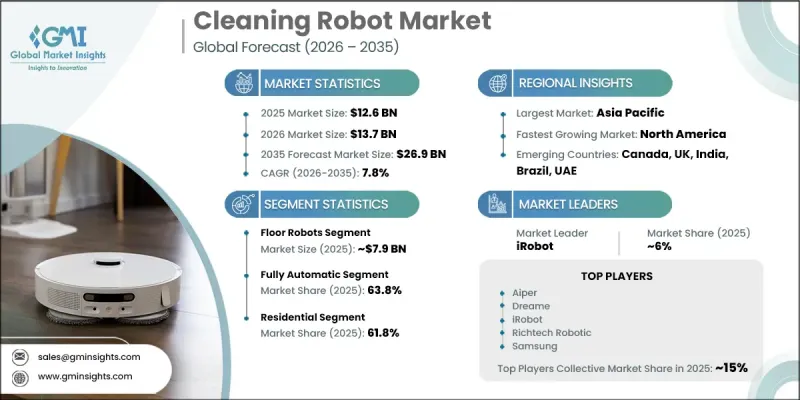
The Global Cleaning Robot Market was valued at USD 12.6 billion in 2025 and is estimated to grow at a CAGR of 7.8% to reach USD 26.9 billion by 2035.
Growth is supported by increasing urban population density and the shift toward time-efficient household technologies. Modern lifestyles, particularly in dual-income households, have significantly raised demand for devices that reduce manual cleaning effort while maintaining consistent hygiene standards. Heightened global attention to sanitation, reinforced by post-pandemic behavioral changes, has further strengthened adoption across both residential and commercial settings. Cleaning robots equipped with advanced filtration systems and ultraviolet-based disinfection capabilities are gaining broader acceptance, especially in environments where hygiene compliance is critical. Their integration into smart home ecosystems is also accelerating demand, as consumers increasingly prefer connected devices that can be controlled remotely and scheduled through digital platforms. Continuous innovation in navigation, sensing, and automation technologies is improving performance and affordability, further widening the addressable consumer base across developed and emerging economies.
| Market Scope | |
|---|---|
| Start Year | 2025 |
| Forecast Year | 2026-2035 |
| Start Value | $12.6 Billion |
| Forecast Value | $26.9 Billion |
| CAGR | 7.8% |
Floor cleaning robots accounted for USD 7.9 billion in 2025 and is projected to grow at a CAGR of 8% through 2035. This category, which includes robotic vacuum and mop systems, remains central to household automation because it addresses frequent and repetitive cleaning needs. Enhanced functionality, such as intelligent mapping, real-time obstacle detection, and automated scheduling, continues to improve usability and adoption across diverse home layouts.
The residential applications segment held a 61.8% share in 2025 and is expected to maintain a CAGR of 8% through 2035. Growing urbanization, smaller living spaces, and increasing workforce participation have encouraged households to adopt automated cleaning solutions. Features such as compact design, smart navigation, and app-based control align well with modern residential lifestyles, making these devices a practical choice for daily maintenance.
North America Cleaning Robot Market captured USD 3 billion in 2025 and is projected to grow at a CAGR of 8.1% through 2035. Strong consumer purchasing power, high digital literacy, and early adoption of smart home technologies continue to drive demand. Busy urban lifestyles and sustained emphasis on hygiene have reinforced adoption across both households and commercial environments.
Major players operating in the global cleaning robot industry include Ecovacs Robotics Co., Ltd., iRobot Corporation, Samsung Electronics, Xiaomi Corporation / Roborock, LG Electronics, Panasonic Corporation, Dyson Ltd., Haier Group, Miele & Cie. KG, Karcher (Alfred Karcher SE & Co. KG), Nilfisk Group, HOBOT Technology Inc., Cecotec Innovaciones S.L., ILIFE (Zhiyi Technology Co., Ltd.), Narwal Robotics, Dreame Technology, Proscenic, 360 Smart Life (Qihoo 360), SharkNinja (Shark Robotics division), Tineco Intelligent Technology Co., Ltd., and Makita Corporation. Companies in the cleaning robot market are strengthening their position by investing heavily in artificial intelligence, machine vision, and sensor fusion technologies to improve navigation accuracy and cleaning efficiency. They are also expanding product portfolios to cover multiple price segments, ensuring accessibility for both premium and budget-conscious consumers. Strategic emphasis on smart home integration allows seamless connectivity with voice assistants and IoT ecosystems, improving user convenience. Firms are increasingly adopting subscription-based service models and extended warranty programs to generate recurring revenue. Partnerships with e-commerce platforms and retail chains are improving distribution reach globally.
Table of Contents
Chapter 1 Methodology & Scope
- 1.1 Market scope and definition
- 1.2 Research design
- 1.2.1 Research approach
- 1.2.2 Data collection methods
- 1.3 Data mining sources
- 1.3.1 Global
- 1.3.2 Regional/Country
- 1.4 Base estimates and calculations
- 1.4.1 Base year calculation
- 1.4.2 Key trends for market estimation
- 1.5 Primary research and validation
- 1.5.1 Primary sources
- 1.6 Forecast model
- 1.7 Research assumptions and limitations
Chapter 2 Executive Summary
- 2.1 Industry 360° synopsis
- 2.2 Key market trends
- 2.2.1 Regional
- 2.2.2 Type
- 2.2.3 Mode of operation
- 2.2.4 Price
- 2.2.5 End user
- 2.2.6 Distribution channel
Chapter 3 Industry Insights
- 3.1 Industry ecosystem analysis
- 3.1.1 Supplier landscape
- 3.1.2 Profit margin
- 3.1.3 Value addition at each stage
- 3.1.4 Factor affecting the value chain
- 3.2 Industry impact forces
- 3.2.1 Growth drivers
- 3.2.1.1 Growing demand for convenience and time-saving solutions
- 3.2.1.2 Increasing awareness of hygiene and cleanliness
- 3.2.1.3 Rising adoption of smart homes and connected devices
- 3.2.2 Industry pitfalls & challenges
- 3.2.2.1 Battery life constraints
- 3.2.2.2 Performance issues on certain surfaces
- 3.2.3 Opportunities
- 3.2.3.1 Rising demand for commercial cleaning robots
- 3.2.3.2 Subscription-based services and Robot-as-a-Service (RaaS) models
- 3.2.1 Growth drivers
- 3.3 Growth potential analysis
- 3.4 Future market trends
- 3.5 Technology and innovation landscape
- 3.5.1 Current technological trends
- 3.5.2 Emerging technologies
- 3.6 Regulatory landscape
- 3.6.1 Standards and compliance requirements
- 3.6.2 Regional regulatory frameworks
- 3.6.3 Certification standards
- 3.7 Trade data analysis (HS Code 8508)
- 3.7.1 Import/export volume & value trends
- 3.7.2 Key trade corridors & tariff impact
- 3.8 Pricing analysis
- 3.8.1 Historical price trend analysis (driven by primary research)
- 3.8.2 Pricing strategy by player type (premium / value / mass market)
- 3.9 Impact of AI & generative AI on the market
- 3.9.1 AI-driven disruption of existing business models
- 3.9.2 GenAI use cases & adoption roadmap by segment
- 3.9.3 Risks, limitations & regulatory considerations
- 3.10 Porter's analysis
- 3.11 PESTEL analysis
- 3.12 Consumer buying behavior analysis
- 3.12.1 Demographic trends
- 3.12.2 Factors affecting buying decisions
- 3.12.3 Consumer product adoption
- 3.12.4 Preferred distribution channel
Chapter 4 Competitive Landscape, 2025
- 4.1 Introduction
- 4.2 Company market share analysis
- 4.2.1 By Region
- 4.2.1.1 North America
- 4.2.1.2 Europe
- 4.2.1.3 Asia Pacific
- 4.2.1.4 Latin America
- 4.2.1.5 Middle East & Africa
- 4.2.1 By Region
- 4.3 Company matrix analysis
- 4.4 Competitive analysis of major market players
- 4.5 Competitive positioning matrix
- 4.6 Key developments
- 4.6.1 Mergers & acquisitions
- 4.6.2 Partnerships & collaborations
- 4.6.3 New product launches
- 4.6.4 Expansion plans
Chapter 5 Market Estimates & Forecast, By Type, 2022 - 2035, (USD Billion) (Million Units)
- 5.1 Key trends
- 5.2 Floor robots
- 5.3 Window robots
- 5.4 Lawn robots
- 5.5 Pool robots
- 5.6 Others (duct robots etc.)
Chapter 6 Market Estimates & Forecast, By Mode of Operation, 2022 - 2035, (USD Billion) (Million Units)
- 6.1 Key trends
- 6.2 Semi-automatic
- 6.3 Fully automatic
Chapter 7 Market Estimates & Forecast, By Price, 2022 - 2035, (USD Billion) (Million Units)
- 7.1 Key trends
- 7.2 Low
- 7.3 Medium
- 7.4 High
Chapter 8 Market Estimates & Forecast, By End User, 2022 - 2035, (USD Billion) (Million Units)
- 8.1 Key trends
- 8.2 Residential
- 8.3 Commercial
- 8.3.1 Transportation
- 8.3.2 Retail
- 8.3.3 Offices
- 8.3.4 Hospitality
- 8.3.5 Others (schools, universities etc.)
- 8.4 Industrial
Chapter 9 Market Estimates & Forecast, By Distribution Channel, 2022 - 2035, (USD Billion) (Million Units)
- 9.1 Key trends
- 9.2 Online
- 9.2.1 E-commerce
- 9.2.2 Company websites
- 9.3 Offline
- 9.3.1 Supermarkets/hypermarket
- 9.3.2 Specialty retail stores
- 9.3.3 Others (independent retailer etc.)
Chapter 10 Market Estimates & Forecast, By Region, 2022 - 2035, (USD Billion) (Million Units)
- 10.1 Key trends
- 10.2 North America
- 10.2.1 U.S.
- 10.2.2 Canada
- 10.3 Europe
- 10.3.1 Germany
- 10.3.2 UK
- 10.3.3 France
- 10.3.4 Italy
- 10.3.5 Spain
- 10.4 Asia Pacific
- 10.4.1 China
- 10.4.2 India
- 10.4.3 Japan
- 10.4.4 South Korea
- 10.4.5 Australia
- 10.4.6 Indonesia
- 10.4.7 Malaysia
- 10.5 Latin America
- 10.5.1 Brazil
- 10.5.2 Mexico
- 10.5.3 Argentina
- 10.6 MEA
- 10.6.1 Saudi Arabia
- 10.6.2 UAE
- 10.6.3 South Africa
Chapter 11 Company Profiles
- 11.1 Top Global Players
- 11.1.1 iRobot Corporation
- 11.1.2 Ecovacs Robotics Co., Ltd.
- 11.1.3 Xiaomi Corporation / Roborock
- 11.1.4 LG Electronics
- 11.1.5 Samsung Electronics
- 11.1.6 Panasonic Corporation
- 11.1.7 Dyson Ltd.
- 11.2 Regional Champions
- 11.2.1 Haier Group
- 11.2.2 Miele & Cie. KG
- 11.2.3 HOBOT Technology Inc.
- 11.2.4 Cecotec Innovaciones S.L.
- 11.2.5 ILIFE (Zhiyi Technology Co., Ltd.)
- 11.2.6 Karcher (Alfred Karcher SE & Co. KG)
- 11.2.7 Nilfisk Group
- 11.3 Emerging Players
- 11.3.1 Narwal Robotics
- 11.3.2 Dreame Technology
- 11.3.3 Proscenic
- 11.3.4 360 Smart Life (Qihoo 360)
- 11.3.5 SharkNinja (Shark Robotics division)
- 11.3.6 Tineco Intelligent Technology Co., Ltd.
- 11.3.7 Makita Corporation

