PUBLISHER: Global Market Insights Inc. | PRODUCT CODE: 2071337

PUBLISHER: Global Market Insights Inc. | PRODUCT CODE: 2071337
Camera Bag Market Opportunity, Growth Drivers, Industry Trend Analysis, and Forecast 2026 - 2035
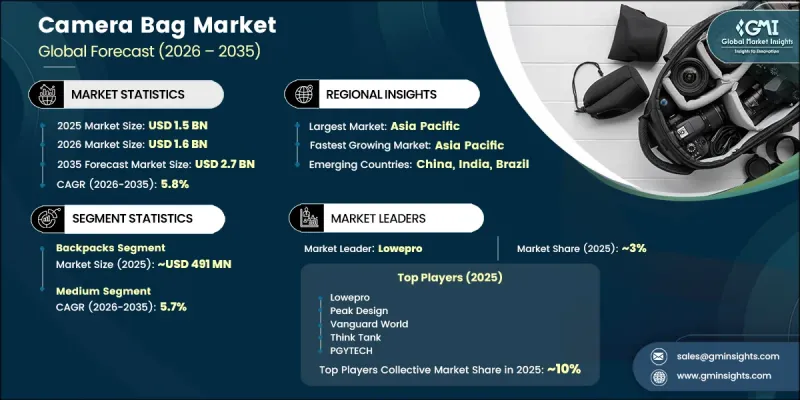
The Global Camera Bag Market was valued at USD 1.5 billion in 2025 and is estimated to grow at a CAGR of 5.8% to reach USD 2.7 billion by 2035.
Market growth is driven by a combination of structural industry shifts, including the global transition from DSLR systems to mirrorless camera platforms, the rising influence of the digital content creator economy across North America, Europe, and Asia Pacific, and the ongoing premiumization of photography accessories. The shift toward mirrorless systems is emerging as the most significant structural transformation, reshaping product design requirements and accelerating demand for lightweight, modular, and protective carrying solutions tailored to compact camera systems. Sustainability considerations are also playing a growing role in material selection and product development, with increasing emphasis on recycled fabrics and durable eco-friendly construction. At the same time, direct-to-consumer distribution channels are expanding rapidly, allowing manufacturers to build stronger customer relationships, improve margin structures, and develop data-driven marketing ecosystems. Digital-first sales strategies supported by influencer collaborations, video-based product demonstrations, and creator-led content are becoming central to brand growth. Improved e-commerce logistics across emerging markets in Asia Pacific and Latin America are further widening access to mid-range and budget camera bags, supported by rising cross-border trade flows and expanding online retail penetration.
| Market Scope | |
|---|---|
| Start Year | 2025 |
| Forecast Year | 2026-2035 |
| Start Value | $1.5 Billion |
| Forecast Value | $2.7 Billion |
| CAGR | 5.8% |
The backpacks segment generated USD 491 million in 2025 and is projected to grow at a CAGR of 6.1% between 2026 and 2035. This segment leads the market due to its ability to accommodate complete camera setups, particularly mirrorless systems, within a single ergonomic and protective carrying solution. Growth in this category is primarily driven by rising demand for backpack-style designs optimized for mirrorless camera ecosystems, as the global installed base continues to shift away from traditional DSLR configurations. Consumers increasingly favor backpacks due to their balance of storage capacity, portability, and equipment protection, making them the preferred choice among professional and enthusiast photographers.
The medium price segment accounted for 52.9% share in 2025 and is expected to grow at a CAGR of 5.7% through 2035. This category primarily serves photography enthusiasts and semi-professional users who prioritize a balance between affordability and performance. Demand is strongly supported by e-commerce platforms and specialty retail channels, which provide broad access to mid-tier offerings from both established and emerging brands. Growing digital accessibility has significantly expanded the reach of medium-priced camera bags, enabling hobbyist photographers to choose from a wider range of functional and design-oriented products across global markets.
United States Camera Bag Market captured USD 381.8 million in 2025, and is projected to grow at a CAGR of 5.6% through 2035. The country maintains its leadership position due to the strong presence of established domestic brands and a highly developed digital retail infrastructure for photography accessories. The U.S. market benefits from advanced e-commerce penetration, strong brand visibility, and a large base of professional and enthusiast photographers. Continued innovation in product design and digital marketing strategies further supports the country's dominant position within the regional market.
Major companies operating in the global camera bag industry include Lowepro, Manfrotto, Think Tank Photo, Peak Design, Vanguard World, Tamrac, Tenba, Billingham, Crumpler, PGYTECH, Domke, Thule Group, ONA Bags, Hama GmbH & Co KG, WANDRD, Shimoda Designs, F-Stop Gear, Gura Gear, Brevite, Atlas Packs, and Cotton Carrier. Companies in the camera bag market are adopting diversified growth strategies to strengthen their market position and enhance global competitiveness. Product innovation is a key focus area, with manufacturers developing lightweight, modular, and weather-resistant designs tailored to mirrorless and hybrid camera systems. Sustainability initiatives are gaining importance, with increased use of recycled and eco-conscious materials in product manufacturing. Expansion of direct-to-consumer channels is enabling brands to improve profit margins while building stronger customer relationships through personalized engagement. Influencer marketing, content creator partnerships, and social media-driven campaigns play a central role in brand visibility and consumer acquisition.
Table of Contents
Chapter 1 Research Methodology
- 1.1 Research approach
- 1.2 Quality Commitments
- 1.2.1 GMI AI policy & data integrity commitment
- 1.2.1.1 Source consistency protocol
- 1.2.1 GMI AI policy & data integrity commitment
- 1.3 Research trail & confidence scoring
- 1.3.1 Research trail components
- 1.3.2 Scoring components
- 1.4 Data Collection
- 1.4.1 Partial list of primary sources
- 1.5 Data mining sources
- 1.5.1 Paid sources
- 1.5.1.1 Sources, by region
- 1.5.1 Paid sources
- 1.6 Base estimates and calculations
- 1.6.1 Base year calculation
- 1.7 Forecast model
- 1.7.1 Quantified market impact analysis
- 1.7.1.1 Mathematical impact of growth parameters on forecast
- 1.7.1 Quantified market impact analysis
- 1.8 Research transparency addendum
- 1.8.1 Source attribution framework
- 1.8.2 Quality assurance metrics
- 1.8.3 Our commitment to trust
Chapter 2 Executive Summary
- 2.1 Industry 360° synopsis
- 2.2 Business trends
- 2.3 Regional
- 2.4 Product type
- 2.5 Surface material
- 2.6 Price
- 2.7 End-user
- 2.8 Distribution channel
Chapter 3 Industry Insights
- 3.1 Industry ecosystem analysis
- 3.1.1 Supplier landscape
- 3.1.2 Manufacturers
- 3.1.3 Distributors
- 3.1.4 Retailers
- 3.1.5 Profit margin analysis
- 3.1.6 Value addition at each stage
- 3.1.7 Factor affecting the value chain
- 3.2 Industry impact forces
- 3.2.1 Growth drivers
- 3.2.1.1 Mirrorless ILC Adoption Surge
- 3.2.1.2 Digital Content Creator Economy Expansion
- 3.2.1.3 Premiumization & Lifestyle Positioning
- 3.2.2 Industry pitfalls & challenges
- 3.2.2.1 Smartphone Camera Technology Moderating Entry-Level ILC Purchases
- 3.2.2.2 Macroeconomic Sensitivity and Discretionary Spending Compression
- 3.2.3 Opportunities
- 3.2.1 Growth drivers
- 3.3 Growth potential analysis
- 3.4 Technology and innovation landscape
- 3.4.1 Current technological trends
- 3.4.2 Emerging technologies
- 3.5 Pricing analysis (driven by primary research)
- 3.5.1 Historical price trend analysis by product category
- 3.5.2 Pricing strategy by player type (premium / value / cost-plus)
- 3.6 Trade data analysis (based on paid database)
- 3.6.1 Import/export volume & value trends
- 3.6.2 Key trade corridors & tariff impact
- 3.7 Regulatory landscape
- 3.7.1 Standards and compliance requirements
- 3.7.2 Regional regulatory frameworks
- 3.7.3 Certification standards
- 3.8 Porter's analysis
- 3.9 PESTEL analysis
- 3.10 Impact of AI & generative AI on the market
- 3.10.1 AI-driven disruption of existing business models
- 3.10.2 GenAI use cases & adoption roadmap by segment
- 3.10.3 Risks, limitations & regulatory considerations
Chapter 4 Competitive Landscape, 2025
- 4.1 Introduction
- 4.2 Company market share analysis
- 4.2.1 By Region
- 4.2.1.1 North America
- 4.2.1.2 Europe
- 4.2.1.3 Asia Pacific
- 4.2.1.4 Latin America
- 4.2.1.5 Middle East & Africa
- 4.2.1 By Region
- 4.3 Company matrix analysis
- 4.4 Competitive analysis of major market players
- 4.5 Competitive positioning matrix
- 4.6 Key developments
- 4.6.1 Mergers & acquisitions
- 4.6.2 Partnerships & collaborations
- 4.6.3 New product launches
- 4.6.4 Expansion plans
Chapter 5 Market Estimates & Forecast, By Product Type, 2022 - 2035, (USD Billion) (Units)
- 5.1 Key trends
- 5.2 Backpacks
- 5.2.1 DSLR camera backpacks
- 5.2.2 Mirrorless camera backpacks
- 5.2.3 Drone & aerial gear backpacks
- 5.2.4 Adventure & outdoor backpacks
- 5.3 Shoulder/messenger bags
- 5.4 Sling bags
- 5.5 Holster bags
- 5.6 Camera cases
- 5.7 Rolling/trolley bags
- 5.8 Others
Chapter 6 Market Estimates & Forecast, By Surface Material, 2022 - 2035, (USD Billion) (Units)
- 6.1 Key trends
- 6.2 Synthetic textile
- 6.3 Leather
- 6.4 Natural textile
- 6.5 Plastic
- 6.6 Others
Chapter 7 Market Estimates & Forecast, By Price, 2022 - 2035, (USD Billion) (Units)
- 7.1 Key trends
- 7.2 Economy
- 7.3 Medium
- 7.4 Premium
Chapter 8 Market Estimates & Forecast, By End-User, 2022 - 2035, (USD Billion) (Units)
- 8.1 Key trends
- 8.2 Professional photographers & videographers
- 8.3 Hobbyists & photography enthusiasts
- 8.4 Digital content creators
- 8.5 Travel & outdoor enthusiasts
Chapter 9 Market Estimates & Forecast, By Distribution Channel, 2022 - 2035, (USD Billion) (Units)
- 9.1 Key trends
- 9.2 Online
- 9.2.1 Brand websites
- 9.2.2 E-commerce marketplaces
- 9.3 Offline
- 9.3.1 Specialty photography & electronics stores
- 9.3.2 Hypermarkets
- 9.3.3 Sporting goods & outdoor retailers
- 9.3.4 Others
Chapter 10 Market Estimates & Forecast, By Region, 2022 - 2035, (USD Billion) (Units)
- 10.1 Key trends
- 10.2 North America
- 10.2.1 U.S
- 10.2.2 Canada
- 10.3 Europe
- 10.3.1 Germany
- 10.3.2 UK
- 10.3.3 France
- 10.3.4 Italy
- 10.3.5 Spain
- 10.3.6 Sweden
- 10.3.7 Netherlands
- 10.4 Asia Pacific
- 10.4.1 China
- 10.4.2 India
- 10.4.3 Japan
- 10.4.4 South Korea
- 10.4.5 Australia
- 10.4.6 Indonesia
- 10.5 Latin America
- 10.5.1 Brazil
- 10.5.2 Mexico
- 10.5.3 Argentina
- 10.6 Middle East and Africa
- 10.6.1 Saudi Arabia
- 10.6.2 UAE
- 10.6.3 South Africa
Chapter 11 Company Profiles
- 11.1 Global Players
- 11.1.1 Lowepro
- 11.1.2 Manfrotto
- 11.1.3 Think Tank Photo
- 11.1.4 Peak Design
- 11.1.5 Vanguard World
- 11.1.6 Tamrac
- 11.1.7 Tenba
- 11.2 Regional Players
- 11.2.1 Billingham
- 11.2.2 Crumpler
- 11.2.3 PGYTECH
- 11.2.4 Domke
- 11.2.5 Thule Group
- 11.2.6 ONA Bags
- 11.2.7 Hama GmbH & Co KG
- 11.3 Emerging Players & Innovators
- 11.3.1 WANDRD
- 11.3.2 Shimoda Designs
- 11.3.3 F-Stop Gear
- 11.3.4 Gura Gear
- 11.3.5 Brevite
- 11.3.6 Atlas Packs
- 11.3.7 Cotton Carrier

