PUBLISHER: Global Market Insights Inc. | PRODUCT CODE: 2071342

PUBLISHER: Global Market Insights Inc. | PRODUCT CODE: 2071342
Table and Kitchen Linen Market Opportunity, Growth Drivers, Industry Trend Analysis, and Forecast 2026 - 2035
The Global Table and Kitchen Linen Market was valued at USD 26.2 billion in 2025 and is estimated to grow at a CAGR of 5.7% to reach USD 45.8 billion by 2035.
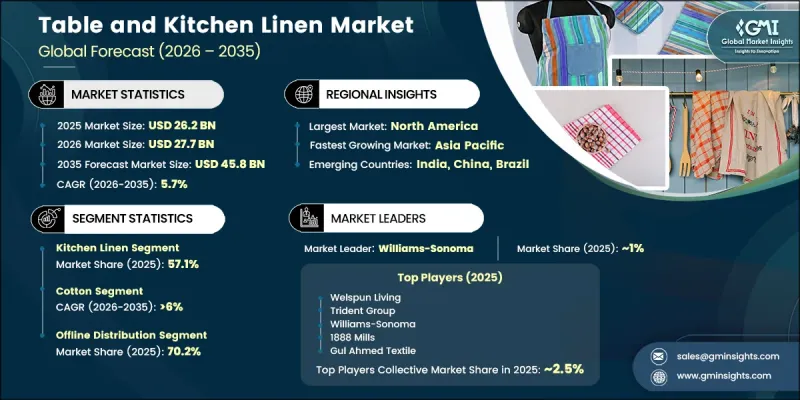
Market expansion is supported by steady consumption growth across established Western economies as well as rapidly developing regions such as Asia Pacific and the Middle East. Rising disposable income levels, continuous expansion of the global hospitality sector, and a clear shift in consumer preference toward premium and lifestyle-focused home textiles are strengthening long-term demand fundamentals. Increased penetration of organized retail formats and e-commerce platforms is further improving product accessibility, enabling brands to serve both value-oriented and premium customer segments through integrated online channels. In parallel, procurement practices within hotels and food service operators are becoming more structured, with long-term supply agreements increasingly replacing irregular purchasing behavior across institutional buyers. The hospitality and food service industry continues to represent the core demand driver for commercial-grade table and kitchen linen products. Ongoing investments in hotel capacity expansion, restaurant development, and broader food service infrastructure across Asia Pacific, the Middle East, and North America are sustaining stable demand for essential linen products, including table coverings, kitchen towels, napkins, and aprons.
| Market Scope | |
|---|---|
| Start Year | 2025 |
| Forecast Year | 2026-2035 |
| Start Value | $26.2 Billion |
| Forecast Value | $45.8 Billion |
| CAGR | 5.7% |
The kitchen linen segment held a 57.1% share and is projected to grow at a CAGR of 5.3% through 2035. The segment's dominance is supported by its wide product portfolio, which includes dish towels, kitchen towels, oven mitts, aprons, and protective kitchen accessories, serving both household and institutional end users. Demand in this category is largely driven by functional replacement cycles, ensuring consistent replenishment across residential kitchens and commercial food service operations. Unlike decorative table linen, kitchen linen benefits from frequent usage and higher replacement frequency, which sustains stable and recurring demand across global markets.
The cotton segment is projected to grow at a CAGR of 6% through 2035. Its dominance is attributed to strong consumer preference for its natural properties, including high absorbency, breathability, durability, and ease of maintenance. Cotton is also widely compatible with both household washing and industrial laundering processes, making it suitable for residential and commercial applications. Stable global cotton fiber production levels, maintained at approximately 25-26 million metric tonnes annually in recent years, have supported consistent raw material availability for textile manufacturers, contributing to supply stability across the value chain.
North America Table and Kitchen Linen Market accounted for 26.9% share in 2025 and is expected to grow at a CAGR of 6% through 2035. Market expansion is driven by rising consumer interest in premium home textiles and a recovering commercial hospitality sector. Increasing hotel construction activity and expanding food service infrastructure are generating strong institutional demand for table and kitchen linen products, supporting consistent procurement cycles across commercial end users.
Major companies operating in the global table and kitchen linen market include Welspun Living, Trident Group, Garnier-Thiebaut, Libeco, Ralph Lauren Home, and 1888 Mills. Companies in the table and kitchen linen market are adopting diversified growth strategies to strengthen their market presence and enhance long-term competitiveness. Product innovation is a key focus area, with manufacturers introducing premium, durable, and design-oriented linen products tailored to evolving consumer lifestyles. Sustainability initiatives are gaining importance, with increased adoption of eco-friendly fibers, responsible sourcing practices, and low-impact dyeing processes. Expansion of e-commerce and direct-to-consumer channels is enabling brands to improve market reach while building stronger customer relationships and improving margin structures. Strategic partnerships with hospitality and food service operators support long-term supply contracts and ensuring consistent demand visibility.
Table of Contents
Chapter 1 Methodology and Scope
- 1.1 Market scope and definition
- 1.2 Research design
- 1.2.1 Research approach
- 1.2.2 Data collection methods
- 1.3 Data mining sources
- 1.3.1 Global
- 1.3.2 Regional/Country
- 1.4 Base estimates and calculations
- 1.4.1 Base year calculation
- 1.4.2 Key trends for market estimation
- 1.5 Primary research and validation
- 1.5.1 Primary sources
- 1.6 Forecast model
- 1.7 Research assumptions and limitations
Chapter 2 Executive Summary
- 2.1 Industry 360° synopsis
- 2.2 Key market trends
- 2.2.1 Regional
- 2.2.2 Product type
- 2.2.3 Material
- 2.2.4 Price
- 2.2.5 End user
- 2.2.6 Distribution channel
Chapter 3 Industry Insights
- 3.1 Industry ecosystem analysis
- 3.1.1 Raw material suppliers
- 3.1.2 Manufacturers & textile mills
- 3.1.3 Distributors, wholesalers & importers
- 3.1.4 Retail channels
- 3.1.5 End users
- 3.1.6 Profit margin
- 3.1.7 Value addition at each stage
- 3.1.8 Factor affecting the value chain
- 3.2 Industry impact forces
- 3.2.1 Growth drivers
- 3.2.1.1 Rising global hospitality & food service industry expansion driving commercial linen procurement
- 3.2.1.2 Growing consumer spending on home decor & kitchen aesthetics fueling residential demand
- 3.2.1.3 Social media influence on dining & kitchen styling
- 3.2.2 Pitfalls & challenges
- 3.2.2.1 Volatility in raw material prices increasing production costs
- 3.2.2.2 Increasing competition from low-cost synthetic substitutes & disposable tableware alternatives
- 3.2.3 Opportunities
- 3.2.3.1 Premiumization & customization trend creating high-margin growth segments
- 3.2.3.2 Growing demand for sustainable, organic & OEKO-TEX certified linen products
- 3.2.1 Growth drivers
- 3.3 Growth potential analysis
- 3.4 Technology and innovation landscape
- 3.4.1 Advanced fabric technologies
- 3.4.2 Digital textile printing & custom design innovation
- 3.4.3 Smart textiles & functional fabric developments
- 3.5 Regulatory & licensing framework
- 3.5.1 Global textile safety & chemical regulations
- 3.5.2 Sustainability & eco-label compliance requirements
- 3.6 Pricing analysis (driven by primary research)
- 3.6.1 Historical price trend analysis by product category
- 3.6.2 Pricing strategy by player type (premium / value / cost-plus)
- 3.7 Supply chain analysis
- 3.7.1 Global sourcing hubs
- 3.7.2 Supply chain disruption risks & mitigation strategies
- 3.7.3 Nearshoring & reshoring trends in textile procurement
- 3.8 Trade data analysis (driven by paid database) (HS code- 6302)
- 3.8.1 Import/export volume & value trends by product category
- 3.8.2 Key trade corridors & tariff impact
- 3.9 Impact of AI & generative AI on the market
- 3.9.1 AI-driven disruption of existing business models
- 3.9.2 GenAI use cases & adoption roadmap by segment
- 3.9.3 Risks, limitations & regulatory considerations
- 3.10 Distribution infrastructure & channel penetration landscape (driven by primary research)
- 3.10.1 Channel coverage by region & format (modern vs. traditional trade)
- 3.10.2 Last-mile infrastructure gaps & emerging channel shifts
Chapter 4 Competitive Landscape, 2025
- 4.1 Introduction
- 4.2 Company market share analysis
- 4.2.1 By region
- 4.2.1.1 North America
- 4.2.1.2 Europe
- 4.2.1.3 Asia Pacific
- 4.2.1.4 Latin America
- 4.2.1.5 Middle East and Africa
- 4.2.1 By region
- 4.3 Company matrix analysis
- 4.4 Competitive analysis of major market players
- 4.5 Competitive positioning matrix
- 4.6 Key developments
- 4.6.1 Mergers & acquisitions
- 4.6.2 Partnerships & collaborations
- 4.6.3 New product launches
- 4.6.4 Expansion plans
Chapter 5 Market Estimates and Forecast, By Product Type, 2022 - 2035 (USD Billion) (Million Units)
- 5.1 Key trends
- 5.2 Table linen
- 5.2.1 Tablecloths
- 5.2.2 Table runners
- 5.2.3 Placemats & table mat
- 5.2.4 Napkins
- 5.2.5 Others (table skirting, table overlays, etc.)
- 5.3 Kitchen linen
- 5.3.1 Kitchen towels & dish towels
- 5.3.2 Aprons
- 5.3.3 Pot holders & oven mitts/gloves
- 5.3.4 Others (dishcloths, sink mats, etc.)
Chapter 6 Market Estimates and Forecast, By Material, 2022 - 2035 (USD Billion) (Million Units)
- 6.1 Key trends
- 6.2 Cotton
- 6.2.1 Conventional cotton
- 6.2.2 Organic & sustainably sourced cotton
- 6.3 Linen
- 6.4 Artificial fibers (polyester, microfiber & blends)
- 6.4.1 Polyester
- 6.4.2 Microfiber
- 6.4.3 Blended fabrics (cotton-polyester, etc.)
- 6.5 Others (silk, wool, bamboo, terrycloth)
Chapter 7 Market Estimates and Forecast, By Price Range, 2022 - 2035 (USD Billion) (Million Units)
- 7.1 Key trends
- 7.2 Low
- 7.3 Medium
- 7.4 High
Chapter 8 Market Estimates and Forecast, By End Use, 2022 - 2035 (USD Billion) (Million Units)
- 8.1 Key trends
- 8.2 Residential
- 8.3 Commercial
- 8.3.1 Hospitality
- 8.3.2 Food service
- 8.3.3 Institutional
Chapter 9 Market Estimates and Forecast, By Distribution Channel, 2022 - 2035 (USD Billion) (Million Units)
- 9.1 Key trends
- 9.2 Online
- 9.2.1 Company website
- 9.2.2 E-commerce website
- 9.3 Offline
- 9.3.1 Hypermarkets & supermarkets
- 9.3.2 Departmental & specialty home stores
- 9.3.3 Wholesale & institutional supply channels
- 9.3.4 Others (home decor boutiques, pop-up stores)
Chapter 10 Market Estimates and Forecast, By Region, 2022 - 2035 (USD Billion) (Million Units)
- 10.1 Key trends
- 10.2 North America
- 10.2.1 U.S.
- 10.2.2 Canada
- 10.3 Europe
- 10.3.1 Germany
- 10.3.2 UK
- 10.3.3 France
- 10.3.4 Italy
- 10.3.5 Spain
- 10.4 Asia Pacific
- 10.4.1 China
- 10.4.2 Japan
- 10.4.3 India
- 10.4.4 Australia
- 10.4.5 South Korea
- 10.5 Latin America
- 10.5.1 Brazil
- 10.5.2 Mexico
- 10.5.3 Argentina
- 10.6 Middle East and Africa
- 10.6.1 South Africa
- 10.6.2 Saudi Arabia
- 10.6.3 UAE
Chapter 11 Company Profiles
- 11.1 Global players
- 11.1.1 Welspun Living
- 11.1.2 Trident Group
- 11.1.3 Garnier-Thiebaut
- 11.1.4 Libeco
- 11.1.5 Ralph Lauren Home
- 11.1.6 1888 Mills
- 11.2 Regional players
- 11.2.1 Alok Industries
- 11.2.2 Gul Ahmed Textile Mills
- 11.2.3 Milliken & Company (Table Linens)
- 11.2.4 Williams-Sonoma
- 11.2.5 Zorluteks Tekstil
- 11.2.6 Beauville (MIE)
- 11.2.7 Tessitura Carlo Lamperti
- 11.2.8 SFERRA Fine Linens
- 11.2.9 American Dawn (ADI)
- 11.2.10 AB Siulas (Linen Fashion)
- 11.2.11 LinenMe
- 11.3 Emerging players
- 11.3.1 Coyuchi
- 11.3.2 Cultiver
- 11.3.3 Rough Linen
- 11.3.4 NJU Linen

