PUBLISHER: Global Market Insights Inc. | PRODUCT CODE: 2071351

PUBLISHER: Global Market Insights Inc. | PRODUCT CODE: 2071351
Disposable Endoscopes Market Opportunity, Growth Drivers, Industry Trend Analysis, and Forecast 2026 - 2035
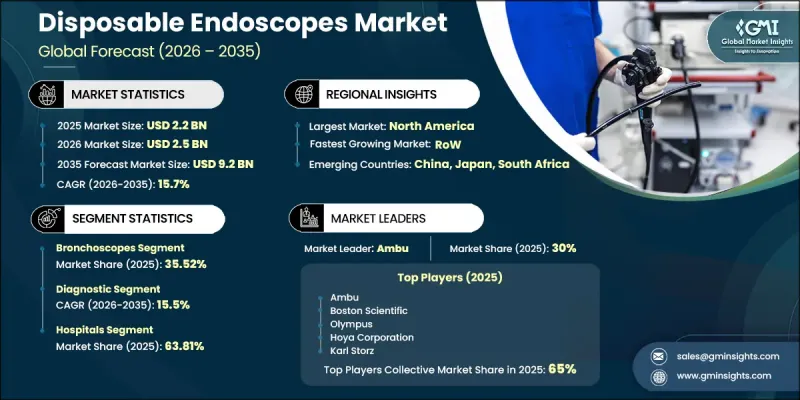
The Global Disposable Endoscopes Market was valued at USD 2.2 billion in 2025 and is estimated to grow at a CAGR of 15.7% to reach USD 9.2 billion by 2035.
Strong market momentum is fueled by increasing adoption of single-use endoscopic devices across hospitals, ambulatory surgical centers, and critical care facilities worldwide. Rising prevalence of gastrointestinal disorders, respiratory diseases, and other conditions requiring minimally invasive diagnostic and therapeutic procedures continues to support demand growth. At the same time, healthcare providers are placing greater emphasis on infection prevention and patient safety, leading to a growing preference for disposable devices that eliminate risks associated with reprocessing reusable equipment. Technological advancements in imaging systems, device durability, and miniaturization have significantly enhanced the performance of disposable endoscopes, making them increasingly comparable to reusable alternatives. As a result, purchasing decisions are increasingly centered on operational efficiency, infection control, and cost optimization rather than technological limitations. The ongoing shift of medical procedures from inpatient settings to outpatient and ambulatory care environments is further accelerating adoption. In addition, healthcare reimbursement frameworks are increasingly supporting minimally invasive procedures, encouraging healthcare facilities to invest in single-use endoscopic solutions that improve workflow efficiency, reduce turnaround times, and minimize sterilization-related costs.
| Market Scope | |
|---|---|
| Start Year | 2025 |
| Forecast Year | 2026-2035 |
| Start Value | $2.2 Billion |
| Forecast Value | $9.2 Billion |
| CAGR | 15.7% |
The bronchoscope segment held a 35.52% share, generating USD 781 million in 2025. Growth is being driven by the increasing burden of respiratory diseases, rising utilization of bronchoscopic procedures in critical care environments, and the growing importance of infection prevention in clinical settings. Continued improvements in single-use bronchoscope performance have further strengthened market penetration across healthcare facilities globally.
The hospitals segment held a 63.81% share, generating USD 1.40 billion in 2025. Adoption within hospital settings is supported by extensive use across multiple clinical specialties where minimally invasive diagnostic and treatment procedures are routinely performed. The ability of disposable endoscopes to reduce contamination risks, streamline workflow processes, and eliminate reprocessing requirements continues to drive utilization across major healthcare institutions.
North America Disposable Endoscopes Market accounted for 49.93% share, generating USD 1.10 billion in 2025. Growth is supported by advanced healthcare infrastructure, strong adoption of innovative medical technologies, favorable reimbursement policies, and increasing emphasis on infection prevention. The region also benefits from a well-established procurement ecosystem and broad availability of commercially approved single-use endoscopic devices, which continue to support market expansion.
Major companies operating in the disposable endoscopes market include Verathon, Coloplast, Ambu A/S, Boston Scientific Corporation, Karl Storz SE & Co. KG, Olympus Corporation, CooperSurgical, Hoya Corporation (PENTAX Medical), Flexicare, RICHARD WOLF, HugeMed, Vathin Medical, UE Medical, and TSC (Tiansong Medical). Companies operating in the disposable endoscopes market are pursuing a range of strategic initiatives to strengthen their market presence and enhance competitive positioning. A primary focus is on continuous product innovation, including the development of advanced imaging capabilities, improved maneuverability, and enhanced device durability to increase clinical acceptance. Manufacturers are expanding their product portfolios across multiple procedural applications to address a broader range of healthcare requirements. Strategic partnerships with hospitals, healthcare systems, and distribution networks are helping companies accelerate market penetration and strengthen customer relationships. Investments in research and development remain a priority to improve device performance while reducing production costs.
Table of Contents
Chapter 1 Methodology & Scope
- 1.1 Research approach
- 1.2 Quality commitments
- 1.2.1 GMI AI policy & data integrity commitment
- 1.2.1.1 Source consistency protocol
- 1.2.1 GMI AI policy & data integrity commitment
- 1.3 Research trail & confidence scoring
- 1.3.1 Research trail components
- 1.3.2 Scoring components
- 1.4 Data collection
- 1.4.1 Partial list of primary sources
- 1.5 Data mining sources
- 1.5.1 Paid sources
- 1.5.1.1 Sources, by region
- 1.5.1 Paid sources
- 1.6 Base estimates and calculations
- 1.6.1 Base year calculation for any one approach
- 1.7 Market estimates & forecasts parameters
- 1.8 Forecast model
- 1.8.1 Quantified market impact analysis
- 1.8.1.1 Mathematical impact of growth parameters on forecast
- 1.8.1 Quantified market impact analysis
- 1.9 Research transparency addendum
- 1.9.1 Source attribution framework
- 1.9.2 Quality assurance metrics
- 1.9.3 Our commitment to trust
- 1.10 Market definitions
Chapter 2 Executive Summary
- 2.1 Industry synopsis, 2022 - 2035
- 2.1.1 Business trends
- 2.1.2 Product type trends
- 2.1.3 Clinical use trends
- 2.1.4 End use trends
- 2.1.5 Regional trends
Chapter 3 Industry Insights
- 3.1 Industry ecosystem analysis
- 3.2 Industry impact forces
- 3.2.1 Growth drivers
- 3.2.1.1 Rising incidence of gastrointestinal disorders, cancer, and chronic conditions.
- 3.2.1.2 Technological advancements in disposable endoscopes
- 3.2.1.3 Increased focus on contamination and infection control
- 3.2.2 Industry pitfalls and challenges
- 3.2.2.1 Shortage of skilled physicians and endoscopists
- 3.2.2.2 Higher per-procedure cost relative to reusable platforms
- 3.2.2.3 Environmental and waste management concerns
- 3.2.3 Market opportunities
- 3.2.3.1 Biodegradable and eco-compatible single-use scope development
- 3.2.1 Growth drivers
- 3.3 Growth potential analysis
- 3.4 Regulatory landscape (Driven by primary research)
- 3.4.1 North America
- 3.4.2 Europe
- 3.5 Technology landscape
- 3.5.1 Current technological trends
- 3.5.2 Emerging technologies
- 3.6 Pricing trend analysis (Driven by primary research)
- 3.7 Future market trends
- 3.8 Patent analysis
- 3.9 Porter's analysis
- 3.10 PESTEL analysis
- 3.11 Impact of AI and Generative AI on the market (Driven by primary research)
- 3.12 Value chain analysis (Driven by primary research)
- 3.13 Investment & funding analysis (Driven by primary research)
Chapter 4 Competitive Landscape, 2025
- 4.1 Introduction
- 4.2 Company market share analysis, by region, 2025
- 4.2.1 North America
- 4.2.2 Europe
- 4.3 Key developments
- 4.3.1 Key partnerships & collaborations
- 4.3.2 Major M&A activities
- 4.3.3 Product innovations & launches
- 4.3.4 Market expansion strategies
- 4.4 Competitive positioning matrix
Chapter 5 Market Size and Forecast, By Product Type, 2022 - 2035 (USD Million)
- 5.1 Key trends
- 5.2 Bronchoscopes
- 5.3 Cystoscopes
- 5.4 Duodenoscopes
- 5.5 Hysteroscopes
- 5.6 Laryngoscopes
- 5.7 Ureteroscopes
- 5.8 Other product types
Chapter 6 Market Size and Forecast, By Clinical Use, 2022 - 2035 (USD Million)
- 6.1 Key trends
- 6.2 Diagnostic
- 6.3 Surgical
Chapter 7 Market Size and Forecast, By End Use, 2022 - 2035 (USD Million)
- 7.1 Key trends
- 7.2 Hospital
- 7.3 Ambulatory surgical centers
- 7.4 Other end users
Chapter 8 Market Size and Forecast, By Region, 2022 - 2035 (USD Million)
- 8.1 Key trends
- 8.2 North America
- 8.2.1 U.S.
- 8.2.2 Canada
- 8.3 Europe
- 8.3.1 Germany
- 8.3.2 France
- 8.3.3 UK
- 8.3.4 Netherlands
- 8.3.5 Spain
- 8.3.6 Italy
- 8.4 RoW
Chapter 9 Company Profiles
- 9.1 Ambu
- 9.2 Boston Scientific
- 9.3 Coloplast
- 9.4 CooperSurgical
- 9.5 Flexicare
- 9.6 Hoya Corporation
- 9.7 HugeMed
- 9.8 Karl Storz
- 9.9 OLYMPUS
- 9.10 RICHARD WOLF
- 9.11 TSC
- 9.12 UE MEDICAL
- 9.13 Vathin Medical
- 9.14 Verathon

