PUBLISHER: Global Market Insights Inc. | PRODUCT CODE: 2071364

PUBLISHER: Global Market Insights Inc. | PRODUCT CODE: 2071364
High-Speed Camera Market Opportunity, Growth Drivers, Industry Trend Analysis, and Forecast 2026 - 2035
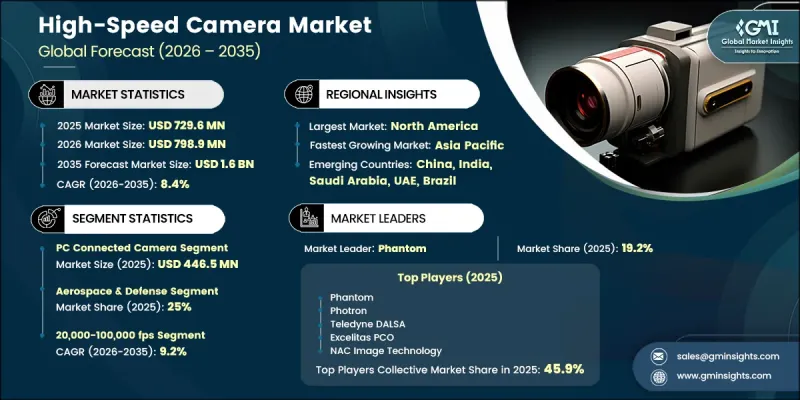
The Global High-Speed Camera Market was valued at USD 729.6 million in 2025 and is estimated to grow at a CAGR of 8.4% to reach USD 1.6 billion by 2035.
Market growth is driven by rising demand for advanced imaging solutions capable of capturing ultra-fast motion across multiple industries, including automotive, aerospace, healthcare, media, and industrial applications. These systems play a critical role in analyzing high-speed events by delivering precise visual data for research, diagnostics, and quality control processes. Continuous technological evolution has significantly enhanced product capabilities, with improvements in frame rates, image resolution, and sensor performance contributing to greater efficiency and versatility. The increasing integration of high-speed imaging technologies in scientific research, industrial automation, and defense applications is further strengthening market expansion. As innovation continues, manufacturers are focusing on delivering high-performance imaging systems that meet evolving industry requirements, ensuring sustained growth across global markets.
| Market Scope | |
|---|---|
| Start Year | 2025 |
| Forecast Year | 2026-2035 |
| Start Value | $729.6 Million |
| Forecast Value | $1.6 Billion |
| CAGR | 8.4% |
The market is also supported by ongoing advancements in digital imaging and optical technologies, enabling improved performance and reliability in capturing rapid motion sequences. Continuous innovation in high-speed imaging solutions is enhancing capabilities for research and development activities, particularly in motion analysis and slow-motion visualization. Technological progress in visualization tools is contributing to wider adoption across engineering and medical fields, supporting the growing importance of high-speed imaging systems in precision-driven applications.
The portable cameras segment is expected to register a CAGR of 9.1% throughout 2035. Portable high-speed cameras are gaining traction due to their compact design, ease of operation, and flexibility across multiple applications. Their increasing adoption in research and development activities is driving segment growth, supported by continuous improvements in portability and performance capabilities.
The 20,000 to 100,000 frames-per-second segment is projected to grow at a CAGR of 9.2% from 2026 to 2035. This segment is witnessing strong demand due to its suitability for high-precision analysis and advanced research applications. These cameras are widely utilized in sectors requiring detailed motion capture, where accuracy and speed are critical. Increasing investment in research and development activities is further supporting the growth of this segment.
United States High-Speed Camera Market accounted for 81% share in 2025. The country continues to demonstrate strong growth, driven by rapid technological advancements and increasing adoption across various industries. High-speed imaging solutions are widely utilized in research, development, and manufacturing processes, particularly for quality control and performance analysis. Growing industrial innovation and expanding use of advanced imaging technologies are supporting market expansion across the region.
Major players operating in the global high-speed camera industry include Excelitas PCO, Keyence, NAC Image Technology, Phantom, Photron, Shimadzu, Teledyne DALSA, Antelope Camera Systems, Baumer, Emergent Vision Technologies, Optronis, SVS-Vistek, Toshiba Teli, Xcitex, Edgertronic / Sanstreak Corp., IMAGO Technologies, Kron Technologies, Lambert Instruments, SinceVision Technology, Stanford Computer Optics, and XIMEA. Companies in the high-speed camera market are adopting innovation-focused strategies to strengthen their competitive position and expand market presence. Leading players are investing heavily in research and development to enhance imaging performance, including higher frame rates, improved resolution, and advanced sensor technologies. Strategic collaborations with research institutions and industrial partners are supporting the development of application-specific solutions. Firms are also expanding their product portfolios with compact and portable systems to address diverse industry requirements. Increasing emphasis on customization and software integration is improving usability and data analysis capabilities. Additionally, companies are strengthening global distribution networks and customer support services to enhance market reach and build long-term client relationships.
Table of Contents
Chapter 1 Methodology and scope
- 1.1 Research approach
- 1.2 Quality Commitments
- 1.2.1 GMI AI policy & data integrity commitment
- 1.2.1.1 Source consistency protocol
- 1.2.1 GMI AI policy & data integrity commitment
- 1.3 Research Trail & Confidence Scoring
- 1.3.1 Research Trail Components
- 1.3.2 Scoring Components
- 1.4 Data Collection
- 1.4.1 Partial list of primary sources
- 1.5 Data mining sources
- 1.5.1 Paid sources
- 1.5.1.1 Sources, by region
- 1.5.1 Paid sources
- 1.6 Base estimates and calculations
- 1.6.1 Base year calculation for any one approach
- 1.7 Forecast model
- 1.7.1 Quantified market impact analysis
- 1.7.1.1 Mathematical impact of growth parameters on forecast
- 1.7.1 Quantified market impact analysis
- 1.8 Research transparency addendum
- 1.8.1 Source attribution framework
- 1.8.2 Quality assurance metrics
- 1.8.3 Our commitment to trust
Chapter 2 Executive summary
- 2.1 Industry 360° synopsis
- 2.2 Key market trends
- 2.2.1 Regional
- 2.2.2 Product type
- 2.2.3 Pixel
- 2.2.4 Frame rates
- 2.2.5 Light sensitivity
- 2.2.6 End use application
- 2.2.7 Distribution channel
Chapter 3 Industry insights
- 3.1 Industry ecosystem analysis
- 3.1.1 Supplier landscape
- 3.1.2 Profit margin
- 3.1.3 Value addition at each stage
- 3.1.4 Factor affecting the value chain
- 3.1.5 Disruptions
- 3.2 Industry impact forces
- 3.2.1 Growth drivers
- 3.2.2 Industry pitfalls & challenges
- 3.2.3 Opportunities
- 3.3 Growth potential analysis
- 3.4 Price trends
- 3.4.1 Historical price trend analysis
- 3.4.2 Pricing strategy by player type
- 3.5 Regulatory framework
- 3.5.1 Automotive Safety Testing Standards Mandating High-Speed Imaging (NHTSA, Euro NCAP, IIHS)
- 3.5.2 Aerospace & Defense Procurement & Testing Regulations (DoD, NATO Standards)
- 3.5.3 Export Control Regulations for High-Performance Imaging Systems (ITAR, EAR)
- 3.5.4 Industrial Workplace Safety & Machine Vision Compliance Standards
- 3.6 Porter's five forces analysis
- 3.7 PESTEL analysis
- 3.8 Trade data analysis (based on paid database) (HS Code: 85258020)
- 3.8.1 Import/export volume & value trends
- 3.8.2 Key trade corridors & tariff impact
- 3.9 Impact of AI & generative AI on the market
- 3.9.1 AI-driven disruption of traditional business models
- 3.9.2 GenAI use cases & adoption roadmap by customer segment
- 3.9.3 Risks, limitations & regulatory considerations
- 3.9.4 AI-enabled ecosystem integration
- 3.10 Future market trends
- 3.11 Technology and innovation landscape
- 3.11.1 Current technological trends
- 3.11.2 Emerging technologies
Chapter 4 Competitive landscape, 2025
- 4.1 Introduction
- 4.2 Company market share analysis
- 4.2.1 North America
- 4.2.2 Europe
- 4.2.3 Asia Pacific
- 4.2.4 Latin America
- 4.2.5 MEA
- 4.3 Company matrix analysis
- 4.4 Competitive analysis of major market players
- 4.5 Competitive positioning matrix
- 4.6 Key developments
- 4.6.1 Mergers & acquisitions
- 4.6.2 Partnerships & collaborations
- 4.6.3 New product launches
- 4.6.4 Expansion plans
Chapter 5 Market Estimates & Forecast, By Product Type, 2022 - 2035 ($Million, Thousand Units)
- 5.1 Key trends
- 5.2 Portable camera
- 5.3 PC connected camera
Chapter 6 Market Estimates & Forecast, By Pixel, 2022 - 2035 ($Million, Thousand Units)
- 6.1 Key trends
- 6.2 Up to 2 MP
- 6.3 2 - 4 MP
- 6.4 Above 4 MP
Chapter 7 Market Estimates & Forecast, By Frame Rates, 2022 - 2035 ($Million, Thousand Units)
- 7.1 Key trends
- 7.2 Less than 5,000 fps
- 7.3 5,000-20,000 fps
- 7.4 20,000-100,000 fps
- 7.5 More than 100,000 fps
Chapter 8 Market Estimates & Forecast, By Light Sensitivity, 2022 - 2035 ($Million, Thousand Units)
- 8.1 Key trends
- 8.2 Color
- 8.3 Monochrome
Chapter 9 Market Estimates & Forecast, By End Use Application, 2022 - 2035 ($Million, Thousand Units)
- 9.1 Key trends
- 9.2 Automotive & transportation
- 9.3 Aerospace & defense
- 9.4 Industrial manufacturing
- 9.5 Healthcare & life sciences
- 9.6 Media, entertainment & sports
- 9.7 Research, design & testing (RD&T)
- 9.8 Others (paper & printing etc.)
Chapter 10 Market Estimates & Forecast, By Distribution Channel, 2022 - 2035 ($Million, Thousand Units)
- 10.1 Key trends
- 10.2 Direct sales
- 10.3 Indirect sales
Chapter 11 Market Estimates & Forecast, By Region, 2022 - 2035 ($Million, Thousand Units)
- 11.1 Key trends
- 11.2 North America
- 11.2.1 U.S.
- 11.2.2 Canada
- 11.3 Europe
- 11.3.1 Germany
- 11.3.2 UK
- 11.3.3 France
- 11.3.4 Spain
- 11.3.5 Italy
- 11.3.6 Netherlands
- 11.4 Asia Pacific
- 11.4.1 China
- 11.4.2 Japan
- 11.4.3 India
- 11.4.4 Australia
- 11.4.5 South Korea
- 11.5 Latin America
- 11.5.1 Brazil
- 11.5.2 Mexico
- 11.5.3 Argentina
- 11.6 MEA
- 11.6.1 South Africa
- 11.6.2 Saudi Arabia
- 11.6.3 UAE
Chapter 12 Company Profiles
- 12.1 Global Key Players
- 12.1.1 Excelitas PCO
- 12.1.2 Keyence
- 12.1.3 NAC Image Technology
- 12.1.4 Phantom
- 12.1.5 Photron
- 12.1.6 Shimadzu
- 12.1.7 Teledyne DALSA
- 12.2 Regional Players
- 12.2.1 Antelope Camera Systems
- 12.2.2 Baumer
- 12.2.3 Emergent Vision Technologies
- 12.2.4 Optronis
- 12.2.5 SVS-Vistek
- 12.2.6 Toshiba Teli
- 12.2.7 Xcitex
- 12.3 Emerging / Niche Specialists
- 12.3.1 Edgertronic / Sanstreak Corp.
- 12.3.2 IMAGO Technologies
- 12.3.3 Kron Technologies
- 12.3.4 Lambert Instruments
- 12.3.5 SinceVision Technology
- 12.3.6 Stanford Computer Optics
- 12.3.7 XIMEA

