
PUBLISHER: Global Market Insights Inc. | PRODUCT CODE: 2071366

PUBLISHER: Global Market Insights Inc. | PRODUCT CODE: 2071366
Military Radar Market Opportunity, Growth Drivers, Industry Trend Analysis, and Forecast 2026 - 2035
The Global Military Radar Market was valued at USD 15.38 billion in 2025 and is estimated to grow at a CAGR of 5.9% to reach USD 26.92 billion by 2035.
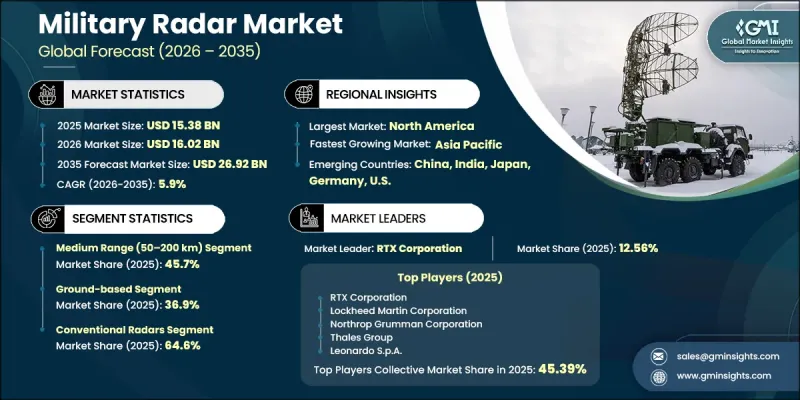
The market is expanding due to rising geopolitical tensions, increased defense modernization programs, growing adoption of advanced aerial platforms, and continuous improvements in radar system technologies. Military radar systems are widely utilized for surveillance, target detection, missile guidance, border security, and battlefield monitoring applications. Growing global security concerns and the need for strengthened air defense and missile defense capabilities are further accelerating demand. Governments across multiple regions are increasing defense investments to enhance situational awareness, threat detection capabilities, and operational readiness. The growing deployment of unmanned aerial vehicles, stealth aircraft, and next-generation combat systems is also driving demand for advanced radar technologies capable of identifying low-observable targets with high precision. Active electronically scanned array radar systems are gaining significant traction due to their enhanced tracking capabilities, resistance to electronic warfare interference, and ability to monitor multiple targets simultaneously. Continuous technological advancements in radar resolution, signal processing, and multi-domain integration are further strengthening market growth across defense applications.
| Market Scope | |
|---|---|
| Start Year | 2025 |
| Forecast Year | 2026-2035 |
| Start Value | $15.38 Billion |
| Forecast Value | $26.92 Billion |
| CAGR | 5.9% |
The military radar market is further supported by rising investments in defense infrastructure modernization and the increasing need for real-time intelligence and surveillance capabilities. Armed forces worldwide are focusing on strengthening border protection systems and enhancing multi-layered defense networks. The integration of radar technologies into airborne, naval, and ground-based platforms is improving operational efficiency and situational awareness. Continuous innovation in electronic warfare resilience and long-range detection capabilities is further shaping market development. These factors collectively contribute to the steady expansion of the global military radar industry.
The medium range segment (50-200 km) accounted for a share of 45.7% in 2025. This segment remains dominant due to its extensive use in air surveillance, battlefield monitoring, missile tracking, and border protection applications. Its versatility across airborne, naval, and land-based defense systems continues to drive strong demand. Military organizations are increasingly deploying medium-range radar systems to enhance detection capabilities and improve coordination across multi-domain operations, further reinforcing the segment's leading position.
The conventional radar segment held a 64.6% share in 2025. This leadership is attributed to its widespread deployment across air, sea, and land defense platforms for surveillance, target identification, and air defense operations. Conventional radar systems continue to be extensively used due to their proven reliability, established infrastructure integration, and ongoing modernization programs. Continuous upgrades and system enhancements are further ensuring their sustained relevance across global defense networks.
North America Military Radar Market accounted for 38.8% share in 2025. The region's growth is driven by extensive defense modernization initiatives, rising military expenditures, and strong demand for advanced surveillance and missile defense systems. The presence of leading defense contractors and advanced technological capabilities supports rapid deployment of next-generation radar systems. Continuous investment in border security, naval defense, and airborne monitoring applications further strengthens the region's dominance in the global market.
Key companies operating in the Global Military Radar Market include RTX Corporation (Raytheon), Lockheed Martin Corporation, Northrop Grumman Corporation, Thales Group, Leonardo S.p.A, BAE Systems, Saab AB, Israel Aerospace Industries (IAI), Hensoldt AG, Aselsan A.S, Bharat Electronics Limited (BEL), CETC (China Electronics Technology Group Corporation), Almaz-Antey, Telephonics Corporation, Terma A/S, SRC Inc., RADA Electronic Industries, Echodyne Corp, and Fortem Technologies. Companies operating in the military radar market are adopting multiple strategies to strengthen their competitive positioning and expand their global footprint. Heavy investment in research and development is enabling the creation of advanced radar systems with improved detection accuracy, enhanced range, and better resistance to electronic warfare. Strategic collaborations with defense agencies and government organizations are supporting large-scale procurement programs and technology integration. Firms are also focusing on developing next-generation active electronically scanned array systems and multi-function radar platforms to meet evolving battlefield requirements. Expansion into emerging defense markets and participation in long-term defense contracts are further reinforcing revenue stability. In addition, companies are enhancing production capabilities, upgrading existing radar systems, and integrating artificial intelligence and digital signal processing technologies to improve real-time threat detection.
Table of Contents
Chapter 1 Methodology and Scope
- 1.1 Market scope and definition
- 1.2 Research design
- 1.2.1 Research approach
- 1.2.2 Data collection methods
- 1.3 Data mining sources
- 1.3.1 Global
- 1.3.2 Regional/Country
- 1.4 Base estimates and calculations
- 1.4.1 Base year calculation
- 1.4.2 Key trends for market estimation
- 1.5 Primary research and validation
- 1.5.1 Primary sources
- 1.6 Forecast model
- 1.7 Research assumptions and limitations
Chapter 2 Executive Summary
- 2.1 Industry 360° synopsis, 2022 - 2035
- 2.2 Key market trends
- 2.2.1 Platform Type trends
- 2.2.2 Technology type trends
- 2.2.3 Application trends
- 2.2.4 Range trends
- 2.2.5 Regional trends
- 2.3 TAM Analysis, 2026-2035
- 2.4 CXO perspectives: Strategic imperatives
Chapter 3 Industry Insights
- 3.1 Industry ecosystem analysis
- 3.1.1 Supplier Landscape
- 3.1.2 Profit Margin
- 3.1.3 Cost structure
- 3.1.4 Value addition at each stage
- 3.1.5 Factor affecting the value chain
- 3.1.6 Disruptions
- 3.2 Industry impact forces
- 3.2.1 Growth drivers
- 3.2.1.1 Increasing geopolitical tensions and border security concerns
- 3.2.1.2 Growing defense modernization programs and military expenditure
- 3.2.1.3 Rising adoption of UAVs, stealth aircraft, and advanced combat systems
- 3.2.1.4 Technological advancements in AI and electronically scanned array radar systems
- 3.2.1.5 Increasing demand for integrated air and missile defense systems
- 3.2.2 Industry pitfalls and challenges
- 3.2.2.1 High development, procurement, and maintenance costs
- 3.2.2.2 Vulnerability to electronic warfare and cyber threats
- 3.2.3 Market opportunities
- 3.2.3.1 Growing deployment of next-generation naval and airborne radar systems
- 3.2.3.2 Expansion of multi-domain surveillance and space-based defense programs
- 3.2.1 Growth drivers
- 3.3 Growth potential analysis
- 3.4 Regulatory landscape
- 3.4.1 North America
- 3.4.2 Europe
- 3.4.3 Asia Pacific
- 3.4.4 Latin America
- 3.4.5 Middle East & Africa
- 3.5 Porter's analysis
- 3.6 PESTEL analysis
- 3.7 Technology and Innovation landscape
- 3.7.1 Current technological trends
- 3.7.2 Emerging technologies
- 3.8 Price trends
- 3.8.1 By region
- 3.8.2 By product
- 3.9 Pricing Strategies
- 3.10 Emerging Business Models
- 3.11 Compliance Requirements
- 3.12 Patent and IP analysis
Chapter 4 Competitive Landscape, 2025
- 4.1 Introduction
- 4.2 Company market share analysis
- 4.2.1 By region
- 4.2.1.1 North America
- 4.2.1.2 Europe
- 4.2.1.3 Asia Pacific
- 4.2.1.4 Latin America
- 4.2.1.5 Middle East & Africa
- 4.2.2 Market concentration analysis
- 4.2.1 By region
- 4.3 Competitive benchmarking of key players
- 4.3.1 Financial performance comparison
- 4.3.1.1 Revenue
- 4.3.1.2 Profit margin
- 4.3.1.3 R&D
- 4.3.2 Product portfolio comparison
- 4.3.2.1 Product range breadth
- 4.3.2.2 Technology
- 4.3.2.3 Innovation
- 4.3.3 Geographic presence comparison
- 4.3.3.1 Global footprint analysis
- 4.3.3.2 Service network coverage
- 4.3.3.3 Market penetration by region
- 4.3.4 Competitive positioning matrix
- 4.3.4.1 Leaders
- 4.3.4.2 Challengers
- 4.3.4.3 Followers
- 4.3.4.4 Niche players
- 4.3.5 Strategic outlook matrix
- 4.3.1 Financial performance comparison
- 4.4 Key developments
- 4.4.1 Mergers and acquisitions
- 4.4.2 Partnerships and collaborations
- 4.4.3 Technological advancements
- 4.4.4 Expansion and investment strategies
- 4.4.5 Digital transformation initiatives
- 4.5 Emerging/ startup competitors landscape
Chapter 5 Market Estimates and Forecast, By Platform Type, 2022 - 2035 (USD Billion)
- 5.1 Key trends
- 5.2 Airborne
- 5.3 Ground-Based
- 5.4 Naval
- 5.5 Space-Based
Chapter 6 Market Estimates and Forecast, By Technology Type, 2022 - 2035 (USD Billion)
- 6.1 Key trends
- 6.2 Software-Defined Radars
- 6.3 Conventional Radars
- 6.4 Quantum Radars
Chapter 7 Market Estimates and Forecast, By Application, 2022 - 2035 (USD Billion)
- 7.1 Key trends
- 7.2 Surveillance & Reconnaissance
- 7.3 Fire Control
- 7.4 Target Acquisition
- 7.5 Air Traffic Control
- 7.6 Weather Monitoring
- 7.7 Others
Chapter 8 Market Estimates and Forecast, By Range, 2022 - 2035 (USD Billion)
- 8.1 Key trends
- 8.2 Short Range (<50 km)
- 8.3 Medium Range (50-200 km)
- 8.4 Long Range (>200 km)
Chapter 9 Market Estimates and Forecast, By Region, 2022 - 2035 (USD Billion)
- 9.1 Key trends
- 9.2 North America
- 9.2.1 U.S.
- 9.2.2 Canada
- 9.3 Europe
- 9.3.1 Germany
- 9.3.2 UK
- 9.3.3 France
- 9.3.4 Spain
- 9.3.5 Italy
- 9.4 Asia Pacific
- 9.4.1 China
- 9.4.2 India
- 9.4.3 Japan
- 9.4.4 Australia
- 9.4.5 South Korea
- 9.5 Latin America
- 9.5.1 Brazil
- 9.5.2 Mexico
- 9.5.3 Argentina
- 9.6 Middle East and Africa
- 9.6.1 South Africa
- 9.6.2 Saudi Arabia
- 9.6.3 UAE
Chapter 10 Company Profiles
- 10.1 Global Key Players
- 10.1.1 RTX Corporation (Raytheon)
- 10.1.2 Lockheed Martin Corporation
- 10.1.3 Northrop Grumman Corporation
- 10.1.4 Thales Group
- 10.1.5 Leonardo S.p.A
- 10.2 Regional key players
- 10.2.1 North America
- 10.2.1.1 L3Harris Technologies
- 10.2.1.2 General Dynamics
- 10.2.2 Asia Pacific
- 10.2.2.1 Bharat Electronics Limited (BEL)
- 10.2.2.2 CETC (China Electronics Technology Group Corporation)
- 10.2.3 Europe
- 10.2.3.1 BAE Systems
- 10.2.3.2 Hensoldt AG
- 10.2.1 North America
- 10.3 Niche Players/Disruptors
- 10.3.1 Telephonics Corporation
- 10.3.2 RADA Electronic Industries

