PUBLISHER: Global Market Insights Inc. | PRODUCT CODE: 2071371

PUBLISHER: Global Market Insights Inc. | PRODUCT CODE: 2071371
Eco-Friendly Toys Market Opportunity, Growth Drivers, Industry Trend Analysis, and Forecast 2026 - 2035
The Global Eco-Friendly Toys Market was valued at USD 4.5 billion in 2025 and is estimated to grow at a CAGR of 7.2% to reach USD 9.1 billion by 2035.
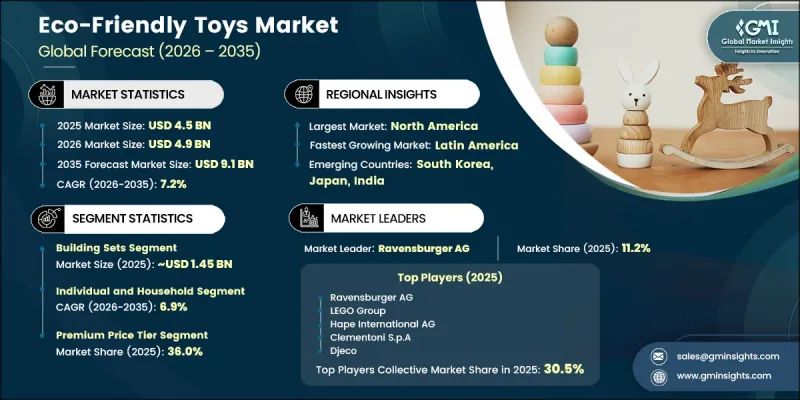
Growth is shaped by the wider adoption of bio-based materials, expansion of direct-to-consumer distribution channels, and increased use of eco-certification standards, all of which are broadening product availability and strengthening consumer reach. Unlike purely preference-driven markets, demand in this segment is increasingly reinforced by regulatory requirements and institutional sourcing standards, creating a more stable long-term growth foundation. North America continues to dominate the market, supported by strict chemical safety regulations and heightened awareness of non-toxic product standards. Millennial parents represent the core consumer base, showing consistently higher willingness to pay for certified eco-friendly toys compared to conventional alternatives. This behavior is driven by increased awareness of chemical exposure risks, sustainability concerns, and value alignment with environmentally responsible consumption. Educational institutions across developed regions are also adopting certified non-toxic toy standards for classrooms and childcare environments, further reinforcing demand stability. As sustainability expectations deepen across retail and institutional procurement systems, eco-friendly toys are becoming an embedded requirement rather than a niche consumer choice.
| Market Scope | |
|---|---|
| Start Year | 2025 |
| Forecast Year | 2026-2035 |
| Start Value | $4.5 Billion |
| Forecast Value | $9.1 Billion |
| CAGR | 7.2% |
The building sets segment held a 32.2% share in 2025, equivalent to USD 1.45 billion, and is expected to grow at a CAGR of 7.4% through 2035. This segment continues to lead due to strong compatibility between sustainable raw materials and modular toy designs that emphasize durability and reuse. Demand is further supported by increasing preference for structured, educational play formats that align with environmentally responsible production methods. Material innovation in wood-based and bio-derived polymers is also strengthening product performance and expanding design possibilities across this category.
The premium price segment above USD 35 accounted for 36% share in 2025, at a USD 1.62 billion, and is projected to grow at the fastest CAGR of 8.2% through 2035. This segment is outperforming lower price tiers due to strong consumer commitment to sustainability-driven purchases, with buyers demonstrating higher brand loyalty and reduced sensitivity to price changes. Repeat purchasing behavior is also stronger in this segment, particularly in gifting-driven consumption cycles, which continues to reinforce its revenue contribution and long-term growth trajectory.
North America Eco-Friendly Toys Market held a 36.8% share, representing USD 1.66 billion, and is expected to grow at a CAGR of 6.9% through 2035. The region's leadership is supported by stringent product safety regulations and well-established chemical compliance frameworks that strongly influence toy manufacturing and distribution standards. High consumer awareness regarding product safety and sustainability further supports steady market expansion. Institutional adoption across educational and childcare settings also plays a significant role in reinforcing demand across the region.
Major companies operating in the global eco-friendly toys market include Lego Group, Clementoni S.p.A., Djeco (Editions du Jouet SA), Hape International AG, Vilac SA, Ravensburger AG, EverEarth International GmbH, Green Toys Inc., Ostheimer GmbH, PlanToys Co., Ltd., Dantoy A/S, Le Toy Van Ltd., Bajo (Bajo Wojciech Bajor), Tikiri Toys (DSL Toys Pvt. Ltd.), Bannor Toys, BeginAgain Toys, Goki / Gollnest & Kiesel GmbH, BiOBUDDI Group B.V., Plasticant Mobilo GmbH, Grimm's Spiel und Holz Design, and Lanka Kade (UK) Ltd. Companies operating in the eco-friendly toys market are adopting several strategic approaches to strengthen their competitive position and expand market share. A key focus area is product innovation, with manufacturers investing in bio-based materials, non-toxic formulations, and recyclable packaging to meet evolving sustainability standards. Firms are also expanding certification compliance to align with global eco-label requirements, enhancing brand credibility and consumer trust. Direct-to-consumer channel expansion and digital retail strategies are being used to improve market access and customer engagement. Strategic collaborations with educational institutions and institutional buyers are helping companies secure stable demand streams.
Table of Contents
Chapter 1 Methodology & Scope
- 1.1 Research approach
- 1.2 Quality commitments
- 1.2.1 GMI AI policy & data integrity commitment
- 1.2.1.1 Source consistency protocol
- 1.2.1 GMI AI policy & data integrity commitment
- 1.3 Research trail & confidence scoring
- 1.3.1 Research trail components
- 1.3.2 Scoring components
- 1.4 Data collection
- 1.4.1 Partial list of primary sources
- 1.5 Data mining sources
- 1.5.1 Paid sources
- 1.5.1.1 Sources, by region
- 1.5.1 Paid sources
- 1.6 Base estimates and calculations
- 1.6.1 Base year calculation for any one approach
- 1.7 Market estimates & forecasts parameters
- 1.8 Forecast model
- 1.8.1 Quantified market impact analysis
- 1.8.1.1 Mathematical impact of growth parameters on forecast
- 1.8.1 Quantified market impact analysis
- 1.9 Research transparency addendum
- 1.9.1 Source attribution framework
- 1.9.2 Quality assurance metrics
- 1.9.3 Our commitment to trust
- 1.10 Market definitions
Chapter 2 Executive Summary
- 2.1 Industry synopsis, 2022 - 2035
- 2.1.1 Business trends
- 2.1.2 Product type trends
- 2.1.3 Material trends
- 2.1.4 Age group trends
- 2.1.5 Price range trends
- 2.1.6 End user trends
- 2.1.7 Distribution channel trends
- 2.1.8 Regional trends
Chapter 3 Industry Insights
- 3.1 Industry ecosystem analysis
- 3.2 Industry impact forces
- 3.2.1 Growth drivers
- 3.2.1.1 Rising Consumer Awareness of Sustainability & Environmental Consciousness
- 3.2.1.2 Innovations in Eco-Friendly Materials (Bamboo, Organic Cotton, Recycled PET, Bio-based Plastics)
- 3.2.1.3 Stringent Government Regulations Restricting Toxic Materials in Children's Products
- 3.2.1.4 Growing Gifting Culture & Premiumization in Children's Products Globally
- 3.2.2 Industry pitfalls and challenges
- 3.2.2.1 Limited Availability & Higher Cost of Certified Sustainable Raw Materials
- 3.2.2.2 Intense Competition from Conventional & Low-Cost Traditional Toy Manufacturers
- 3.2.3 Market opportunities
- 3.2.3.1 Expanding E-Commerce Penetration in Emerging Economies (Asia Pacific, Latin America)
- 3.2.3. 2 Growing Adoption of Subscription-Based & Toy Rental Models for Eco-Toys
- 3.2.1 Growth drivers
- 3.3 Growth potential analysis
- 3.4 Regulatory landscape (Driven by primary research)
- 3.4.1 North America
- 3.4.2 Europe
- 3.4.3 Asia Pacific
- 3.4.4 Latin America
- 3.4.5 MEA
- 3.5 Technology landscape
- 3.5.1 Current technological trends
- 3.5.2 Emerging technologies
- 3.6 Pricing trend analysis (Driven by primary research)
- 3.7 Future market trends
- 3.8 Patent analysis
- 3.9 Porter's analysis
- 3.10 PESTEL analysis
- 3.11 Impact of AI and Generative AI on the market (Driven by primary research)
- 3.12 Value chain analysis (Driven by primary research)
- 3.13 Investment & funding analysis (Driven by primary research)
- 3.14 Consumer insights (Driven by primary research)
Chapter 4 Competitive Landscape, 2025
- 4.1 Introduction
- 4.2 Company market share analysis, by region, 2025
- 4.2.1 North America
- 4.2.2 Europe
- 4.2.3 Asia Pacific
- 4.2.4 Middle East & Africa
- 4.2.5 Latin America
- 4.3 Key developments
- 4.3.1 Key partnerships & collaborations
- 4.3.2 Major M&A activities
- 4.3.3 Product innovations & launches
- 4.3.4 Market expansion strategies
- 4.4 Competitive positioning matrix
Chapter 5 Market Size and Forecast, By Product Type, 2022 - 2035 (USD Million)
- 5.1 Key trends
- 5.1.1 Building sets
- 5.1.1.1 Classic stacking & block sets
- 5.1.1.2 Interlocking & construction sets
- 5.1.1.3 Magnetic building sets
- 5.1.2 Action figures & figurines
- 5.1.3 Games & puzzles
- 5.1.3.1 Board games
- 5.1.3.2 Eco-puzzles
- 5.1.3.3 STEM learning games & science kits
- 5.1.4 Sports & outdoor toys
- 5.1.5 Others
- 5.1.1 Building sets
Chapter 6 Market Size and Forecast, By Material, 2022 - 2035 (USD Million)
- 6.1 Key trends
- 6.2 Wood
- 6.2.1 Virgin certified wood
- 6.2.2 Reclaimed, recycled & upcycled wood
- 6.3 Bamboo
- 6.4 Paper & cardboard
- 6.4.1 Recycled cardboard
- 6.4.2 Virgin sustainable paper
- 6.5 Wool & cotton
- 6.6 Natural rubber
- 6.7 Recycled plastics
- 6.8 Bio-based plastics
- 6.9 Others
Chapter 7 Market Size and Forecast, By Age Group, 2022 - 2035 (USD Million)
- 7.1 Key trends
- 7.2 Toddlers
- 7.3 Preschoolers
- 7.4 School-age children
- 7.5 Teens
- 7.6 Adults
Chapter 8 Market Size and Forecast, By Price Range, 2022 - 2035 (USD Million)
- 8.1 Key trends
- 8.2 Budget
- 8.3 Mid-range
- 8.4 Premium
Chapter 9 Market Size and Forecast, By End User, 2022 - 2035 (USD Million)
- 9.1 Key trends
- 9.2 Individual / household purchase
- 9.3 Commercial
- 9.4 Schools & educational institutions
- 9.5 Daycare & childcare centers
- 9.6 Hospitals & child therapy centers
- 9.7 Corporate gifting
Chapter 10 Market Size and Forecast, By Distribution Channel, 2022 - 2035 (USD Million)
- 10.1 Key trends
- 10.2 Online
- 10.2.1 E-commerce platforms
- 10.2.2 Company-owned direct-to-consumer websites
- 10.3 Social commerce & influencer-driven sales channels
- 10.4 Offline
- 10.4.1 Supermarkets & hypermarkets
- 10.4.2 Specialty toy chains & independent toy stores
- 10.4.3 Natural, organic & eco-wellness retail stores
- 10.4.4 Others
Chapter 11 Market Size and Forecast, By Region, 2022 - 2035 (USD Million)
- 11.1 Key trends
- 11.2 North America
- 11.2.1 U.S.
- 11.2.2 Canada
- 11.3 Europe
- 11.3.1 Germany
- 11.3.2 France
- 11.3.3 UK
- 11.3.4 Netherlands
- 11.3.5 Spain
- 11.3.6 Italy
- 11.4 Asia Pacific
- 11.4.1 China
- 11.4.2 Japan
- 11.4.3 South Korea
- 11.4.4 India
- 11.4.5 Australia
- 11.5 Middle East & Africa
- 11.5.1 Saudi Arabia
- 11.5.2 UAE
- 11.5.3 South Africa
- 11.6 Latin America
- 11.6.1 Brazil
- 11.6.2 Argentina
- 11.6.3 Mexico
Chapter 12 Company Profiles
- 12.1 Global Players
- 12.1.1 Lego Group
- 12.1.2 Clementoni S.p.A.
- 12.1.3 Djeco (Editions du Jouet SA)
- 12.1.4 Hape International AG
- 12.1.5 Vilac SA
- 12.1.6 Ravensburger AG
- 12.1.7 EverEarth International GmbH
- 12.2 Regional Players
- 12.2.1 Green Toys Inc.
- 12.2.2 Ostheimer GmbH
- 12.2.3 PlanToys Co., Ltd.
- 12.2.4 Dantoy A/S
- 12.2.5 Le Toy Van Ltd.
- 12.2.6 Bajo (Bajo Wojciech Bajor)
- 12.2.7 Tikiri Toys (DSL Toys Pvt. Ltd.)
- 12.3 Niche & Specialist Players
- 12.3.1 Bannor Toys
- 12.3.2 BeginAgain Toys
- 12.3.3 Goki / Gollnest & Kiesel GmbH
- 12.3.4 BiOBUDDi Group B.V.
- 12.3.5 Plasticant Mobilo GmbH
- 12.3.6 Grimm's Spiel und Holz Design
- 12.3.7 Lanka Kade (UK) Ltd.
- 12.3.8 Ypsomed Holding

