PUBLISHER: Global Market Insights Inc. | PRODUCT CODE: 2071377

PUBLISHER: Global Market Insights Inc. | PRODUCT CODE: 2071377
Household Cleaning Products Market Opportunity, Growth Drivers, Industry Trend Analysis, and Forecast 2026 - 2035
The Global Household Cleaning Products Market was valued at USD 215 billion in 2025 and is estimated to grow at a CAGR of 6.2% to reach USD 390 billion by 2035.
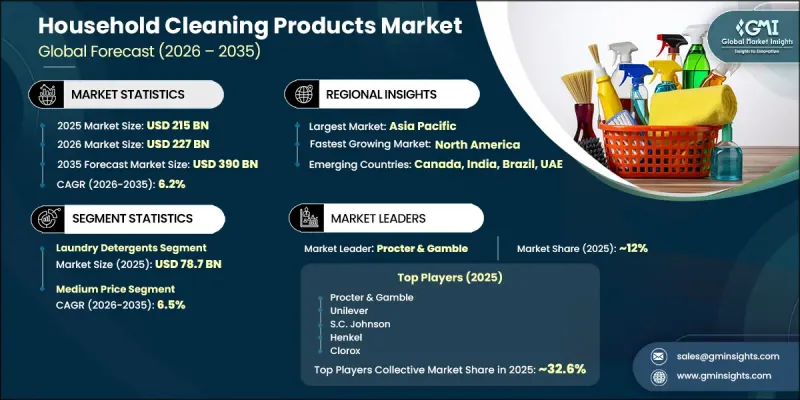
Market continues to benefit from consistent consumer spending across categories such as laundry care, dishwashing products, surface cleaners, floor care solutions, and specialty cleaning formulations. Together, these product categories serve essential household cleaning needs, making the market highly resilient and fundamentally non-discretionary. Long-term market expansion is supported by a combination of heightened hygiene awareness, increasing consumer preference for premium cleaning solutions, and rising adoption of environmentally responsible formulations. Across both developed and developing economies, evolving purchasing behaviors and growing emphasis on product performance are reshaping competitive dynamics within the industry. The market is increasingly transitioning away from being viewed solely as a routine household expense and toward a category where consumers actively evaluate value, efficacy, sustainability, and ingredient transparency. Elevated cleaning habits established during recent years have remained firmly embedded in daily routines, creating lasting demand across multiple product categories. Market observations indicate that household cleaning activity in higher-income regions remains approximately 18% to 22% above levels recorded before 2020. More importantly, consumers are demonstrating greater willingness to invest in products offering improved cleaning performance, innovative formats, enhanced safety profiles, and transparent ingredient disclosures, creating favorable conditions for continued category growth.
| Market Scope | |
|---|---|
| Start Year | 2025 |
| Forecast Year | 2026-2035 |
| Start Value | $215 Billion |
| Forecast Value | $390 Billion |
| CAGR | 6.2% |
The laundry detergents segment accounted for USD 78.7 billion in 2025 and is forecast to grow at a CAGR of 6% through 2035. The segment remains the largest product category due to the universal nature of laundry care and the continued shift toward higher-value product offerings. Market development has progressed from traditional bulk formulations toward concentrated alternatives and increasingly convenient single-use formats that generate significantly higher per-use value compared to conventional products. Product innovation within the laundry detergent segment is being driven by three major factors: enhanced cleaning effectiveness through advanced formulation technologies, increased emphasis on sustainable and environmentally conscious ingredients, and growing consumer demand for convenience-focused product designs that simplify daily cleaning routines.
The medium-priced segment held a 45.8% share. Its strong position is supported by a balanced value proposition that appeals to a broad consumer base. The segment benefits from consumers shifting upward from economy products as purchasing power improves, while also attracting value-conscious buyers seeking quality performance without entering premium price tiers. Established branded products dominate this segment due to strong consumer trust, widespread retail availability, and a competitive combination of affordability and effectiveness, making it the largest accessible market category globally.
United States Household Cleaning Products Market generated USD 41.2 billion in 2025 and is projected to expand at a CAGR of 6.5% over the forecast period. Market growth is being influenced by increasingly stringent product transparency requirements and growing emphasis on sustainable product development. Regulatory initiatives focused on ingredient disclosure, consumer safety, and environmental responsibility continue to shape product formulation and marketing strategies. These evolving standards are encouraging manufacturers to prioritize transparency, safer ingredient profiles, and sustainable innovation while strengthening consumer confidence across the household cleaning products industry. As a result, regulatory developments are increasingly serving as a catalyst for product differentiation and long-term market growth.
Major companies operating in the global household cleaning products market include Werner & Mertz GmbH, Church & Dwight Co., Inc., Kao Corporation, Reckitt Benckiser Group PLC, The Clorox Company, Henkel AG & Co. KGaA, Unilever PLC, Method Products PBC, Ecover, Procter & Gamble Co., Colgate-Palmolive Company, Godrej Consumer Products Ltd., S.C. Johnson & Son Inc., LG Household & Health Care Ltd., McBride PLC, and Seventh Generation Inc. Companies operating in the household cleaning products market are implementing a combination of product innovation, sustainability initiatives, brand premiumization, and digital expansion strategies to strengthen their competitive positions. Manufacturers are increasingly investing in environmentally friendly formulations, biodegradable ingredients, refillable packaging solutions, and reduced-plastic product designs to align with evolving consumer preferences and regulatory expectations. Firms are also expanding premium product portfolios featuring enhanced cleaning performance, ingredient transparency, and convenience-focused formats. Strategic partnerships with retailers, growth in direct-to-consumer channels, and stronger e-commerce capabilities are helping companies broaden market reach and improve customer engagement.
Table of Contents
Chapter 1 Methodology & Scope
- 1.1 Market scope and definition
- 1.2 Research design
- 1.2.1 Research approach
- 1.2.2 Data collection methods
- 1.3 Data mining sources
- 1.3.1 Global
- 1.3.2 Regional/Country
- 1.4 Base estimates and calculations
- 1.4.1 Base year calculation
- 1.4.2 Key trends for market estimation
- 1.5 Primary research and validation
- 1.5.1 Primary sources
- 1.6 Forecast model
- 1.7 Research assumptions and limitations
Chapter 2 Executive Summary
- 2.1 Industry 360° synopsis
- 2.2 Key market trends
- 2.2.1 Regional
- 2.2.2 Product type
- 2.2.3 Ingredient type
- 2.2.4 Product form
- 2.2.5 Price
- 2.2.6 End user
- 2.2.7 Distribution channel
Chapter 3 Industry Insights
- 3.1 Industry ecosystem analysis
- 3.1.1 Supplier landscape
- 3.1.2 Profit margin
- 3.1.3 Value addition at each stage
- 3.1.4 Factor affecting the value chain
- 3.2 Industry impact forces
- 3.2.1 Growth drivers
- 3.2.1.1 Rising hygiene awareness & post-pandemic behavioral shift in household cleaning frequency
- 3.2.1.2 Accelerating consumer demand for eco-friendly, plant-based & sustainable formulations
- 3.2.1.3 Rapid growth of e-commerce & direct-to-consumer (DTC) distribution channels
- 3.2.1.4 Urbanization & rising disposable incomes driving premium product adoption
- 3.2.1.5 Innovation in concentrated, refillable & unit-dose product formats
- 3.2.2 Industry pitfalls & challenges
- 3.2.2.1 Balancing cost-performance-sustainability in natural/organic formulations
- 3.2.2.2 Supply chain fragility & tariff exposure in raw material procurement
- 3.2.2.3 Consumer retention in a highly fragmented, price-sensitive category
- 3.2.2.4 Navigating multi-jurisdictional regulatory compliance across key geographies
- 3.2.3 Opportunities
- 3.2.4 Premiumization & wellness-oriented cleaning products (neuroscience-backed, fragrance-free, hypoallergenic)
- 3.2.5 Emerging markets untapped demand in southeast Asia, Africa & Latin America
- 3.2.6 Subscription & refill business models enabling recurring revenue streams
- 3.2.7 B2B/commercial channel expansion HoReCa, healthcare & institutional segments
- 3.2.1 Growth drivers
- 3.3 Growth potential analysis
- 3.4 Future market trends
- 3.5 Technology and innovation landscape
- 3.5.1 Current technological trends
- 3.5.2 Emerging technologies
- 3.6 Regulatory landscape
- 3.6.1 Standards and compliance requirements
- 3.6.2 Regional regulatory frameworks
- 3.6.3 Certification standards
- 3.7 Trade data analysis (HS Code 3402)
- 3.7.1 Import/export volume & value trends
- 3.7.2 Key trade corridors & tariff impact
- 3.8 Pricing analysis
- 3.8.1 Historical price trend analysis (driven by primary research)
- 3.8.2 Pricing strategy by player type (premium / value / mass market)
- 3.9 Impact of AI & generative AI on the market
- 3.9.1 AI-driven disruption of existing business models
- 3.9.2 GenAI use cases & adoption roadmap by segment
- 3.9.3 Risks, limitations & regulatory considerations
- 3.10 Porter's analysis
- 3.11 PESTEL analysis
Chapter 4 Competitive Landscape, 2025
- 4.1 Introduction
- 4.2 Company market share analysis
- 4.2.1 By Region
- 4.2.1.1 North America
- 4.2.1.2 Europe
- 4.2.1.3 Asia Pacific
- 4.2.1.4 Latin America
- 4.2.1.5 Middle East & Africa
- 4.2.1 By Region
- 4.3 Company matrix analysis
- 4.4 Competitive analysis of major market players
- 4.5 Competitive positioning matrix
- 4.6 Key developments
- 4.6.1 Mergers & acquisitions
- 4.6.2 Partnerships & collaborations
- 4.6.3 New product launches
- 4.6.4 Expansion plans
Chapter 5 Market Estimates & Forecast, By Product Type, 2022 - 2035, (USD Billion) (Million Units)
- 5.1 Key trends
- 5.2 Laundry detergents
- 5.3 Surface cleaners
- 5.4 Dishwashing products
- 5.5 Toilet bowl cleaners
- 5.6 Air fresheners & deodorizers
- 5.7 Others (drain cleaners & uncloggers)
Chapter 6 Market Estimates & Forecast, By Ingredient Type, 2022 - 2035, (USD Billion) (Million Units)
- 6.1 Key trends
- 6.2 Chemical/synthetic
- 6.3 Natural/organic
Chapter 7 Market Estimates & Forecast, By Product Form, 2022 - 2035, (USD Billion) (Million Units)
- 7.1 Key trends
- 7.2 Liquid
- 7.3 Powder
- 7.4 Gel/cream
- 7.5 Spray (trigger & aerosol)
- 7.6 Wipes/sheets (disposable & dissolvable)
- 7.7 Tablets/pods/capsules
Chapter 8 Market Estimates & Forecast, By Price, 2022 - 2035, (USD Billion) (Million Units)
- 8.1 Key trends
- 8.2 Low
- 8.3 Medium
- 8.4 High
Chapter 9 Market Estimates & Forecast, By End-Use, 2022 - 2035, (USD Billion) (Million Units)
- 9.1 Key trends
- 9.2 Residential
- 9.3 Commercial
- 9.3.1 HoReCa (hotels, restaurants & catering)
- 9.3.2 Healthcare & institutional facilities
- 9.3.3 Corporate/office & educational facilities
Chapter 10 Market Estimates & Forecast, By Distribution Channel, 2022 - 2035, (USD Billion) (Million Units)
- 10.1 Key trends
- 10.2 Online
- 10.2.1 E-commerce
- 10.2.2 Company websites
- 10.3 Offline
- 10.3.1 Supermarkets & hypermarkets
- 10.3.2 Specialty stores
- 10.3.3 Others retail stores
Chapter 11 Market Estimates & Forecast, By Region, 2022 - 2035, (USD Billion) (Million Units)
- 11.1 Key trends
- 11.2 North America
- 11.2.1 U.S.
- 11.2.2 Canada
- 11.3 Europe
- 11.3.1 Germany
- 11.3.2 UK
- 11.3.3 France
- 11.3.4 Italy
- 11.3.5 Spain
- 11.4 Asia Pacific
- 11.4.1 China
- 11.4.2 India
- 11.4.3 Japan
- 11.4.4 South Korea
- 11.4.5 Australia
- 11.4.6 Indonesia
- 11.4.7 Malaysia
- 11.5 Latin America
- 11.5.1 Brazil
- 11.5.2 Mexico
- 11.5.3 Argentina
- 11.6 MEA
- 11.6.1 Saudi Arabia
- 11.6.2 UAE
- 11.6.3 South Africa
Chapter 12 Company Profiles
- 12.1 Top Global Players
- 12.1.1 Procter & Gamble Co.
- 12.1.2 Unilever PLC
- 12.1.3 Reckitt Benckiser Group PLC
- 12.1.4 Henkel AG & Co. KGaA
- 12.1.5 Colgate-Palmolive Company
- 12.1.6 The Clorox Company
- 12.2 Regional Champions
- 12.2.1 S.C. Johnson & Son Inc.
- 12.2.2 Kao Corporation
- 12.2.3 Church & Dwight Co., Inc.
- 12.2.4 Godrej Consumer Products Ltd.
- 12.2.5 McBride PLC
- 12.2.6 LG Household & Health Care Ltd.
- 12.3 Emerging Players
- 12.3.1 Method Products PBC (SC Johnson)
- 12.3.2 Seventh Generation Inc.
- 12.3.3 Werner & Mertz GmbH
- 12.3.4 Ecover

