PUBLISHER: Global Market Insights Inc. | PRODUCT CODE: 2071381

PUBLISHER: Global Market Insights Inc. | PRODUCT CODE: 2071381
Edge AI Market Opportunity, Growth Drivers, Industry Trend Analysis, and Forecast 2026 - 2035
The Global Edge AI Market was valued at USD 25.2 billion in 2025 and is estimated to grow at a CAGR of 24.7% to reach USD 225.5 billion by 2035.
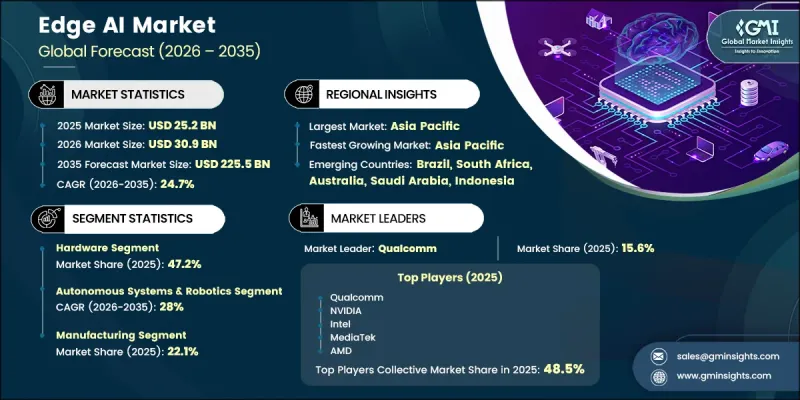
Market growth is driven by the rising need for real-time data processing, low-latency decision-making, and enhanced data privacy across connected environments. Edge AI enables artificial intelligence workloads to be processed locally on devices such as sensors, cameras, industrial equipment, and autonomous systems, reducing dependence on centralized cloud infrastructure. This capability is increasingly critical as data volumes surge across IoT, smart manufacturing, automotive, healthcare, and surveillance applications. By minimizing latency and bandwidth usage, edge AI improves system responsiveness and reliability, making it ideal for mission-critical and time-sensitive use cases.
| Market Scope | |
|---|---|
| Start Year | 2025 |
| Forecast Year | 2026-2035 |
| Start Value | $25.2 Billion |
| Forecast Value | $225.5 Billion |
| CAGR | 24.7% |
The growing adoption of connected devices, 5G networks, and intelligent automation is further accelerating edge AI deployment across enterprises. Organizations are leveraging edge-based intelligence to improve operational efficiency, enable predictive maintenance, and enhance safety and monitoring capabilities. Additionally, increasing concerns around data security and regulatory compliance are encouraging enterprises to process sensitive data locally rather than transmitting it to centralized data centers. These advantages are driving widespread adoption of edge AI solutions across both industrial and commercial applications, positioning the market for sustained long-term growth.
Based on the component, the hardware segment held a 47.2% share in 2025. Edge AI hardware, including AI-enabled processors, GPUs, ASICs, FPGAs, and edge servers, forms the backbone of real-time inference and analytics at the network edge. Demand for high-performance, energy-efficient chips capable of running complex AI models locally is rising rapidly across automotive, manufacturing, and smart city deployments. Semiconductor companies are focusing on developing specialized edge AI accelerators optimized for low power consumption and high computational throughput. The rapid proliferation of smart cameras, industrial robots, and autonomous devices continues to drive strong investment in edge AI hardware solutions.
The video surveillance segment captured significant share in 2025, driven by the growing need for real-time video analytics, enhanced security, and intelligent monitoring across public and private environments. Edge AI enables video data to be processed locally on cameras and edge devices, allowing instant threat detection, facial recognition, object tracking, and behavioral analysis without relying on cloud connectivity. This significantly reduces latency, bandwidth usage, and data transmission costs while improving response times in critical situations. Video surveillance powered by edge AI is increasingly deployed in smart cities, transportation hubs, retail stores, industrial facilities, and critical infrastructure.
China Edge AI Market generated USD 3.9 billion in 2025, driven by rapid industrialization, large-scale deployment of smart infrastructure, and strong government support for AI and digital transformation initiatives. China's edge AI landscape is experiencing strong growth as cloud-based technologies, advanced 5G connectivity, and decentralized AI processing capabilities increasingly converge. Businesses and telecommunications providers are accelerating the adoption of edge-centric infrastructures to enable real-time data processing, ultra-low-latency analytics, and faster on-site decision-making. Major technology companies, including Huawei and ZTE, continue to expand investments in integrated edge AI solutions that combine computing power, network management, and AI coordination capabilities to support large-scale 5G deployments and industrial IoT applications.
Key players operating in the Global Edge AI Market include NVIDIA Corporation, Intel Corporation, Qualcomm Technologies, Advanced Micro Devices (AMD), Arm Ltd., Google LLC, IBM Corporation, Amazon Web Services, Microsoft Corporation, and Huawei Technologies. These companies compete through innovation in AI chips, edge platforms, and integrated hardware-software solutions, while expanding partnerships across automotive, industrial, and telecom ecosystems. Companies in the edge AI market are strengthening their market position through continuous innovation in AI-specific hardware and optimized edge software platforms. Leading players are investing heavily in developing low-power, high-performance processors tailored for real-time inference at the edge. Strategic partnerships with OEMs, industrial automation providers, and telecom operators help accelerate solution deployment across key industries. Firms are also expanding end-to-end edge AI ecosystems by integrating hardware, software, and cloud orchestration capabilities.
Table of Contents
Chapter 1 Methodology
- 1.1 Research approach
- 1.2 Quality Commitments
- 1.2.1 GMI AI policy & data integrity commitment
- 1.2.1.1 Source consistency protocol
- 1.2.1 GMI AI policy & data integrity commitment
- 1.3 Research Trail & Confidence Scoring
- 1.3.1 Research Trail Components
- 1.3.2 Scoring Components
- 1.4 Data Collection
- 1.4.1 Partial list of primary sources
- 1.5 Data mining sources
- 1.5.1 Paid sources
- 1.5.1.1 Sources, by region
- 1.5.1 Paid sources
- 1.6 Base estimates and calculations
- 1.6.1 Base year calculation for any one approach
- 1.7 Forecast model
- 1.7.1 Quantified market impact analysis
- 1.7.1.1 Mathematical impact of growth parameters on forecast
- 1.7.1 Quantified market impact analysis
- 1.8 Research transparency addendum
- 1.8.1 Source attribution framework
- 1.8.2 Quality assurance metrics
- 1.8.3 Our commitment to trust
Chapter 2 Executive Summary
- 2.1 Industry 360° synopsis, 2022 - 2035
- 2.2 Key market trends
- 2.2.1 Regional
- 2.2.2 Component
- 2.2.3 Application
- 2.2.4 End Use
- 2.3 TAM Analysis, 2026-2035
- 2.4 CXO perspectives: Strategic imperatives
Chapter 3 Industry Insights
- 3.1 Industry ecosystem analysis
- 3.1.1 Supplier landscape
- 3.1.2 Profit margin analysis
- 3.1.3 Cost structure
- 3.1.4 Value addition at each stage
- 3.1.5 Factor affecting the value chain
- 3.1.6 Disruptions
- 3.2 Industry impact forces
- 3.2.1 Growth drivers
- 3.2.1.1 Increasing adoption of edge devices across various end-user verticals.
- 3.2.1.2 Growing investment in the AI technology.
- 3.2.1.3 Growing adoption of 5G network.
- 3.2.1.4 Surging adoption of cloud computing technology.
- 3.2.2 Industry pitfalls and challenges
- 3.2.2.1 Privacy and security concerns
- 3.2.2.2 Interoperability issues
- 3.2.3 Market opportunities
- 3.2.3.1 Expansion of 5G-enabled edge computing infrastructure
- 3.2.3.2 Rising adoption of IoT and connected devices across industries
- 3.2.3.3 Increasing demand for real-time analytics and low-latency processing
- 3.2.3.4 Growth in autonomous systems and smart industrial automation
- 3.2.1 Growth drivers
- 3.3 Growth potential analysis
- 3.4 Technology and innovation landscape
- 3.4.1 Current technological trends
- 3.4.1.1 AI-enabled edge computing devices
- 3.4.1.2 5G-integrated edge infrastructure
- 3.4.1.3 Edge-based computer vision systems
- 3.4.1.4 IoT-enabled edge analytics platforms
- 3.4.2 Emerging technologies
- 3.4.2.1 Federated learning at the edge
- 3.4.2.2 Neuromorphic computing for edge AI
- 3.4.2.3 Edge AI chips and accelerators (NPUs/ASICs)
- 3.4.2.4 Generative AI models deployed on edge devices
- 3.4.1 Current technological trends
- 3.5 Pricing Analysis (Driven by primary research)
- 3.5.1 Historical Price Trend Analysis
- 3.5.2 Pricing Strategy by Player Type
- 3.6 Regulatory landscape
- 3.6.1 North America
- 3.6.2 Europe
- 3.6.3 Asia Pacific
- 3.6.4 Latin America
- 3.6.5 Middle East & Africa
- 3.7 Porter's analysis
- 3.8 PESTEL analysis
- 3.9 Patent analysis (Driven by primary research)
- 3.10 Cost breakdown analysis
- 3.11 Impact of AI and Generative AI on the Market
- 3.11.1 AI Driven Disruption of Existing Business Models
- 3.11.2 GenAI Use Cases and Adoption Roadmap by Segment
- 3.11.3 Risks Limitations and Regulatory Considerations
- 3.12 Sustainability and environmental aspects
- 3.12.1 Sustainable practices
- 3.12.2 Waste reduction strategies
- 3.12.3 Energy efficiency in production
- 3.12.4 Eco-friendly Initiatives
- 3.12.5 Carbon footprint considerations
- 3.13 Forecast assumptions & scenario analysis (Driven by Primary Research)
- 3.13.1 Base Case- Key Macro & Industry Variables Driving CAGR
- 3.13.2 Optimistic Scenarios- Favorable macro and industry tailwinds
- 3.13.3 Pessimistic Scenario - Macroeconomic slowdown or industry headwinds
Chapter 4 Competitive Landscape, 2025
- 4.1 Introduction
- 4.2 Company market share analysis
- 4.2.1 North America
- 4.2.2 Europe
- 4.2.3 Asia Pacific
- 4.2.4 LATAM
- 4.2.5 MEA
- 4.3 Competitive analysis of major market players
- 4.4 Competitive positioning matrix
- 4.5 Key developments
- 4.5.1 Mergers & acquisitions
- 4.5.2 Partnerships & collaborations
- 4.5.3 New Product Launches
- 4.5.4 Expansion Plans and funding
- 4.6 Company tier benchmarking
- 4.6.1 Tier classification criteria & qualifying thresholds
- 4.6.2 Tier positioning matrix by revenue, geography & innovation
Chapter 5 Market Estimates & Forecast, By Component, 2022 - 2035 (USD Mn)
- 5.1 Key trends
- 5.2 Hardware
- 5.2.1 Graphics Processing Unit (GPU)
- 5.2.2 Application Specific Integrated Circuit (ASIC),
- 5.2.3 Central Processing Unit (CPU)
- 5.2.4 Field-Programmable Gate Array (FPGA)
- 5.3 Software
- 5.4 Service
- 5.4.1 Training & consulting
- 5.4.2 Support & maintenance
- 5.4.3 System integration and testing
Chapter 6 Market Estimates & Forecast, By Application, 2022 - 2035 (USD Mn)
- 6.1 Key trends
- 6.2 Video surveillance
- 6.3 Remote monitoring
- 6.4 Predictive maintenance
- 6.5 Others
Chapter 7 Market Estimates & Forecast, By End Use, 2022 - 2035 (USD Mn)
- 7.1 Key trends
- 7.2 Manufacturing
- 7.3 Healthcare
- 7.4 BSFI
- 7.5 Government
- 7.6 Retail & e-commerce
- 7.7 Telecommunication
- 7.8 Transport & logistics
- 7.9 Others
Chapter 8 Market Estimates & Forecast, By Region, 2022 - 2035 (USD Mn)
- 8.1 Key trends
- 8.2 North America
- 8.2.1 US
- 8.2.2 Canada
- 8.3 Europe
- 8.3.1 Germany
- 8.3.2 UK
- 8.3.3 France
- 8.3.4 Italy
- 8.3.5 Spain
- 8.3.6 Russia
- 8.3.7 Norway
- 8.3.8 Netherlands
- 8.3.9 Sweden
- 8.4 Asia Pacific
- 8.4.1 China
- 8.4.2 India
- 8.4.3 Japan
- 8.4.4 Australia
- 8.4.5 South Korea
- 8.4.6 Singapore
- 8.4.7 Thailand
- 8.4.8 Indonesia
- 8.4.9 Vietnam
- 8.5 Latin America
- 8.5.1 Brazil
- 8.5.2 Mexico
- 8.5.3 Argentina
- 8.6 MEA
- 8.6.1 South Africa
- 8.6.2 Saudi Arabia
- 8.6.3 UAE
- 8.6.4 Turkey
Chapter 9 Company Profiles
- 9.1 Global Players
- 9.1.1 NVIDIA Corporation
- 9.1.2 Intel Corporation
- 9.1.3 Microsoft Corporation
- 9.1.4 Amazon Web Services (AWS)
- 9.1.5 Alphabet (Google)
- 9.1.6 IBM
- 9.1.7 Qualcomm
- 9.1.8 Apple Inc.
- 9.1.9 Huawei Technologies
- 9.2 Regional Players
- 9.2.1 ADLINK Technology Inc.
- 9.2.2 Synaptics Incorporated
- 9.2.3 Gorilla Technology Group
- 9.2.4 Robert Bosch GmbH
- 9.2.5 Siemens AG
- 9.2.6 Dell Technologies
- 9.2.7 Nutanix Inc.
- 9.2.8 Edge Impulse Inc.
- 9.2.9 FogHorn Systems
- 9.3 Emerging Players / Disruptors
- 9.3.1 Kneron Inc.
- 9.3.2 Ambiq Micro
- 9.3.3 SiMa.ai
- 9.3.4 Viso.ai

