PUBLISHER: Global Market Insights Inc. | PRODUCT CODE: 2071383

PUBLISHER: Global Market Insights Inc. | PRODUCT CODE: 2071383
Ultra-low Temperature Freezers Market Opportunity, Growth Drivers, Industry Trend Analysis, and Forecast 2026 - 2035
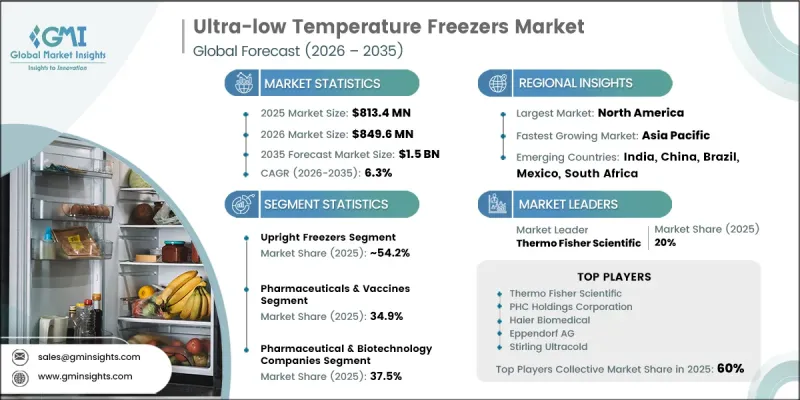
The Global Ultra-Low Temperature Freezers Market was valued at USD 813.4 million in 2025 and is estimated to grow at a CAGR of 6.3% to reach USD 1.5 billion by 2035.
Market expansion is driven by rising demand for biobanking and cryopreservation solutions, ongoing advancements in vaccine storage requirements, and the rapid growth of pharmaceutical and biotechnology research activities. The industry is also being shaped by the increasing reliance on temperature-sensitive biologics, clinical trial expansion, and the growing adoption of personalized medicine, all of which require highly controlled storage environments. Demand is further reinforced by the need for reproducible research outcomes and strict regulatory compliance across life sciences sectors. Continuous innovation in biologics and regenerative medicine is also intensifying the requirement for stable cold-chain infrastructure. As global R&D investments rise, the need for energy-efficient, high-capacity ultra-low temperature storage systems is expected to strengthen significantly over the forecast period.
| Market Scope | |
|---|---|
| Start Year | 2025 |
| Forecast Year | 2026-2035 |
| Start Value | $813.4 Million |
| Forecast Value | $1.5 Billion |
| CAGR | 6.3% |
Ultra-low temperature freezers are specialized refrigeration systems engineered to maintain extremely low temperatures, typically ranging from -40°C to -150°C, for the long-term preservation of sensitive biological materials and pharmaceutical samples. These systems are widely used to store DNA, RNA, proteins, vaccines, and other critical research specimens that require strict thermal stability. ULT freezers, generally operating between -40°C and -86°C, play a vital role in ensuring sample integrity across biobanks, laboratories, and pharmaceutical facilities. Rising clinical research activities and expanding personalized medicine applications have significantly increased the need for reliable cold storage systems. In addition, biopharmaceutical organizations require strict temperature-controlled environments to maintain product quality and regulatory compliance. The growing emphasis on long-term biological sample archiving, combined with advancements in regenerative medicine and biologics development, continues to support widespread adoption of these systems across global research and healthcare infrastructure.
The upright freezers segment accounted for 54.2% share in 2025. This segment maintains its leading position due to its space-efficient vertical design and ease of operation in laboratory and healthcare environments. Upright configurations are widely used in pharmaceutical companies, research institutions, and biobanks because they enable organized storage and quick access to samples. Growing requirements for sample preservation in vaccine storage, genomic research, and clinical trials continue to strengthen demand for these systems.
The pharmaceuticals and vaccines segment held a share of 34.9% in 2025. This segment remains a key driver of the ultra-low temperature freezers market due to strict storage requirements for biologics, advanced therapies, and temperature-sensitive vaccines. Pharmaceutical manufacturers, research organizations, and distribution networks rely on these systems to maintain product stability and efficacy throughout storage and transportation. Expanding biologic drug development pipelines and global immunization initiatives continue to support steady demand.
North America Ultra-Low Temperature Freezers Market accounted for 42.1% share in 2025. The region is witnessing strong growth supported by expanding biobanking and cryopreservation activities. A well-developed network of biobanks across North America depends heavily on advanced ultra-low temperature storage systems to preserve biological specimens for long-term research and clinical use. These facilities prioritize highly reliable and consistent freezing technologies to maintain sample quality and integrity.
Prominent players operating in the global ultra-low temperature freezers industry include:
Arctiko A/S, Avantor (VWR), B Medical Systems, Eppendorf AG, Esco Lifesciences, Froilabo, Haier Biomedical, Helmer Scientific, Labcold Ltd., NuAire Inc., PHC Holdings Corporation, So-Low Environmental Equipment, Stirling Ultracold, Thermo Fisher Scientific, Zhongke Meiling Cryogenics. Companies in the ultra-low temperature freezers market are strengthening their position through continuous product innovation focused on energy efficiency, temperature precision, and improved sample security features. Many manufacturers are investing in advanced compressor technologies, eco-friendly refrigerants, and enhanced insulation systems to reduce operational costs and improve sustainability. Strategic collaborations with pharmaceutical firms, research institutes, and healthcare providers are enabling customized solutions for specialized storage needs. Firms are also expanding their global distribution networks and after-sales service capabilities to improve customer retention. Integration of IoT-based monitoring systems, remote diagnostics, and predictive maintenance tools is further enhancing product reliability.
Table of Contents
Chapter 1 Research Methodology
- 1.1 Research approach
- 1.2 Quality commitments
- 1.2.1 GMI AI policy and data integrity commitment
- 1.2.1.1 Source consistency protocol
- 1.2.1 GMI AI policy and data integrity commitment
- 1.3 Research trail and confidence scoring
- 1.3.1 Research trail components
- 1.3.2 Scoring components
- 1.4 Data collection
- 1.4.1 Partial list of primary sources
- 1.5 Data mining sources
- 1.5.1 Paid sources
- 1.5.1.1 Sources, by region
- 1.5.1 Paid sources
- 1.6 Base estimates and calculations
- 1.6.1 Base year calculation for any one approach
- 1.7 Forecast model
- 1.7.1 Quantified market impact analysis
- 1.7.1.1 Mathematical impact of growth parameters on forecast
- 1.7.1 Quantified market impact analysis
- 1.8 Research transparency addendum
- 1.8.1 Source attribution framework
- 1.8.2 Quality assurance metrics
- 1.8.3 Our commitment to trust
Chapter 2 Executive Summary
- 2.1 Industry 3600 synopsis
- 2.2 Key market trends
- 2.2.1 Type trends
- 2.2.2 Application trends
- 2.2.3 Capacity trends
- 2.2.4 End use trends
- 2.2.5 Regional trends
- 2.3 CXO perspectives: Strategic imperatives
Chapter 3 Industry Insights
- 3.1 Industry ecosystem analysis
- 3.2 Industry impact forces
- 3.2.1 Growth drivers
- 3.2.1.1 Rising demand for biobanking and cryopreservation.
- 3.2.1.2 Advancements in vaccine storage.
- 3.2.1.3 Growth in pharmaceutical and biotechnology research.
- 3.2.1.4 Innovations in energy efficient ultra-low temperature freezers.
- 3.2.2 Industry pitfalls and challenges
- 3.2.2.1 Regulatory issues pertaining to medical grade refrigeration systems.
- 3.2.2.2 High cost associated with ultra-low temperature freezers.
- 3.2.3 Market opportunities
- 3.2.3.1 Freezer-as-a-Service (FaaS) rental model adoption unlocking new revenue streams
- 3.2.1 Growth drivers
- 3.3 Growth potential analysis
- 3.4 Regulatory landscape (Driven by primary research)
- 3.4.1 North America
- 3.4.2 Europe
- 3.4.3 Asia Pacific
- 3.4.4 Latin America
- 3.4.5 Middle East and Africa
- 3.5 Technology landscape (Driven by primary research)
- 3.5.1 Current technological trends
- 3.5.1.1 Integration of IoT and smart monitoring systems
- 3.5.1.2 Advancements in energy-efficient cooling technologies
- 3.5.2 Emerging technologies
- 3.5.2.1 Development of compact and portable ultra-low temperature freezers
- 3.5.2.2 AI-Enabled predictive maintenance and performance optimization
- 3.5.1 Current technological trends
- 3.6 Future market trends (Driven by primary research)
- 3.7 Impact of AI and Generative AI on the market (Driven by primary research)
- 3.8 Pricing trend analysis (Driven by primary research)
- 3.9 Porter's analysis
- 3.10 PESTEL analysis
Chapter 4 Competitive Landscape, 2025
- 4.1 Introduction
- 4.2 Company market share analysis
- 4.2.1 Global
- 4.2.2 North America
- 4.2.3 Europe
- 4.2.4 Asia Pacific
- 4.3 Company matrix analysis
- 4.4 Competitive analysis of major market players
- 4.5 Competitive positioning matrix
- 4.6 Key developments
- 4.6.1 Mergers and acquisitions
- 4.6.2 Partnerships and collaborations
- 4.6.3 New product launches
- 4.6.4 Expansion plans
Chapter 5 Market Estimates and Forecast, By Type, 2022 - 2035 ($ Mn)
- 5.1 Key trends
- 5.2 Upright freezers
- 5.3 Chest freezers
- 5.4 Other types
Chapter 6 Market Estimates and Forecast, By Application, 2022 - 2035 ($ Mn)
- 6.1 Key trends
- 6.2 Blood and blood products
- 6.3 Organs & tissue preservation
- 6.4 Pharmaceuticals & vaccines
- 6.5 Forensic and genomic research
- 6.6 Other applications
Chapter 7 Market Estimates and Forecast, By Capacity, 2022 - 2035 ($ Mn)
- 7.1 Key trends
- 7.2 Less than 300 Liters
- 7.3 301-700 Liters
- 7.4 Above 700 Liters
Chapter 8 Market Estimates and Forecast, By End Use, 2022 - 2035 ($ Mn)
- 8.1 Key trends
- 8.2 Pharmaceutical & biotechnology companies
- 8.3 Bio-bank
- 8.4 Academic & research laboratories
- 8.5 Hospitals & blood centers
- 8.6 Contract research organizations
- 8.7 Other end users
Chapter 9 Market Estimates and Forecast, By Region, 2022 - 2035 ($ Mn)
- 9.1 Key trends
- 9.2 North America
- 9.2.1 U.S.
- 9.2.2 Canada
- 9.3 Europe
- 9.3.1 Germany
- 9.3.2 UK
- 9.3.3 France
- 9.3.4 Spain
- 9.3.5 Italy
- 9.3.6 Netherlands
- 9.4 Asia Pacific
- 9.4.1 China
- 9.4.2 Japan
- 9.4.3 India
- 9.4.4 Australia
- 9.4.5 South Korea
- 9.5 Latin America
- 9.5.1 Brazil
- 9.5.2 Mexico
- 9.5.3 Argentina
- 9.6 Middle East and Africa
- 9.6.1 South Africa
- 9.6.2 Saudi Arabia
- 9.6.3 UAE
Chapter 10 Company Profiles
- 10.1 Arctiko A/S
- 10.2 Avantor (VWR)
- 10.3 B Medical Systems
- 10.4 Eppendorf AG
- 10.5 Esco Lifesciences
- 10.6 Froilabo
- 10.7 Haier Biomedical
- 10.8 Helmer Scientific
- 10.9 Labcold Ltd.
- 10.10 NuAire Inc.
- 10.11 PHC Holdings Corporation
- 10.12 So-Low Environmental Equipment
- 10.13 Stirling Ultracold
- 10.14 Thermo Fisher Scientific
- 10.15 Zhongke Meiling Cryogenics

