
PUBLISHER: Global Market Insights Inc. | PRODUCT CODE: 2071385

PUBLISHER: Global Market Insights Inc. | PRODUCT CODE: 2071385
Pet Monitoring Camera Market Opportunity, Growth Drivers, Industry Trend Analysis, and Forecast 2026 - 2035
The Global Pet Monitoring Camera Market was valued at USD 246.1 million in 2025 and is estimated to grow at a CAGR of 10.3% to reach USD 645 million by 2035.
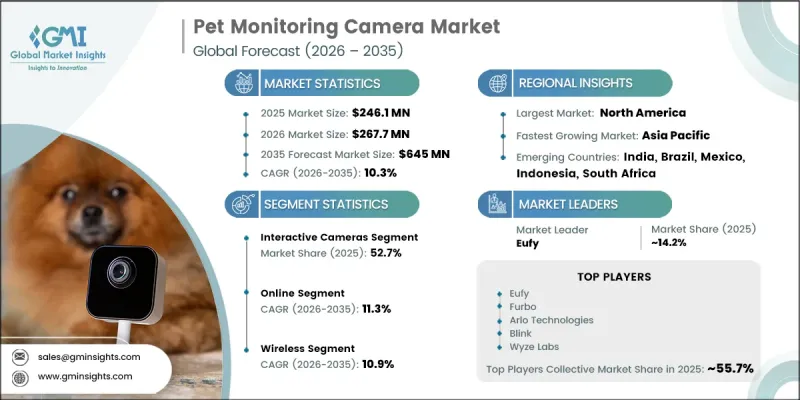
Market expansion is fueled by the growing emotional attachment between owners and pets, rising pet adoption levels, and increasing penetration of smart home ecosystems. The demand for connected pet care solutions continues to strengthen as consumers seek advanced technologies that allow continuous monitoring and interaction. The industry includes intelligent camera systems designed for remote pet supervision, offering features such as real-time video access, two-way communication, motion and sound alerts, night vision, AI-enabled behavior tracking, and cloud-based connectivity. Continuous innovation has enhanced product capabilities, making these systems more intuitive and efficient. Advancements in artificial intelligence, mobile integration, and cloud storage have significantly improved the user experience. Additionally, increasing awareness of pet behavioral health, anxiety management, and preventive care is encouraging adoption of smart monitoring devices that provide actionable insights and real-time updates.
| Market Scope | |
|---|---|
| Start Year | 2025 |
| Forecast Year | 2026-2035 |
| Start Value | $246.1 Million |
| Forecast Value | $645 Million |
| CAGR | 10.3% |
Interactive camera solutions accounted for 52.7% share in 2025 and is anticipated to grow at a CAGR of 11% from 2026 to 2035. These advanced devices represent a high-value segment by enabling real-time engagement rather than passive monitoring. They typically include communication features that allow pet owners to interact remotely, along with mechanisms that support engagement and behavioral reinforcement. This capability to maintain connection while away from home has driven strong consumer interest, particularly among users seeking more immersive pet care solutions.
The online distribution channel generated USD 157.1 million in 2025 and is forecast to grow at a CAGR of 11.3% during 2026-2035. Growth in this segment is largely driven by the increasing shift toward digital purchasing platforms and direct-to-consumer sales strategies. Online platforms provide detailed product insights, comparisons, user feedback, and competitive pricing, enabling more informed buying decisions. The convenience of browsing multiple brands and models in one place continues to strengthen consumer confidence and accelerate online adoption.
North America Pet Monitoring Camera Market accounted for 55.4% share in 2025. Strong demand in this region is supported by high pet ownership rates, increased spending on pet care, widespread adoption of connected home technologies, and advanced digital infrastructure. Consumers in this region increasingly treat pets as family members, driving investments in technologies that enhance safety, monitoring, and overall well-being. The rapid adoption of smart home devices and the growing demand for AI-powered consumer electronics further contribute to regional market growth.
Key players in the global pet monitoring camera market include Arlo Technologies, Blink (Amazon), Eufy (Anker Innovations), Ezviz, Furbo (Tomofun), Motorola (Binatone Global), Wyze Labs, YI Technology, Zmodo, Canary Connect, Pawbo (Acer), Petcube, PetChatz, Petzi (Wagz), Vimtag Technology, Nooie, NETVUE, Skymee, Tooge, and Wopet. Companies operating in the pet monitoring camera industry are strengthening their market position through continuous product innovation, strategic partnerships, and expansion of digital ecosystems. They are investing heavily in artificial intelligence, cloud integration, and advanced analytics to deliver enhanced user experiences and differentiated offerings. Many players are focusing on developing multifunctional devices that combine monitoring, interaction, and health tracking capabilities within a single platform. Expanding direct-to-consumer channels and improving e-commerce presence is also a key priority to reach a wider customer base. In addition, firms are emphasizing subscription-based services for cloud storage and premium features to generate recurring revenue. Geographic expansion, brand positioning, and integration with broader smart home systems are further supporting long-term growth strategies.
Table of Contents
Chapter 1 Methodology and Scope
- 1.1 Market scope and definition
- 1.2 Research approach
- 1.3 Quality commitments
- 1.3.1 GMI AI policy and data integrity commitment
- 1.3.1.1 Source consistency protocol
- 1.3.1 GMI AI policy and data integrity commitment
- 1.4 Research trail and confidence scoring
- 1.4.1 Research trail components
- 1.4.2 Scoring components
- 1.5 Data collection
- 1.5.1 Partial list of primary sources
- 1.6 Data mining sources
- 1.6.1 Paid sources
- 1.6.1.1 Sources, by region
- 1.6.1 Paid sources
- 1.7 Base estimates and calculations
- 1.7.1 Revenue share analysis
- 1.7.2 Base year calculation
- 1.8 Forecast model
- 1.9 Research transparency addendum
- 1.9.1 Source attribution framework
- 1.9.2 Quality assurance metrics
- 1.9.3 Our commitment to trust
Chapter 2 Executive Summary
- 2.1 Industry 360° synopsis
- 2.2 Key market trends
- 2.2.1 Regional trends
- 2.2.2 Product trends
- 2.2.3 Distribution channel trends
- 2.2.4 Technology trends
- 2.2.5 End use trends
- 2.3 CXO perspectives: Strategic imperatives
Chapter 3 Industry Insights
- 3.1 Industry ecosystem analysis
- 3.2 Industry impact forces
- 3.2.1 Growth drivers
- 3.2.1.1 Increasing numbers of pet owners and spendings on pets
- 3.2.1.2 Technological advancements in cameras with various features
- 3.2.1.3 Increased focus on pet safety and well-being
- 3.2.1.4 Increasing adoption of smart home technology
- 3.2.2 Industry pitfalls and challenges
- 3.2.2.1 Data privacy and security concerns
- 3.2.2.2 Technological challenges and user experience
- 3.2.3 Market opportunities
- 3.2.3.1 Increasing demand for subscription-based cloud monitoring services
- 3.2.3.2 Integration of telehealth and pet wellness monitoring features
- 3.2.1 Growth drivers
- 3.3 Growth potential analysis
- 3.4 Technology landscape
- 3.4.1 Current technology
- 3.4.2 Emerging technologies
- 3.5 Pricing analysis (Driven by Primary Research)
- 3.6 Regulatory landscape (Driven by Primary Research)
- 3.6.1 North America
- 3.6.2 Europe
- 3.6.3 Asia Pacific
- 3.6.4 Latin America
- 3.6.5 MEA
- 3.7 Porter's analysis
- 3.8 PESTEL analysis
- 3.9 Consumer behaviour analysis
- 3.10 Pet population, by country
- 3.10.1 Dog population, by country
- 3.10.2 Cat population, by country
- 3.11 Impact of AI and generative AI on the market (Driven by Primary Research)
- 3.12 Future market trends (Driven by Primary Research)
Chapter 4 Competitive Landscape, 2025
- 4.1 Introduction
- 4.2 Company market share analysis
- 4.2.1 North America
- 4.2.2 Europe
- 4.2.3 Asia Pacific
- 4.3 Company matrix analysis
- 4.4 Competitive analysis of major market players
- 4.5 Competitive positioning matrix
- 4.6 Key developments
- 4.6.1 Merger and acquisition
- 4.6.2 Partnership and collaboration
- 4.6.3 New product launches
Chapter 5 Market Estimates and Forecast, By Product, 2022 - 2035 ($ Mn & Units)
- 5.1 Key trends
- 5.2 Interactive cameras
- 5.3 Standalone cameras
Chapter 6 Market Estimates and Forecast, By Distribution Channel, 2022 - 2035 ($ Mn)
- 6.1 Key trends
- 6.2 Online
- 6.3 Offline
Chapter 7 Market Estimates and Forecast, By Technology, 2022 - 2035 ($ Mn)
- 7.1 Key trends
- 7.2 Wired
- 7.3 Wireless
Chapter 8 Market Estimates and Forecast, By End Use, 2022 - 2035 ($ Mn)
- 8.1 Key trends
- 8.2 Household
- 8.3 Commercial
Chapter 9 Market Estimates and Forecast, By Region, 2022 - 2035 ($ Mn & Units)
- 9.1 Key trends
- 9.2 North America
- 9.2.1 U.S.
- 9.2.2 Canada
- 9.3 Europe
- 9.3.1 Germany
- 9.3.2 UK
- 9.3.3 France
- 9.3.4 Spain
- 9.3.5 Italy
- 9.3.6 Netherlands
- 9.4 Asia Pacific
- 9.4.1 China
- 9.4.2 India
- 9.4.3 Japan
- 9.4.4 Australia
- 9.4.5 South Korea
- 9.5 Latin America
- 9.5.1 Brazil
- 9.5.2 Mexico
- 9.5.3 Argentina
- 9.6 Middle East and Africa
- 9.6.1 South Africa
- 9.6.2 Saudi Arabia
- 9.6.3 UAE
Chapter 10 Company Profiles
- 10.1 Arlo Technologies
- 10.2 Blink (Amazon)
- 10.3 Eufy (Anker Innovations)
- 10.4 Ezviz
- 10.5 Furbo (Tomofun)
- 10.6 Motorola (Binatone Global)
- 10.7 Wyze Labs
- 10.8 YI Technology
- 10.9 Zmodo
- 10.10 Canary Connect
- 10.11 Pawbo (Acer)
- 10.12 Petcube
- 10.13 PetChatz
- 10.14 Petzi (Wagz)
- 10.15 Vimtag Technology
- 10.16 Nooie
- 10.17 NETVUE
- 10.18 Skymee
- 10.19 Tooge
- 10.20 Wopet

