PUBLISHER: Global Market Insights Inc. | PRODUCT CODE: 2071387

PUBLISHER: Global Market Insights Inc. | PRODUCT CODE: 2071387
Lice Treatment Market Opportunity, Growth Drivers, Industry Trend Analysis, and Forecast 2026 - 2035
The Global Lice Treatment Market was valued at USD 1.16 billion in 2025 and estimated to grow at a CAGR of 7.2% to reach USD 2.3 billion by 2035.
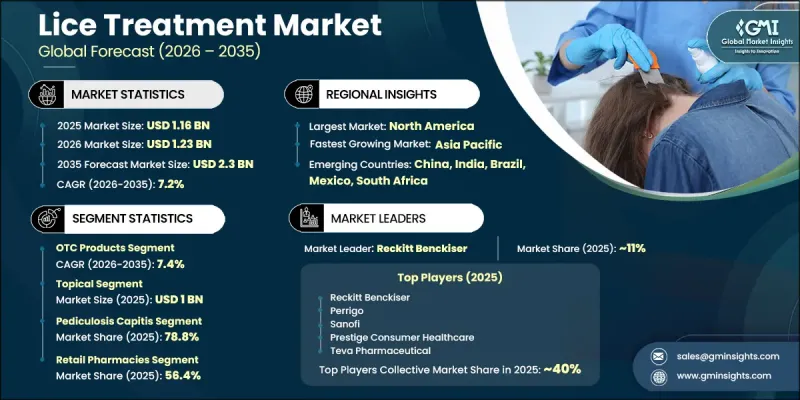
Market expansion is driven by the persistent global prevalence of lice infestations and the increasing need for fast, effective treatment solutions. Head lice continue to be highly common among school-aged children, spreading easily through close contact in schools, childcare environments, camps, and households. The recurring nature of infestations, combined with the urgency of treatment after detection, continues to support consistent demand for both over-the-counter and prescription-based products. Growing awareness of hygiene and personal care, along with improved access to treatment options across physical and digital retail channels, is further strengthening market penetration. At the same time, rising preference for safer and more convenient solutions is encouraging innovation in formulations and application formats. Manufacturers are increasingly focusing on resistance management, alternative active ingredients, and non-chemical approaches to address concerns related to treatment resistance and product safety. These evolving dynamics are supporting steady adoption across developed and emerging regions, reinforcing long-term market stability.
| Market Scope | |
|---|---|
| Start Year | 2025 |
| Forecast Year | 2026-2035 |
| Start Value | $1.16 Billion |
| Forecast Value | $2.3 Billion |
| CAGR | 7.2% |
The over-the-counter (OTC) segment is projected to grow at a CAGR of 7.4% through 2035. This segment includes permethrin, pyrethrin, and other OTC-based formulations. Its dominance is driven by widespread product availability, allowing consumers to begin treatment immediately after identifying an infestation without requiring medical consultation. This ease of access supports faster intervention and helps reduce further transmission. Increasing consumer demand for safer, environmentally conscious, and low-toxicity solutions is further supporting segment growth, along with rising interest in non-pesticide and naturally derived treatment alternatives.
The retail pharmacies segment accounted for 56.4% share in 2025. This channel maintains dominance due to its extensive physical reach and strong consumer trust, making it a primary destination for immediate treatment purchases. Retail pharmacies offer a wide assortment of lice treatment products, including medicated shampoos, topical solutions, sprays, combs, and supportive care accessories. This variety allows consumers to compare products easily and select appropriate solutions based on severity and preference. Parents and caregivers particularly rely on these outlets for quick and convenient access to treatment options following infestation detection in home or school environments.
North America Lice Treatment Market held a 39.1% share in 2025. Regional dominance is supported by high infestation rates among school-aged populations, strong awareness of personal hygiene, and broad availability of treatment products across pharmacies, supermarkets, and online platforms. Market growth is further reinforced by manufacturers expanding their portfolios across over-the-counter solutions, prescription therapies, natural formulations, and device-based treatments. Increasing emphasis on early detection, self-care practices, and resistance-effective solutions continues to strengthen market development across the region.
Key companies operating in the global lice treatment industry include Sanofi, Sun Pharmaceutical, Perrigo, Reckitt Benckiser, Teva Pharmaceutical, Prestige Consumer Healthcare, STADA Arzneimittel, Alliance Pharma, Azurity Pharmaceuticals, Cooper Laboratories, ICB PHARMA, Oystershell Consumer Health, Lice Clinics of America, and TecLabs. Companies in the lice treatment market are focusing on developing advanced formulations that address resistance concerns while improving treatment safety and efficacy. Many players are expanding into natural, pesticide-free, and low-toxicity product lines to meet growing consumer demand for safer alternatives. Strengthening distribution networks through pharmacies, supermarkets, and e-commerce platforms is a key strategy to improve product accessibility and brand reach. Firms are also investing in awareness campaigns and educational initiatives to promote early detection and proper treatment practices. In addition, continuous product innovation, including combination therapies and device-based solutions, is helping companies differentiate their offerings and build stronger consumer trust in a competitive and evolving market landscape.
Table of Contents
Chapter 1 Methodology and Scope
- 1.1 Market scope and definition
- 1.2 Research approach
- 1.3 Quality commitments
- 1.3.1 GMI AI policy and data integrity commitment
- 1.3.1.1 Source consistency protocol
- 1.3.1 GMI AI policy and data integrity commitment
- 1.4 Research trail and confidence scoring
- 1.4.1 Research trail components
- 1.4.2 Scoring components
- 1.5 Data collection
- 1.5.1 Partial list of primary sources
- 1.6 Data mining sources
- 1.6.1 Paid sources
- 1.6.1.1 Sources, by region
- 1.6.1 Paid sources
- 1.7 Base estimates and calculations
- 1.7.1 Revenue share analysis
- 1.7.2 Base year calculation
- 1.8 Forecast model
- 1.9 Research transparency addendum
- 1.9.1 Source attribution framework
- 1.9.2 Quality assurance metrics
- 1.9.3 Our commitment to trust
Chapter 2 Executive Summary
- 2.1 Industry 360-degree synopsis
- 2.2 Key market trends
- 2.2.1 Regional trends
- 2.2.2 Product type trends
- 2.2.3 Type trends
- 2.2.4 Route of administration trends
- 2.2.5 Condition trends
- 2.2.6 Dosage form trends
- 2.2.7 Distribution channel trends
- 2.3 CXO perspectives: Strategic imperatives
Chapter 3 Industry Insights
- 3.1 Industry ecosystem analysis
- 3.2 Industry impact forces
- 3.2.1 Growth drivers
- 3.2.1.1 High and persistent prevalence of lice infestation
- 3.2.1.2 Easy availability of lice treatment products
- 3.2.1.3 Increased consumer awareness of hygiene, health, and prevention
- 3.2.1.4 Rising demand for non toxic, natural, and alternative treatments
- 3.2.2 Industry pitfalls & challenges
- 3.2.2.1 Lack of awareness
- 3.2.2.2 Lack of awareness in certain regions and populations
- 3.2.2.3 Side effects and safety concerns associated with chemical treatments
- 3.2.3 Market opportunities
- 3.2.3.1 Growing demand for natural, organic, and non chemical treatments
- 3.2.3.2 Expansion through e commerce and online channels
- 3.2.1 Growth drivers
- 3.3 Growth potential analysis
- 3.4 Regulatory landscape (Driven by Primary Research)
- 3.4.1 North America
- 3.4.2 Europe
- 3.4.3 Asia Pacific
- 3.4.4 Latin America
- 3.4.5 MEA
- 3.5 Technology and innovation landscape (Driven by Primary Research)
- 3.5.1 Current trends
- 3.5.2 Emerging technologies
- 3.6 Pricing analysis, by dosage form (Driven by Primary Research)
- 3.7 Pipeline analysis (Driven by Primary Research)
- 3.8 Future market trends (Driven by Primary Research)
- 3.9 Impact of AI and Generative AI on the market (Driven by Primary Research)
- 3.10 Pediculicide resistance patterns & evolution
- 3.11 Porter's analysis
- 3.12 PESTEL analysis
Chapter 4 Competitive Landscape, 2025
- 4.1 Introduction
- 4.2 Company market share analysis
- 4.2.1 North America
- 4.2.2 Europe
- 4.2.3 Asia Pacific
- 4.3 Company matrix analysis
- 4.4 Competitive analysis of major market players
- 4.5 Competitive positioning matrix
- 4.6 Key developments
- 4.6.1 Merger and acquisition
- 4.6.2 Partnership and collaboration
- 4.6.3 New product launches
- 4.6.4 Expansion plans
Chapter 5 Market Estimates and Forecast, By Product Type, 2022 - 2035 ($ Million)
- 5.1 Key trends
- 5.2 OTC products
- 5.2.1 Permethrin
- 5.2.2 Pyrethrin
- 5.2.3 Other OTC products
- 5.3 Prescription medications
- 5.3.1 Ivermectin
- 5.3.2 Spinosad
- 5.3.3 Malathion
- 5.3.4 Other prescription medications
Chapter 6 Market Estimates and Forecast, By Type, 2022 - 2035 ($ Million)
- 6.1 Key trends
- 6.2 Branded
- 6.3 Generic
Chapter 7 Market Estimates and Forecast, By Route of Administration, 2022 - 2035 ($ Million)
- 7.1 Key trends
- 7.2 Oral
- 7.3 Topical
Chapter 8 Market Estimates and Forecast, By Condition, 2022 - 2035 ($ Million)
- 8.1 Key trends
- 8.2 Pediculosis capitis
- 8.3 Pediculosis corporis
- 8.4 Pediculosis pubis
Chapter 9 Market Estimates and Forecast, By Dosage Form, 2022 - 2035 ($ Million)
- 9.1 Key trends
- 9.2 Tablets
- 9.3 Shampoos
- 9.4 Lotions
- 9.5 Cream
- 9.6 Other dosage forms
Chapter 10 Market Estimates and Forecast, By Distribution Channel, 2022 - 2035 ($ Million)
- 10.1 Key trends
- 10.2 Hospital pharmacies
- 10.3 Retail pharmacies
- 10.4 Other distribution channels
Chapter 11 Market Estimates and Forecast, By Region, 2022 - 2035 ($ Mn)
- 11.1 Key trends
- 11.2 North America
- 11.2.1 U.S.
- 11.2.2 Canada
- 11.3 Europe
- 11.3.1 Germany
- 11.3.2 UK
- 11.3.3 France
- 11.3.4 Spain
- 11.3.5 Italy
- 11.3.6 Netherlands
- 11.4 Asia Pacific
- 11.4.1 China
- 11.4.2 Japan
- 11.4.3 India
- 11.4.4 Australia
- 11.4.5 South Korea
- 11.5 Latin America
- 11.5.1 Brazil
- 11.5.2 Mexico
- 11.5.3 Argentina
- 11.6 Middle East and Africa
- 11.6.1 South Africa
- 11.6.2 Saudi Arabia
- 11.6.3 UAE
Chapter 12 Company Profiles
- 12.1 Alliance Pharma
- 12.2 Azurity Pharmaceuticals
- 12.3 Cooper Laboratories
- 12.4 ICB PHARMA
- 12.5 Lice Clinics of America
- 12.6 Oystershell Consumer Health
- 12.7 Perrigo
- 12.8 Prestige Consumer Healthcare
- 12.9 Reckitt Benckiser
- 12.10 Sanofi
- 12.11 STADA Arzneimittel
- 12.12 Sun Pharmaceutical
- 12.13 TecLabs
- 12.14 Teva Pharmaceutical

