PUBLISHER: Global Market Insights Inc. | PRODUCT CODE: 2071391

PUBLISHER: Global Market Insights Inc. | PRODUCT CODE: 2071391
Crystal Products Market Opportunity, Growth Drivers, Industry Trend Analysis, and Forecast 2026 - 2035
The Global Crystal Products Market was valued at USD 8.9 billion in 2025 and is estimated to grow at a CAGR of 4.4% to reach USD 13.6 billion by 2035.
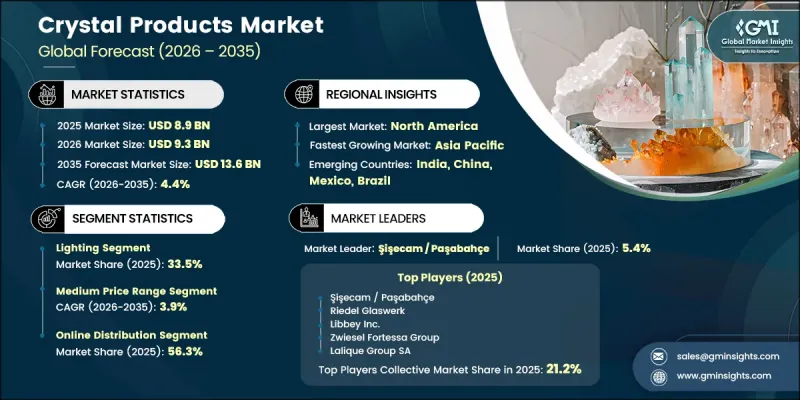
Market growth is shaped by a clear shift in consumer preference toward premium, artisanal, and design-led lifestyle goods, with discretionary spending increasingly directed toward home aesthetics and expressive interior styling. Demand is further supported by the expansion of global gifting traditions, steady growth in the hospitality and leisure sector, and rising appreciation for handcrafted and sustainable production methods across consumer segments. Higher disposable incomes and a growing focus on lifestyle-oriented consumption are reinforcing long-term market stability. Consumers are increasingly shifting from purely functional purchases to experience-driven buying behavior, where crystal products serve as symbols of taste, refinement, and personal identity. This trend is especially visible in developed markets such as North America and Western Europe, where strong brand recognition and well-established retail ecosystems encourage premium purchasing behavior. Rising expenditure on home decor and furnishings since 2021 has further strengthened the position of crystal products within discretionary spending baskets, with premium categories capturing a larger share of incremental demand growth over time.
| Market Scope | |
|---|---|
| Start Year | 2025 |
| Forecast Year | 2026-2035 |
| Start Value | $8.9 Billion |
| Forecast Value | $13.6 Billion |
| CAGR | 4.4% |
The lighting segment held a 33.5% share in 2025 and is projected to grow at a CAGR of 4.6% through 2035. Demand is strongly supported by ongoing investments in high-end residential construction, luxury hospitality developments, and architectural interior design projects that prioritize decorative lighting solutions. Crystal-based lighting fixtures, including chandeliers, pendant systems, and wall-mounted decorative installations, continue to be widely integrated into upscale residential and commercial environments, particularly in premium hospitality developments across expanding global tourism destinations.
The medium price segment held a 47.6% share in 2025, growing at a CAGR of 3.9% through 2035. This segment appeals to a wide consumer base, including aspirational households, corporate gifting buyers, and hospitality operators seeking a balance between quality and cost efficiency. Competitive intensity in this tier has increased as manufacturers focus on improving durability, design flexibility, and dishwasher-safe product engineering while maintaining accessible pricing structures. Brands such as RONA, Libbey Inc., Zwiesel Fortessa Group, Riedel Glaswerk, and Bormioli Rocco continue to strengthen their presence through diversified product portfolios that combine functional performance with aesthetic refinement.
North America Crystal Products Market held a 42% share in 2025, making it the largest regional contributor, with the United States leading overall demand and Canada providing a steady secondary market base. Regional growth is supported by strong consumer purchasing power, a well-developed premium retail ecosystem, and consistent demand from corporate gifting channels that generate recurring commercial activity. Market dynamics in the United States remain particularly resilient, as premium gifting continues to outperform broader discretionary spending categories across economic cycles.
Key companies operating in the Global Crystal Products Market include Lalique, Villeroy & Boch, Crystal Bohemia, Pasabahce / Sisecam, RCR Cristalleria Italiana, Saint-Louis, Moser, Stolzle Lausitz, Dartington Crystal, Schonbek, Preciosa, Zwiesel Fortessa Group, Libbey Inc., Riedel Glaswerk, RONA, Bormioli Rocco, Luigi Bormioli, Lucaris Crystal (Ocean Glass PCL), Diamondlife Lighting Group, and Vista Alegre / Atlantis Crystal. Companies in the crystal products market are strengthening their competitive positioning by focusing on premium design innovation and expanding collections that emphasize craftsmanship, heritage appeal, and modern aesthetics. Many manufacturers are investing in advanced glassmaking technologies to improve clarity, durability, and precision in product detailing. Sustainability initiatives, including energy-efficient production methods and recyclable packaging, are being increasingly adopted to align with evolving consumer expectations. Firms are also expanding omnichannel retail strategies by integrating flagship boutiques with strong e-commerce platforms to enhance global reach. Personalization and customization services are being introduced to capture high-value gifting demand, while collaborations with designers and hospitality brands are helping strengthen brand prestige.
Table of Contents
Chapter 1 Methodology and Scope
- 1.1 Market scope and definition
- 1.2 Research design
- 1.2.1 Research approach
- 1.2.2 Data collection methods
- 1.3 Data mining sources
- 1.3.1 Global
- 1.3.2 Regional/Country
- 1.4 Base estimates and calculations
- 1.4.1 Base year calculation
- 1.4.2 Key trends for market estimation
- 1.5 Primary research and validation
- 1.5.1 Primary sources
- 1.6 Forecast model
- 1.7 Research assumptions and limitations
Chapter 2 Executive Summary
- 2.1 Industry 360° synopsis
- 2.2 Key market trends
- 2.2.1 Regional
- 2.2.2 Product type
- 2.2.3 Material
- 2.2.4 Price
- 2.2.5 End user
- 2.2.6 Distribution channel
Chapter 3 Industry Insights
- 3.1 Industry ecosystem analysis
- 3.1.1 Raw material suppliers
- 3.1.2 Crystal manufacturers & processing units
- 3.1.3 Design & craftsmanship layer (artisan vs. machine-made)
- 3.1.4 Wholesale distributors & trading companies
- 3.1.5 Retail & e-commerce channels
- 3.1.6 End consumers
- 3.1.7 Profit margin
- 3.1.8 Value addition at each stage
- 3.1.9 Factor affecting the value chain
- 3.2 Industry impact forces
- 3.2.1 Growth drivers
- 3.2.1.1 Rising consumer demand for premium home decor & luxury lifestyle products
- 3.2.1.2 Robust growth in hospitality, f&b, and hotel sectors driving commercial demand
- 3.2.1.3 Expanding gifting culture & corporate gifting market globally.
- 3.2.2 Pitfalls & challenges
- 3.2.2.1 Supply chain disruptions & raw material price volatility
- 3.2.2.2 Regulatory restrictions on lead content raising compliance costs
- 3.2.3 Opportunities
- 3.2.3.1 Product innovation with lead-free and eco-friendly crystal
- 3.2.3.2 Expanding e-commerce and direct-to-consumer channels
- 3.2.1 Growth drivers
- 3.3 Growth potential analysis
- 3.4 Technology and innovation landscape
- 3.4.1 Advances in crystal cutting & polishing technologies
- 3.4.2 Laser engraving & precision etching innovations
- 3.4.3 Lead-free crystal formulation advances
- 3.4.4 Sustainable manufacturing technologies
- 3.4.5 Smart & connected crystal products
- 3.5 Regulatory & licensing framework
- 3.5.1 EU Directive on lead content in crystal glassware
- 3.5.2 U.S. FDA & CPSC standards for lead-containing household products
- 3.5.3 REACH compliance & chemical safety regulations
- 3.5.4 Sustainability & circular economy directives
- 3.6 Pricing analysis (driven by primary research)
- 3.6.1 Historical price trend analysis by product category
- 3.6.2 Pricing strategy by player type (premium / value / cost-plus)
- 3.7 Trade data analysis (driven by paid database) (HS code- 6815)
- 3.7.1 Import/export volume & value trends by product category
- 3.7.2 Key trade corridors & tariff impact
- 3.8 Impact of AI & generative AI on the market
- 3.8.1 AI-driven disruption of existing business models
- 3.8.2 GenAI use cases & adoption roadmap by segment
- 3.8.3 Risks, limitations & regulatory considerations
- 3.9 Distribution infrastructure & channel penetration landscape (driven by primary research)
- 3.9.1 Channel coverage by region & format (modern vs. Traditional trade)
- 3.9.2 Last-mile infrastructure gaps & emerging channel shifts
Chapter 4 Competitive Landscape, 2025
- 4.1 Introduction
- 4.2 Company market share analysis
- 4.2.1 By region
- 4.2.1.1 North America
- 4.2.1.2 Europe
- 4.2.1.3 Asia Pacific
- 4.2.1.4 Latin America
- 4.2.1.5 Middle East and Africa
- 4.2.1 By region
- 4.3 Company matrix analysis
- 4.4 Competitive analysis of major market players
- 4.5 Competitive positioning matrix
- 4.6 Key developments
- 4.6.1 Mergers & acquisitions
- 4.6.2 Partnerships & collaborations
- 4.6.3 New product launches
- 4.6.4 Expansion plans
Chapter 5 Market Estimates and Forecast, By Product Type, 2022 - 2035 (USD Billion) (Million Units)
- 5.1 Key trends
- 5.2 Barware
- 5.2.1 Glasses
- 5.2.2 Decanters
- 5.2.3 Pitchers
- 5.2.4 Shakers
- 5.2.5 Others (bar accessories, etc.)
- 5.3 Lighting
- 5.3.1 Chandeliers
- 5.3.2 Table lamps
- 5.3.3 Candleholders
- 5.3.4 Others (sconces, wall fixtures, etc.)
- 5.4 Home decor
- 5.4.1 Vases
- 5.4.2 Figurines
- 5.4.3 Coasters
- 5.4.4 Others (display stands, decorative bowls, etc.)
- 5.5 Others (jewelry & watches)
Chapter 6 Market Estimates and Forecast, By Material, 2022 - 2035 (USD Billion) (Million Units)
- 6.1 Key trends
- 6.2 Lead crystal
- 6.2.1 Full lead crystal (≥30% lead oxide)
- 6.2.2 Lead crystal (24-30% lead oxide)
- 6.3 Lead-free crystal
- 6.3.1 Barium crystal
- 6.3.2 Potassium crystal
- 6.3.3 Others (titanium oxide-based, zinc oxide-based)
Chapter 7 Market Estimates and Forecast, By Price Range, 2022 - 2035 (USD Billion) (Million Units)
- 7.1 Key trends
- 7.2 Low
- 7.3 Medium
- 7.4 High
Chapter 8 Market Estimates and Forecast, By End User, 2022 - 2035 (USD Billion) (Million Units)
- 8.1 Key trends
- 8.2 Residential
- 8.3 Commercial
- 8.3.1 Bars & lounges
- 8.3.2 Restaurants & fine dining
- 8.3.3 Hotels & resorts
- 8.3.4 Others (event venues, caterers, corporate gifting buyers)
Chapter 9 Market Estimates and Forecast, By Distribution Channel, 2022 - 2035 (USD Billion) (Million Units)
- 9.1 Key trends
- 9.2 Online
- 9.2.1 Company website
- 9.2.2 E-commerce website
- 9.3 Offline
- 9.3.1 Specialty stores
- 9.3.2 Supermarkets & hypermarkets
- 9.3.3 Department stores
- 9.3.4 Others (duty-free, pop-up retail, craft fairs)
Chapter 10 Market Estimates and Forecast, By Region, 2022 - 2035 (USD Billion) (Million Units)
- 10.1 Key trends
- 10.2 North America
- 10.2.1 U.S.
- 10.2.2 Canada
- 10.3 Europe
- 10.3.1 Germany
- 10.3.2 UK
- 10.3.3 France
- 10.3.4 Italy
- 10.3.5 Spain
- 10.4 Asia Pacific
- 10.4.1 China
- 10.4.2 Japan
- 10.4.3 India
- 10.4.4 Australia
- 10.4.5 South Korea
- 10.5 Latin America
- 10.5.1 Brazil
- 10.5.2 Mexico
- 10.5.3 Argentina
- 10.6 Middle East and Africa
- 10.6.1 South Africa
- 10.6.2 Saudi Arabia
- 10.6.3 UAE
Chapter 11 Company Profiles
- 11.1 Global players
- 11.1.1 Bandai Namco / BANDAI SPIRITS
- 11.1.2 Good Smile Company
- 11.1.3 Kotobukiya Co., Ltd.
- 11.1.4 Medicom Toy Corporation
- 11.1.5 Kaiyodo Co., Ltd.
- 11.1.6 Takara Tomy Co., Ltd.
- 11.1.7 Max Factory
- 11.2 Regional players
- 11.2.1 Abysse Corp
- 11.2.2 SEGA Corporation
- 11.2.3 Bushiroad Inc.
- 11.2.4 Alter Co., Ltd.
- 11.2.5 Furyu Corporation
- 11.2.6 Phat! Company
- 11.2.7 Taito Corporation
- 11.3 Emerging players
- 11.3.1 Stronger Co., Ltd.
- 11.3.2 Sentinel Co., Ltd.
- 11.3.3 Pop Mart
- 11.3.4 HobbyMax
- 11.3.5 Union Creative
- 11.3.6 Myethos
- 11.3.7 APEX Innovation

