PUBLISHER: Global Market Insights Inc. | PRODUCT CODE: 2071395

PUBLISHER: Global Market Insights Inc. | PRODUCT CODE: 2071395
Aesthetic Injectables Market Opportunity, Growth Drivers, Industry Trend Analysis, and Forecast 2026 - 2035
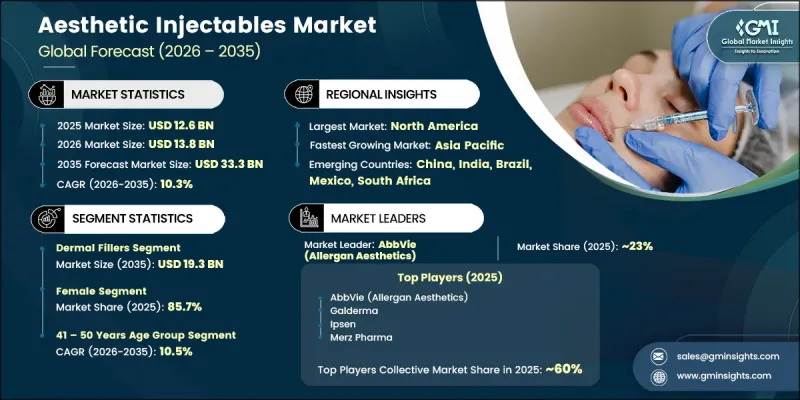
The Global Aesthetic Injectables Market was valued at USD 12.6 billion in 2025 and is estimated to grow at a CAGR of 10.3% to reach USD 33.3 billion by 2035.
Growth in this market is driven by the rising global preference for minimally invasive cosmetic procedures that deliver visible results with reduced recovery time compared to surgical alternatives. Increasing adoption of injectable treatments reflects a broader shift in consumer attitudes toward aesthetic enhancement and preventive skin care. The growing aging population is also significantly influencing demand, as individuals seek solutions for wrinkles, reduced skin elasticity, and facial volume loss. Environmental factors such as pollution exposure, stress, and sun damage are further accelerating the need for corrective aesthetic treatments. Healthcare providers, dermatology clinics, and cosmetic centers are expanding their service portfolios to include advanced injectable procedures supported by evolving technologies. Botulinum toxin products and dermal fillers remain the primary categories, offering solutions for wrinkle reduction, facial contouring, and volume restoration. These treatments work by temporarily relaxing targeted muscles, restoring facial fullness, and stimulating collagen activity, resulting in improved facial symmetry and rejuvenation outcomes. Overall, the market continues to expand due to technological progress, rising disposable income, and increasing acceptance of non-surgical cosmetic enhancements globally.
| Market Scope | |
|---|---|
| Start Year | 2025 |
| Forecast Year | 2026-2035 |
| Start Value | $12.6 Billion |
| Forecast Value | $33.3 Billion |
| CAGR | 10.3% |
The dermal fillers segment is projected to reach USD 19.3 billion by 2035, supported by strong demand for non-invasive facial rejuvenation procedures. This segment continues to grow due to its effectiveness in addressing volume loss, smoothing wrinkles, and enhancing facial contours. Dermal fillers are widely adopted across aesthetic practices due to their strong safety profile, predictable outcomes, and versatility in cosmetic applications. Increasing preference for minimally invasive procedures further reinforces their market expansion.
The female segment accounted for 85.7% of the total market share in 2025, driven by higher awareness of aesthetic treatments and early adoption of cosmetic enhancement procedures. Women remain the primary consumer base for injectable aesthetics, utilizing treatments for wrinkle reduction, facial contour improvement, and prevention of early aging signs. Growing focus on personal appearance, self-care routines, and professional presentation continues to expand demand across various age groups, from younger consumers seeking preventive care to older populations pursuing rejuvenation solutions.
North America Aesthetic Injectables Market with revenue of USD 6.5 billion in 2025 and is expected to reach USD 15.7 billion by 2035, growing at a CAGR of 9.3%. The region maintains its dominance due to strong demand for elective cosmetic procedures, advanced healthcare infrastructure, and a high concentration of skilled aesthetic practitioners. Widespread availability of innovative injectable treatments and rapid adoption of new aesthetic technologies further strengthen market growth. The increasing popularity of combination therapies involving injectables and complementary cosmetic procedures continues to support regional expansion.
Key companies operating in the global aesthetic injectables market include Galderma, AbbVie Inc (Allergan Aesthetics), Merz Pharma, Ipsen, Sinclair Pharma, Teoxane Laboratories, Bio-Med, Bioxis Pharmaceuticals, Cytophil, Laboratoires Vivacy, Suneva Medical, and Mesoestetic. Companies in the aesthetic injectables market are adopting a range of strategic initiatives to strengthen their competitive positioning and expand global reach. A primary focus is placed on continuous product innovation, particularly in developing advanced formulations with improved safety profiles, longer-lasting effects, and enhanced precision. Firms are heavily investing in research and development to introduce next-generation botulinum toxins and dermal fillers. Strategic collaborations with dermatology clinics, aesthetic centers, and healthcare professionals are helping companies expand treatment accessibility and brand trust. Expanding geographic presence through emerging markets is another key strategy, supported by localized distribution networks. Companies are also strengthening their marketing efforts through digital engagement, influencer partnerships, and educational campaigns to raise awareness of aesthetic treatments.
Table of Contents
Chapter 1 Methodology and Scope
- 1.1 Market scope and definition
- 1.2 Research approach
- 1.3 Quality commitments
- 1.3.1 GMI AI policy and data integrity commitment
- 1.3.1.1 Source consistency protocol
- 1.3.1 GMI AI policy and data integrity commitment
- 1.4 Research trail and confidence scoring
- 1.4.1 Research trail components
- 1.4.2 Scoring components
- 1.5 Data collection
- 1.5.1 Partial list of primary sources
- 1.6 Data mining sources
- 1.6.1 Paid sources
- 1.6.1.1 Sources, by region
- 1.6.1 Paid sources
- 1.7 Base estimates and calculations
- 1.7.1 Revenue share analysis
- 1.7.2 Base year calculation
- 1.8 Forecast model
- 1.9 Research transparency addendum
- 1.9.1 Source attribution framework
- 1.9.2 Quality assurance metrics
- 1.9.3 Our commitment to trust
Chapter 2 Executive Summary
- 2.1 Industry 360° synopsis
- 2.2 Key market trends
- 2.2.1 Regional trends
- 2.2.2 Type trends
- 2.2.3 Gender trends
- 2.2.4 Age group trends
- 2.2.5 End use trends
- 2.3 CXO perspectives: Strategic imperatives
Chapter 3 Industry Insights
- 3.1 Industry ecosystem analysis
- 3.2 Industry impact forces
- 3.2.1 Growth drivers
- 3.2.1.1 Rising demand for minimally invasive cosmetic procedures
- 3.2.1.2 Increasing aging population and beauty consciousness
- 3.2.1.3 Growing influence of social media and aesthetic awareness
- 3.2.1.4 Expanding availability of certified aesthetic practitioners
- 3.2.2 Industry pitfalls and challenges
- 3.2.2.1 High cost of aesthetic injectable procedures
- 3.2.2.2 Risk of side effects and complications
- 3.2.3 Market opportunities
- 3.2.3.1 Development of longer-lasting and safer injectables
- 3.2.3.2 Increasing adoption among male consumers
- 3.2.1 Growth drivers
- 3.3 Growth potential analysis
- 3.4 Technology landscape
- 3.4.1 Current technology
- 3.4.2 Emerging technologies
- 3.5 Pricing Analysis (Driven by Primary Research)
- 3.6 Regulatory landscape (Driven by primary research)
- 3.6.1 North America
- 3.6.2 Europe
- 3.6.3 Asia Pacific
- 3.6.4 Latin America
- 3.6.5 MEA
- 3.7 Brand analysis
- 3.8 Porter's analysis
- 3.9 PESTEL analysis
- 3.10 Future market trends (Driven by primary research)
- 3.11 Impact of AI and generative AI on the market
Chapter 4 Competitive Landscape, 2025
- 4.1 Introduction
- 4.2 Company market share analysis
- 4.2.1 North America
- 4.2.2 Europe
- 4.2.3 Asia Pacific
- 4.3 Company matrix analysis
- 4.4 Competitive analysis of major market players
- 4.5 Competitive positioning matrix
- 4.6 Key developments
- 4.6.1 Merger and acquisition
- 4.6.2 Partnership and collaboration
- 4.6.3 New product launches
Chapter 5 Market Estimates and Forecast, By Type, 2022 - 2035 ($ Mn)
- 5.1 Key trends
- 5.2 Botulinum toxin
- 5.2.1 Botulinum toxin A
- 5.2.2 Botulinum toxin B
- 5.3 Dermal fillers
- 5.3.1 Product type
- 5.3.1.1 Hyaluronic acid
- 5.3.1.2 Calcium hydroxylapatite
- 5.3.1.3 Poly-L-lactic acid
- 5.3.1.4 Polymethyl-methacrylate microspheres (PMMA)
- 5.3.1.5 Collagen
- 5.3.1.6 Fat fillers
- 5.3.1.7 Other dermal fillers
- 5.3.2 Application
- 5.3.2.1 Face lift
- 5.3.2.2 Facial correction
- 5.3.2.3 Wrinkles reduction
- 5.3.2.4 Acne scar
- 5.3.2.5 Lipoatrophy
- 5.3.2.6 Lip enhancement
- 5.3.2.7 Hip augmentation
- 5.3.2.8 Breast enhancement
- 5.3.2.9 Hand rejuvenation
- 5.3.2.10 Penis enlargement
- 5.3.2.11 Blepharoplasty
- 5.3.2.12 Neck & chin lift
- 5.3.2.13 Other applications
- 5.3.1 Product type
Chapter 6 Market Estimates and Forecast, By Gender, 2022 - 2035 ($ Mn)
- 6.1 Key trends
- 6.2 Female
- 6.3 Male
Chapter 7 Market Estimates and Forecast, By Age Group, 2022 - 2035 ($ Mn)
- 7.1 Key trends
- 7.2 15-30
- 7.3 31-40
- 7.4 41-50
- 7.5 51-60
- 7.6 >60
Chapter 8 Market Estimates and Forecast, By End Use, 2022 - 2035 ($ Mn)
- 8.1 Key trends
- 8.2 Hospitals
- 8.3 Dermatology clinics
- 8.4 Other end users
Chapter 9 Market Estimates and Forecast, By Region, 2022 - 2035 ($ Mn)
- 9.1 Key trends
- 9.2 North America
- 9.2.1 U.S.
- 9.2.2 Canada
- 9.3 Europe
- 9.3.1 Germany
- 9.3.2 UK
- 9.3.3 France
- 9.3.4 Spain
- 9.3.5 Italy
- 9.3.6 Netherlands
- 9.4 Asia Pacific
- 9.4.1 China
- 9.4.2 Japan
- 9.4.3 India
- 9.4.4 Australia
- 9.4.5 South Korea
- 9.5 Latin America
- 9.5.1 Brazil
- 9.5.2 Mexico
- 9.5.3 Argentina
- 9.6 Middle East and Africa
- 9.6.1 South Africa
- 9.6.2 Saudi Arabia
- 9.6.3 UAE
Chapter 10 Company Profiles
- 10.1 AbbVie Inc (Allergan Aesthetics )
- 10.2 Bio-Med
- 10.3 Bioxis Pharmaceuticals
- 10.4 Cytophil
- 10.5 Galderma
- 10.6 Ipsen
- 10.7 Laboratories Vivacy
- 10.8 Merz Pharma
- 10.9 Mesoestetic
- 10.10 Sinclair Pharma
- 10.11 Suneva Medical
- 10.12 Teoxane Laboratories

