PUBLISHER: Global Market Insights Inc. | PRODUCT CODE: 2071402

PUBLISHER: Global Market Insights Inc. | PRODUCT CODE: 2071402
Knee Braces Market Opportunity, Growth Drivers, Industry Trend Analysis, and Forecast 2026 - 2035
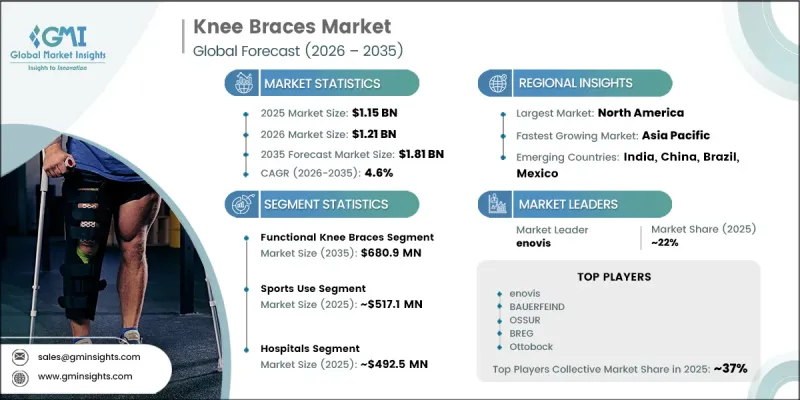
The Global Knee Braces Market is valued at USD 1.15 billion in 2025 and is estimated to grow at a CAGR of 4.6% to reach USD 1.81 billion by 2035.
The market is witnessing steady expansion due to the increasing prevalence of orthopedic disorders, rising cases of osteoarthritis, and a growing number of road accidents and sports-related injuries. Knee braces are medical support devices designed to stabilize, protect, and support the knee joint, and they are widely used for injury prevention, post-surgical rehabilitation, and chronic condition management. Growing cases of degenerative joint diseases are significantly boosting demand for non-invasive treatment solutions. Aging populations, sedentary lifestyles, and higher participation in high-impact physical activities are further contributing to rising knee-related complications worldwide. Osteoarthritis remains one of the most widespread degenerative joint disorders, often resulting in long-term pain and reduced mobility, which strengthens the need for supportive orthopedic care solutions. Increasing awareness regarding early intervention and rehabilitation support is also encouraging the adoption of knee braces across clinical and personal care settings. In addition, advancements in material technology and ergonomic design are improving product comfort, durability, and usability, further supporting market growth across developed and emerging economies.
| Market Scope | |
|---|---|
| Start Year | 2025 |
| Forecast Year | 2026-2035 |
| Start Value | $1.15 Billion |
| Forecast Value | $1.81 Billion |
| CAGR | 4.6% |
The functional knee braces segment held a share of 40.8% in 2025 and is projected to reach USD 680.9 million by 2035. This segment remains widely adopted due to its effectiveness in providing controlled stability and movement support for individuals suffering from ligament injuries and joint instability. Functional knee braces are commonly used in managing anterior cruciate ligament and posterior cruciate ligament conditions, offering controlled motion while preventing excessive or abnormal knee movement. Their strong adoption is supported by rising sports participation, increasing incidence of ligament injuries, and growing demand for long-term joint support solutions among active individuals. Continuous improvements in brace design, including enhanced flexibility and lightweight construction, are further strengthening their clinical and athletic applications.
The sports use segment accounted for USD 517.1 million in 2025. This segment continues to expand due to rising participation in both professional and recreational sports activities worldwide. Knee braces are widely used in sports environments to improve joint stability, reduce injury risks, and support recovery from strain or ligament damage. They are particularly important in high-impact activities that involve sudden directional changes and physical stress on the knee joint. Ongoing product innovation focusing on lightweight structures, improved mobility, and enhanced performance support is further boosting adoption across athletes and fitness enthusiasts.
North America Knee Braces Market held a share of 38.5% in 2025. The region remains a key contributor to global demand due to the high prevalence of musculoskeletal disorders and a large population requiring orthopedic care. Rising cases of osteoarthritis, sports-related injuries, and age-related joint degeneration continue to drive the need for knee support products. Strong healthcare infrastructure, growing awareness of rehabilitation therapies, and increasing adoption of preventive orthopedic solutions are further supporting regional market growth.
Major players operating in the Global Knee Braces Market include 3M, ALEX ORTHOPEDIC, BAUERFEIND, BREG, Dicarre, Enovis, Essity, HELY & WEBER, MCDAVID, MEDI-DYNE, MEDLINE, MUELLER SPORTS MEDICINE, Ossur, Ottobock, Push Braces, and Tynor. Companies operating in the knee braces market are strengthening their position through continuous product innovation focused on lightweight, ergonomic, and high-performance designs that improve patient comfort and mobility. They are increasingly investing in advanced materials and smart orthopedic solutions that enhance support and durability while ensuring better clinical outcomes. Strategic collaborations with healthcare providers, physiotherapy centers, and sports organizations are helping expand product adoption across rehabilitation and athletic segments. Manufacturers are also expanding their global distribution networks and strengthening online sales channels to improve accessibility. In addition, companies are focusing on personalized and adjustable brace designs tailored to individual patient needs.
Table of Contents
Chapter 1 Research Methodology
- 1.1 Research approach
- 1.2 Quality commitments
- 1.2.1 GMI AI policy & data integrity commitment
- 1.2.1.1 Source consistency protocol
- 1.2.1 GMI AI policy & data integrity commitment
- 1.3 Research trail & confidence scoring
- 1.3.1 Research trail components
- 1.3.2 Scoring components
- 1.4 Data collection
- 1.4.1 Partial list of primary sources
- 1.5 Data mining sources
- 1.5.1 Paid sources
- 1.5.1.1 Sources, by region
- 1.5.1 Paid sources
- 1.6 Base estimates and calculations
- 1.6.1 Base year calculation
- 1.7 Forecast model
- 1.7.1 Quantified market impact analysis
- 1.7.1.1 Mathematical impact of growth parameters on forecast
- 1.7.1 Quantified market impact analysis
- 1.8 Research transparency addendum
- 1.8.1 Source attribution framework
- 1.8.2 Quality assurance metrics
- 1.8.3 Our commitment to trust
Chapter 2 Executive Summary
- 2.1 Industry 360° synopsis
- 2.2 Key market trends
- 2.2.1 Regional trends
- 2.2.2 Product trends
- 2.2.3 Application trends
- 2.2.4 End use trends
- 2.3 CXO perspectives: Strategic imperatives
Chapter 3 Industry Insights
- 3.1 Industry ecosystem analysis
- 3.2 Industry impact forces
- 3.2.1 Growth drivers
- 3.2.1.1 Surging prevalence of osteoarthritis and orthopedic conditions
- 3.2.1.2 Rising number of road accidents and sport-related injuries
- 3.2.1.3 Technological advancements
- 3.2.1.4 Increasing geriatric population prone to knee ailments
- 3.2.2 Industry pitfalls and challenges
- 3.2.2.1 Lack of education about preventive care and rehabilitation options
- 3.2.2.2 High cost of knee braces
- 3.2.3 Opportunities
- 3.2.3.1 Integration of IoT and sensor technology for real-time monitoring and rehabilitation support
- 3.2.3.2 Customization and comfort-oriented designs
- 3.2.1 Growth drivers
- 3.3 Growth potential analysis
- 3.4 Regulatory landscape
- 3.4.1 North America
- 3.4.2 Europe
- 3.4.3 Asia Pacific
- 3.4.4 Latin America
- 3.4.5 Middle East and Africa
- 3.5 Pricing trend analysis (Driven by Primary Research)
- 3.6 Technology and innovation landscape (Driven by Primary Research)
- 3.6.1 Current technological trends
- 3.6.2 Emerging technologies
- 3.7 Future market trends (Driven by Primary Research)
- 3.8 Number of knee braces (units), by region, 2022 - 2035
- 3.8.1 North America
- 3.8.2 Europe
- 3.8.3 Asia Pacific
- 3.8.4 Latin America
- 3.8.5 MEA
- 3.9 Investment landscape
- 3.10 Pipeline analysis
- 3.11 Reimbursement scenario
- 3.12 Impact of AI & Generative AI on the Market (Driven by Primary Research)
- 3.13 Porter's analysis
- 3.14 PESTEL analysis
Chapter 4 Competitive Landscape, 2025
- 4.1 Introduction
- 4.2 Company matrix analysis
- 4.3 Company market share analysis (Driven by Primary Research)
- 4.3.1 Global
- 4.3.2 North America
- 4.3.3 Europe
- 4.3.4 Asia Pacific
- 4.3.5 LAMEA
- 4.4 Competitive analysis of major market players
- 4.5 Competitive positioning matrix
- 4.6 Key developments
- 4.6.1 Mergers & acquisitions
- 4.6.2 Partnerships & collaborations
- 4.6.3 New product launches
- 4.6.4 Expansion plans
Chapter 5 Market Estimates and Forecast, By Product, 2022 - 2035 ($ Mn)
- 5.1 Key trends
- 5.2 Functional knee braces
- 5.3 Prophylactic knee braces
- 5.4 Unloader knee braces
- 5.5 Rehabilitative knee braces
Chapter 6 Market Estimates and Forecast, By Application, 2022 - 2035 ($ Mn)
- 6.1 Key trends
- 6.2 Sports use
- 6.3 Ligament
- 6.4 Other applications
Chapter 7 Market Estimates and Forecast, By End Use, 2022 - 2035 ($ Mn)
- 7.1 Key trends
- 7.2 Hospitals
- 7.3 Orthopedic clinics
- 7.4 Other end users
Chapter 8 Market Estimates and Forecast, By Region, 2022 - 2035 ($ Mn)
- 8.1 Key trends
- 8.2 North America
- 8.2.1 U.S.
- 8.2.2 Canada
- 8.3 Europe
- 8.3.1 Germany
- 8.3.2 UK
- 8.3.3 France
- 8.3.4 Spain
- 8.3.5 Italy
- 8.3.6 Netherlands
- 8.4 Asia Pacific
- 8.4.1 China
- 8.4.2 Japan
- 8.4.3 India
- 8.4.4 Australia
- 8.4.5 South Korea
- 8.5 Latin America
- 8.5.1 Brazil
- 8.5.2 Mexico
- 8.5.3 Argentina
- 8.6 MEA
- 8.6.1 South Africa
- 8.6.2 Saudi Arabia
- 8.6.3 UAE
Chapter 9 Company Profiles
- 9.1 3M
- 9.2 ALEX ORTHOPEDIC
- 9.3 BAUERFEIND
- 9.4 BREG
- 9.5 Dicarre
- 9.6 enovis
- 9.7 essity
- 9.8 HELY & WEBER
- 9.9 MCDAVID
- 9.10 MEDI-DYNE
- 9.11 MEDLINE
- 9.12 MUELLER SPORTS MEDICINE
- 9.13 OSSUR
- 9.14 ottobock
- 9.15 push braces
- 9.16 tynor

