PUBLISHER: Global Market Insights Inc. | PRODUCT CODE: 2071404

PUBLISHER: Global Market Insights Inc. | PRODUCT CODE: 2071404
Alpha-1 Antitrypsin Deficiency Disease Treatment Market Opportunity, Growth Drivers, Industry Trend Analysis, and Forecast 2026 - 2035
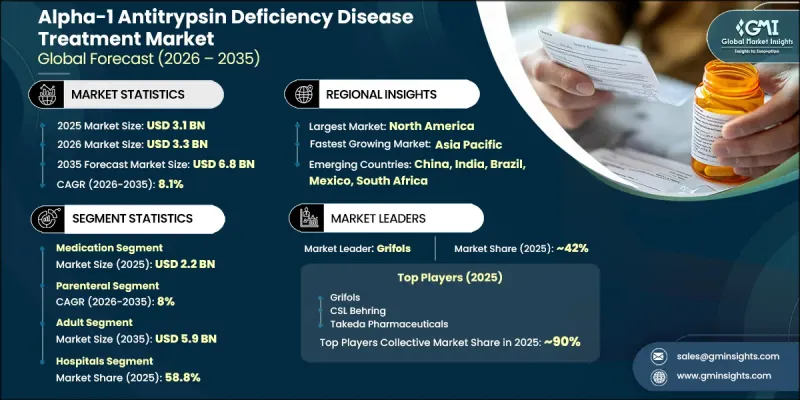
The Global Alpha-1 Antitrypsin Deficiency Disease Treatment Market was valued at USD 3.1 billion in 2025 and is estimated to grow at a CAGR of 8.1% to reach USD 6.8 billion by 2035.
The market is experiencing steady expansion due to the increasing incidence of alpha-1 antitrypsin deficiency (AATD)-related respiratory and liver conditions, growing recognition of rare genetic disorders, expanding disease screening programs, and ongoing progress in diagnostic and therapeutic technologies. The rising prevalence of chronic respiratory and hepatic complications associated with AATD is creating significant demand for effective disease management solutions. Alpha-1 antitrypsin is a naturally occurring protein synthesized by the liver that plays a vital role in protecting lung tissue from inflammatory damage. Insufficient levels of this protein can result in serious pulmonary and liver-related health complications, particularly when additional environmental factors contribute to disease progression. The market encompasses a broad range of treatment and management approaches, including diagnostic technologies, augmentation therapies, gene-focused therapeutic strategies, inhalation-based treatments, and supportive care solutions. Continuous innovation in biotechnology and precision medicine is further supporting the development of advanced treatment options designed to improve patient outcomes and address the long-term challenges associated with alpha-1 antitrypsin deficiency disease.
| Market Scope | |
|---|---|
| Start Year | 2025 |
| Forecast Year | 2026-2035 |
| Start Value | $3.1 Billion |
| Forecast Value | $6.8 Billion |
| CAGR | 8.1% |
The alpha-1 antitrypsin deficiency disease treatment market is benefiting from significant advances in disease identification and therapeutic intervention. Increasing awareness among healthcare professionals and patients is encouraging earlier diagnosis and treatment initiation, contributing to improved disease management. The growing emphasis on personalized healthcare approaches is supporting the adoption of targeted therapies that address the underlying causes and progression of the disorder. In addition, advancements in biologics, genetic medicine, and novel therapeutic platforms are creating new opportunities for innovation across the treatment landscape. Healthcare providers continue to focus on comprehensive disease management strategies aimed at reducing complications, preserving organ function, and enhancing quality of life for affected individuals. These developments are expected to support sustained growth across the market over the forecast period.
The medication segment generated USD 2.2 billion in 2025. This segment plays a central role in managing disease symptoms, slowing clinical progression, and minimizing complications associated with both respiratory and hepatic manifestations of the condition. The widespread use of pharmacological therapies reflects the significant burden of pulmonary disorders commonly associated with alpha-1 antitrypsin deficiency. Medication-based treatment approaches are widely utilized to improve respiratory function, support disease management, and enhance overall patient well-being. Continued advancements in pharmaceutical therapies are further strengthening the segment's position within the market.
The parenteral segment is anticipated to grow at a CAGR of 8% throughout 2035. The strong position of this segment is attributed to the effectiveness of parenteral administration in delivering therapies directly into systemic circulation, ensuring optimal therapeutic outcomes. Within the alpha-1 antitrypsin deficiency treatment landscape, augmentation therapies delivered through intravenous administration remain a primary treatment approach. This route of administration is widely preferred due to its ability to maintain appropriate protein levels within the body, helping reduce progressive tissue damage and support long-term disease management. As treatment protocols continue to evolve, the parenteral segment is expected to remain a critical component of patient care.
North America Alpha-1 Antitrypsin Deficiency Disease Treatment Market accounted for 60.2% share in 2025, maintaining its position as the leading regional market. Growth across the region is supported by broad access to advanced genetic testing technologies, strong awareness of rare respiratory disorders, and widespread adoption of specialized treatment options. The presence of established biopharmaceutical companies, extensive plasma collection capabilities, and robust infusion therapy infrastructure contributes to consistent treatment accessibility. Rising prevalence of respiratory conditions associated with alpha-1 antitrypsin deficiency, combined with the increasing adoption of precision medicine approaches, continues to strengthen market demand throughout the region. These factors collectively reinforce North America's leadership within the global market.
Key companies operating in the Global Alpha-1 Antitrypsin Deficiency Disease Treatment Market include Takeda Pharmaceutical, Grifols, CSL Behring, Kamada, LFB Biotechnologies, Intellia Therapeutics, Prime Medicine, Arrowhead Pharmaceuticals, Inhibrx, Jaguar Gene Therapy, Octapharma, National Jewish Health, The Johns Hopkins Hospital, and The General Hospital. Companies participating in the alpha-1 antitrypsin deficiency disease treatment market are implementing a variety of strategies to strengthen their market position and expand their competitive advantage. Significant investments in research and development remain a primary focus as organizations work to advance innovative therapies, including gene-based treatments, biologics, and precision medicine solutions. Strategic collaborations with research institutions, healthcare organizations, and biotechnology companies are accelerating product development and clinical advancement. Many companies are also expanding their clinical trial programs to evaluate new therapeutic approaches and improve treatment effectiveness. In addition, businesses are prioritizing geographic expansion, regulatory approvals, and enhanced patient access initiatives to broaden their market reach. Strengthening manufacturing capabilities, improving treatment availability, and investing in advanced diagnostic technologies are further helping market participants reinforce their presence and secure long-term growth within the global alpha-1 antitrypsin deficiency disease treatment industry.
Table of Contents
Chapter 1 Methodology and Scope
- 1.1 Market scope and definition
- 1.2 Research approach
- 1.3 Quality commitments
- 1.3.1 GMI AI policy and data integrity commitment
- 1.3.1.1 Source consistency protocol
- 1.3.1 GMI AI policy and data integrity commitment
- 1.4 Research trail and confidence scoring
- 1.4.1 Research trail components
- 1.4.2 Scoring components
- 1.5 Data collection
- 1.5.1 Partial list of primary sources
- 1.6 Data mining sources
- 1.6.1 Paid sources
- 1.6.1.1 Sources, by region
- 1.6.1 Paid sources
- 1.7 Base estimates and calculations
- 1.7.1 Revenue share analysis
- 1.7.2 Base year calculation
- 1.8 Forecast model
- 1.9 Research transparency addendum
- 1.9.1 Source attribution framework
- 1.9.2 Quality assurance metrics
- 1.9.3 Our commitment to trust
Chapter 2 Executive Summary
- 2.1 Industry 3600 synopsis
- 2.2 Key market trends
- 2.2.1 Regional trends
- 2.2.2 Treatment type trends
- 2.2.3 Route of administration trends
- 2.2.4 Age group trends
- 2.2.5 End use trends
- 2.3 CXO perspectives: Strategic imperatives
Chapter 3 Industry Insights
- 3.1 Industry ecosystem analysis
- 3.2 Industry impact forces
- 3.2.1 Growth drivers
- 3.2.1.1 Increasing prevalence of alpha-1 antitrypsin deficiencey disease (AATD)
- 3.2.1.2 Advancements in biotechnology
- 3.2.1.3 Approval of novel therapies for AATD
- 3.2.1.4 Improving reimbursement coverage and rare disease policies
- 3.2.2 Industry pitfalls and challenges
- 3.2.2.1 High cost of treatment
- 3.2.2.2 Adverse effects associated with treatment
- 3.2.3 Market opportunities
- 3.2.3.1 Advancement in gene therapy and biologics
- 3.2.3.2 Increasing awareness and early diagnosis programs
- 3.2.1 Growth drivers
- 3.3 Growth potential analysis
- 3.4 Regulatory landscape (Driven By Primary Research)
- 3.4.1 North America
- 3.4.2 Europe
- 3.4.3 Asia Pacific
- 3.4.4 Latin America
- 3.4.5 Middle East and Africa
- 3.5 Pipeline analysis (Driven By Primary Research)
- 3.6 Impact of AI and Generative AI on the market (Driven By Primary Research)
- 3.7 Epidemiology and patient population analysis (Driven By Primary Research)
- 3.8 Future market trends (Driven By Primary Research)
- 3.9 Porter's analysis
- 3.10 PESTEL analysis
Chapter 4 Competitive Landscape, 2025
- 4.1 Introduction
- 4.2 Company market share analysis
- 4.2.1 North America
- 4.2.2 Europe
- 4.2.3 Asia Pacific
- 4.3 Company matrix analysis
- 4.4 Competitive analysis of major market players
- 4.5 Competitive positioning matrix
- 4.6 Key developments
- 4.6.1 Merger and acquisition
- 4.6.2 Partnership and collaboration
- 4.6.3 New product launches
- 4.6.4 Expansion plans
Chapter 5 Market Estimates and Forecast, By Treatment Type, 2022-2035 ($ Mn)
- 5.1 Key trends
- 5.2 Medication
- 5.2.1 Alpha-1 proteinase inhibitor
- 5.2.2 Bronchodilators
- 5.2.3 Corticosteroids
- 5.2.4 Other medications
- 5.3 Therapy
- 5.3.1 Augmentation therapy
- 5.3.2 Oxygen therapy
- 5.3.3 Other therapies
- 5.4 Surgery
Chapter 6 Market Estimates and Forecast, By Route of Administration, 2022-2035 ($ Mn)
- 6.1 Key trends
- 6.2 Parenteral
- 6.3 Intranasal
- 6.4 Oral
Chapter 7 Market Estimates and Forecast, By Age Group, 2022-2035 ($ Mn)
- 7.1 Key trends
- 7.2 Pediatric
- 7.3 Adult
Chapter 8 Market Estimates and Forecast, By End Use, 2022-2035 ($ Mn)
- 8.1 Key trends
- 8.2 Hospitals
- 8.3 Specialty clinics
- 8.4 Other end users
Chapter 9 Market Estimates and Forecast, By Region, 2022 - 2035 ($ Mn)
- 9.1 Key trends
- 9.2 North America
- 9.2.1 U.S.
- 9.2.2 Canada
- 9.3 Europe
- 9.3.1 Germany
- 9.3.2 UK
- 9.3.3 France
- 9.3.4 Spain
- 9.3.5 Italy
- 9.3.6 Netherlands
- 9.4 Asia-Pacific
- 9.4.1 China
- 9.4.2 Japan
- 9.4.3 India
- 9.4.4 Australia
- 9.4.5 South Korea
- 9.5 Latin America
- 9.5.1 Brazil
- 9.5.2 Mexico
- 9.5.3 Argentina
- 9.6 Middle East and Africa
- 9.6.1 South Africa
- 9.6.2 Saudi Arabia
- 9.6.3 UAE
Chapter 10 Company Profiles
- 10.1 Manufacturers
- 10.1.1 CSL Behring
- 10.1.2 Grifols
- 10.1.3 Takeda Pharmaceutical
- 10.1.4 Kamada
- 10.1.5 LFB Biotechnologies
- 10.2 Pipeline/emerging players
- 10.2.1 Prime Medicine
- 10.2.2 Jaguar Gene Therapy
- 10.2.3 Intellia Therapeutics
- 10.2.4 Inhibrx
- 10.2.5 Arrowhead Pharmaceuticals
- 10.2.6 Octapharma
- 10.3 Service providers
- 10.3.1 The Johns Hopkins Hospital
- 10.3.2 The General Hospital
- 10.3.3 National Jewish Health

