PUBLISHER: Global Market Insights Inc. | PRODUCT CODE: 2071407

PUBLISHER: Global Market Insights Inc. | PRODUCT CODE: 2071407
Space Tourism Market Opportunity, Growth Drivers, Industry Trend Analysis, and Forecast 2026 - 2035
The Global Space Tourism Market was valued at USD 1.2 billion in 2025 and is projected to grow at a CAGR of 18.5% to reach USD 6.6 billion in 2035.
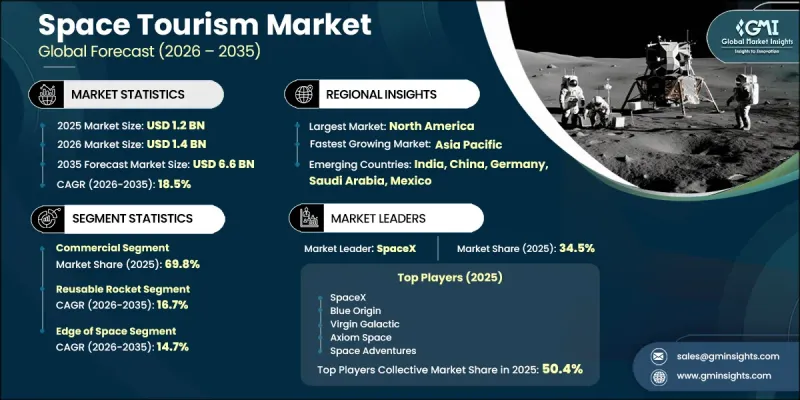
The industry is propelled by continuous advancements in aerospace engineering, especially in reusable launch vehicles and next-generation spacecraft development. These innovations are reducing operational costs, improving safety standards, and enhancing the reliability of commercial space travel, making it more commercially viable and accessible. Growing private sector investment in reusable rocket systems is significantly lowering launch costs while increasing mission frequency and operational efficiency. Rising interest from high-net-worth individuals seeking exclusive and premium travel experiences is further accelerating market expansion. Space tourism is increasingly perceived as a symbol of exclusivity and prestige, which continues to stimulate demand and strengthen industry growth. Improvements in reusable technologies have also reduced launch turnaround times by 40% since 2020, enabling higher flight capacity and broader tourism mission availability.
| Market Scope | |
|---|---|
| Start Year | 2025 |
| Forecast Year | 2026-2035 |
| Start Value | $1.2 Billion |
| Forecast Value | $6.6 Billion |
| CAGR | 18.5% |
The commercial segment accounted for 69.8% share in 2025 and is expected to grow at a CAGR of 18.4% from 2026 to 2035. This segment leads due to rising participation from private operators and increasing demand from wealthy travelers seeking unique experiences beyond conventional tourism offerings. Commercial providers are focusing on passenger-oriented services supported by reusable spacecraft technologies and integrated premium experience models. Increasing competition among private space companies is expanding booking opportunities and improving overall accessibility for customers.
The short-duration segment held a 65% share in 2025 and is projected to grow at a CAGR of 15.1% through 2035. This segment leads because it requires shorter preparation timelines, simpler mission planning, and broader customer eligibility. Short-duration experiences primarily focus on brief sub-orbital journeys designed for first-time space travelers, offering a more accessible entry point into commercial space tourism.
North America Space Tourism Market reached USD 459.3 million in 2025. The region maintains its leadership due to a well-established aerospace ecosystem, strong private investment inflows, and early adoption of commercial human spaceflight programs. It benefits from advanced launch infrastructure, supportive regulatory frameworks, and the presence of leading private space enterprises focused on reusable launch systems and astronaut tourism services. Continuous innovation in spacecraft technologies and sustained development of commercial flight offerings further reinforce regional growth.
The major companies operating in the Global Space Tourism Industry include SpaceX, Blue Origin, Virgin Galactic, Axiom Space, Space Adventures, The Boeing Company, Airbus, Space Perspective, and World View Enterprises. Companies in the space tourism market are actively strengthening their positions through heavy investment in reusable launch technologies and spacecraft innovation to reduce mission costs and improve flight frequency. Strategic partnerships with aerospace suppliers and research institutions are supporting faster development cycles and improved safety standards. Firms are expanding commercial flight portfolios by introducing differentiated travel experiences, including sub-orbital and orbital missions tailored to high-net-worth customers. Many players are also investing in advanced training infrastructure and simulation systems to enhance passenger readiness and safety assurance. Marketing strategies are increasingly focused on exclusivity-driven branding to attract affluent travelers. Additionally, companies are scaling infrastructure for launch operations and developing long-term booking frameworks to improve customer access. Collaboration with space agencies and private investors is further enabling capital-intensive projects, while continuous R&D in propulsion and reusable systems is ensuring long-term cost efficiency and market competitiveness.
Table of Contents
Chapter 1 Methodology
- 1.1 Research approach
- 1.2 Quality Commitments
- 1.2.1 GMI AI policy & data integrity commitment
- 1.2.1.1 Source consistency protocol
- 1.2.1 GMI AI policy & data integrity commitment
- 1.3 Research Trail & Confidence Scoring
- 1.3.1 Research Trail Components
- 1.3.2 Scoring Components
- 1.4 Data Collection
- 1.4.1 Partial list of primary sources
- 1.5 Data mining sources
- 1.5.1 Paid sources
- 1.5.1.1 Sources, by region
- 1.5.1 Paid sources
- 1.6 Base estimates and calculations
- 1.6.1 Base year calculation
- 1.7 Forecast model
- 1.7.1 Quantified market impact analysis
- 1.7.1.1 Mathematical impact of growth parameters on forecast
- 1.7.1 Quantified market impact analysis
- 1.8 Research transparency addendum
- 1.8.1 Source attribution framework
- 1.8.2 Quality assurance metrics
- 1.8.3 Our commitment to trust
Chapter 2 Executive Summary
- 2.1 Industry 360° synopsis
- 2.2 Key market trends
- 2.2.1 Regional
- 2.2.2 Altitude
- 2.2.3 Vehicle
- 2.2.4 Destination
- 2.2.5 Flight Duration
- 2.2.6 End User
- 2.3 TAM analysis, 2026-2035
- 2.4 CXO perspectives: Strategic imperatives
Chapter 3 Industry Insights
- 3.1 Industry ecosystem analysis
- 3.1.1 Supplier landscape
- 3.1.2 Profit margin
- 3.1.3 Cost structure
- 3.1.4 Value addition at each stage
- 3.1.5 Factor affecting the value chain
- 3.1.6 Disruptions
- 3.2 Industry impact forces
- 3.2.1 Growth drivers
- 3.2.1.1 Technological advancements in aerospace innovation and efficiency.
- 3.2.1.2 Rising demand from affluent individuals seeking unique experiences.
- 3.2.1.3 Supportive government policies and partnerships.
- 3.2.1.4 Private sector investments fostering competition and innovation.
- 3.2.2 Industry pitfalls and challenges
- 3.2.2.1 High costs inhibit widespread accessibility.
- 3.2.2.2 Limited infrastructure for space tourism operations.
- 3.2.3 Market opportunities
- 3.2.3.1 Expansion of private space stations enabling orbital accommodation and long duration tourism experiences.
- 3.2.3.2 Development of reusable spacecraft technology reducing launch costs and improving mission frequency.
- 3.2.3.3 Growth in near space tourism through high altitude balloon platforms and alternative flight systems.
- 3.2.3.4 Partnerships between aerospace companies and luxury travel providers creating integrated premium travel experiences.
- 3.2.1 Growth drivers
- 3.3 Growth potential analysis
- 3.4 Technology and innovation landscape
- 3.4.1 Current technological trends
- 3.4.2 Emerging technologies
- 3.5 Pricing analysis (Driven by Primary Research)
- 3.5.1 Historical price trend analysis
- 3.5.2 Pricing strategy by player type (premium / value / cost-plus)
- 3.6 Regulatory landscape
- 3.6.1 North America
- 3.6.1.1 U.S. - Commercial Space Launch Competitiveness Act & FAA Space Tourism Regulations
- 3.6.1.2 Canada - Canadian Space Agency Licensing & Commercial Spaceflight Framework
- 3.6.2 Europe
- 3.6.2.1 Germany - German Aerospace Safety & EU Space Transportation Regulations
- 3.6.2.2 UK - UK Space Industry Act & Civil Aviation Authority Spaceflight Rules
- 3.6.2.3 France - French Space Operations Act & CNES Regulatory Framework
- 3.6.3 Asia Pacific
- 3.6.3.1 China - China National Space Administration Commercial Spaceflight Policies
- 3.6.3.2 India - IN-SPACe Commercial Spaceflight & Space Activities Regulations
- 3.6.3.3 Japan - Japanese Space Activities Act & JAXA Commercial Space Policies
- 3.6.4 Latin America
- 3.6.4.1 Brazil - Brazilian Space Agency Commercial Launch Regulations
- 3.6.5 Middle East & Africa
- 3.6.5.1 Saudi Arabia - Saudi Space Commission Space Tourism & Commercial Space Regulations
- 3.6.1 North America
- 3.7 Porter's analysis
- 3.8 PESTEL analysis
- 3.9 Cost breakdown analysis
- 3.10 Patent analysis (Driven by Primary Research)
- 3.11 Impact of AI & Generative AI on the Market
- 3.11.1 AI-driven disruption of existing business models
- 3.11.2 Gen AI use cases & adoption roadmap by segment
- 3.11.3 Risks, limitations & regulatory considerations
- 3.12 Sustainability and environmental aspects
- 3.12.1 Sustainable practices
- 3.12.2 Waste reduction strategies
- 3.12.3 Energy efficiency in production
- 3.12.4 Eco-friendly initiatives
- 3.12.5 Carbon footprint considerations
- 3.13 Forecast assumptions & scenario analysis (Driven by primary research)
- 3.13.1 Base Case - key macro & industry variables driving CAGR
- 3.13.2 Optimistic Scenarios - Favorable macro and industry tailwinds
- 3.13.3 Pessimistic Scenario - Macroeconomic slowdown or industry headwinds
Chapter 4 Competitive Landscape, 2025
- 4.1 Introduction
- 4.2 Company market share analysis
- 4.2.1 North America
- 4.2.2 Europe
- 4.2.3 Asia Pacific
- 4.2.4 LATAM
- 4.2.5 MEA
- 4.3 Competitive analysis of major market players
- 4.4 Competitive positioning matrix
- 4.5 Key developments
- 4.5.1 Mergers & acquisitions
- 4.5.2 Partnerships & collaborations
- 4.5.3 New product launches
- 4.5.4 Expansion plans and funding
- 4.6 Company tier benchmarking
- 4.6.1 Tier classification criteria & qualifying thresholds
- 4.6.2 Tier positioning matrix by revenue, geography & innovation intensity
Chapter 5 Market Estimates & Forecast, By Altitude, 2022 - 2035 ($Mn)
- 5.1 Key trends
- 5.2 Orbital
- 5.3 Sub-orbital
- 5.4 Others
Chapter 6 Market Estimates & Forecast, By Vehicle, 2022 - 2035 ($Mn)
- 6.1 Key trends
- 6.2 Reusable Rocket
- 6.3 Spaceplane
- 6.4 High-Altitude Balloon
Chapter 7 Market Estimates & Forecast, By Destination, 2022 - 2035 ($Mn)
- 7.1 Key trends
- 7.2 Edge of Space
- 7.3 LEO/ISS
- 7.4 Private Station
- 7.5 Lunar Fly-By
Chapter 8 Market Estimates & Forecast, By Flight Duration, 2022 - 2035 ($Mn)
- 8.1 Key trends
- 8.2 Short-duration (mins-2hrs)
- 8.3 Extended (days-weeks)
Chapter 9 Market Estimates & Forecast, By End User, 2022 - 2035 ($Mn)
- 9.1 Key trends
- 9.2 Government
- 9.3 Commercial
- 9.4 Others
Chapter 10 Market Estimates & Forecast, By Region, 2022 - 2035 ($Mn)
- 10.1 Key trends
- 10.2 North America
- 10.2.1 U.S.
- 10.2.2 Canada
- 10.3 Europe
- 10.3.1 Germany
- 10.3.2 UK
- 10.3.3 France
- 10.3.4 Italy
- 10.3.5 Spain
- 10.3.6 Nordics
- 10.3.7 Russia
- 10.3.8 Poland
- 10.3.9 Romania
- 10.4 Asia Pacific
- 10.4.1 China
- 10.4.2 India
- 10.4.3 Japan
- 10.4.4 South Korea
- 10.4.5 ANZ
- 10.4.6 Vietnam
- 10.4.7 Indonesia
- 10.4.8 Philippines
- 10.5 Latin America
- 10.5.1 Brazil
- 10.5.2 Mexico
- 10.5.3 Argentina
- 10.6 MEA
- 10.6.1 South Africa
- 10.6.2 Saudi Arabia
- 10.6.3 UAE
Chapter 11 Company Profiles
- 11.1 Global players
- 11.1.1 SpaceX
- 11.1.2 Blue Origin
- 11.1.3 Virgin Galactic
- 11.1.4 Axiom Space
- 11.1.5 Space Adventures
- 11.1.6 The Boeing Company
- 11.1.7 Airbus
- 11.1.8 Space Adventures
- 11.1.9 Space Perspective
- 11.1.10 World View Enterprises
- 11.2 Regional players
- 11.2.1 Sierra Space
- 11.2.2 Zero 2 Infinity
- 11.2.3 Zero Gravity
- 11.2.4 Starchaser Industries
- 11.2.5 Blue Abyss
- 11.2.6 HALO Space
- 11.2.7 Vast Space
- 11.2.8 Deep Blue Aerospace
- 11.2.9 PD AeroSpace
- 11.2.10 Orbite
- 11.2.11 Excalibur Almaz

