PUBLISHER: Global Market Insights Inc. | PRODUCT CODE: 2071411

PUBLISHER: Global Market Insights Inc. | PRODUCT CODE: 2071411
Radar Absorbing Materials Market Opportunity, Growth Drivers, Industry Trend Analysis, and Forecast 2026 - 2035
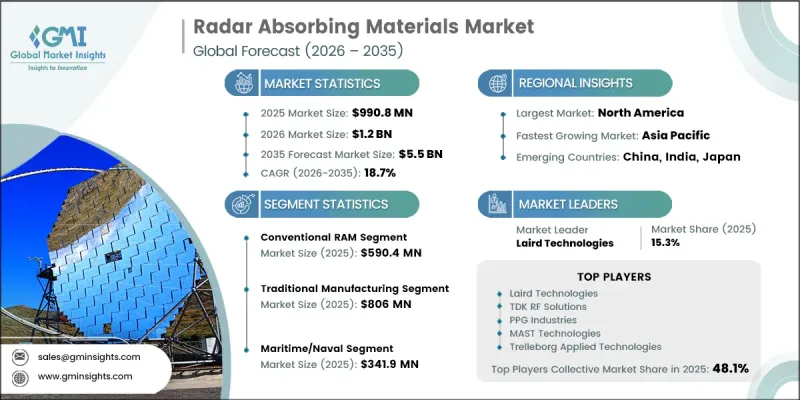
The Global Radar Absorbing Materials Market was valued at USD 990.8 million in 2025 and is estimated to grow at a CAGR of 18.7% to reach USD 5.5 billion by 2035.
Radar absorbing materials (RAM) are specialized engineered substances designed to reduce radar signal reflection by absorbing electromagnetic waves, primarily within radar frequency ranges, thereby lowering detectability. These materials function by converting incoming electromagnetic energy into heat or dissipating it within the material structure through dielectric and magnetic loss mechanisms. RAM formulations typically incorporate conductive polymers, ferrites, carbon-based compounds, and advanced composite blends, enabling performance customization based on application needs. Depending on design requirements, these materials can be applied as coatings, integrated into structural composites, used as layered sheets, or embedded directly into material systems. Key performance factors include operating frequency range, thickness, density, and environmental durability. Demand for radar absorbing materials is rising due to increasing requirements for electromagnetic interference control across multiple industries. Their applications now extend beyond defense into telecommunications, automotive electronics, and electronic shielding systems. As electronic platforms become more complex, the need to manage electromagnetic signatures has intensified, supporting broader adoption. Growth is also supported by rising use of lightweight composite structures in aerospace and transportation systems, where embedded absorption capabilities help improve performance without increasing structural weight.
| Market Scope | |
|---|---|
| Start Year | 2025 |
| Forecast Year | 2026-2035 |
| Start Value | $990.8 Million |
| Forecast Value | $5.5 Billion |
| CAGR | 18.7% |
Conventional radar absorbing materials accounted for USD 590.4 million in 2025. These materials continue to be widely adopted due to their established manufacturing processes and consistent performance across specific frequency ranges. Traditional RAM formulations commonly rely on ferrites, carbon-based polymers, and coating systems that are continuously being refined for improved performance. Ongoing advancements are focused on enhancing durability, environmental resistance, and application efficiency, particularly in aerospace and defense environments where reliability and cost efficiency remain critical priorities.
The traditional manufacturing processes represented a USD 806 million in 2025. These methods are widely used due to their scalability, operational stability, and suitability for high-volume production. Established techniques such as coating application, molding, and lamination continue to ensure consistent output quality across a broad range of applications. At the same time, newer hybrid and advanced manufacturing approaches are gradually being introduced to improve precision, efficiency, and material performance. The industry trend indicates a gradual transition where conventional manufacturing remains foundational while advanced processes are increasingly integrated to meet evolving technical and design requirements.
North America Radar Absorbing Materials Market is expected grow from USD 361.3 million in 2025 to USD 2.2 billion by 2035. Regional expansion is being driven by continuous modernization of defense systems, advancement in aerospace programs, and rising emphasis on electromagnetic compatibility across electronic and communication systems. In the United States, ongoing investments in next-generation defense platforms and aerospace technologies are supporting broader integration of radar absorbing materials across multiple high-performance applications, strengthening long-term market growth in the region.
Major companies operating in the global radar absorbing materials market include Saab AB, PPG Industries, TDK RF Solutions, Echodyne Inc., Kymeta Corporation, Laird Technologies, Trelleborg, Armorthane, Hyper Stealth Technologies Pvt. Ltd, MAJR Products, MWT Materials Inc., Soliani EMC, Diamond Microwave Chambers Ltd, SLTL Group, Wittenburg Group, MAST Technologies, RF Nanocomposites Pvt. Ltd, Dutch Microwave Absorber Solutions, Fractal Antenna Systems, and JEM Engineering. Companies operating in the radar absorbing materials market are focusing on strengthening their competitive position through continuous material innovation, advanced composite development, and performance optimization across wider frequency ranges. Significant investment is being directed toward research and development aimed at improving absorption efficiency, thermal stability, and environmental durability of materials used in defense and aerospace applications. Market participants are also expanding production capabilities through the scaling of advanced manufacturing technologies while maintaining conventional production lines for established applications. Strategic collaborations with defense contractors, aerospace manufacturers, and telecommunications providers are helping companies secure long-term supply agreements and expand application reach.
Table of Contents
Chapter 1 Methodology & Scope
- 1.1 Market scope and definition
- 1.2 Research design
- 1.2.1 Research approach
- 1.2.2 Data collection methods
- 1.3 Data mining sources
- 1.3.1 Global
- 1.3.2 Regional/Country
- 1.4 Base estimates and calculations
- 1.4.1 Base year calculation
- 1.4.2 Key trends for market estimation
- 1.5 Primary research and validation
- 1.5.1 Primary sources
- 1.6 Forecast model
- 1.7 Research assumptions and limitations
Chapter 2 Executive Summary
- 2.1 Industry 360° synopsis
- 2.2 Key market trends
- 2.2.1 Material Type
- 2.2.2 Manufacturing Method
- 2.2.3 Frequency Band
- 2.2.4 Application
- 2.2.5 Regional
- 2.3 TAM Analysis, 2026-2035
- 2.4 CXO perspectives: Strategic imperatives
- 2.5 Future outlook and strategic recommendations
Chapter 3 Industry Insights
- 3.1 Industry ecosystem analysis
- 3.1.1 Supplier landscape
- 3.1.2 Profit margin
- 3.1.3 Value addition at each stage
- 3.1.4 Factor affecting the value chain
- 3.1.5 Disruptions
- 3.2 Industry impact forces
- 3.2.1 Growth drivers
- 3.2.1.1 Defense modernization and stealth platform demand
- 3.2.1.2 Miniaturization, weight reduction and multi-functional material integration
- 3.2.1.3 5G/6G infrastructure build-out and EMI shielding demand
- 3.2.2 Industry pitfalls and challenges
- 3.2.2.1 High manufacturing cost and yield challenges for metamaterial-based RAM
- 3.2.2.2 Export control and ITAR/EAR compliance as market access barriers
- 3.2.3 Market opportunities
- 3.2.3.1 Increasing demand for stealth defense technologies
- 3.2.3.2 Growing use in advanced electronic shielding
- 3.2.3.3 Expansion in aerospace composite material applications
- 3.2.1 Growth drivers
- 3.3 Growth potential analysis
- 3.4 Regulatory landscape
- 3.4.1 North America
- 3.4.2 Europe
- 3.4.3 Asia Pacific
- 3.4.4 Latin America
- 3.4.5 Middle East & Africa
- 3.5 Porter's analysis
- 3.6 PESTEL analysis
- 3.7 Technology and innovation landscape
- 3.7.1 Current technological trends
- 3.7.2 Emerging technologies
- 3.8 Price trends
- 3.8.1 By region
- 3.8.2 By material type
- 3.9 Future market trends
- 3.10 Patent landscape
- 3.11 Trade statistics (HS code)
- 3.11.1 Major importing countries
- 3.11.2 Major exporting countries
- 3.12 Sustainability and environmental aspects
- 3.12.1 Sustainable practices
- 3.12.2 Waste reduction strategies
- 3.12.3 Energy efficiency in production
- 3.12.4 Eco-friendly initiatives
- 3.13 Carbon footprint consideration
Chapter 4 Competitive Landscape, 2025
- 4.1 Introduction
- 4.2 Company market share analysis
- 4.2.1 By region
- 4.2.1.1 North America
- 4.2.1.2 Europe
- 4.2.1.3 Asia Pacific
- 4.2.1.4 LATAM
- 4.2.1.5 MEA
- 4.2.1 By region
- 4.3 Company matrix analysis
- 4.4 Competitive analysis of major market players
- 4.5 Competitive positioning matrix
- 4.6 Key developments
- 4.6.1 Mergers & acquisitions
- 4.6.2 Partnerships & collaborations
- 4.6.3 New product launches
- 4.6.4 Expansion plans
Chapter 5 Market Estimates and Forecast, By Material Type, 2022-2035 (USD Million) (Kilo Tons)
- 5.1 Key trends
- 5.2 Conventional RAM
- 5.2.1 RAM Paints & Coatings
- 5.2.1.1 X-band RAM Paint
- 5.2.1.2 Other Frequency Band RAM Paints
- 5.2.2 RAM Sheets & Panels
- 5.2.3 RAM Foams
- 5.2.4 RAM Fillers
- 5.2.5 Others
- 5.2.1 RAM Paints & Coatings
- 5.3 Metamaterial-Based RAM
- 5.3.1 Split Ring Resonator (SRR) based
- 5.3.2 Wire Array based
- 5.3.3 Frequency Selective Surface (FSS) based
- 5.3.4 Others
Chapter 6 Market Estimates and Forecast, By Manufacturing Method, 2022-2035 (USD Million) (Kilo Tons)
- 6.1 Key trends
- 6.2 Lithographic Techniques
- 6.3 3D Printing/Additive Manufacturing
- 6.4 Traditional Manufacturing
- 6.5 Others
Chapter 7 Market Estimates and Forecast, By Frequency Band, 2022-2035 (USD Million) (Kilo Tons)
- 7.1 Key trends
- 7.2 X-band (8-12 GHz)
- 7.2.1 Conventional RAM
- 7.2.2 Metamaterial-Based RAM
- 7.3 S-band (2-4 GHz)
- 7.3.1 Conventional RAM
- 7.3.2 Metamaterial-Based RAM
- 7.4 L-band (1-2 GHz)
- 7.4.1 Conventional RAM
- 7.4.2 Metamaterial-Based RAM
- 7.5 C-band (4-8 GHz)
- 7.5.1 Conventional RAM
- 7.5.2 Metamaterial-Based RAM
- 7.6 Ku-band (12-18 GHz)
- 7.6.1 Conventional RAM
- 7.6.2 Metamaterial-Based RAM
- 7.7 Ka-band (26-40 GHz)
- 7.7.1 Conventional RAM
- 7.7.2 Metamaterial-Based RAM
- 7.8 Others
Chapter 8 Market Estimates and Forecast, By Application, 2022-2035 (USD Million) (Kilo Tons)
- 8.1 Key trends
- 8.2 Maritime/Naval
- 8.2.1 Ship Navigation Radar
- 8.2.1.1 Conventional RAM
- 8.2.1.2 Metamaterial-Based RAM
- 8.2.2 Naval Vessels
- 8.2.3 Others
- 8.2.1 Ship Navigation Radar
- 8.3 Aerospace & Defense
- 8.3.1 Conventional RAM
- 8.3.2 Metamaterial-Based RAM
- 8.4 Automotive
- 8.4.1 Conventional RAM
- 8.4.2 Metamaterial-Based RAM
- 8.5 Telecommunications
- 8.5.1 Conventional RAM
- 8.5.2 Metamaterial-Based RAM
- 8.6 Electronics
- 8.6.1 Conventional RAM
- 8.6.2 Metamaterial-Based RAM
- 8.7 Others
Chapter 9 Market Estimates and Forecast, By Region, 2022-2035 (USD Million) (Kilo Tons)
- 9.1 Key trends
- 9.2 North America
- 9.2.1 U.S.
- 9.2.2 Canada
- 9.3 Europe
- 9.3.1 Germany
- 9.3.2 UK
- 9.3.3 France
- 9.3.4 Spain
- 9.3.5 Italy
- 9.3.6 Rest of Europe
- 9.4 Asia Pacific
- 9.4.1 China
- 9.4.2 India
- 9.4.3 Japan
- 9.4.4 Australia
- 9.4.5 South Korea
- 9.4.6 Rest of Asia Pacific
- 9.5 Latin America
- 9.5.1 Brazil
- 9.5.2 Mexico
- 9.5.3 Argentina
- 9.5.4 Rest of Latin America
- 9.6 Middle East and Africa
- 9.6.1 Saudi Arabia
- 9.6.2 South Africa
- 9.6.3 UAE
- 9.6.4 Rest of Middle East and Africa
Chapter 10 Company Profiles
- 10.1 Laird Technologies
- 10.2 Soliani EMC
- 10.3 MWT Materials Inc
- 10.4 Diamond Microwave Chambers Ltd
- 10.5 MAJR Products
- 10.6 SLTL Group
- 10.7 Trelleborg
- 10.8 Wittenburggroup
- 10.9 Armorthane
- 10.10 Hyper Stealth Technologies Pvt. Ltd
- 10.11 PPG Industries
- 10.12 MAST Technologies
- 10.13 RF Nanocomposites Pvt. Ltd
- 10.14 Echodyne Inc.
- 10.15 Dutch Microwave Absorber Solutions
- 10.16 Fractal Antenna Systems
- 10.17 TDK RF Solutions
- 10.18 Saab AB
- 10.19 Kymeta Corporation
- 10.20 JEM Engineering

