PUBLISHER: Global Market Insights Inc. | PRODUCT CODE: 2083044

PUBLISHER: Global Market Insights Inc. | PRODUCT CODE: 2083044
Automotive Application Lifecycle Management (ALM) Software Market Opportunity, Growth Drivers, Industry Trend Analysis, and Forecast 2026 - 2035
The Global Automotive Application Lifecycle Management Software Market was valued at USD 355.7 million in 2025 and is estimated to grow at a CAGR of 12.7% to reach USD 1.14 billion by 2035.
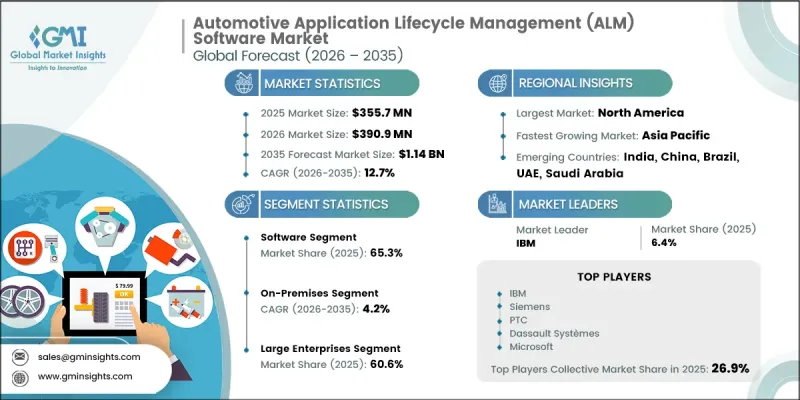
Market expansion is driven by the increasing digitalization of vehicle development processes and the growing complexity of software integration within modern automobiles. Automotive manufacturers, engineering organizations, and software technology providers are strengthening collaborative development ecosystems to support innovation, improve operational efficiency, and streamline product development workflows. The rapid evolution of software-centric vehicles, intelligent mobility solutions, and advanced vehicle technologies is creating strong demand for sophisticated application lifecycle management platforms. As software content within vehicles continues to expand, manufacturers are increasingly investing in digital engineering environments that improve software quality, accelerate development cycles, and support consistent performance throughout the vehicle lifecycle. Modern ALM solutions enable organizations to enhance collaboration, automate development processes, improve traceability, and strengthen regulatory compliance management. These platforms also facilitate seamless coordination between software and engineering teams, allowing companies to manage increasingly complex development programs more effectively. Growing emphasis on agile methodologies, software reliability, cybersecurity management, and lifecycle visibility is further contributing to market growth as automotive organizations seek comprehensive solutions to support next-generation vehicle development initiatives.
| Market Scope | |
|---|---|
| Start Year | 2025 |
| Forecast Year | 2026-2035 |
| Start Value | $355.7 Million |
| Forecast Value | $1.14 Billion |
| CAGR | 12.7% |
The software segment accounted for 65.3% share and is projected to grow at a CAGR of 11.7% from 2026 to 2035. The segment's leadership is primarily attributed to the growing adoption of advanced software platforms designed to manage increasingly sophisticated vehicle software environments. These solutions enable organizations to oversee software requirements, development workflows, testing procedures, configuration management, and compliance activities across the entire software lifecycle. As software complexity continues to increase within modern vehicles, demand for robust ALM software platforms is expected to remain strong.
The passenger vehicles segment held 78.5% share in 2025. Growth within the segment is driven by the expanding integration of digital technologies, advanced electronic systems, intelligent vehicle functions, and connected mobility capabilities across passenger vehicle platforms. Manufacturers are making significant investments in software management solutions to address increasing development complexity and support the growing software requirements of modern vehicles. The ongoing transition toward highly connected and software-centric passenger vehicles is further accelerating the adoption of ALM platforms that facilitate continuous development, testing, deployment, and lifecycle management activities.
U.S. Automotive Application Lifecycle Management Software Market generated USD 98.6 million in 2025 and is anticipated to grow at a CAGR of 10.8% through 2035. The United States represents the largest market within North America due to its strong concentration of automotive technology innovators, vehicle manufacturers, and software development organizations. Increasing investments in advanced software engineering capabilities, vehicle development programs, and digital transformation initiatives are supporting market growth. Rising software complexity across modern vehicle platforms and continued innovation in next-generation automotive technologies are expected to sustain demand for application lifecycle management solutions throughout the forecast period.
Leading companies operating in the global automotive application lifecycle management software market include Siemens, Microsoft, Dassault Systemes, IBM, SAP, Atlassian, PTC, Broadcom, Codebeamer, and Polarion. Companies operating in the automotive application lifecycle management software market are pursuing a variety of strategic initiatives to strengthen their market position and expand their competitive advantage. Significant investments in research and development remain a key priority as vendors focus on enhancing platform capabilities, automation features, analytics tools, and lifecycle management functionalities. Strategic partnerships with automotive manufacturers, technology providers, and engineering organizations are helping companies broaden their customer base and accelerate innovation. Many market participants are expanding cloud-based offerings and integrating advanced technologies to improve collaboration, software quality, and operational efficiency. Acquisitions, product portfolio expansion, and continuous platform modernization are also being utilized to strengthen market presence.
Table of Contents
Chapter 1 Methodology
- 1.1 Research approach
- 1.2 Quality Commitments
- 1.2.1 GMI AI policy & data integrity commitment
- 1.2.1.1 Source consistency protocol
- 1.2.1 GMI AI policy & data integrity commitment
- 1.3 Research Trail & Confidence Scoring
- 1.3.1 Research Trail Components
- 1.3.2 Scoring Components
- 1.4 Data Collection
- 1.4.1 Partial list of primary sources
- 1.5 Data mining sources
- 1.5.1 Paid sources
- 1.5.1.1 Sources, by region
- 1.5.1 Paid sources
- 1.6 Base estimates and calculations
- 1.6.1 Base year calculation
- 1.7 Forecast
- 1.7.1 Quantified market impact analysis
- 1.7.1.1 Mathematical impact of growth parameters on forecast
- 1.7.1 Quantified market impact analysis
- 1.8 Research transparency addendum
- 1.8.1 Source attribution framework
- 1.8.2 Quality assurance metrics
- 1.8.3 Our commitment to trust
Chapter 2 Executive Summary
- 2.1 Industry 360° synopsis
- 2.2 Key market trends
- 2.2.1 Regional
- 2.2.2 Component
- 2.2.3 Deployment Mode
- 2.2.4 Organization Size
- 2.2.5 Application
- 2.2.6 Vehicle
- 2.3 TAM analysis, 2026-2035
- 2.4 CXO perspectives: Strategic imperatives
Chapter 3 Industry Insights
- 3.1 Industry ecosystem analysis
- 3.1.1 Supplier landscape
- 3.1.2 Profit margin
- 3.1.3 Cost structure
- 3.1.4 Value addition at each stage
- 3.1.5 Factor affecting the value chain
- 3.1.6 Disruptions
- 3.2 Industry impact forces
- 3.2.1 Growth drivers
- 3.2.1.1 Integrated ALM for Speed and Agility
- 3.2.1.2 Cloud ALM Appeals to SMEs and Remotes
- 3.2.1.3 ALM Ensures Compliance in Regulated Sectors
- 3.2.1.4 AI Enhances ALM Quality and Speed
- 3.2.2 Industry pitfalls & challenges
- 3.2.2.1 Complexity in Aligning ALM with Tools
- 3.2.2.2 Cloud ALM Raises Data Security Concerns
- 3.2.3 Market Opportunities
- 3.2.3.1 Rising adoption of DevOps and Agile
- 3.2.3.2 Growth of remote and hybrid workforces
- 3.2.3.3 AI and Automation Integration
- 3.2.3.4 Demand for Scalable, Customizable Solutions
- 3.2.1 Growth drivers
- 3.3 Growth potential analysis
- 3.4 Technology and innovation landscape
- 3.4.1 Current technological trends
- 3.4.2 Emerging technologies
- 3.5 Pricing Analysis (Driven by Primary Research)
- 3.5.1 Historical Price Trend Analysis
- 3.5.2 Pricing Strategy by Player Type
- 3.6 Regulatory landscape
- 3.6.1 North America
- 3.6.1.1 National Highway Traffic Safety Administration (NHTSA)
- 3.6.1.2 SAE International
- 3.6.2 Europe
- 3.6.2.1 European Union Agency for Cybersecurity (ENISA)
- 3.6.2.2 UNECE WP.29 Automotive Cybersecurity Regulations
- 3.6.3 Asia Pacific
- 3.6.3.1 Ministry of Industry and Information Technology (MIIT), China
- 3.6.3.2 Automotive Research Association of India (ARAI)
- 3.6.4 LATAM
- 3.6.4.1 Brazilian National Traffic Department (DENATRAN)
- 3.6.4.2 National Institute of Industrial Technology (INTI), Argentina
- 3.6.5 MEA
- 3.6.5.1 Saudi Standards, Metrology and Quality Organization (SASO)
- 3.6.5.2 Emirates Authority for Standardization and Metrology (ESMA)
- 3.6.1 North America
- 3.7 Porter’s analysis
- 3.8 PESTEL analysis
- 3.9 Patent analysis (Driven by Primary Research)
- 3.10 Impact of AI & Generative AI on the Market
- 3.10.1 AI-driven disruption of existing business models
- 3.10.2 Gen AI use cases & adoption roadmap by segment
- 3.10.3 Risks, limitations & regulatory considerations
- 3.11 Sustainability and environmental aspects
- 3.11.1 Sustainable practices
- 3.11.2 Waste reduction strategies
- 3.11.3 Energy efficiency in production
- 3.11.4 Eco-friendly initiatives
- 3.11.5 Carbon footprint considerations
- 3.12 Forecast assumptions & scenario analysis (Driven by primary research)
- 3.12.1 Base Case - key macro & industry variables driving CAGR
- 3.12.2 Optimistic Scenarios - Favorable macro and industry tailwinds
- 3.12.3 Pessimistic Scenario - Macroeconomic slowdown or industry headwinds
Chapter 4 Competitive Landscape, 2025
- 4.1 Introduction
- 4.2 Company market share analysis
- 4.2.1 North America
- 4.2.2 Europe
- 4.2.3 Asia Pacific
- 4.2.4 LATAM
- 4.2.5 MEA
- 4.3 Competitive analysis of major market players
- 4.4 Competitive positioning matrix
- 4.5 Key developments
- 4.5.1 Mergers & acquisitions
- 4.5.2 Partnerships & collaborations
- 4.5.3 New product launches
- 4.5.4 Expansion plans and funding
- 4.6 Company tier benchmarking
- 4.6.1 Tier classification criteria & qualifying thresholds
- 4.6.2 Tier positioning matrix by revenue, geography & innovation
Chapter 5 Market Estimates & Forecast, By Component, 2022 - 2035 ($Mn)
- 5.1 Key trends
- 5.2 Software
- 5.2.1 Agile Centric ALM
- 5.2.2 Process Centric
- 5.3 Services
- 5.3.1 Professional services
- 5.3.1.1 Consulting
- 5.3.1.2 Deployment & integration
- 5.3.1.3 Support & maintenance
- 5.3.2 Managed services
- 5.3.1 Professional services
Chapter 6 Market Estimates & Forecast, By Deployment mode, 2022 - 2035 ($Mn)
- 6.1 Key trends
- 6.2 On-Premises
- 6.3 Cloud-Based
- 6.4 Hybrid
Chapter 7 Market Estimates & Forecast, By Enterprise size, 2022 - 2035 ($Mn)
- 7.1 Key trends
- 7.2 Large enterprises
- 7.3 SMEs
Chapter 8 Market Estimates & Forecast, By Application, 2022 - 2035 ($Mn)
- 8.1 Key trends
- 8.2 Design & Development
- 8.3 Testing
- 8.4 Deployment
- 8.5 Maintenance & Updates
- 8.6 Other
Chapter 9 Market Estimates & Forecast, By Vehicle, 2022 - 2035 ($Mn)
- 9.1 Key trends
- 9.2 Passenger Vehicles
- 9.2.1 SUV
- 9.2.2 Sedan
- 9.2.3 Hatchback
- 9.3 Commercial Vehicles
- 9.3.1 LCV
- 9.3.2 MCV
- 9.3.3 HCV
Chapter 10 Market Estimates & Forecast, By Region, 2022 - 2035 ($Mn)
- 10.1 Key trends
- 10.2 North America
- 10.2.1 U.S.
- 10.2.2 Canada
- 10.3 Europe
- 10.3.1 Germany
- 10.3.2 UK
- 10.3.3 France
- 10.3.4 Italy
- 10.3.5 Spain
- 10.3.6 Russia
- 10.3.7 Nordic
- 10.4 Asia Pacific
- 10.4.1 China
- 10.4.2 India
- 10.4.3 Japan
- 10.4.4 South Korea
- 10.4.5 Australia
- 10.4.6 Vietnam
- 10.4.7 Indonesia
- 10.4.8 Singapore
- 10.5 Latin America
- 10.5.1 Brazil
- 10.5.2 Mexico
- 10.5.3 Argentina
- 10.6 MEA
- 10.6.1 South Africa
- 10.6.2 Saudi Arabia
- 10.6.3 UAE
Chapter 11 Company Profiles
- 11.1 Global players
- 11.1.1 IBM
- 11.1.2 Siemens
- 11.1.3 PTC
- 11.1.4 Dassault Systemes
- 11.1.5 Atlassian
- 11.1.6 Microsoft
- 11.1.7 SAP
- 11.1.8 Broadcom
- 11.1.9 Codebeamer
- 11.1.10 Polarion
- 11.2 Regional players
- 11.2.1 KPIT Technologies
- 11.2.2 Tata Elxsi
- 11.2.3 HCLTech
- 11.2.4 Infosys
- 11.2.5 AVL
- 11.2.6 ETAS
- 11.2.7 Vector Informatik
- 11.2.8 TTTech Auto
- 11.2.9 Elektrobit
- 11.2.10 Sonatus

