PUBLISHER: Global Market Insights Inc. | PRODUCT CODE: 2083047

PUBLISHER: Global Market Insights Inc. | PRODUCT CODE: 2083047
Automotive Immobilizer Market Opportunity, Growth Drivers, Industry Trend Analysis, and Forecast 2026 - 2035
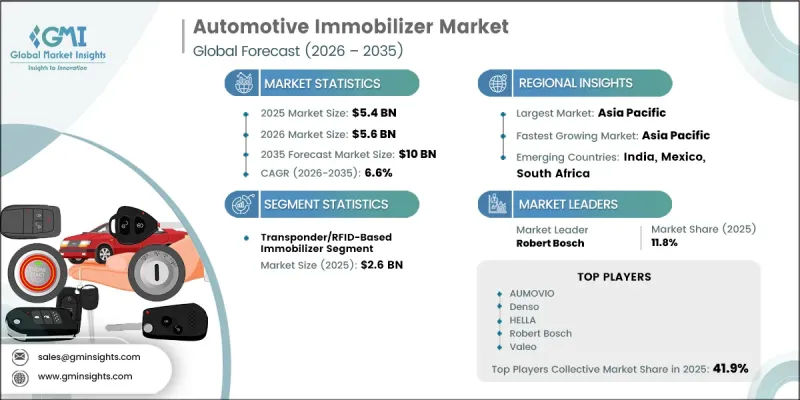
The Global Automotive Immobilizer Market was valued at USD 5.4 billion in 2025 and is estimated to grow at a CAGR of 6.6% to reach USD 10 billion by 2035.
Rising concerns regarding vehicle security and theft prevention continue to accelerate demand for advanced immobilizer technologies across both original equipment manufacturers (OEMs) and the aftermarket. Increasing regulatory emphasis on vehicle safety, coupled with growing consumer awareness of anti-theft technologies, is creating favorable growth opportunities for the global automotive immobilizer market. The industry is also witnessing a gradual transition from conventional security solutions toward more intelligent vehicle protection systems that deliver stronger security capabilities and enhanced functionality. Continuous advancements in connected vehicle technologies are encouraging manufacturers to integrate software-enabled security features capable of supporting remote management and future system upgrades. These technological developments are reshaping competitive dynamics across the market while increasing the value proposition of next-generation immobilizer solutions. At the same time, evolving regulatory frameworks across several regions are encouraging wider adoption of factory-installed vehicle security systems, further supporting long-term market expansion. As automotive manufacturers continue to prioritize integrated electronic security technologies, the automotive immobilizer market is expected to maintain steady growth throughout the forecast period.
| Market Scope | |
|---|---|
| Start Year | 2025 |
| Forecast Year | 2026-2035 |
| Start Value | $5.4 Billion |
| Forecast Value | $10 Billion |
| CAGR | 6.6% |
The integration of automotive immobilizers with connected vehicle platforms is becoming one of the most significant trends influencing market development. Manufacturers are increasingly focusing on software-driven security systems that support remote functionality and future over-the-air software upgrades, allowing vehicle protection technologies to evolve throughout the product lifecycle. This transition is reshaping supplier competition by increasing demand for technologically advanced electronic security solutions while supporting higher product values across multiple technology categories. In addition, regulatory policies governing vehicle insurance in several countries are progressively moving from incentive-based adoption toward mandatory installation requirements for insurance eligibility, creating additional opportunities for automotive immobilizer manufacturers.
The transponder/RFID-based immobilizer segment generated USD 2.6 billion, holding 48.7% share in 2025. Its leading position reflects widespread acceptance as a standard vehicle security technology across global automotive production. Long-term industry adoption, extensive service infrastructure, affordable replacement costs, and broad regulatory acceptance have contributed to the continued dominance of transponder and RFID-based immobilizer systems. Their proven reliability and cost efficiency continue to support strong demand across the global automotive sector.
The OEM sales channel segment captured a significant share in 2025, supported by expanding regulatory requirements and the increasing integration of immobilizer systems as standard vehicle security equipment. Long-term supply agreements between automotive manufacturers and component suppliers continue to shape competitive dynamics within this segment, with suppliers benefiting from established engineering relationships and platform integration capabilities. Strong collaboration between vehicle manufacturers and component suppliers remains a key factor supporting continued growth within the OEM channel, as automakers increasingly prioritize integrated electronic security technologies during vehicle development.
Asia Pacific Automotive Immobilizer Market reached USD 2.1 billion, accounting for 38.1% share in 2025. Continued expansion of domestic vehicle production, regulatory compliance requirements, and a large existing vehicle fleet continue to support both OEM and aftermarket demand for automotive immobilizer systems. Sustained investments in vehicle manufacturing and the growing adoption of advanced automotive security technologies are expected to reinforce the region's market leadership over the forecast period.
Major companies operating in the global automotive immobilizer market include AUMOVIO, Robert Bosch, Denso, Valeo, Hella, Lear, ZF Friedrichshafen, Alps Alpine, Tokai Rika, Aisin, Mitsubishi Electric, and Marquardt. Companies operating in the automotive immobilizer market are strengthening their market position through continuous investment in advanced vehicle security technologies and product innovation. Manufacturers are focusing on developing intelligent immobilizer systems that integrate with connected vehicle platforms and support software-based upgrades to improve long-term functionality. Strategic collaborations with automotive OEMs are helping suppliers secure long-term production contracts while expanding their presence across new vehicle platforms. Businesses are also investing in research and development to enhance cybersecurity, reliability, and compatibility with evolving automotive electronics. Geographic expansion, manufacturing capacity enhancements, and stronger distribution networks are supporting broader market penetration.
Table of Contents
Chapter 1 Methodology
- 1.1 Research approach
- 1.2 Quality Commitments
- 1.2.1 GMI AI policy & data integrity commitment
- 1.3 Research Trail & Confidence Scoring
- 1.3.1 Research Trail Components
- 1.3.2 Scoring Components
- 1.4 Data Collection
- 1.5 Data mining sources
- 1.5.1 Paid sources
- 1.6 Base estimates and calculations
- 1.6.1 Base year calculation
- 1.7 Forecast model
- 1.7.1 Quantified market impact analysis
- 1.8 Research transparency addendum
- 1.8.1 Source attribution framework
- 1.8.2 Quality assurance metrics
- 1.8.3 Our commitment to trust
Chapter 2 Executive Summary
- 2.1 Industry 360° synopsis
- 2.2 Key market trends
- 2.2.1 Regional
- 2.2.2 Technology
- 2.2.3 Sales Channel
- 2.2.4 Vehicle
- 2.3 TAM analysis, 2026-2035
- 2.4 CXO perspectives: Strategic imperatives
Chapter 3 Industry Insights
- 3.1 Industry ecosystem analysis
- 3.1.1 Supplier landscape
- 3.1.2 Profit margin
- 3.1.3 Cost structure
- 3.1.4 Value addition at each stage
- 3.1.5 Factor affecting the value chain
- 3.1.6 Disruptions
- 3.2 Industry impact forces
- 3.2.1 Growth drivers
- 3.2.1.1 Rising vehicle theft rates in emerging markets driving aftermarket retrofit demand
- 3.2.1.2 OEM immobilizer penetration nearing saturation in developed markets
- 3.2.1.3 Insurance mandate expansion as structural aftermarket demand driver
- 3.2.1.4 EV immobilizer architecture differences and new entry points for aftermarket players
- 3.2.2 Industry pitfalls and challenges
- 3.2.2.1 OEM market maturity compressing new installation volumes in developed markets
- 3.2.2.2 Cybersecurity vulnerabilities in digitally connected immobilizers
- 3.2.3 Market opportunities
- 3.2.3.1 Growing Adoption of Electric Vehicles (EVs)
- 3.2.3.2 Rising Demand for Aftermarket Vehicle Security Solutions
- 3.2.3.3 Increasing Deployment of AI-Enabled Anti-Theft Technologies
- 3.2.1 Growth drivers
- 3.3 Technology and innovation landscape
- 3.3.1 Current technological trends
- 3.3.1.1 RFID-Based Immobilizers
- 3.3.1.2 Transponder Key Systems
- 3.3.1.3 ECU Immobilization
- 3.3.2 Emerging technologies
- 3.3.2.1 Smartphone-Based Digital Keys
- 3.3.2.2 Biometric Vehicle Authentication
- 3.3.2.3 AI-Based Vehicle Security Systems
- 3.3.1 Current technological trends
- 3.4 Growth potential analysis
- 3.5 Pricing Analysis (Driven by Primary Research)
- 3.5.1 Historical Price Trend Analysis
- 3.5.2 Pricing Strategy by Player Type (Premium / Value / Cost-plus)
- 3.6 Regulatory landscape
- 3.6.1 North America
- 3.6.1.1 US - NHTSA (National Highway Traffic Safety Administration)
- 3.6.1.2 Canada - ISED (Innovation, Science and Economic Development Canada)
- 3.6.2 Europe
- 3.6.2.1 EU - EC (European Commission)
- 3.6.2.2 Germany - KBA (Kraftfahrt-Bundesamt)
- 3.6.3 Asia Pacific
- 3.6.3.1 China - MIIT (Ministry of Industry and Information Technology)
- 3.6.3.2 Japan - MLIT (Ministry of Land, Infrastructure, Transport and Tourism)
- 3.6.3.3 India - BIS (Bureau of Indian Standards / Department of Transport)
- 3.6.4 LATAM
- 3.6.4.1 Brazil - CONTRAN (Conselho Nacional de Transito)
- 3.6.4.2 Brazil - DENATRAN / SENATRAN
- 3.6.5 MEA
- 3.6.5.1 GCC - GSO (GCC Standardization Organization)
- 3.6.5.2 UAE - ESMA (Emirates Authority for Standardization and Metrology)
- 3.6.1 North America
- 3.7 Porter's analysis
- 3.8 PESTEL analysis
- 3.9 Trade Data Analysis (Driven by Paid Database)
- 3.9.1 Import/Export Volume & Value Trends
- 3.9.2 Key Trade Corridors & Tariff Impact
- 3.10 Capacity & Production Landscape (Driven by Primary Research)
- 3.10.1 Installed Capacity by Region & Key Producer
- 3.10.2 Capacity Utilization Rates & Expansion Pipelines
- 3.11 Cost breakdown analysis
- 3.12 Patent analysis (Driven by Primary Research)
- 3.13 Theft Trends and Vehicle Security Threat Analysis
- 3.14 Case studies
- 3.15 Impact of AI & generative AI on the market
- 3.15.1 AI-driven disruption of existing business models
- 3.15.2 GenAI use cases & adoption roadmap by segment
- 3.15.3 Risks, limitations & regulatory considerations
- 3.16 Forecast assumptions & scenario analysis (Driven by Primary Research)
- 3.16.1 Base Case- Key Macro & Industry Variables Driving CAGR
- 3.16.2 Optimistic Scenarios- Favorable macro and industry tailwinds
- 3.16.3 Pessimistic Scenario - Macroeconomic slowdown or industry headwinds
Chapter 4 Competitive Landscape, 2025
- 4.1 Introduction
- 4.2 Company market share analysis
- 4.2.1 North America
- 4.2.2 Europe
- 4.2.3 Asia Pacific
- 4.2.4 LATAM
- 4.2.5 MEA
- 4.3 Competitive analysis of major market players
- 4.4 Competitive positioning matrix
- 4.5 Key developments
- 4.5.1 Mergers & acquisitions
- 4.5.2 Partnerships & collaborations
- 4.5.3 New product launches
- 4.5.4 Expansion plans and funding
- 4.6 Company tier benchmarking
- 4.6.1 Tier classification criteria & qualifying thresholds
- 4.6.2 Tier positioning matrix by revenue, geography & innovation
Chapter 5 Market Estimates and Forecast, By Technology, 2022 - 2035 ($ Mn, Units)
- 5.1 Key trends
- 5.2 Transponder / RFID-Based Immobilizer
- 5.2.1 Passive Transponder Systems
- 5.2.2 Active Transponder Systems
- 5.3 Rolling Code Immobilizer
- 5.3.1 Fixed Code Systems
- 5.3.2 Dynamic Rolling Code Systems
- 5.4 GPS / Telematics-Integrated Immobilizer
- 5.4.1 Standalone GPS Immobilizer
- 5.4.2 Fleet Telematics-Integrated Immobilizer
- 5.5 OBD-Port Based Immobilizer
- 5.6 Biometric Immobilizer
- 5.6.1 Fingerprint Recognition
- 5.6.2 Facial / Voice Recognition
- 5.7 Others
Chapter 6 Market Estimates and Forecast, By Sales Channel, 2022 - 2035 ($ Mn, Units)
- 6.1 Key trends
- 6.2 OEM
- 6.3 Aftermarket
- 6.3.1 New Vehicle Aftermarket
- 6.3.2 Used Vehicle Aftermarket
Chapter 7 Market Estimates and Forecast, By Vehicle, 2022 - 2035 ($ Mn, Units)
- 7.1 Key trends
- 7.2 Passenger Vehicle
- 7.2.1 Hatchback
- 7.2.2 Sedan
- 7.2.3 SUV
- 7.3 Commercial Vehicle
- 7.3.1 Light Commercial Vehicles (LCV)
- 7.3.2 Medium Commercial Vehicles (MCV)
- 7.3.3 Heavy Commercial Vehicles (HCV)
Chapter 8 Market Estimates & Forecast, By Region, 2022 - 2035 ($Mn, Units)
- 8.1 Key trends
- 8.2 North America
- 8.2.1 US
- 8.2.2 Canada
- 8.3 Europe
- 8.3.1 Germany
- 8.3.2 UK
- 8.3.3 France
- 8.3.4 Italy
- 8.3.5 Spain
- 8.3.6 Netherlands
- 8.3.7 Sweden
- 8.3.8 Poland
- 8.4 Asia Pacific
- 8.4.1 China
- 8.4.2 India
- 8.4.3 Japan
- 8.4.4 Australia
- 8.4.5 South Korea
- 8.4.6 Thailand
- 8.4.7 Vietnam
- 8.4.8 Indonesia
- 8.5 Latin America
- 8.5.1 Brazil
- 8.5.2 Mexico
- 8.5.3 Argentina
- 8.5.4 Chile
- 8.6 MEA
- 8.6.1 South Africa
- 8.6.2 Saudi Arabia
- 8.6.3 UAE
Chapter 9 Company Profiles
- 9.1 Global players
- 9.1.1 AUMOVIO
- 9.1.2 Robert Bosch
- 9.1.3 Denso
- 9.1.4 Valeo
- 9.1.5 Hella
- 9.1.6 Lear
- 9.1.7 ZF Friedrichshafen
- 9.1.8 Alps Alpine
- 9.1.9 Tokai Rika
- 9.1.10 Aisin
- 9.1.11 Mitsubishi Electric
- 9.1.12 Marquardt
- 9.2 Regional players
- 9.2.1 Asahi Denso
- 9.2.2 Scorpion Automotive
- 9.2.3 Pandora Security
- 9.2.4 Dynamco
- 9.2.5 Ravelco
- 9.3 Emerging players
- 9.3.1 Teltonika Telematics
- 9.3.2 Synaptics
- 9.3.3 Goodix Technology

