PUBLISHER: Global Market Insights Inc. | PRODUCT CODE: 2083051

PUBLISHER: Global Market Insights Inc. | PRODUCT CODE: 2083051
Cruise Missile Market Opportunity, Growth Drivers, Industry Trend Analysis, and Forecast 2026 - 2035
The Global Cruise Missile Market was valued at USD 6.2 billion in 2025 and is estimated to grow at a CAGR of 7.8% to reach USD 12.9 billion by 2035.
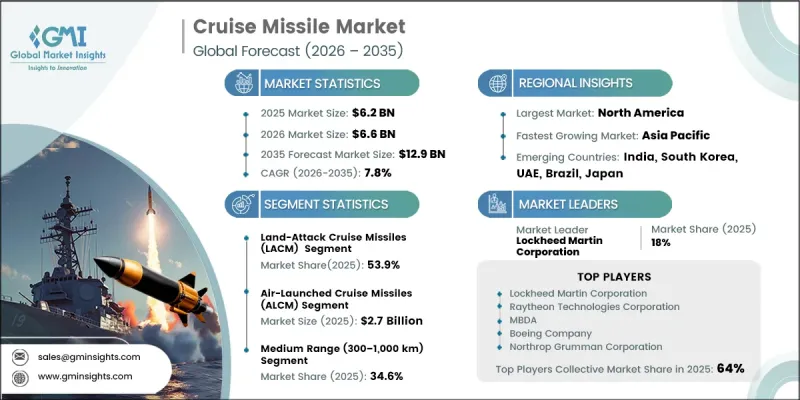
Market growth is driven by rising demand for precision-guided long-range strike capabilities, increasing deployment of sophisticated defense systems, expanding naval modernization initiatives, and growing investments in domestic missile development programs. Defense organizations across the world are placing greater emphasis on advanced strike technologies that enable engagement of strategic targets while maintaining operational stand-off distances and minimizing risks to personnel and military platforms. The growing importance of precision warfare and evolving security challenges are accelerating procurement activities and supporting long-term investment in advanced missile systems. In addition, expanding maritime security requirements and the modernization of naval fleets are generating significant demand for sea-based strike capabilities. Continued focus on defense self-sufficiency, technological advancement, and strategic deterrence is further contributing to market expansion. As military forces seek to strengthen operational readiness and enhance precision engagement capabilities, the cruise missile market is expected to maintain a strong growth trajectory over the coming decade, supported by sustained defense spending and modernization programs worldwide.
| Market Scope | |
|---|---|
| Start Year | 2025 |
| Forecast Year | 2026-2035 |
| Start Value | $6.2 Billion |
| Forecast Value | $12.9 Billion |
| CAGR | 7.8% |
The land-attack cruise missiles segment accounted for 53.9% share in 2025. The segment's dominance is attributed to its critical role in modern precision-strike operations and long-range engagement strategies. These missile systems provide armed forces with the ability to accurately engage protected and strategically important targets from extended distances, reducing the exposure of launch platforms during operations. Broad deployment compatibility across multiple military platforms and increasing demand for versatile mission capabilities continue to support strong growth within this segment.
The medium-range segment, covering distances between 300 and 1,000 kilometers, held a 34.6% share in 2025. The segment benefits from its balance of operational effectiveness, deployment flexibility, and procurement affordability. Medium-range systems are widely utilized for tactical strike missions, regional deterrence operations, and maritime engagement requirements, making them a preferred choice for many defense organizations. Their ability to provide meaningful stand-off capability while maintaining cost efficiency continues to drive procurement activity and support segment growth.
North America Cruise Missile Market accounted for 37.6% share in 2025, maintaining its position as the largest regional market. Regional growth is supported by ongoing investments in long-range strike modernization, advanced defense technologies, and military capability enhancement programs. Demand spans a broad range of missile categories and military applications, supported by a highly developed defense industrial base, extensive procurement programs, and continuous modernization initiatives. Strong research and development capabilities, advanced manufacturing infrastructure, and long-term defense investment strategies continue to reinforce North America's leadership within the global cruise missile industry.
Leading companies operating in the global cruise missile market include MBDA, Raytheon Technologies Corporation, Lockheed Martin Corporation, Northrop Grumman Corporation, Boeing Company, Kongsberg Defence & Aerospace AS, Rafael Advanced Defense Systems Ltd., BrahMos Aerospace Pvt. Ltd., Roketsan A.S., Israel Aerospace Industries, China Aerospace Science and Industry Corporation (CASIC), LIG Nex1, Elbit Systems, and Avibras Industria Aeroespacial S/A. Companies participating in the cruise missile market are implementing a range of strategic initiatives to strengthen their competitive position and expand market presence. Significant investments in research and development remain a primary focus, enabling manufacturers to improve guidance systems, propulsion technologies, precision targeting capabilities, and overall operational effectiveness. Strategic partnerships, defense collaborations, and joint development programs are helping companies accelerate innovation while securing access to new procurement opportunities. Many market participants are also emphasizing indigenous production capabilities and technology localization to address growing demand for defense self-reliance. Product portfolio diversification, modernization of existing missile platforms, and integration of advanced digital technologies are further supporting competitive differentiation.
Table of Contents
Chapter 1 Methodology and Scope
- 1.1 Market scope and definition
- 1.2 Research design
- 1.2.1 Research approach
- 1.2.2 Data collection methods
- 1.3 Data mining sources
- 1.3.1 Global
- 1.3.2 Regional/Country
- 1.4 Base estimates and calculations
- 1.4.1 Base year calculation
- 1.4.2 Key trends for market estimation
- 1.5 Primary research and validation
- 1.5.1 Primary sources
- 1.6 Forecast model
- 1.7 Research assumptions and limitations
Chapter 2 Executive Summary
- 2.1 Industry 360° synopsis, 2022 - 2035
- 2.2 Key market trends
- 2.2.1 Missile type trends
- 2.2.2 Warhead type trends
- 2.2.3 Launch platform trends
- 2.2.4 Range trends
- 2.2.5 Speed trends
- 2.2.6 Regional trends
- 2.3 TAM Analysis, 2026-2035
- 2.4 CXO perspectives: Strategic imperatives
Chapter 3 Industry Insights
- 3.1 Industry ecosystem analysis
- 3.1.1 Supplier Landscape
- 3.1.2 Profit Margin
- 3.1.3 Cost structure
- 3.1.4 Value addition at each stage
- 3.1.5 Factor affecting the value chain
- 3.1.6 Disruptions
- 3.2 Industry impact forces
- 3.2.1 Growth drivers
- 3.2.1.1 Rapid EV adoption increasing IGBT and SiC demand
- 3.2.1.2 Industrial automation growth raising demand for power modules
- 3.2.1.3 Energy efficiency regulations mandating advanced power electronics
- 3.2.1.4 Data center power optimization increasing MOSFET consumption
- 3.2.1.5 Fast-charging infrastructure expansion boosting wide-bandgap semiconductors
- 3.2.2 Industry pitfalls and challenges
- 3.2.2.1 High manufacturing cost of SiC and GaN devices
- 3.2.2.2 Supply chain dependence on limited wafer suppliers
- 3.2.3 Market opportunities
- 3.2.3.1 Adoption of SiC in 800V electric vehicle platforms
- 3.2.3.2 Smart grid upgrades increasing demand for high-power discrete devices
- 3.2.1 Growth drivers
- 3.3 Growth potential analysis
- 3.4 Regulatory landscape
- 3.4.1 North America
- 3.4.2 Europe
- 3.4.3 Asia Pacific
- 3.4.4 Latin America
- 3.4.5 Middle East & Africa
- 3.5 Porter’s analysis
- 3.6 PESTEL analysis
- 3.7 Technology and Innovation landscape
- 3.7.1 Current technological trends
- 3.7.2 Emerging technologies
- 3.8 Price Analysis (Driven by Primary Research)
- 3.8.1 Historical Price Analysis (2022-2025)
- 3.8.2 Pricing Strategy by Player Type (Premium / Value / Cost-plus)
- 3.9 Impact of AI & Generative AI on the Market (Driven by Primary Research)
- 3.9.1 AI-Driven Disruption of Existing Business Models
- 3.9.2 GenAI Use Cases & Adoption Roadmap by Segment
- 3.9.3 Risks, Limitations & Regulatory Considerations
- 3.10 Capacity & Production Landscape (Driven by Primary Research)
- 3.10.1 Installed Capacity by Region & Key Producer
- 3.10.2 Capacity Utilization Rates & Expansion Pipelines
Chapter 4 Competitive Landscape, 2025
- 4.1 Company market share analysis, 2025
- 4.1.1 By Region
- 4.1.1.1 North America
- 4.1.1.2 Europe
- 4.1.1.3 Asia-Pacific
- 4.1.1.4 Latin America
- 4.1.1.5 Middle East and Africa
- 4.1.2 Market Concentration Analysis
- 4.1.1 By Region
- 4.2 Competitive analysis of major market players
- 4.3 Competitive positioning matrix
- 4.3.1 Key developments
- 4.3.2 Mergers & acquisitions
- 4.3.3 Partnerships & collaborations
- 4.3.4 New product launches
- 4.3.5 Expansion plans and funding
- 4.4 Company tier benchmarking
- 4.4.1 Tier classification criteria & qualifying thresholds
- 4.4.2 Tier positioning matrix by revenue, geography & innovation
Chapter 5 Market Estimates and Forecast, By Missile Type, 2022 - 2035 (USD Million & Units)
- 5.1 Key trends
- 5.2 Land-attack cruise missiles (LACM)
- 5.3 Anti-ship cruise missiles (ASCM)
- 5.4 Anti-surface cruise missiles (dual land/sea)
Chapter 6 Market Estimates and Forecast, By Warhead Type, 2022 - 2035 (USD Million & Units)
- 6.1 Key trends
- 6.2 Conventional
- 6.3 Nuclear
Chapter 7 Market Estimates and Forecast, By Launch Platform, 2022 - 2035 (USD Million & Units)
- 7.1 Key trends
- 7.2 Air-launched (ALCM)
- 7.3 Sea-launched (SLCM)
- 7.4 Ground-launched (GLCM)
Chapter 8 Market Estimates and Forecast, By Range, 2022 - 2035 (USD Million & Units)
- 8.1 Key trends
- 8.2 Short range (< 300 km)
- 8.3 Medium range (300-1,000 km)
- 8.4 Long-range (1,000-2,500 km)
- 8.5 Very long-range (> 2,500 km)
Chapter 9 Market Estimates and Forecast, By Speed, 2022 - 2035 (USD Million & Units)
- 9.1 Key trends
- 9.2 Subsonic
- 9.3 Supersonic
- 9.4 Hypersonic
Chapter 10 Market Estimates and Forecast, By Region, 2022 - 2035 (USD Million & Units)
- 10.1 Key trends
- 10.2 North America
- 10.2.1 U.S.
- 10.2.2 Canada
- 10.3 Europe
- 10.3.1 Germany
- 10.3.2 UK
- 10.3.3 France
- 10.3.4 Spain
- 10.3.5 Italy
- 10.3.6 Russia
- 10.4 Asia Pacific
- 10.4.1 China
- 10.4.2 India
- 10.4.3 Japan
- 10.4.4 Australia
- 10.4.5 South Korea
- 10.5 Latin America
- 10.5.1 Brazil
- 10.5.2 Mexico
- 10.5.3 Argentina
- 10.6 Middle East and Africa
- 10.6.1 South Africa
- 10.6.2 Saudi Arabia
- 10.6.3 UAE
Chapter 11 Company Profiles
- 11.1 Global Key Players
- 11.1.1 Lockheed Martin Corporation
- 11.1.2 Raytheon Technologies Corporation
- 11.1.3 MBDA
- 11.1.4 Boeing Company
- 11.1.5 Northrop Grumman Corporation
- 11.2 Regional key players
- 11.2.1 Asia Pacific
- 11.2.1.1 BrahMos Aerospace Pvt. Ltd.
- 11.2.1.2 China Aerospace Science and Industry Corporation (CASIC)
- 11.2.2 Europe
- 11.2.2.1 Kongsberg Defence & Aerospace AS
- 11.2.3 Middle East & Africa
- 11.2.3.1 Roketsan A.S.
- 11.2.3.2 Rafael Advanced Defense Systems Ltd.
- 11.2.3.3 Israel Aerospace Industries
- 11.2.1 Asia Pacific
- 11.3 Niche Players/Disruptors
- 11.3.1 Avibras Industria Aeroespacial S/A
- 11.3.2 LIG Nex1
- 11.3.3 Elbit Systems

