PUBLISHER: Global Market Insights Inc. | PRODUCT CODE: 2083052

PUBLISHER: Global Market Insights Inc. | PRODUCT CODE: 2083052
Asia Pacific Facial Mask Maker Market Opportunity, Growth Drivers, Industry Trend Analysis, and Forecast 2026 - 2035
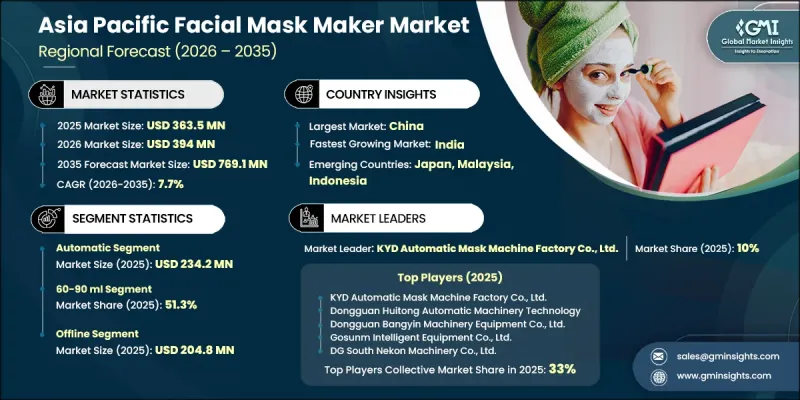
Asia Pacific Facial Mask Maker Market was valued at USD 363.5 million in 2025 and is estimated to grow at a CAGR of 7.7% to reach USD 769.1 million by 2035.
The market is experiencing steady growth as skincare continues to gain importance across the region, driving greater investment in facial mask manufacturing equipment. Rising consumer preference for premium skincare products has encouraged cosmetic manufacturers to expand production capabilities and improve operational efficiency. Growing demand for sheet masks, hydrogel masks, and essence-based facial masks is prompting manufacturers and contract producers to adopt advanced machinery capable of delivering high-volume production with consistent product quality. Increasing emphasis on automation, precision filling, reliable sealing, and efficient packaging is further supporting equipment adoption across manufacturing facilities. The expansion of private-label production, continuous product innovation, and rising manufacturing capacity are also contributing to equipment demand throughout the region. As skincare brands focus on improving productivity while maintaining quality standards, investments in automated and semi-automatic production systems continue to accelerate.
| Market Scope | |
|---|---|
| Start Year | 2025 |
| Forecast Year | 2026-2035 |
| Start Value | $363.5 Million |
| Forecast Value | $769.1 Million |
| CAGR | 7.7% |
In 2025, the automatic segment generated USD 234.2 million. Automatic equipment remains the preferred choice because it combines every major production stage, including substrate feeding, essence filling, sealing, folding, and pouch packaging, into a continuous manufacturing process with minimal manual intervention. These systems can produce between 3,000 and more than 5,000 units per hour, making them well suited for manufacturers handling large-scale production requirements. Market leadership is further supported by the growing transition from semi-automatic equipment to fully automated solutions as manufacturers seek higher efficiency, improved production consistency, and lower operating costs.
The 60-90 ml capacity segment accounted for 51.3% share in 2025, representing the largest share by capacity. This segment maintains its leading position because it aligns with the most widely produced facial mask packaging format across the regional cosmetics industry. Manufacturers prefer this capacity range because it offers an effective balance between providing sufficient essence volume to enhance product performance while optimizing the use of active ingredients and production costs. Its compatibility with mainstream facial mask products continues to support strong demand for machinery designed to handle this packaging specification.
China Facial Mask Maker Market held 42.2% share, generating USD 153.5 million in 2025. The country's dominant position is supported by its role as both the largest consumer market for facial masks and a major manufacturing center for facial mask production equipment. Continued expansion of the domestic cosmetics industry, increasing demand for skincare products, and the growing market presence of domestic beauty brands are strengthening long-term demand for advanced facial mask manufacturing machinery. The country's well-established production ecosystem and ongoing investments in manufacturing capabilities continue to reinforce its leadership within the regional market.
Major companies operating in the Asia Pacific facial mask maker market include KYD Automatic Mask Machine Factory Co., Ltd., NCM Nonwoven Converting Machinery Co., Ltd., Dongguan Huitong Automatic Machinery Technology Co., Ltd., DG South Nekon Machinery Co., Ltd., TRM - Top Rank Machinery Inc., Zhejiang Deheng Machinery Co., Ltd., Guangdong Handy Technology Co., Ltd., Guangzhou Xingshi Equipments Co., Ltd., Nobel (Shandong) Technology Industrial Co., Ltd., Ruian Yongtai Machinery Manufacture Co., Ltd., Dongguan Hengyao Ultrasonic Machinery Co., Ltd., Dongguan Bangyin Machinery Equipment Co., Ltd., Zhangjiagang City ALT Machinery Co., Ltd., Gosunm Intelligent Equipment Co., Ltd., Zhejiang Desheng Intelligent Equipment Tech. Co., Ltd., Wenzhou Goodplus Machinery Co., Ltd., Zhejiang Zhongte (Zonten) Machinery Technology Co., Ltd., Ruian Fangyong Machinery Factory, Super Ultrasonic Co., Ltd., and Guangdong Wolkon Intelligent Technology Co., Ltd. Companies participating in the Asia Pacific facial mask maker market are strengthening their market position by investing in automation technologies, intelligent manufacturing systems, and high-speed production equipment that improve efficiency and product consistency. Many manufacturers are expanding research and development activities to introduce machinery with greater precision, faster production rates, and enhanced operational flexibility. Businesses are also increasing production capacity while integrating advanced control systems to reduce downtime and improve manufacturing performance. Strategic collaborations with cosmetic manufacturers, expansion into emerging regional markets, and customized equipment solutions are helping companies broaden their customer base.
Table of Contents
Chapter 1 Methodology and Scope
- 1.1 Market scope and definition
- 1.2 Research design
- 1.2.1 Research approach
- 1.2.2 Data collection methods
- 1.3 Data mining sources
- 1.3.1 Global
- 1.3.2 Regional/Country
- 1.4 Base estimates and calculations
- 1.4.1 Base year calculation
- 1.4.2 Key trends for market estimation
- 1.5 Primary research and validation
- 1.5.1 Primary sources
- 1.6 Forecast model
- 1.7 Research assumptions and limitations
Chapter 2 Executive Summary
- 2.1 Industry 360° synopsis
- 2.2 Key market trends
- 2.2.1 Country
- 2.2.2 Product type
- 2.2.3 Capacity
- 2.2.4 Price range
- 2.2.5 End use
- 2.2.6 Distribution channel
Chapter 3 Industry Insights
- 3.1 Industry ecosystem analysis
- 3.1.1 Supplier landscape
- 3.1.2 Profit margin
- 3.1.3 Value addition at each stage
- 3.1.4 Factor affecting the value chain
- 3.2 Industry impact forces
- 3.2.1 Growth drivers
- 3.2.1.1 Rising skincare awareness & self-care culture
- 3.2.1.2 Influence of K-beauty & J-beauty ecosystems
- 3.2.1.3 Urbanization & rising disposable income
- 3.2.2 Industry pitfalls & challenges
- 3.2.2.1 Sustainability pressure
- 3.2.2.2 Regulatory & ingredient scrutiny
- 3.2.3 Opportunities
- 3.2.3.1 Clean beauty & ingredient transparency
- 3.2.3.2 Personalization & targeted solutions
- 3.2.1 Growth drivers
- 3.3 Growth potential analysis
- 3.4 Regulatory framework
- 3.4.1 China NMPA regulations for beauty & personal care devices
- 3.4.2 Japan & South Korea regulatory standards (ministry of health compliance)
- 3.4.3 Emerging regulatory developments in India & GCC markets
- 3.5 Pricing analysis
- 3.5.1 Historical price trend analysis (2022-2025)
- 3.5.2 Pricing strategy by player type (premium / value / cost-plus)
- 3.5.3 Price benchmarking across product formats & ingredient types
- 3.6 Trade data analysis (driven by paid data base)
- 3.6.1 Import/export volume & value trends
- 3.6.2 Key trade corridors & tariff impact (China-US, China-EU, South Korea-ASEAN)
- 3.7 Impact of AI & generative AI on the market
- 3.7.1 AI-driven disruption of existing business models
- 3.7.2 GenAI use cases & adoption roadmap by segment
- 3.7.3 Risks, limitations & regulatory considerations for AI in precision manufacturing
- 3.8 Distribution infrastructure & channel penetration landscape (driven by primary research)
- 3.8.1 Channel coverage by region & format (modern trade vs. Traditional trade)
- 3.8.2 Last-mile infrastructure gaps & emerging channel shifts (e-commerce penetration)
Chapter 4 Competitive Landscape, 2025
- 4.1 Introduction
- 4.2 Company market share analysis
- 4.2.1 By country
- 4.2.1.1 China
- 4.2.1.2 India
- 4.2.1.3 Japan
- 4.2.1.4 South Korea
- 4.2.1.5 Australia
- 4.2.1.6 Malaysia
- 4.2.1.7 Indonesia
- 4.2.1.8 Vietnam
- 4.2.1 By country
- 4.3 Company matrix analysis
- 4.4 Competitive analysis of major market players
- 4.5 Competitive positioning matrix
- 4.6 Key developments
- 4.6.1 Mergers & acquisitions
- 4.6.2 Partnerships & collaborations
- 4.6.3 New product launches
- 4.6.4 Expansion plans
Chapter 5 Market Estimates and Forecast, By Product Type, 2022 - 2035 (USD Million) (Thousand Units)
- 5.1 Key trends
- 5.2 Semi-Automatic
- 5.3 Automatic
Chapter 6 Market Estimates and Forecast, By Capacity, 2022 - 2035 (USD Million) (Thousand Units)
- 6.1 Key trends
- 6.2 Below 60 ml
- 6.3 60-90 ml
- 6.4 Above 90 ml
Chapter 7 Market Estimates and Forecast, By Price, 2022 - 2035 (USD Million) (Thousand Units)
- 7.1 Key trends
- 7.2 Low (Below USD 30)
- 7.3 Medium (USD 30-USD 80)
- 7.4 High (Above USD 80)
Chapter 8 Market Estimates and Forecast, By End Use, 2022 - 2035 (USD Million) (Thousand Units)
- 8.1 Key trends
- 8.2 Home use
- 8.2.1 Individual consumers daily skincare routine users
- 8.2.2 At-home spa & self-care wellness enthusiasts
- 8.3 Commercial use
- 8.3.1 Salons & spas
- 8.3.2 Beauty clinics & dermatology centers
- 8.3.3 Hotels & hospitality wellness facilities
- 8.3.4 Others (beauty schools, wellness retreats, corporate gifting)
Chapter 9 Market Estimates and Forecast, By Distribution Channel, 2022 - 2035 (USD Million) (Thousand Units)
- 9.1 Key trends
- 9.2 Online
- 9.2.1 E-commerce websites
- 9.2.2 Company websites
- 9.3 Offline
- 9.3.1 Specialty beauty & personal care stores
- 9.3.2 Supermarkets & hypermarkets
- 9.3.3 Pharmacies & drug stores
- 9.3.4 Others
Chapter 10 Market Estimates and Forecast, By Country, 2022 - 2035 (USD Million) (Million Units)
- 10.1 Key trends
- 10.2 China
- 10.3 India
- 10.4 Japan
- 10.5 South Korea
- 10.6 Australia
- 10.7 Malaysia
- 10.8 Indonesia
- 10.9 Vietnam
Chapter 11 Company Profiles
- 11.1 Global players
- 11.1.1 Unicharm Corporation
- 11.1.2 Omron Healthcare
- 11.1.3 Cochlear Limited
- 11.1.4 Panasonic Holdings Corporation
- 11.1.5 ResMed Inc.
- 11.1.6 Paramount Bed Holdings Co., Ltd.
- 11.1.7 Daio Paper Corporation
- 11.2 Regional players
- 11.2.1 Karma Healthcare Ltd.
- 11.2.2 Merits Health Products Co., Ltd.
- 11.2.3 Apex Medical Corp. (Wellell)
- 11.2.4 Heartway Medical Products Co., Ltd.
- 11.2.5 Hengan International Group
- 11.2.6 COCO Healthcare (Hangzhou Coco)
- 11.2.7 Shanghai Hubang Intelligent Rehab Equipment
- 11.3 Emerging players
- 11.3.1 Yuwell / Jiangsu Yuyue Medical
- 11.3.2 Cyberdyne Inc.
- 11.3.3 Nobel Hygiene Pvt. Ltd.
- 11.3.4 Guangzhou Topmedi Company Ltd.
- 11.3.5 Shenzhen Zuowei Technology Co., Ltd.
- 11.3.6 Shanghai Bangbang Robotics (Robooter)
- 11.3.7 Curaco, Inc.

