PUBLISHER: Global Market Insights Inc. | PRODUCT CODE: 2083059

PUBLISHER: Global Market Insights Inc. | PRODUCT CODE: 2083059
Aircraft Weather Detection Systems Market Opportunity, Growth Drivers, Industry Trend Analysis, and Forecast 2026 - 2035
The Global Aircraft Weather Detection Systems Market was valued at USD 1.08 billion in 2025 and is estimated to grow at a CAGR of 6.7% to reach USD 2.05 billion by 2035.
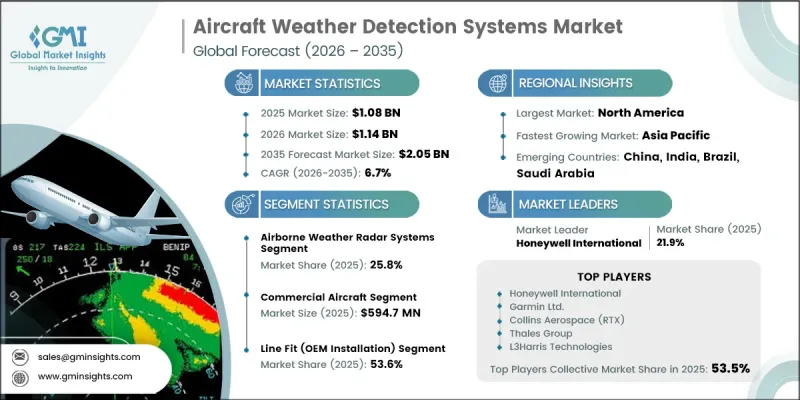
Market growth is driven by the increasing adoption of advanced avionics technologies, the rising need for enhanced operational performance in challenging weather conditions, and growing requirements for reliable all-weather aviation capabilities. Flight safety remains a primary factor influencing market expansion, as aviation operators continue to prioritize technologies that improve weather awareness and reduce operational risks during flight. The growing incorporation of weather detection solutions into modern cockpit ecosystems is also supporting demand, enabling seamless communication between weather monitoring, navigation, flight management, and operational systems. Technological advancements are accelerating the transition toward next-generation weather detection platforms that offer greater accuracy, reliability, and performance. This modernization trend is encouraging replacement of aging systems across commercial, military, and business aviation fleets while creating opportunities in both new aircraft installations and retrofit programs. In addition, the increasing integration of weather intelligence capabilities with broader aviation data networks is improving situational awareness, strengthening operational decision-making, and contributing to the continued evolution of the global aircraft weather detection systems market.
| Market Scope | |
|---|---|
| Start Year | 2025 |
| Forecast Year | 2026-2035 |
| Start Value | $1.08 Billion |
| Forecast Value | $2.05 Billion |
| CAGR | 6.7% |
The airborne weather radar systems segment held a 25.8% share in 2025. The segment's leadership is attributed to its long-standing position as a core weather sensing technology across commercial, military, and business aircraft. Continued aircraft production, expanding global fleet sizes, and ongoing replacement cycles of existing systems are supporting sustained demand. Furthermore, growing interest in advanced weather detection architectures capable of delivering enhanced visibility and improved operational efficiency is contributing to segment growth while helping reduce pilot workload during adverse weather conditions.
The unmanned aerial vehicles segment is expected to grow at a CAGR of 10% during 2026-2035. Rising deployment of UAVs across a broad range of mission-critical applications is creating increasing demand for onboard weather detection capabilities that can operate effectively across extended flight durations, varying altitudes, and complex operational environments. The integration of compact weather sensing technologies and advanced avionics systems is becoming increasingly important as UAV operations continue to expand. In addition, evolving regulatory requirements for advanced unmanned flight operations are encouraging greater investment in weather awareness technologies to support operational safety and compliance objectives.
North America Aircraft Weather Detection Systems Market held a 37.3% share in 2025. Regional growth is supported by one of the world's most extensive and technologically advanced aviation sectors, generating continuous demand for sophisticated weather monitoring solutions across commercial airlines, cargo operators, and general aviation fleets. High levels of air traffic activity and extensive aviation infrastructure contribute to the need for reliable weather detection technologies that enhance flight safety and operational efficiency. Ongoing investments in aircraft modernization, avionics upgrades, and aviation safety technologies are expected to sustain North America's leadership position throughout the forecast period.
Key companies operating in the global aircraft weather detection systems market include Garmin Ltd., Honeywell International Inc., Leonardo S.p.A., Collins Aerospace (RTX Corporation), L3Harris Technologies Inc., HENSOLDT AG, Saab AB, Thales Group, Telephonics Corporation, Japan Radio Co., Ltd., BAE Systems plc, Vaisala Oyj, GAMIC GmbH, and EWR Radar Systems Inc. Companies participating in the aircraft weather detection systems market are focusing on a range of strategic initiatives to strengthen their market position and enhance long-term competitiveness. Significant investments in research and development are enabling manufacturers to improve detection accuracy, system reliability, processing capabilities, and overall operational performance. Many industry participants are prioritizing the development of next-generation weather sensing technologies that support integration with modern avionics and connected aircraft architectures. Strategic partnerships with aircraft manufacturers, avionics suppliers, and defense organizations are helping companies expand their customer base and secure long-term contracts. Organizations are also emphasizing product innovation, technology upgrades, and expansion of retrofit solutions to address growing demand from existing aircraft fleets.
Table of Contents
Chapter 1 Methodology and Scope
- 1.1 Market scope and definition
- 1.2 Research design
- 1.2.1 Research approach
- 1.2.2 Data collection methods
- 1.3 Data mining sources
- 1.3.1 Global
- 1.3.2 Regional/Country
- 1.4 Base estimates and calculations
- 1.4.1 Base year calculation
- 1.4.2 Key trends for market estimation
- 1.5 Primary research and validation
- 1.5.1 Primary sources
- 1.6 Forecast model
- 1.7 Research assumptions and limitations
Chapter 2 Executive Summary
- 2.1 Industry 360° synopsis, 2022 - 2035
- 2.2 Key market trends
- 2.2.1 Platform type trends
- 2.2.2 System type trends
- 2.2.3 Installation type trends
- 2.2.4 Regional trends
- 2.3 TAM Analysis, 2026-2035
- 2.4 CXO perspectives: Strategic imperatives
Chapter 3 Industry Insights
- 3.1 Industry ecosystem analysis
- 3.1.1 Supplier Landscape
- 3.1.2 Profit Margin
- 3.1.3 Cost structure
- 3.1.4 Value addition at each stage
- 3.1.5 Factor affecting the value chain
- 3.1.6 Disruptions
- 3.2 Industry impact forces
- 3.2.1 Growth drivers
- 3.2.1.1 Increasing emphasis on flight safety and adverse weather risk mitigation
- 3.2.1.2 Growth in global air traffic and expansion of commercial aviation fleets
- 3.2.1.3 Rising adoption of advanced avionics and integrated cockpit systems
- 3.2.1.4 Increasing operations in complex and extreme weather environments
- 3.2.1.5 Growing defense aviation requirements for all-weather mission capability
- 3.2.2 Industry pitfalls and challenges
- 3.2.2.1 High cost of advanced weather detection and radar systems
- 3.2.2.2 Complex integration with existing avionics and legacy aircraft systems
- 3.2.3 Market opportunities
- 3.2.3.1 Integration of AI-driven predictive weather analytics in avionics systems
- 3.2.3.2 Rising demand for advanced weather radar systems in next-generation aircraft
- 3.2.1 Growth drivers
- 3.3 Growth potential analysis
- 3.4 Regulatory landscape
- 3.4.1 North America
- 3.4.2 Europe
- 3.4.3 Asia Pacific
- 3.4.4 Latin America
- 3.4.5 Middle East & Africa
- 3.5 Porter's analysis
- 3.6 PESTEL analysis
- 3.7 Technology and Innovation landscape
- 3.7.1 Current technological trends
- 3.7.2 Emerging technologies
- 3.8 Price trends
- 3.8.1 By region
- 3.8.2 By product
- 3.9 Pricing Strategies
- 3.10 Emerging Business Models
- 3.11 Compliance Requirements
- 3.12 Patent and IP analysis
Chapter 4 Competitive Landscape, 2025
- 4.1 Introduction
- 4.2 Company market share analysis
- 4.2.1 By region
- 4.2.1.1 North America
- 4.2.1.2 Europe
- 4.2.1.3 Asia Pacific
- 4.2.1.4 Latin America
- 4.2.1.5 Middle East & Africa
- 4.2.2 Market concentration analysis
- 4.2.1 By region
- 4.3 Competitive benchmarking of key players
- 4.3.1 Financial performance comparison
- 4.3.1.1 Revenue
- 4.3.1.2 Profit margin
- 4.3.1.3 R&D
- 4.3.2 Product portfolio comparison
- 4.3.2.1 Product range breadth
- 4.3.2.2 Technology
- 4.3.2.3 Innovation
- 4.3.3 Geographic presence comparison
- 4.3.3.1 Global footprint analysis
- 4.3.3.2 Service network coverage
- 4.3.3.3 Market penetration by region
- 4.3.4 Competitive positioning matrix
- 4.3.4.1 Leaders
- 4.3.4.2 Challengers
- 4.3.4.3 Followers
- 4.3.4.4 Niche players
- 4.3.5 Strategic outlook matrix
- 4.3.1 Financial performance comparison
- 4.4 Key developments
- 4.4.1 Mergers and acquisitions
- 4.4.2 Partnerships and collaborations
- 4.4.3 Technological advancements
- 4.4.4 Expansion and investment strategies
- 4.4.5 Digital transformation initiatives
- 4.5 Emerging/ startup competitors landscape
Chapter 5 Market Estimates and Forecast, By System Type, 2022 - 2035 (USD Million)
- 5.1 Key trends
- 5.2 Airborne weather radar systems
- 5.2.1 Pulse-doppler weather radar (X-band)
- 5.2.2 Phased array & active electronically scanned array (AESA) weather radar
- 5.2.3 Others
- 5.3 Lightning detection systems
- 5.3.1 Passive lightning detection (stormscope-type)
- 5.3.2 Active lightning detection & ranging systems
- 5.4 Turbulence detection systems
- 5.4.1 Radar-based turbulence detection
- 5.4.2 LIDAR-based clear air turbulence (CAT) detection
- 5.4.3 Eddy dissipation rate (EDR) measurement systems
- 5.5 Predictive wind shear detection systems
- 5.5.1 Predictive wind shear alert systems
- 5.5.2 Reactive wind shear detection systems
- 5.6 Ice & storm detection systems
- 5.7 Weather data processing units
- 5.7.1 Standalone weather processor units
- 5.7.2 Integrated multi-sensor processing units
- 5.8 Cockpit weather display systems
- 5.9 Satellite weather data integration systems
- 5.10 Avionics weather monitoring software
- 5.11 Others
Chapter 6 Market Estimates and Forecast, By Platform Type, 2022 - 2035 (USD Million)
- 6.1 Key trends
- 6.2 Commercial aircraft
- 6.2.1 Narrow-body aircraft
- 6.2.2 Wide-body aircraft
- 6.2.3 Regional jets & turboprops
- 6.2.4 Others
- 6.3 Military aircraft
- 6.3.1 Fixed-wing combat aircraft
- 6.3.2 Military transport & patrol aircraft
- 6.3.3 Others
- 6.4 Business jets & general aviation
- 6.4.1 Large cabin & ultra-long range business jets
- 6.4.2 Mid-size & light business jets
- 6.4.3 General aviation
- 6.5 Helicopters
- 6.5.1 Offshore energy support helicopters
- 6.5.2 Emergency medical services (EMS) & search & rescue (SAR) helicopters
- 6.5.3 Others
- 6.6 Unmanned aerial vehicles (UAVs/UAS)
- 6.6.1 MALE/HALE UAVs
- 6.6.2 Commercial UAVs
- 6.6.3 Civil monitoring & surveillance UAVs
Chapter 7 Market Estimates and Forecast, By Installation Type, 2022 - 2035 (USD Million)
- 7.1 Key trends
- 7.2 Line fit (OEM installation)
- 7.3 Retrofit/aftermarket installation
Chapter 8 Market Estimates and Forecast, By Region, 2022 - 2035 (USD Million)
- 8.1 Key trends
- 8.2 North America
- 8.2.1 U.S.
- 8.2.2 Canada
- 8.3 Europe
- 8.3.1 Germany
- 8.3.2 UK
- 8.3.3 France
- 8.3.4 Spain
- 8.3.5 Italy
- 8.3.6 Russia
- 8.4 Asia Pacific
- 8.4.1 China
- 8.4.2 India
- 8.4.3 Japan
- 8.4.4 Australia
- 8.4.5 South Korea
- 8.5 Latin America
- 8.5.1 Brazil
- 8.5.2 Mexico
- 8.5.3 Argentina
- 8.6 Middle East and Africa
- 8.6.1 South Africa
- 8.6.2 Saudi Arabia
- 8.6.3 UAE
Chapter 9 Company Profiles
- 9.1 Global Key Players
- 9.1.1 Honeywell International
- 9.1.2 Garmin Ltd.
- 9.1.3 Collins Aerospace (RTX)
- 9.1.4 Thales Group
- 9.1.5 L3Harris Technologies
- 9.2 Regional key players
- 9.2.1 North America
- 9.2.1.1 Telephonics Corporation
- 9.2.1.2 EWR Radar Systems Inc.
- 9.2.2 Asia Pacific
- 9.2.2.1 Japan Radio Co., Ltd.
- 9.2.3 Europe
- 9.2.3.1 Leonardo S.p.A.
- 9.2.3.2 HENSOLDT AG
- 9.2.3.3 BAE Systems plc
- 9.2.3.4 Saab AB
- 9.2.3.5 Vaisala Oyj
- 9.2.3.6 GAMIC GmbH
- 9.2.1 North America

